The route finderCivil procedure · first instance
Which court to go to for your dispute in France, and when a lawyer is compulsory
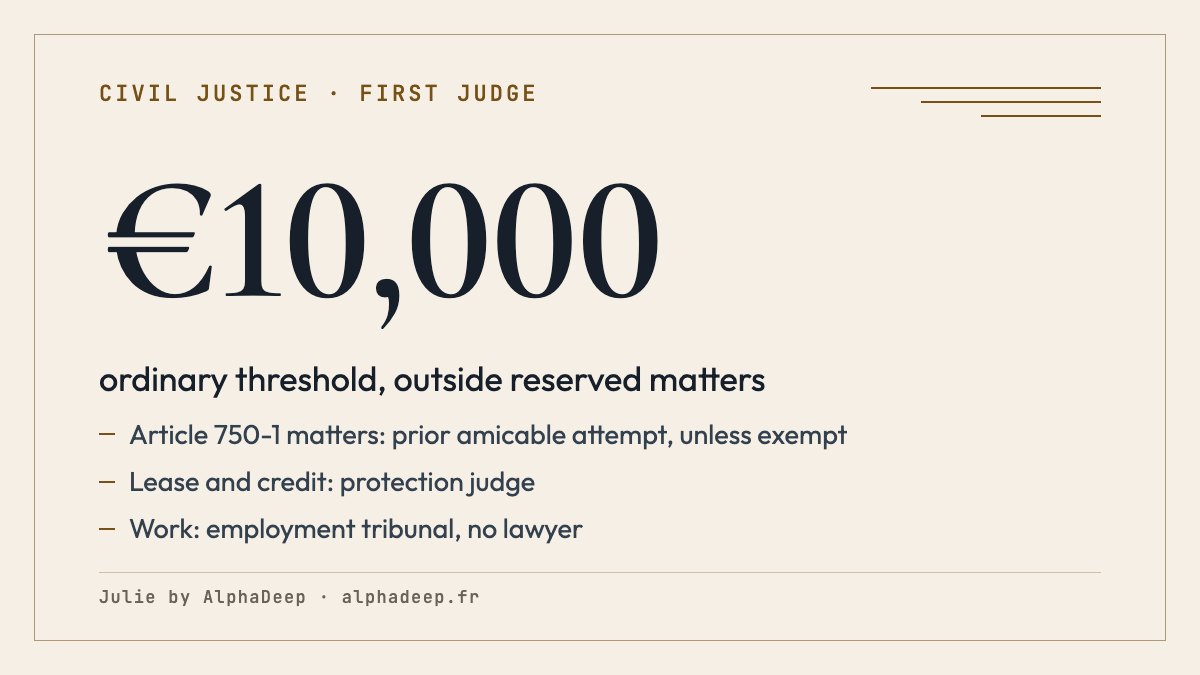
The competent court depends first on subject matter: judicial, protection for residential leases or credit, commercial, employment or a specialist route. The judicial court’s ordinary €10,000 lawyer threshold has reserved-matter exceptions; prior amicable steps up to €5,000 apply only within article 750-1, unless exempt. A CAF decision does not automatically go to the social division: housing aid, RSA and medical disputes require the appeal type to be identified.
Go to the tool: the route finder
Julie by AlphaDeep is an AI legal assistant for French law: it researches official references to help answer your questions (Légifrance, case law, service-public), analyses your documents and drafts your letters, for individuals and professionals alike.
General legal information with official references and dated checks. It is not personalised advice: for a decision that commits you, have your situation checked by a qualified professional.

Let’s look at your situation
Describe the dispute, the sum at stake and the person or business on the other side, without names.
Example questions
Your question carries over after signup. Maximum 400 characters. Avoid health data and names.
Which judge for which dispute, and with or without a lawyer?
The most common first-instance judges for an individual or a small business.
| Dispute | Competent judge | Lawyer compulsory |
|---|---|---|
| Civil dispute up to €10,000 | Judicial court or local court (tribunal de proximité) | No |
| Civil dispute above €10,000 | Judicial court | Yes |
| Residential lease, consumer credit | Protection judge | No, whatever the amount |
| Dispute between traders or commercial companies | Commercial court or economic activities court | Yes above €10,000 |
| Dispute over an employment contract | Employment tribunal (conseil de prud’hommes) | No |
| Administrative social-security decision within CRA scope, excluding housing aid, RSA and medical decisions | Social division of the judicial court, after a prior appeal | No |
In matters reserved to the judicial court that are not exempt from a lawyer, a lawyer is compulsory whatever the amount (Code of Civil Procedure, article 761).
Sources: CPC 761 · COJ L211-3 · CPC 853
Which judge should you go to for your dispute, and how?
Choose the type of dispute and, if it concerns a sum, its amount: the route finder gives an initial orientation on the competent judge, whether a lawyer is compulsory, the prior step and how to bring the case. The example: a sum of €8,000 claimed from a private individual. The result is indicative: confirm the ordinary-case conditions; a special case or unknown decisive fact prevents calculation.
Fictional example · court route finder
The judicial court, or its local court depending on the commune.
The competent judge
The judicial court, or its local court depending on the commune
Is a lawyer compulsory?
No: up to €10,000, you can represent yourself, and the procedure is oral
The prior step
No compulsory prior step at this amount
How to bring the case
A summons served by a commissaire de justice
Before the judicial court, without a lawyer, you can be assisted or represented by your spouse, a relative or a person attached to your business, holding a special power of attorney.
When is a lawyer compulsory before the judicial court?
In principle always: the parties must be represented by a lawyer before the judicial court (Code of Civil Procedure, article 760). They are exempt in the protection judge’s matters, in certain matters listed by the Code of Judicial Organisation, and when the claim does not exceed €10,000 (article 761).
Without a lawyer, the procedure is oral (article 817). You can defend yourself, or be assisted or represented by your spouse, your partner or Pacs partner, a relative or a person attached to your business, holding a special power of attorney (article 762).
Must you try conciliation before going to court?
Within the judicial-court scope of article 750-1, yes unless exempt, when the claim seeks payment of a sum not exceeding €5,000, concerns an abnormal neighbourhood nuisance or certain actions between neighbours: an attempt at conciliation by a court conciliator, at mediation or at a participatory procedure (Code of Civil Procedure, article 750-1).
You are exempt if a party asks for an agreement to be approved, if a prior appeal is already required, or for a legitimate reason: manifest urgency, or conciliators unavailable for more than 3 months.
Source: CPC 750-1
How do you bring a case before the judicial court without a lawyer?
Up to €5,000, an application handed in or sent to the court registry is enough; above that, the claim is made by a summons, served by a commissaire de justice (bailiff), or by a joint application of the parties (Code of Civil Procedure, article 818).
The summons is then filed with the registry before the hearing date, otherwise it lapses (article 843). For the amicable step and its evidence, consult the guide to claims up to €5,000; jurisdiction and representation still need separate checking.
Source: CPC 818
What has changed for going to court since 2020?
A new map of the courts, then a restored prior conciliation and a commercial experiment.
The district court and the regional court merge into the judicial court, with a protection judge and local courts (law no. 2019-222 of 23 March 2019).
Source: COJ L211-3
The rule was restored by the decree of 11 May 2023; it applies to proceedings introduced from 1 October 2023 within article 750-1 (decree no. 2023-357 of 11 May 2023, Code of Civil Procedure, article 750-1).
Source: CPC 750-1
In 12 cities, including Paris, Lyon and Marseille, the commercial court becomes for 4 years an economic activities court, competent for the amicable and collective procedures of any business in difficulty, except certain regulated professions (law no. 2023-1059 of 20 November 2023, article 26).
Source: Order of 5 July 2024
What does article 761 of the Code of Civil Procedure say about lawyers?
The exceptions to the compulsory lawyer before the judicial court, including the €10,000 threshold.
Les parties sont dispensées de constituer avocat dans les cas prévus par la loi ou le règlement et dans les cas suivants :
1° Dans les matières relevant de la compétence du juge des contentieux de la protection ; (…)
3° A l’exclusion des matières relevant de la compétence exclusive du tribunal judiciaire, lorsque la demande porte sur un montant inférieur ou égal à 10 000 euros ou a pour objet une demande indéterminée ayant pour origine l’exécution d’une obligation dont le montant n’excède pas 10 000 euros.
In English, briefly (our summary, not an official translation): The parties are exempt from being represented by a lawyer in the cases provided by law or regulation and in the following cases: in matters within the protection judge’s competence; and, except for matters within the exclusive competence of the judicial court, when the claim is for 10,000 euros or less, or is an undetermined claim arising from the performance of an obligation not exceeding 10,000 euros. The general rule is in article 760: unless otherwise provided, the parties are represented by a lawyer before the judicial court. The amount is calculated under articles 35 to 37.
What do litigants ask before going to court?
Do you need a lawyer before the employment tribunal?
No. Before the employment tribunal (conseil de prud’hommes), the parties defend themselves and can be assisted or represented (Labour Code, article R1453-1). The tribunal first tries to reconcile the parties before judging (article L1411-1).
Does the commercial court require a lawyer?
Yes above €10,000, except for the procedures of book VI of the Commercial Code, such as reorganisation or liquidation, and disputes over the trade register. Up to €10,000, you can be represented by the person of your choice, with a special power of attorney (Code of Civil Procedure, article 853).
What is the protection judge?
A judge of the judicial court in charge in particular of residential leases, consumer credit, over-indebtedness and the guardianship of adults (Code of Judicial Organisation, articles L213-4-2 to L213-4-7). Before this judge, a lawyer is not compulsory.
Where do you file a claim for €3,000?
With the registry of the competent judicial court or local court, after trying conciliation, mediation or a participatory procedure, compulsory at this amount unless there is a legitimate reason (Code of Civil Procedure, articles 750-1 and 818).
Which texts is this court route finder based on?
- Housing aid: administrative-court jurisdictionLégifrance, in French
- Administrative social-security appeal to the CRAService-public.fr, in French
- RSA: administrative appealService-public.fr, in French
- Amicable step: applies from 1 October 2023Légifrance, in French
- Code of Civil Procedure, articles 760 and 761 (representation before the judicial court)Légifrance, in French
- Code of Judicial Organisation, articles L211-3, L212-8 and L213-4-2 to L213-4-8 (judicial court, protection judge)Légifrance, in French
- Code of Civil Procedure, articles 762 and 817 (representation without a lawyer, oral procedure)Légifrance, in French
- Code of Civil Procedure, article 853 (commercial court)Légifrance, in French
- Code of Civil Procedure, article 750-1 (prior attempt at amicable resolution)Légifrance, in French
- Code of Civil Procedure, articles 818 and 843 (application, summons, filing with the registry)Légifrance, in French
- Order of 5 July 2024 on the experiment of the economic activities courtLégifrance, Journal officiel, in French
- Labour Code, articles L1411-1 and R1453-1 (employment tribunal)Légifrance, in French
Texts cited last checked: 25 September 2026