The legal briefOnline harassment · complaint
Cyberbullying in France: online harassment, the law, the penalties, the evidence to keep, reporting and the complaint
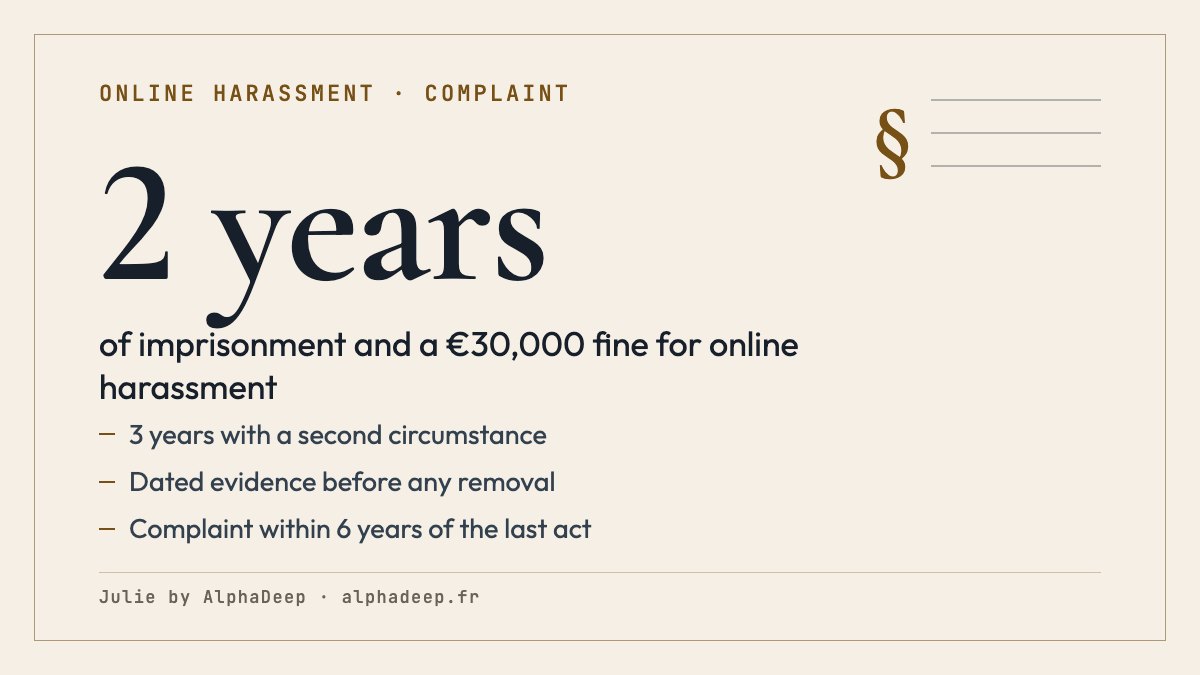
Online harassment carries maximum penalties of 2 years and €30,000, or 3 years and €45,000 with a second aggravating circumstance (article 222-33-2-2). One message may count in a concerted attack or repetition known to its author, if the other elements, including harm to health, are established. Keep dated evidence, report the content and complain, including against an unknown person, within 6 years of the last act.
Go to the tool: the legal brief
Julie by AlphaDeep is an AI legal assistant for French law: it researches official references to help answer your questions (Légifrance, case law, service-public), analyses your documents and drafts your letters, for individuals and professionals alike.
General legal information with official references and dated checks. It is not personalised advice: for a decision that commits you, have your situation checked by a qualified professional.

Let’s look at your situation
Describe the messages, the authors, how long it has lasted and its effects on you.
Example questions
Your question carries over after signup. Maximum 400 characters. Avoid health data and names.
Which penalties depending on the circumstances?
The Penal Code maximums for moral harassment and school harassment.
| Situation | Maximum penalty | Text |
|---|---|---|
| Moral harassment, no aggravating circumstance | 1 year and €15,000 | Art. 222-33-2-2 Penal Code |
| With one circumstance, including use of an online service | 2 years and €30,000 | Art. 222-33-2-2 Penal Code |
| With two circumstances, for example online against a minor | 3 years and €45,000 | Art. 222-33-2-2 Penal Code |
| School harassment | 3 years and €45,000 | Art. 222-33-2-3 Penal Code |
| School harassment, incapacity of more than 8 days | 5 years and €75,000 | Art. 222-33-2-3 Penal Code |
| School harassment that led to a suicide or an attempt | 10 years and €150,000 | Art. 222-33-2-3 Penal Code |
These penalties require the offence’s elements to be established, including degraded living conditions and harm to health; a group alone is insufficient. The other aggravating circumstances: a total incapacity for work of more than 8 days, a minor victim, an apparent or known vulnerability, an elected official as victim, a minor witnessing the acts.
Sources: C. pén. 222-33-2-2 · C. pén. 222-33-2-3
What is cyberbullying under French law?
Harassing someone by repeated remarks or behaviour that degrade their living conditions and harm their physical or mental health is an offence (Penal Code, article 222-33-2-2); doing so through an online public communication service or a digital medium is an aggravating circumstance.
A single message is part of the repetition when several people act in concert or at the instigation of one of them, or one after another knowing that their remarks form a repetition: harassment by a group (fiche F32239).
Sources: C. pén. 222-33-2-2 · Service-public F32239
Which penalties does the author face?
1 year’s imprisonment and a €15,000 fine at base, 2 years and €30,000 with one aggravating circumstance, including the use of an online service, and 3 years and €45,000 with two: a minor victim, a total incapacity for work (ITT) of more than 8 days, vulnerability, an elected official as victim or a minor witness (article 222-33-2-2).
Between pupils or staff of the same school, school harassment is punishable by 3 years and €45,000, by 5 years and €75,000 beyond 8 days of incapacity, and by 10 years and €150,000 if it led the victim to take or attempt to take their own life (article 222-33-2-3).
Sources: C. pén. 222-33-2-2 · C. pén. 222-33-2-3
Which evidence should you keep before getting content removed?
Screenshots, copies of emails, recordings, witness statements with their full identity, a medical certificate and any police report (main courante), all dated: they serve both the report and the complaint, even if the facts have lasted for years (fiche F32239).
A commissaire de justice can record the harassment, for a fee. Also note the page addresses and account names before blocking anyone: a report must locate the content.
Source: Service-public F32239
How do you get content removed and file a complaint?
Report the content to the platform or host, without having to contact the author, describing the content, its address and your details; for threats or incitement to violence, also report it on PHAROS, and ask search engines to de-index it (fiche F32239).
File a complaint against the author or against an unknown person (contre X) at the police or gendarmerie station of your choice, or by letter to the public prosecutor, within 6 years of the last act (fiche F32239; Code of Criminal Procedure, article 8).
Sources: Service-public F32239 · PHAROS · CPP art. 8
What does the author of your cyberbullying face?
Say who the author is, the circumstances and the date of the last message: the brief presents possible criteria and next steps, without establishing a criminal offence. The example: a concerted online attack on a minor, whose last message dates from 10 September 2026.
Fictional example · brief on your cyberbullying
Possible offence: Online moral harassment; up to 3 years’ imprisonment and a €45,000 fine.
- Possible offence
- Online moral harassment
- Maximum penalty
- 3 years and €45,000
- Complaint
- within 6 years of the last act
For these reasons
In view of your answers and the Penal Code:
- Qualification: a concerted attack, may constitute the offence even if each author acted only once, if the other legal elements are met (Penal Code, article 222-33-2-2, a).
- Penalty faced: 3 years’ imprisonment and a €45,000 fine, with 2 aggravating circumstances including the use of an online service (article 222-33-2-2).
- Report: ask the platform or host to remove the content without having to contact the author; for threats or incitement to violence, also report it on PHAROS (fiche F32239). For a young person, the 3018 answers 7 days a week, free of charge and anonymously.
- Complaint: against the author or an unknown person, at a police or gendarmerie station or by letter to the prosecutor, within 6 years of the last act, here 10 September 2026 (fiche F32239).
Your answers do not prove an offence: degraded living conditions and harm to health must in particular be established. Figures are maximums if the legal elements are met; the court sets the sentence.
What does article 222-33-2-2 of the Penal Code say?
The text that defines moral harassment and its commission by a group.
Le fait de harceler une personne par des propos ou comportements répétés ayant pour objet ou pour effet une dégradation de ses conditions de vie se traduisant par une altération de sa santé physique ou mentale est puni d’un an d’emprisonnement et de 15 000 € d’amende lorsque ces faits ont causé une incapacité totale de travail inférieure ou égale à huit jours ou n’ont entraîné aucune incapacité de travail.
L’infraction est également constituée : a) Lorsque ces propos ou comportements sont imposés à une même victime par plusieurs personnes, de manière concertée ou à l’instigation de l’une d’elles, alors même que chacune de ces personnes n’a pas agi de façon répétée ; b) Lorsque ces propos ou comportements sont imposés à une même victime, successivement, par plusieurs personnes qui, même en l’absence de concertation, savent que ces propos ou comportements caractérisent une répétition.
In English, briefly (our summary, not an official translation): Harassing a person by repeated remarks or behaviour whose purpose or effect is a degradation of their living conditions, resulting in harm to their physical or mental health, is punishable by one year’s imprisonment and a €15,000 fine when it caused a total incapacity for work of eight days or less, or none. The offence also exists when several people impose these remarks on the same victim in concert or at the instigation of one of them, even if each acted only once, or one after another knowing they form a repetition. The following paragraphs set the aggravating circumstances, including the use of an online public communication service or a digital medium (4°).
What has changed since 2022?
Two laws have extended the punishment of harassment.
School harassment becomes a separate offence, applicable even if the acts continue after the author or the victim has left (Penal Code, article 222-33-2-3, loi no. 2022-299 of 2 March 2022).
Source: C. pén. 222-33-2-3
Harassment of a holder of elected office becomes an aggravating circumstance (article 222-33-2-2, 4° bis, loi no. 2024-247 of 21 March 2024).
Source: C. pén. 222-33-2-2
What do victims of cyberbullying ask?
What if the victim is a child?
The 3018, the national number for young victims of harassment and digital violence, answers anonymously and confidentially, 7 days a week, free of charge; a chat also lets minors report the facts to the police or gendarmerie (fiche F32239).
Can you file a complaint if the author is anonymous?
Yes, against an unknown person (contre X): the complaint sets out the facts, their dates and the harm, and attaches the dated evidence (fiche F32239).
Is a false report risky?
Yes: reporting content as illegal while knowing it is lawful exposes you to 1 year’s imprisonment and a €15,000 fine (fiche F32239).
Is one isolated message harassment?
Not if it comes from one person, as article 222-33-2-2 requires repetition; yes if it is part of a concerted attack, or of a repetition its author knew about.
Does school harassment stop with a change of school?
No: article 222-33-2-3 also applies when the acts continue after the author or the victim no longer studies or works at the school.
Which texts and fiches is this brief based on?
- Penal Code, article 222-33-2-2 (moral harassment)Légifrance, in French
- Penal Code, article 222-33-2-3 (school harassment)Légifrance, in French
- Cyberbullying: what to do? (fiche F32239)Service-public.fr, in French · checked by the publisher on 7 August 2026
- Code of Criminal Procedure, article 8 (limitation for délits)Légifrance, in French
- PHAROS, the platform for reporting illegal contentMinistry of the Interior, in French · page opened on 26 September 2026
Texts cited last checked: 26 September 2026