The calendarPublic transport · fine
Train or metro fine in France: the amount, the 3 months to pay or contest, and what comes next
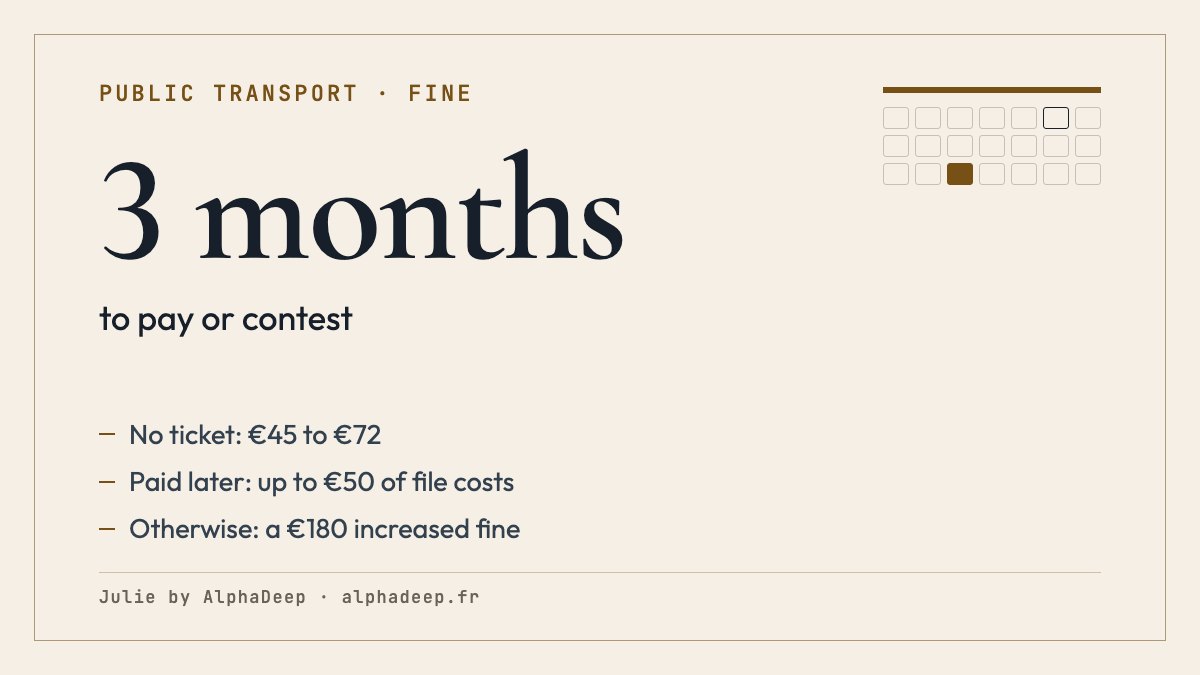
A fine issued on a French train, metro or bus is settled by a transaction: the fixed indemnity, paid to the agent, or within 3 months with up to €50 of file costs. Within that time, you can contest instead. For travelling without a ticket, the indemnity ranges from €45 to €72; with no payment or protest within 3 months, a €180 increased fine is due (article 529-5 of the Code of Criminal Procedure).
Julie by AlphaDeep is an AI legal assistant for French law: it researches official references to help answer your questions (Légifrance, case law, service-public), analyses your documents and drafts your letters, for individuals and professionals alike.
General legal information with official references and dated checks. It is not personalised advice: for a decision that commits you, have your situation checked by a qualified professional.

Let’s look at your situation
Give the network, the date of the check, the offence and the amounts on the offence report.
Example questions
Your question carries over after signup. Maximum 400 characters. Avoid health data and names.
What is the amount for each class of offence?
The class is printed on the offence report; it sets the increased fine and the cap on the indemnity.
| Class | Increased fixed fine | Indemnity at most | Indemnity at least |
|---|---|---|---|
| 1st class | €33 | €13 | No minimum |
| 2nd class | €75 | €30 | No minimum |
| 3rd class, including travelling without a ticket | €180 | €72 | €45 for travelling without a ticket |
| 4th class | €375 | €150 | No minimum |
The indemnity is 40% of the increased fine, rounded down to the euro; the operator can apply less. Paid after the check, it comes with file costs of €50 at most (Transport Code, articles R2243-1 and R2243-4).
Sources: CPP R49-7 · C. transports R2243-1 · C. transports R2243-4
Until when can you pay or contest, and how much?
Give the offence, the date of the check, the amounts on the offence report and what you intend to do: the calendar gives the last day, the amounts and, if you contest, the date when the mediator becomes possible. The example: travelling without a ticket on the metro, recorded on Saturday 19 September 2026, indemnity and file costs at the cap.
Fictional example · fine calendar
€72.00 to the agent, or €122.00 by 21 December 2026; otherwise, a €180.00 increased fine.
- To the agent, at the check
- €72.00
- To the operator’s service, within 3 months
- €122.00
- With no payment or protest
- €180.00
| M | T | W | T | F | S | S |
|---|---|---|---|---|---|---|
| 1 | 2 | 3 | 4 | 5 | 6 | |
| 7 | 8 | 9 | 10 | 11 | 12 | 13 |
| 14 | 15 | 16 | 17 | 18 | 19 | 20 |
| 21 | 22 | 23 | 24 | 25 | 26 | 27 |
| 28 | 29 | 30 |
| M | T | W | T | F | S | S |
|---|---|---|---|---|---|---|
| 1 | 2 | 3 | 4 | 5 | 6 | |
| 7 | 8 | 9 | 10 | 11 | 12 | 13 |
| 14 | 15 | 16 | 17 | 18 | 19 | 20 |
| 21 | 22 | 23 | 24 | 25 | 26 | 27 |
| 28 | 29 | 30 | 31 |
- Check and offence report
- Last day to pay or protest
The time limit would end on 19 December 2026, a Saturday, a Sunday or a public holiday: it is extended to 21 December 2026 (Code of Criminal Procedure, article 801).
Time limit counted from the check. To be safe, send the protest by registered letter with acknowledgement of receipt well before the last day, and keep the proof of sending.
How much is a fine on a French train or metro?
The operator sets a fixed indemnity of at most 40% of the increased fixed fine for the class of the offence, rounded down to the euro: €13, €30, €72 or €150 for classes 1 to 4. For travelling without a valid ticket, a 3rd-class offence, it cannot be lower than 25%, so €45 (Transport Code, articles R2242-1 and R2243-1).
Outside urban transport, the fare is added for travelling without a ticket. The operator must inform passengers of the amounts it applies on its network, by type of breach.
Sources: C. transports R2242-1 · C. transports R2243-1
When and how do you pay the transaction?
Straight away, to the agent, or within 3 months of the check to the operator’s service named in the transaction offer; in that second case, file costs are added, €50 at most (Code of Criminal Procedure, article 529-4; Transport Code, article R2243-4).
If you do not pay straight away, the sworn agent can take down your identity and address. Keep the transaction offer: it is the document that names the service where you pay.
Sources: CPP 529-4 · C. transports R2243-4
How do you contest a fine issued on public transport?
Instead of paying, send a protest to the operator’s service within 3 months of the check; it is forwarded, with the offence report (procès-verbal), to the public prosecutor (Code of Criminal Procedure, article 529-5). Service-public advises a registered letter with acknowledgement of receipt.
If the answer does not satisfy you, or with no answer within 1 month, you can refer the matter to the company’s mediator, such as the SNCF or RATP mediator; recovery is suspended during the mediation (fiche F31852).
Sources: CPP 529-5 · Service-public F31852
What happens with no payment or protest within 3 months?
The operator sends the offence report to the public prosecutor and you owe, by operation of law, an increased fixed fine collected by the Treasury (Trésor public) (Code of Criminal Procedure, article 529-5): €180 for travelling without a ticket, €33, €75 or €375 for the other classes (article R49-7).
The 3 months run from the check; if the time limit ends on a Saturday, a Sunday or a public holiday, it is extended to the next working day (article 801).
What has changed for fines on public transport?
Two texts recently in force, and a date already set for the Code of Criminal Procedure.
Since this date, article R2243-1 of the Transport Code sets the indemnity at 40% of the increased fine, with a minimum of 25% for travelling without a ticket, and article R2243-4 caps file costs at €50.
Sources: C. transports R2243-1 · C. transports R2243-4
In its wording in force since this date, article R2242-1 keeps travelling without a ticket as a 3rd-class offence, except for a passenger who contacts the staff as soon as the journey starts to buy a ticket on board, when the railway company allows it.
Source: C. transports R2242-1
What does article 529-5 of the Code of Criminal Procedure say?
The text that opens 3 months to pay or protest, and says what happens next.
Dans le délai prévu par l’article précédent, le contrevenant doit s’acquitter du montant des sommes dues au titre de la transaction, à moins qu’il ne formule dans le délai de trois mois à compter de la constatation de l’infraction une protestation auprès du service de l’exploitant. Cette protestation, accompagnée du procès-verbal d’infraction, est transmise au ministère public.
A défaut de paiement ou de protestation dans le délai de trois mois précité, le procès-verbal d’infraction est adressé par l’exploitant au ministère public et le contrevenant devient redevable de plein droit d’une amende forfaitaire majorée recouvrée par le Trésor public en vertu d’un titre rendu exécutoire par le ministère public.
In English, briefly (our summary, not an official translation): Within the time limit of the previous article, the offender must pay the sums due under the transaction, unless, within three months of the offence being recorded, they send a protest to the operator’s service; the protest, with the offence report, is forwarded to the public prosecutor. Failing payment or protest within those three months, the operator sends the report to the public prosecutor and the offender owes, by operation of law, an increased fixed fine collected by the Treasury under an enforceable title issued by the prosecutor.
What do passengers ask after a ticket check?
Can you buy your ticket on board to avoid the fine?
On a train, yes, if the railway company allows it and you contact the staff immediately after the journey starts to buy the ticket and pay for it on board: travelling without a ticket is then not an offence (Transport Code, article R2242-1).
What do you risk if you refuse to give your identity?
If you refuse or cannot prove it, the agent informs a judicial police officer and you must stay available to the agent in the meantime: failing to do so is punished by 2 months’ imprisonment and a €7,500 fine (Transport Code, article L2241-2).
What if your ticket was on a phone with a flat battery?
Service-public cites this case among those where contesting is possible, as not showing the ticket was without intent to defraud: send a claim to the carrier’s customer service within 3 months, by registered letter with acknowledgement of receipt, with the proof of purchase (fiche F31852).
Who can issue an offence report on public transport?
Besides the police, the sworn agents of the operator or of a company acting on its behalf, and those of the internal security services of the SNCF and the RATP, among others (Transport Code, article L2241-1).
Does paying the transaction end the matter?
Yes: the paid transaction ends the prosecution, there are no further proceedings for that offence (Code of Criminal Procedure, article 529-3). If you dispute the offence, protest within 3 months instead of paying.
Which texts is this fine calendar based on?
- Code of Criminal Procedure, article 529-3 (transaction on public transport)Légifrance, in French
- Code of Criminal Procedure, article 529-4 (paying the transaction)Légifrance, in French
- Code of Criminal Procedure, article 529-5 (protest, increased fine)Légifrance, in French
- Code of Criminal Procedure, article 801 (end of time limits)Légifrance, in French
- Transport Code, article R2242-1 (travelling without a ticket)Légifrance, in French
- Transport Code, article R2243-1 (amount of the fixed indemnity)Légifrance, in French
- Transport Code, article R2243-4 (file costs)Légifrance, in French
- Code of Criminal Procedure, article R49-7 (increased fixed fine)Légifrance, in French
- Contesting an offence report received on public transport (fiche F31852)Service-public.fr, in French · checked by the publisher on 21 July 2026
- Transport Code, article L2241-2 (identity check)Légifrance, in French
- Transport Code, article L2241-1 (authorised agents)Légifrance, in French
Texts cited last checked: 26 September 2026