The letterComplaint · Letter to the prosecutor
Criminal complaint by letter to the French public prosecutor: what it must contain, the evidence to attach and the deadlines that matter
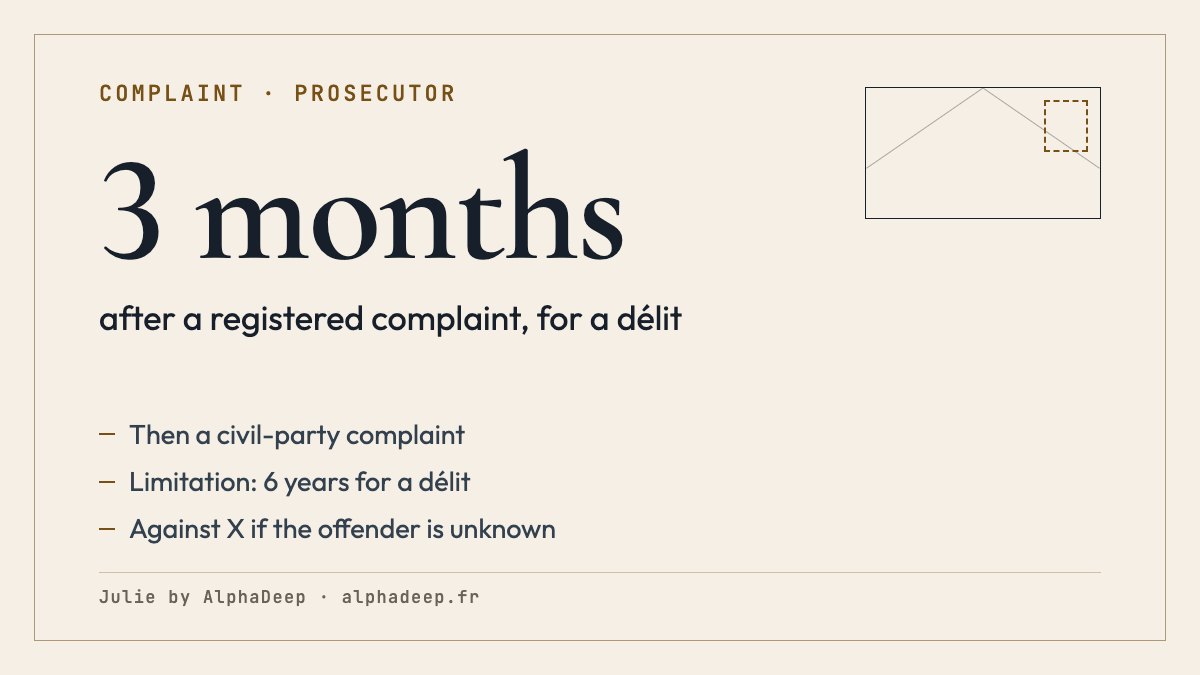
A French complaint can go by letter to the public prosecutor of the court for the place of the facts or the offender’s home, against X if unknown. It gives your details, a dated account of the facts, the witnesses and the harm, with the evidence (fiche F1435). Sent by registered post with acknowledgment, it starts the 3 months after which, for an ordinary délit, you can apply to join as civil party (Code of Criminal Procedure, article 85).
Julie by AlphaDeep is an AI legal assistant for French law: it researches official references to help answer your questions (Légifrance, case law, service-public), analyses your documents and drafts your letters, for individuals and professionals alike.
General legal information with official references and dated checks. It is not personalised advice: for a decision that commits you, have your situation checked by a qualified professional.

Let’s look at your situation
Tell the facts with their date and place, say whether you know who did it, and what evidence you have.
Example questions
Your question carries over after signup. Maximum 400 characters. Avoid health data and names.
Until when can you file, and when can you go to the investigating judge?
Give the date of the facts, whether it is a crime, a délit or a contravention, whether a special regime, continuing or repeated offence, interrupting act or suspension may apply, and the date your complaint was received if it has gone: the letter dates the limitation period in the general case and the opening of the civil-party route, and drafts the complaint, in French, for the French court. The example: a délit committed on 10 February 2026, complaint against X received on 2 March, no answer.
Fictional example · the complaint to the prosecutor
With no answer, a civil-party complaint is possible from 2 June 2026, 3 months after receipt.
- Limitation, general case: act before
- 11 February 2032
- Civil party possible from
- 2 June 2026
- Addressee
- Public prosecutor, judicial court for the place of the facts or the offender’s home
Lettre recommandée avec demande d’avis de réception
[Vos nom et prénom][Votre date et lieu de naissance][Votre adresse, téléphone et courriel]
Procureur de la RépubliqueTribunal judiciaire de [ville du lieu des faits ou du domicile de l’auteur]
À [ville], le [date]
ObjetPlainte pour des faits commis le 10 février 2026
Madame la Procureure de la République, Monsieur le Procureur de la République,
Je porte plainte contre X pour les faits suivants, commis le 10 février 2026 à [lieu].
Les faits : [racontez dans l’ordre, avec les dates, les heures et les lieux].
Témoins : [noms et adresses, ou aucun].
Mon préjudice : [sa nature et son estimation, même provisoire].
Je joins à cette plainte les pièces numérotées dont la liste suit.
Je vous remercie de m’aviser des suites données à ma plainte, comme le prévoit l’article 40-2 du Code de procédure pénale.
Cette plainte vous est adressée par lettre recommandée avec demande d’avis de réception : sa date de réception fera courir le délai de trois mois prévu à l’article 85 du même code.
Je vous prie d’agréer, Madame la Procureure de la République, Monsieur le Procureur de la République, l’expression de mes salutations respectueuses.[Signature]
Pièces jointes : les pièces numérotées : certificats médicaux, photos, factures, captures d’écran ou constats
Indicative result: how the facts are classified and any investigation step can change the limitation period; the calculation does not carry a deadline ending on a weekend or public holiday over. The complaint is in French because the French court works in French.
Which prosecutor should the complaint go to?
The public prosecutor (procureur de la République) of the judicial court for the place of the offence or the offender’s home; if the offender is unknown, the complaint is filed against X. It can also be handed in at the court’s front desk (fiche F1435). The prosecutor receives complaints and decides what follows (Code of Criminal Procedure, article 40).
A letter does not close the police route: police and gendarmerie must take the complaint, even outside their area, and at once hand over a receipt that states the limitation periods (article 15-3).
Sources: Service-public F1435 · CPP 40 · CPP 15-3
What must the complaint letter contain?
Your civil status and full contact details, a detailed account of the facts with their date and place, the name of the presumed offender if you know it, the names and addresses of witnesses, and a description and estimate, provisional or final, of the harm (fiche F1435).
You do not have to give the legal name of the offence: tell the facts precisely, in order, and refer to each exhibit by its number.
Sources: Service-public F1435 · Service-public R11469
Must the complaint be sent by registered post?
Not for it to be valid: the official model accepts an ordinary letter, a registered letter with acknowledgment of receipt, or filing at the court (model R11469).
For an ordinary délit outside article85 exemptions, a complaint filed against a receipt or sent by registered post with acknowledgment starts the 3-month period after which you can file a civil-party complaint before the investigating judge (Code of Criminal Procedure, article 85).
Sources: Service-public R11469 · CPP 85
How long do you have to file a complaint?
In the general case, 20 years for a crime, 6 years for a délit and 1 year for a contravention, from the day of the facts (Code of Criminal Procedure, articles 7, 8 and 9). Longer periods, sometimes running from the age of majority, apply to offences against minors.
For a concealed or disguised offence, the period runs from the day it came to light and could be established in conditions enabling prosecution, but no longer than 12 years for a délit and 30 years for a crime from the facts (article 9-1). A simple complaint does not by itself interrupt the limitation period; investigation or prosecution steps do (article 9-2).
Sources: CPP 7 · CPP 8 · CPP 9 · CPP 9-1 · CPP 9-2 · Service-public F31982
What if the prosecutor does not answer, or drops the case?
The prosecutor must tell the complainant about any prosecution or measure decided and, when dropping the case, the legal or practical reasons for it (article 40-2). That decision can be challenged before the procureur général (article 40-3).
For an ordinary délit, the prior-complaint condition for a civil-party complaint is met from the notice of no prosecution, or 3 months after the proved complaint; for a crime, with no prior complaint; for a contravention, this route is unavailable (article 85). Other admissibility requirements, including any deposit requested by the judge, still need checking (fiche F20798).
Sources: CPP 40-2 · CPP 40-3 · CPP 85 · Service-public F20798
Which evidence should go with the complaint?
Number each exhibit and quote its number in your account: the prosecutor can then match the facts, the harm and the proof.
- Document 1
Medical certificates and sick notes
They prove the injuries and how long they lasted; ask for a descriptive certificate as soon as possible after the facts.
- Document 2
Photographs and videos
Dated, with the place; keep the original files.
- Document 3
Invoices, quotes and official reports
They put a figure on the material harm: repair, replacement, costs incurred.
- Document 4
Screenshots and messages
With the date, the sender and the page address, for facts that happened online.
- Document 5
Witness details
Their name and address, so investigators can hear them.
What changes for criminal complaints in 2029?
The French Code of Criminal Procedure is being rewritten: the articles cited here apply until 31 December 2028.
The legislative part of the Code of Criminal Procedure is replaced by a rewritten version; the current versions of articles 7 to 9-2, 15-3, 40 to 40-3 and 85 are repealed on that date (ordinance no. 2025-1091 of 19 November 2025).
Source: Ordonnance n° 2025-1091
What does article 85 of the French Code of Criminal Procedure say?
The text that makes registered post the key to the investigating judge, for a délit.
Toute personne qui se prétend lésée par un crime ou un délit peut en portant plainte se constituer partie civile devant le juge d’instruction compétent en application des dispositions des articles 52, 52-1 et 706-42.
Toutefois, la plainte avec constitution de partie civile n’est recevable qu’à condition que la personne justifie soit que le procureur de la République lui a fait connaître, à la suite d’une plainte déposée devant lui ou un service de police judiciaire, qu’il n’engagera pas lui-même des poursuites, soit qu’un délai de trois mois s’est écoulé depuis qu’elle a déposé plainte devant ce magistrat, contre récépissé ou par lettre recommandée avec demande d’avis de réception, ou depuis qu’elle a adressé, selon les mêmes modalités, copie à ce magistrat de sa plainte déposée devant un service de police judiciaire.
In English, briefly (our summary, not an official translation): Anyone who claims to have been harmed by a crime or a délit can, by filing a complaint, join as civil party before the competent investigating judge. However, a civil-party complaint is admissible only if the person shows either that the prosecutor, after a complaint filed with them or with a police service, has told them they will not prosecute, or that three months have passed since they filed a complaint with the prosecutor against a receipt or by registered letter with acknowledgment of receipt, or sent the prosecutor a copy, the same way, of a complaint filed with the police. Our note: the rest of the article waives this condition for crimes, some press offences and some electoral offences.
What do victims writing to a French prosecutor ask?
Can I file a complaint without knowing who did it?
Yes: the complaint is then filed against X (fiche F1435).
Does the letter to the prosecutor interrupt the limitation period?
Not by itself: investigation steps by the prosecution, police reports and investigation acts effectively seeking or prosecuting the offender, and judgments not tainted by nullity interrupt it, each opening a new period equal to the first (article 9-2).
Can the police station refuse my complaint?
No: police officers and agents must take it, even if their service is not the local one (Code of Criminal Procedure, article 15-3).
Must the prosecutor tell me what they decide?
Yes: the prosecutor tells the complainant about any prosecution or alternative measure decided, and the reasons for dropping the case (article 40-2).
Which texts is a complaint to the prosecutor based on?
- Code of Criminal Procedure, article 40 (receiving complaints)Légifrance
- Code of Criminal Procedure, article 40-2 (notice to the complainant)Légifrance
- Code of Criminal Procedure, article 40-3 (appeal to the procureur général)Légifrance
- Code of Criminal Procedure, article 85 (civil-party complaint)Légifrance
- Code of Criminal Procedure, article 7 (limitation for crimes)Légifrance
- Code of Criminal Procedure, article 8 (limitation for délits)Légifrance
- Code of Criminal Procedure, article 9 (limitation for contraventions)Légifrance
- Code of Criminal Procedure, article 9-1 (concealed or disguised offences)Légifrance
- Code of Criminal Procedure, article 9-2 (interrupting steps)Légifrance
- Code of Criminal Procedure, article 15-3 (police must take complaints)Légifrance
- Ordinance no. 2025-1091 of 19 November 2025 rewriting the Code of Criminal Procedure (in French)Légifrance
- Filing a complaint (fiche F1435, in French)Service-public.fr · checked on 8 July 2026
- Complaint to the public prosecutor, model letter (R11469, in French)Service-public.fr · checked on 12 December 2025
- Criminal justice: limitation periods (fiche F31982, in French)Service-public.fr · checked on 29 July 2025
- Civil-party complaint (fiche F20798, in French)Service-public.fr
Texts cited last checked: 27 September 2026