The deadline registerTargeted by published words
Online defamation or insult in France: the 3-month time limit and your remedies
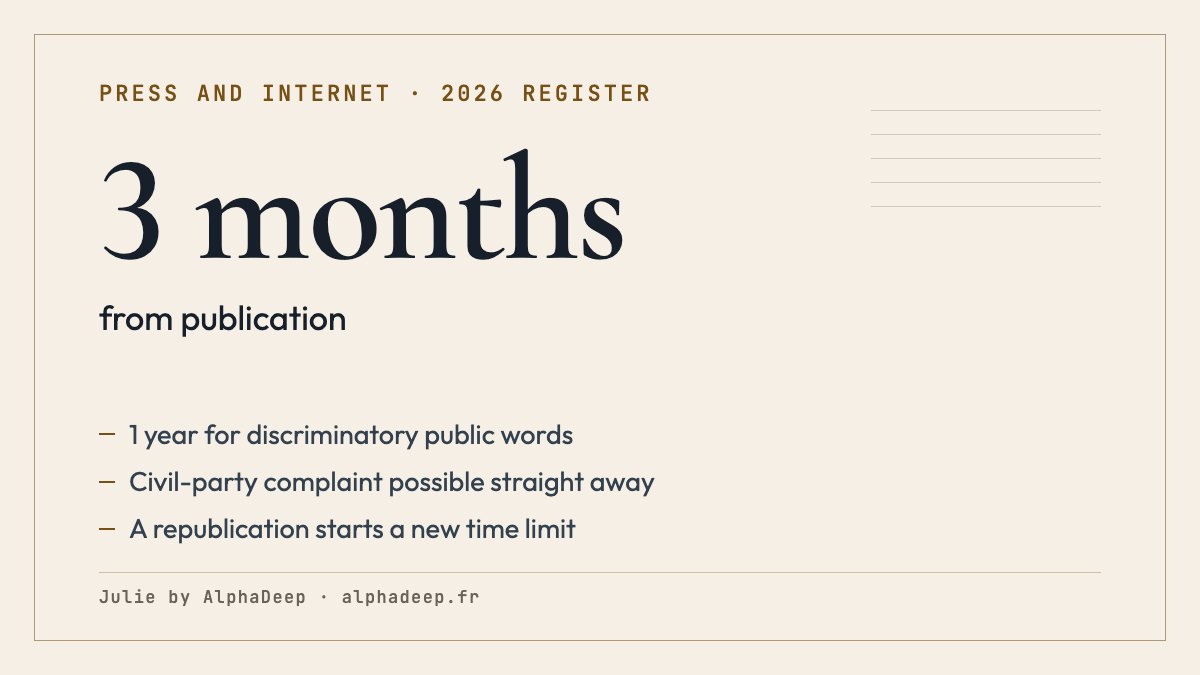
Under French law, defamation, which alleges a fact that harms someone’s honour, and insult, an offensive expression with no specific fact, published online are time-barred 3 months after publication (law of 29 July 1881, article 65), and 1 year when they target origin, religion, sex or sexual orientation (article 65-3). After that, a complaint can no longer succeed: keeping the evidence and acting fast is therefore decisive.
Go to the tool: the deadline register
Julie by AlphaDeep is an AI legal assistant for French law: it researches official references to help answer your questions (Légifrance, case law, service-public), analyses your documents and drafts your letters, for individuals and professionals alike.
General legal information with official references and dated checks. It is not personalised advice: for a decision that commits you, have your situation checked by a qualified professional.

Let’s look at your situation
Describe the message and its date, without copying any personal data.
Example questions
Your question carries over after signup. Maximum 400 characters. Avoid health data and names.
Until when can you act against a published message?
Enter the publication date, the nature of the words and who could read them: the register gives the prudent last day to act, the possible routes and the evidence to keep. The example is a public message published on 10 September 2026.
Fictional example · limitation register
Act by 9 December 2026 at the latest: 3 months from publication. Penalty: a €12,000 fine.
Days left: to be calculated
Message published: the time limit starts that day
Prudent last day to act: 3 months, article 65 of the law of 29 July 1881
Possible routes
- Report the content to the platform: Useful to get it removed, but it does not interrupt the limitation period.
- Ask for a right of reply: Within 3 months of posting, from the publication director or, if the publisher is anonymous, from the host.
- File a complaint, against persons unknown if the author is unknown: Before a prosecution, only the prosecutor’s requests for an investigation interrupt the time limit.
- Complaint with a civil-party application: Possible straight away for public defamation or insult, without waiting 3 months (Code of Criminal Procedure, article 85).
- Direct summons before the court: If the author is identified: criminal court, through a judicial officer.
Evidence to keep from today
- A screenshot showing the message, the account, the date and the page address
- The exact address (URL) of the message and of the author’s profile
- The number of followers or the visibility setting, which prove it is public
- A record by a judicial officer if the message may be deleted
Prudent date, set the day before the deadline. A new publication of the same text by its author starts a new time limit; simply staying online does not.
From when does the 3-month time limit run?
From the day of publication, not the day you discover the message: the action is time-barred after three full months from the day the words were published (law of 29 July 1881, article 65). A message staying online does not restart the time limit.
On the other hand, any reproduction of the text in a published writing is a new publication that starts a new time limit. The Cour de cassation has held this for a hyperlink inserted by the author to their own text (Cass. crim., 2 November 2016, no. 15-87.163) and for a website deliberately reactivated (Cass. crim., 7 February 2017, no. 15-83.439).
Sources: Loi 1881, art. 65 · Cass. crim. 2016 and 2017
Defamation or insult: how do you tell them apart?
Defamation alleges a specific fact that harms a person’s honour or reputation, even in a doubtful form or without naming them if they can be identified. An insult is an offensive expression, a term of contempt or an invective that contains no allegation of fact (article 29 of the 1881 law).
"He stole the association’s till" is defamation, because the fact can be checked; abuse with no specific fact is an insult. Whether words are public depends on the audience: according to service-public.fr, an account open to everyone makes them public, a small circle of people linked to each other makes them non-public.
Sources: Loi 1881, art. 29 · Service-public F32079
Which step really stops the clock?
Before a prosecution begins, only the prosecutor’s requests for an investigation interrupt the limitation period (article 65, second paragraph): a report to the platform does not stop it. For the discriminatory words of article 65-3, this restriction does not apply.
For public defamation or insult, a complaint with a civil-party application to the investigating judge (plainte avec constitution de partie civile) can be filed straight away, without the prior complaint and the 3-month wait required for other offences (Code of Criminal Procedure, article 85). If the author is identified, a direct summons (citation directe) brings the case before the court; if not, the complaint is filed against persons unknown.
Sources: Loi 1881, art. 65 · CPP 85 · Service-public F32079
Which offence, which penalty and which time limit to act?
The classification changes the penalty and sometimes the time limit: 3 months in principle, 1 year for discriminatory public words. Non-public words go to the police court.
| Words | What characterises them | Penalty | Time limit to act |
|---|---|---|---|
| Public defamation | Allegation of a specific fact, published | €12,000 fine (1881 law, art. 32) | 3 months |
| Public insult | Offensive expression with no specific fact, published | €12,000 fine (art. 33) | 3 months |
| Discriminatory public defamation or insult | Targets origin, religion, sex, sexual orientation, gender identity or disability | 1 year’s imprisonment and a €45,000 fine | 1 year (art. 65-3) |
| Non-public defamation or insult | Addressed to one person or people linked together, with no public access | €38 fine at most (Criminal Code, art. R621-1 and R621-2) | 3 months |
| Discriminatory non-public defamation or insult | Same grounds, in a restricted setting | €1,500 fine at most, according to service-public.fr | 3 months |
Proof that the facts are true can, under conditions, clear the author of defamation; an insult cannot be justified by the truth. The publication director may be prosecuted as the principal offender if the message was fixed before communication to the public. For a user’s message in an identified personal-contributions area, liability as principal offender is excluded if the director had no actual knowledge before posting or removed it promptly once aware (1982 law, article 93-3).
Sources: Loi 1881, art. 29 · Loi 1881, art. 32 and 33 · Service-public F32079 · C. pén. R621-1 · Loi 1982, art. 93-3
How much hateful content is reported online in France?
According to the Ministry of the Interior, the PHAROS platform received 109,302 reports of illegal content in the first half of 2025. These figures cover all reported content, not only defamation.
- Reports received by PHAROS
- 109,302First half of 2025 · Ministry of the Interior, Ma Sécurité
- Reports classified under "discrimination"
- 19,959First half of 2025 · Ministry of the Interior, Ma Sécurité
- Items notified to hosts for removal
- 938First half of 2025 · Ministry of the Interior, Ma Sécurité
What has changed recently in these rules?
Three dated changes affect the right of reply, the penalties and the future of the text on the time limit.
Public insult of the bodies and persons protected by articles 30 and 31, such as a public authority, an elected official or a civil servant, is punishable by a €12,000 fine and community service (article 33 of the 1881 law).
Source: Loi 1881, art. 32 and 33
The online right of reply is set out in article 1-1 III of the law of 21 June 2004: a request within 3 months of posting, publication within 3 days, free of charge, on pain of a €3,750 fine.
Source: LCEN, art. 1-1
Légifrance announces the deferred repeal of article 65 on this date. On the day it was checked, the 3-month time limit applies unchanged.
Source: Loi 1881, art. 65
What does article 65 of the law of 29 July 1881 say?
Article 65 is the text that sets the 3-month time limit and the strict rule on interrupting it before a prosecution.
L’action publique et l’action civile résultant des crimes, délits et contraventions prévus par la présente loi se prescriront après trois mois révolus, à compter du jour où ils auront été commis ou du jour du dernier acte d’instruction ou de poursuite s’il en a été fait.
Toutefois, avant l’engagement des poursuites, seules les réquisitions aux fins d’enquête seront interruptives de prescription. Ces réquisitions devront, à peine de nullité, articuler et qualifier les provocations, outrages, diffamations et injures à raison desquels l’enquête est ordonnée.
In English, briefly (our summary, not an official translation): Public and civil actions arising from the offences under this law are time-barred after three full months from the day they were committed, or from the last act of investigation or prosecution if there was one. Before a prosecution begins, however, only requests for an investigation interrupt the limitation period, and on pain of nullity they must set out and classify the incitements, contempt, defamation and insults for which the investigation is ordered. Article 65-3 extends the time limit to one year for discriminatory public defamation and insult, and sets aside the second paragraph for them.
What should you do in practice about a defamatory message?
Do you need a judicial officer to record the words?
It is not compulsory: in criminal matters, an offence can be proven by any means (Code of Criminal Procedure, article 427), and service-public.fr lists screenshots among the evidence. A record made by a judicial officer (commissaire de justice) is stronger if the message may be deleted or disputed.
Can you act against an anonymous account?
Yes, through a complaint against persons unknown; a direct summons, however, requires an identified author. A non-professional publisher can stay anonymous online provided they gave their identity to their host, whose professional secrecy cannot be relied on against the judicial authority (article 1-1 of the law of 21 June 2004).
What does the author of public defamation risk?
A €12,000 fine for defaming a private individual (article 32 of the 1881 law). If the defamation targets origin, religion, sex, sexual orientation, gender identity or disability, the penalty rises to one year’s imprisonment and a €45,000 fine. Damages can be added.
Can you demand a right of reply on a website or social network?
Anyone named or designated in an online service has a right of reply, to be requested within 3 months of posting from the publication director, or from the host if the publisher is anonymous. The reply must be published within 3 days, free of charge (article 1-1 III of the law of 21 June 2004).
Which texts and decisions set this time limit?
- Law of 29 July 1881 on the freedom of the press, article 29 (definitions)Légifrance, in French
- Law of 29 July 1881, articles 65 and 65-3 (time limits)Légifrance, in French
- Code of Criminal Procedure, articles 85 and 427Légifrance, in French
- Law of 29 July 1881, articles 32 and 33 (penalties for defamation and insult)Légifrance, in French
- Law no. 2004-575 of 21 June 2004, article 1-1 (identifying the publisher, online right of reply)Légifrance, in French
- Cour de cassation, criminal chamber, 2 November 2016, no. 15-87.163, and 7 February 2017, no. 15-83.439Légifrance, case law, in French
- Defamation (fiche F32079)Service-public.fr, in French
- Criminal Code, articles R621-1, R621-2 and 131-13 (non-public defamation and insult)Légifrance, in French
- PHAROS activity report for 2025Ministry of the Interior, Ma Sécurité, in French
- Law of 29 July 1982 on audiovisual communication, article 93-3 (publication director liability)Légifrance, in French
Texts cited last checked: 24 September 2026