The deadline registerEmployee or employer
French employment tribunal: the time limit for each claim and how to file the application
An employee can apply to the French employment tribunal using form Cerfa 15586. The time limit depends on the claim:12 months for termination,2 years for performance,3 years for wages,5 years for harassment or discrimination. An application filed from1October 2026 includes its document list and the latest payslip related to the dispute or a document establishing the employer’s activity (Labour Code, article R1452-2).
Go to the tool: the deadline register
Julie by AlphaDeep is an AI legal assistant for French law: it researches official references to help answer your questions (Légifrance, case law, service-public), analyses your documents and drafts your letters, for individuals and professionals alike.
General legal information with official references and dated checks. It is not personalised advice: for a decision that commits you, have your situation checked by a qualified professional.

Let’s look at your situation
Give what you are claiming and the date of the starting event.
Example questions
Your question carries over after signup. Maximum 400 characters. Avoid health data and names.
What changes for employment tribunal claims in 2026?
Two 2026 texts change how the tribunal is seized: a €50 contribution and a lighter application from 1 October. The time limits for acting do not change.
A €50 legal aid contribution is due from the party that starts the case, unless it receives legal aid; it is paid online (General Tax Code, article 1635 bis Q).
Source: CGI 1635 bis Q
The application no longer comes with all the documents: a list (bordereau) sets them out, and only the latest payslip related to the dispute, or a document showing the employer’s activity, must be attached (Labour Code, article R1452-2).
Sources: C. trav. R1452-2 · Decree 2026-683
Each party sends its documents to the other before the conciliation hearing or the trial, and hands in a copy that day, instead of first filing them with the court office (articles R1452-3 and R1452-4).
Sources: C. trav. R1452-2 · Decree 2026-683
By which date can you take your case to the French employment tribunal?
Choose your claim and the date that starts the time limit: the register shows the indicative deadline, the days left and the documents for the application. The example is a dismissal notified on 15 January 2026.
Fictional example · time-limit register
File by 15 January 2027 at the latest: 1 year from that date.
Days left: to be calculated
Notification of the termination
New-style application: list of documents and latest payslip (decree no. 2026-683)
Indicative deadline to seize the tribunal: 1 year, article L1471-1 of the Labour Code
Documents for the application
- The application, on form Cerfa no. 15586 for an employee, with the details required by article 57 of the Code of Civil Procedure
- A short statement of the grounds and each head of claim
- A list of the documents, without attaching them
- The latest payslip related to the dispute, or a document showing the employer’s activity
- The documents themselves, sent to the employer before the hearing, with a copy handed in that day
Indicative date: seizing the tribunal interrupts the limitation period, but a time limit is worked out from the exact date proven. File well before the deadline.
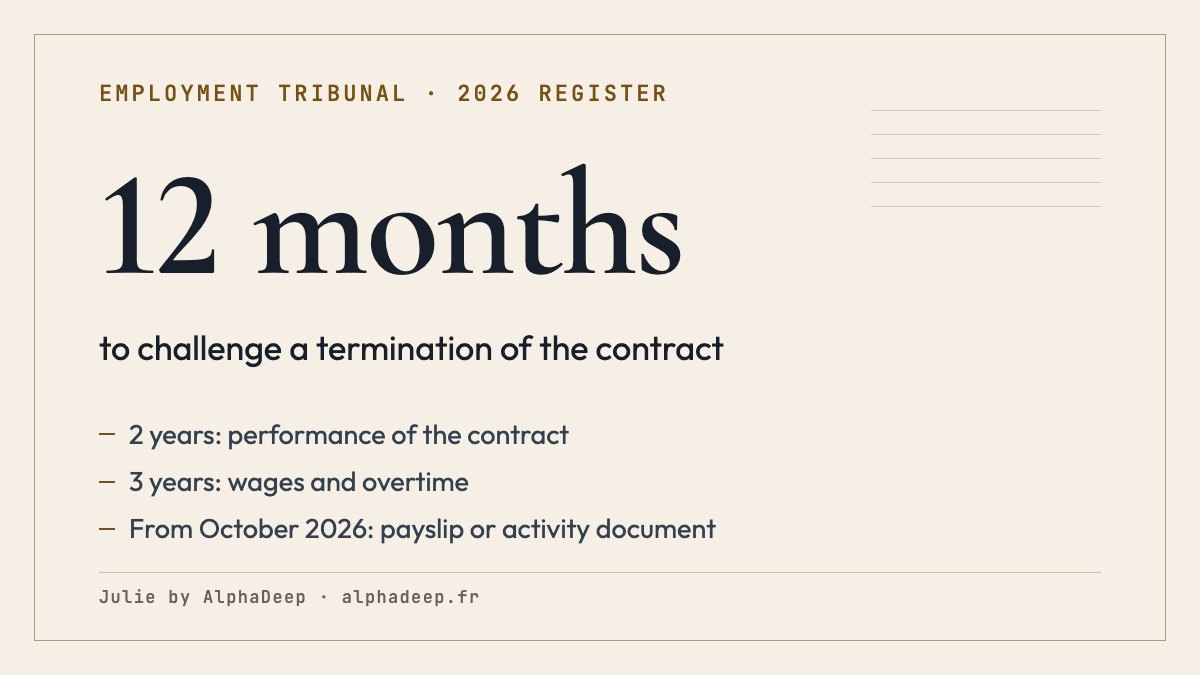
Which time limit applies to each employment tribunal claim?
The time limit depends on what you claim, not on the reason for leaving: 12 months for the termination, 2 years for the performance of the contract, 3 years for wages, 5 years for harassment or discrimination, 10 years for personal injury.
| Claim | Time limit | Starting point | Text |
|---|---|---|---|
| Challenging a dismissal or another termination | 12 months | Notification of the termination | C. trav., art. L1471-1 |
| Performance of the contract: sanction, grading, working conditions | 2 years | Day you learned of the facts | C. trav., art. L1471-1 |
| Wages, overtime, bonuses | 3 years | Day you learned of the facts, in practice the pay date | C. trav., art. L3245-1 |
| Approved negotiated termination (rupture conventionnelle) | 12 months | Date of approval | C. trav., art. L1237-14 |
| Sum in a signed final pay statement (solde de tout compte) | 6 months | Signature of the receipt | C. trav., art. L1234-20 |
| Moral or sexual harassment | 5 years | Last act of harassment | C. civ., art. 2224 |
| Discrimination | 5 years | Discovery of the discrimination | C. trav., art. L1134-5 |
| Personal injury linked to work | 10 years | Stabilisation of the injury (consolidation) | C. civ., art. 2226 |
Harassment and personal injury fall outside the time limits of article L1471-1 and follow the Civil Code; for harassment, service-public.fr says the time limit starts from the last act. Without signature, the time limit depends on the claim:3 years for wages,2 years for performance or12 months for termination, each with its starting point; the signed receipt’s6 months cover the sums it expressly lists.
Sources: C. trav. L1471-1 · C. trav. L3245-1 · C. trav. L1237-14 · C. trav. L1134-5 · Service-public F2360 · C. civ. 2224 and 2226
How do you date several claims in one application?
Make one line per head of claim, recording its type, starting date and the document proving it: the end of the contract does not give the whole application one starting date. For a termination, find its notification; for a negotiated termination, its approval. The French-language dismissal-deadline guide explains the exceptions for challenging a termination. For a sum expressly listed on a signed final-pay receipt, check the signature and the French-language final-pay-receipt guide; without a signature or for an unlisted sum, identify the claim type.
For wages, the 3-year time limit runs from the day you learned of the facts: date each unpaid due date separately. Reminders, the formal notice and choosing the urgent procedure belong to the unpaid-wages recovery guide. Here, bring those claims and their documents together in the application; to number the file, use the employment-tribunal evidence bundle guide.
Sources: C. trav. L1471-1 · C. trav. L3245-1 · Service-public F2360
What must the application filed with the court office contain?
The application is handed in or sent to the tribunal’s court office. It contains the details required by article 57 of the Code of Civil Procedure, a short statement of the grounds and each head of claim, and it is made in as many copies as there are defendants, plus one for the tribunal (Labour Code, article R1452-2).
Until 30 September 2026, the documents relied on went with the application, with their list. Since 1 October 2026, only the list sets them out, and the application attaches the latest payslip related to the dispute or a document establishing the employer’s activity. The competent tribunal is the one for the place of work, or for the home of an employee who works away from any establishment (article R1412-1).
Sources: C. trav. R1452-2 · C. trav. R1412-1 and following
Does taking the case to the tribunal stop the clock?
Yes. Seizing the employment tribunal, even one without jurisdiction, interrupts the limitation period (Labour Code, article R1452-1). What counts is the date of the application, not that of the hearing.
If the €50 contribution has not been paid, the court office must invite you to put it right within one month before the claim can be declared inadmissible (General Tax Code, article 1635 bis Q). After that month, the claim is inadmissible and must be filed again, according to service-public.fr.
Sources: C. trav. R1452-2 · CGI 1635 bis Q · Service-public F2360
How long does a French employment tribunal case take?
According to the Ministry of Justice, an employment tribunal case completed in 2025 lasted 13.5 months on average, summary proceedings included. These are national averages, not guaranteed times.
- Average length of all completed cases
- 13.5 months2025 · Ministry of Justice, SSER
- Average duration of completed cases on the merits
- 15.4 months2025 · Ministry of Justice, SSER
- Average length of summary proceedings (référé)
- 3.0 months2025 · Ministry of Justice, SSER
- Cases brought before the employment tribunals, up 11%
- 132,0002025 · Ministry of Justice, SSER
What does article R1452-2 of the Labour Code say in its version of 1 October 2026?
Here is the text applicable to applications filed from 1 October 2026, as worded by decree no. 2026-683 of 27 July 2026.
La requête est faite, remise ou adressée au greffe du conseil de prud’hommes. Elle comporte les mentions prescrites à peine de nullité à l’article 57 du code de procédure civile. En outre, elle contient un exposé sommaire des motifs de la demande et mentionne chacun des chefs de celle-ci. Il lui est annexé un bordereau énumérant les pièces que le demandeur souhaite invoquer à l’appui de ses prétentions.
La requête et le bordereau sont établis en autant d’exemplaires qu’il existe de défendeurs, outre l’exemplaire destiné à la juridiction. La requête est en outre accompagnée du dernier bulletin de salaire afférent au litige ou de toute pièce permettant de déterminer l’activité de l’employeur.
In English, briefly (our summary, not an official translation): The application is made, handed in or sent to the court office of the employment tribunal. It contains the details required, on pain of nullity, by article 57 of the Code of Civil Procedure, a short statement of the grounds of the claim and each of its heads, and a list (bordereau) of the documents the claimant intends to rely on. The application and the list are made in as many copies as there are defendants, plus the tribunal’s copy, and the application comes with the latest payslip related to the dispute or any document showing the employer’s activity. The version in force until 30 September 2026 instead had the documents themselves accompany the application, listed on the bordereau.
Which practical questions come up before the hearing?
Do you need a lawyer at the French employment tribunal?
No. The parties defend themselves and can be assisted or represented (article R1453-1) by an employee or employer from the same sector, a union defender, their spouse, Pacs partner or cohabiting partner, or a lawyer (article R1453-2). A representative who is not a lawyer needs a special power of attorney.
How much does it cost to take a case to the tribunal?
Since 21 February 2026, the party that starts the case pays a €50 legal aid contribution, online, unless it receives legal aid (General Tax Code, article 1635 bis Q). Lawyer’s fees, if any, come on top.
What are summary proceedings (référé) at the employment tribunal?
A fast procedure before a panel of one employee member and one employer member (article R1455-1). In an emergency, it orders the measures that meet no serious challenge, stops a manifestly unlawful disturbance or grants an interim payment on an obligation that cannot seriously be disputed (articles R1455-5 to R1455-7).
What happens at the conciliation hearing?
The conciliation and referral panel hears the parties, in private, and seeks an agreement; a record is drawn up. For a dismissal, a fixed conciliation payment can end the dispute. Without agreement, the case goes to the trial panel, according to justice.fr.
Which texts set these time limits and this application?
- Labour Code, articles R1452-1 to R1452-4 (application, versions of 1 October 2026)Légifrance, in French
- Labour Code, article L1471-1 (performance and termination of the contract)Légifrance, in French
- Labour Code, article L3245-1 (wage claims)Légifrance, in French
- Labour Code, articles L1237-14 and L1234-20 (negotiated termination, final pay statement)Légifrance, in French
- Labour Code, article L1134-5 (discrimination)Légifrance, in French
- General Tax Code, article 1635 bis Q (€50 legal aid contribution)Légifrance, in French
- Taking a case to the employment tribunal (CPH) (fiche F2360)Service-public.fr, in French
- Justice statistical references 2026, sheet 4.4: the employment tribunalsMinistry of Justice, statistical service, in French
- Decree no. 2026-683 of 27 July 2026, article 10Légifrance, Journal officiel, in French
- Civil Code, articles 2224 and 2226 (general limitation period, personal injury)Légifrance, in French
- Labour Code, articles R1412-1, R1453-1, R1453-2, R1455-1 and R1455-5 to R1455-7Légifrance, in French
- Employment tribunal (CPH): how a case proceedsMinistry of Justice, justice.fr, in French
Texts cited last checked: 24 September 2026