The checklist gridAudit grid · Pregnancy and work
Pregnant employee in France: the periods of protection against dismissal, the forbidden steps and the rights during pregnancy
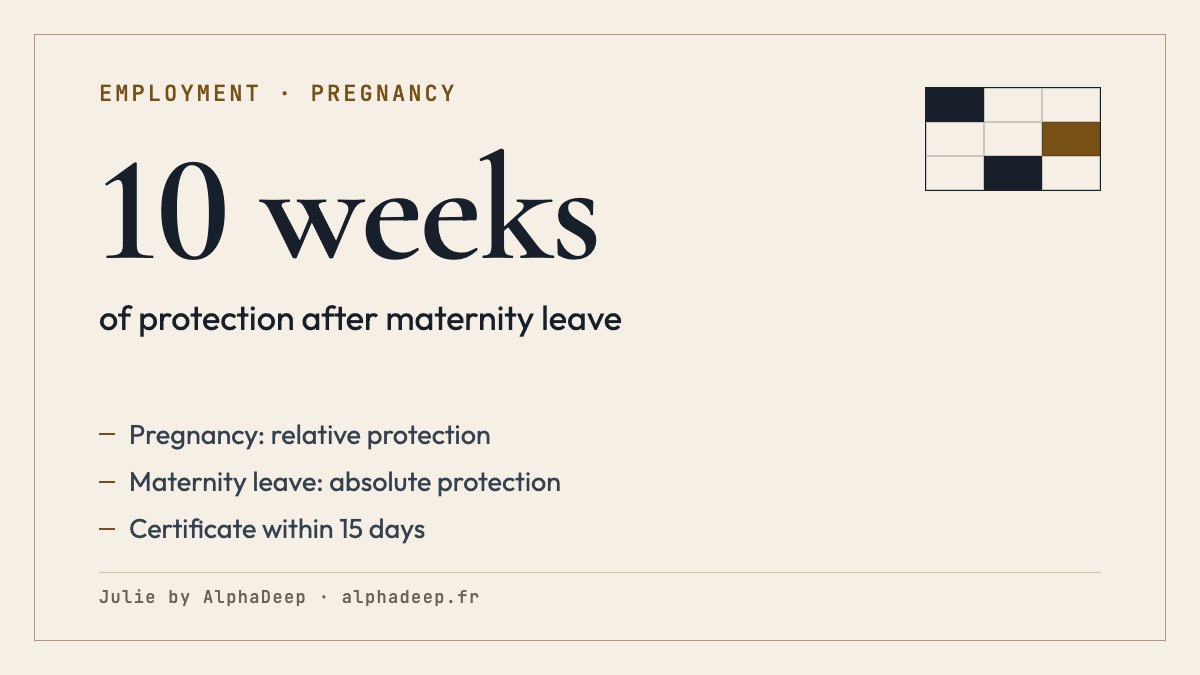
A pregnant employee in France cannot be dismissed while her pregnancy is medically established, except for gross misconduct unrelated to it or the impossibility of keeping the contract; during maternity leave and paid leave taken right after, no dismissal can be notified or take effect; protection lasts another 10 weeks (Labour Code, article L1225-4).
Go to the tool: the checklist grid
Julie by AlphaDeep is an AI legal assistant for French law: it researches official references to help answer your questions (Légifrance, case law, service-public), analyses your documents and drafts your letters, for individuals and professionals alike.
General legal information with official references and dated checks. It is not personalised advice: for a decision that commits you, have your situation checked by a qualified professional.

Let’s look at your situation
Give the expected due date, when the employer was told, the step taken and its date.
Example questions
Your question carries over after signup. Maximum 400 characters. Avoid health data and names.
Which protection periods apply, in order?
Five successive periods, from the pregnancy announcement to the end of protection.
During the pregnancy
Relative protection: dismissal only for gross misconduct unrelated to the pregnancy or the impossibility of keeping the contract for an unrelated reason (article L1225-4).
During maternity leave
Absolute protection, whether or not you take the whole leave: no dismissal can be notified or take effect, whatever the reason.
During paid leave taken right after
Absolute protection too, provided the leave follows maternity leave immediately.
During the next 10 weeks
Relative protection again, with the same two exceptions.
Afterwards
No special protection against dismissal: the ordinary dismissal rules apply again.
How long is maternity leave?
The legal length, which sets the absolute protection period.
| Situation | Before the birth | After the birth | Total |
|---|---|---|---|
| First or second child | 6 weeks | 10 weeks | 16 weeks |
| Third child or more | 8 weeks | 18 weeks | 26 weeks |
| Twins | 12 weeks | 22 weeks | 34 weeks |
| Triplets or more | 24 weeks | 22 weeks | 46 weeks |
| Certified pathological condition | Up to 2 more weeks | Up to 4 more weeks | Per the certificate |
With the health professional’s approval, up to 3 weeks of prenatal leave can be moved to after the birth (article L1225-17).
Sources: C. trav. L1225-17 · C. trav. L1225-18 · C. trav. L1225-19 · C. trav. L1225-21
Is your employer allowed to do what it is doing?
Give the expected due date, your situation, the paid leave taken right after, the date of the step and the reason given: the grid sorts each step into forbidden, allowed under conditions or allowed, and works out your protection periods. The example: a first child due on 1 August 2026 and a dismissal notified on 15 July 2026.
Fictional example · the protection grid
At least one step is forbidden: it can be annulled or challenged.
- On the date of the step
- Absolute protection
- Maternity leave, provisional dates
- 20 June 2026 to 10 October 2026
- End of the protection
- 19 December 2026
1 · Forbidden0 · Under conditions1 · Allowed
| Clause or point checked | Forbidden | Under conditions | Allowed |
|---|---|---|---|
| Dismissal notified on the date givenarticle L1225-4 | Forbidden | ||
| Fixed-term contract ending on its agreed datearticle L1243-5 | Allowed |
Provisional dates, worked out from the due date: an early or late birth, a postponed prenatal leave or a pathological condition move them, and the pregnancy is assumed to be medically established.
Must you tell your employer you are pregnant?
No, neither when hired nor during the contract, except to claim the legal protections (article L1225-2); the employer may not look for this information or use it to refuse a hire, end a trial period or transfer you (article L1225-1).
To benefit from the protection, inform the employer and prove your condition with a medical certificate (sheet F2873); a registered letter dates the information.
Sources: C. trav. L1225-2 · C. trav. L1225-1 · Service-public F2873
What if the employer did not know of the pregnancy?
The dismissal is annulled if you send a medical pregnancy certificate within 15 days of its notification, by registered letter with acknowledgement of receipt (articles L1225-5 and R1225-2). The example in sheet F2873: notified on 19 March, sent by 3 April at the latest.
The annulment does not apply if the dismissal rests on gross misconduct unrelated to the pregnancy or on the impossibility of keeping the contract, nor to ending a valid trial period (Cass. soc., 21 December 2006, no. 05-44.806).
Sources: C. trav. L1225-5 · C. trav. R1225-2 · Service-public F2873 · Cass. soc., 21 Dec. 2006
Which adjustments apply during pregnancy?
A temporary move to another job if your health requires it, with no pay cut; another establishment needs your consent (article L1225-7). If you work nights, you move to a day job at your request (article L1225-9).
The compulsory medical check-ups of pregnancy are authorised absences, with no loss of pay and counted as working time (article L1225-16).
Sources: C. trav. L1225-7 · C. trav. L1225-9 · C. trav. L1225-16
What does article L1225-4 of the French Labour Code say?
The protection periods and their only two exceptions.
Aucun employeur ne peut rompre le contrat de travail d’une salariée lorsqu’elle est en état de grossesse médicalement constaté, pendant l’intégralité des périodes de suspension du contrat de travail auxquelles elle a droit au titre du congé de maternité, qu’elle use ou non de ce droit, et au titre des congés payés pris immédiatement après le congé de maternité ainsi que pendant les dix semaines suivant l’expiration de ces périodes.
Toutefois, l’employeur peut rompre le contrat s’il justifie d’une faute grave de l’intéressée, non liée à l’état de grossesse, ou de son impossibilité de maintenir ce contrat pour un motif étranger à la grossesse ou à l’accouchement. Dans ce cas, la rupture du contrat de travail ne peut prendre effet ou être notifiée pendant les périodes de suspension du contrat de travail mentionnées au premier alinéa.
In English, briefly (our summary, not an official translation): No employer may end the employment contract of an employee while her pregnancy is medically established, during the whole of the maternity-leave suspension periods she is entitled to, whether or not she uses them, and the paid leave taken immediately after maternity leave, and during the ten weeks after those periods end. The employer may however end the contract if it proves gross misconduct by her unrelated to the pregnancy, or that it cannot keep the contract for a reason unrelated to the pregnancy or the birth; the ending then cannot take effect or be notified during the suspension periods. Our note: a dismissal that breaks these periods is annulled; the employee can ask the labour court for reinstatement (sheet F2873).
What do pregnant employees ask?
Does my fixed-term contract stop during my pregnancy?
Yes, if it reaches its end: a fixed-term contract ends automatically on the agreed date (article L1243-5); the protection does not extend it.
Can the employer invite me to an interview during my leave?
No: during absolute protection it cannot invite you to a pre-dismissal interview either (sheet F2873).
Is a mutual termination still possible?
Yes, if you and the employer agree, even during absolute protection (sheet F2873).
Does paid leave after maternity leave extend the protection?
Yes, if taken immediately after: absolute protection covers it, and the 10 weeks run from its end (article L1225-4).
Which texts does a pregnant employee’s protection rest on?
- Labour Code, article L1225-1 (pregnancy and the employer’s decisions)Légifrance
- Labour Code, article L1225-2 (no duty to reveal)Légifrance
- Labour Code, article L1225-4 (protection periods)Légifrance
- Labour Code, article L1225-5 (annulment by certificate)Légifrance
- Labour Code, article R1225-2 (certificate sent by registered letter)Légifrance
- Labour Code, article L1225-7 (temporary move)Légifrance
- Labour Code, article L1225-17 (length of leave)Légifrance
- Labour Code, article L1225-18 (multiple births)Légifrance
- Labour Code, article L1225-19 (third child)Légifrance
- Labour Code, article L1225-21 (pathological condition)Légifrance
- Cour de cassation, social chamber, 21 December 2006, no. 05-44.806 (trial period)Légifrance
- Dismissal of a pregnant employee or one on maternity leave (sheet F2873, in French)Service-public.fr · checked on 18 September 2026
- Labour Code, article L1225-9 (night work)Légifrance
- Labour Code, article L1225-16 (medical check-ups)Légifrance
- Labour Code, article L1243-5 (end of a fixed-term contract)Légifrance
Texts cited last checked: 27 September 2026