The exhibit listExhibit list · Reclassification as an employee
False self-employment in France: the evidence to have the relationship reclassified as an employment contract, and the deadlines
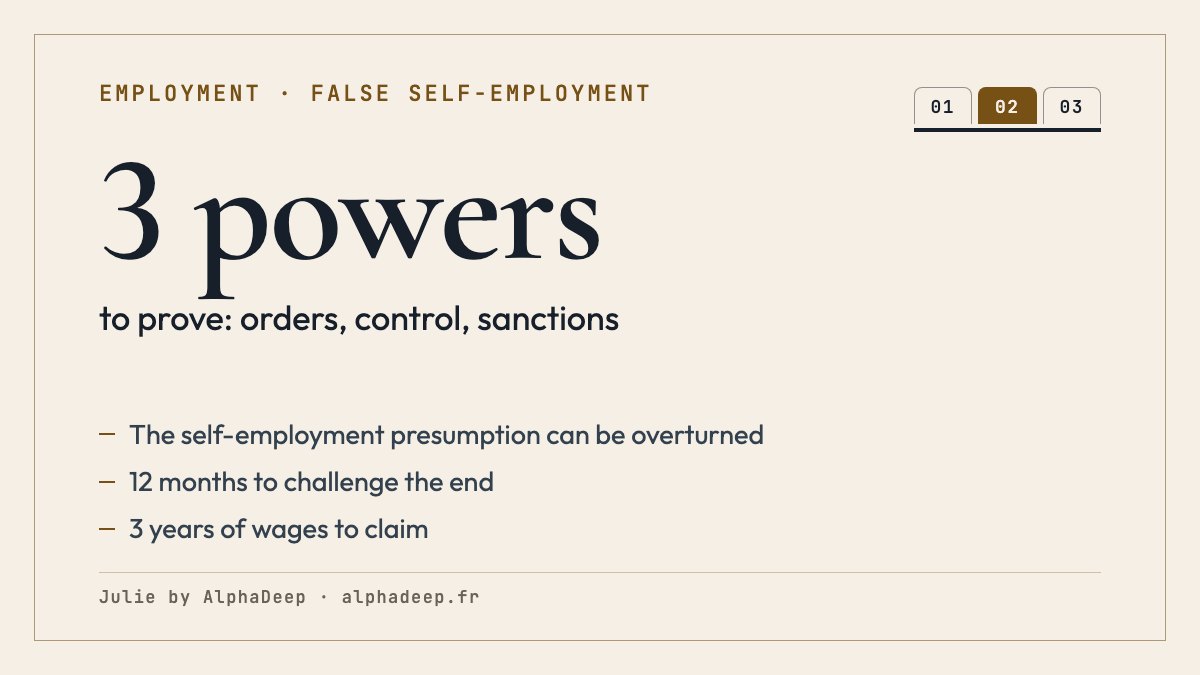
A worker registered as self-employed in France is presumed not to be an employee, but the presumption falls if they work under permanent legal subordination (Labour Code, article L8221-6). That link is proved by the client’s power to give orders, check their performance and sanction failings (Cour de cassation, 13 November 1996). The claim goes to the employment tribunal (prud’hommes), with the evidence.
Go to the tool: the exhibit list
Julie by AlphaDeep is an AI legal assistant for French law: it researches official references to help answer your questions (Légifrance, case law, service-public), analyses your documents and drafts your letters, for individuals and professionals alike.
General legal information with official references and dated checks. It is not personalised advice: for a decision that commits you, have your situation checked by a qualified professional.

Let’s look at your situation
Describe your activity, the client, what they impose on you and the evidence you have, without naming anyone.
Example questions
Your question carries over after signup. Maximum 400 characters. Avoid health data and names.
Which evidence do you already have, and which is missing?
Tick what you can prove: instructions, monitoring, sanctions, hours, prices, tools supplied, and say whether the relationship has ended: the exhibit list numbers the documents, says what each may document, flags the missing ones and dates your deadlines. The example: a self-employed courier, instructions, geolocation and deactivations proved, prices imposed, relationship ended on 30 June 2026.
Fictional example · the exhibit list
You report documents for all three powers: their contents must still establish the actual working conditions.
- Powers for which you report documents
- 3 of 3
- Qualification claim by
- 30 June 2031
- Challenge the notified termination by
- 30 June 2027
- Wages claimable from
- 30 June 2023
| No. | Exhibit | What it proves | Status |
|---|---|---|---|
| 01 | Services contract and invoices | The relationship, its length and the sums paid, not its legal nature | In the file |
| 02 | Instructions, directions, messages received | The power to give orders | In the file |
| 03 | Monitoring, geolocation, required reports | Control of the work | In the file |
| 04 | Warnings, penalties, account deactivation | The power to sanction | In the file |
| 05 | Schedule, hours or shifts imposed | Working conditions set by the client alone | Optional |
| 06 | Price list imposed | No freedom to set prices | In the file |
| 07 | Tools, badge, email address or uniform supplied | Integration into a service organised by the client | Optional |
Indicative result: no sign is enough on its own; the judge weighs all the actual conditions. The back-pay amount depends on the hours proved and the collective agreement.
Which procedural documents should you prepare for the prud’hommes?
The evidence on the exhibit list goes with a claim form that must put a figure on each claim.
- Document 1
The claim (requête)
On plain paper or the official form, dated and signed: your details, the principal’s, the subject and a short statement of the claims with their amounts (fiche F2360).
- Document 2
The exhibit list (bordereau de communication de pièces)
The numbered list of the documents attached, in the order of the exhibit list above.
- Document 3
The €50 contribution
An electronic tax stamp, unless you receive legal aid (General Tax Code, article 1635 bis Q).
- Document 4
The copies
As many copies of the claim and the exhibit list as there are opposing parties, plus one for the court office (fiche F2360).
- Document 5
Your registration proof
It shows the presumption to overturn and the period covered (article L8221-6).
Can a micro-entrepreneur be recognised as an employee in France?
This file concerns services presented as self-employment: document the actual working conditions. If you already work under a fixed-term employment contract and challenge that contract, use CDD-to-CDI reclassification.
Yes. Registered persons, micro-entrepreneurs included, are presumed not to be bound to the principal by an employment contract, but one can be established when they work in conditions that place them under permanent legal subordination (French Labour Code, article L8221-6).
The name of the contract does not count: whether an employment relationship exists depends neither on the parties’ wishes nor on what they called their agreement, but on the actual conditions of the work (Cour de cassation, 28 November 2018).
Sources: C. trav. L8221-6 · Cass. soc., 28 nov. 2018, n° 17-20.079
What proves subordination?
Work done under the authority of an employer who has the power to give orders and directions, to check their performance and to sanction failings (Cour de cassation, employment chamber, 13 November 1996, no. 94-13.187).
Working within an organised service is only a sign, taken into account when the principal alone sets its terms (same decision). So gather the proof of the three powers first, then the signs that support them.
Are platform workers covered?
Yes. For a courier, a geolocation system tracking their position in real time and a power to sanction established a power of direction and control, hence subordination, even though they chose their shifts (Cour de cassation, 28 November 2018, no. 17-20.079).
For a driver, self-employed status was held to be fictitious: they joined a service entirely organised by the platform, with no clientele of their own, setting neither their prices nor their working conditions freely (4 March 2020, no. 19-13.316).
Sources: Cass. soc., 28 nov. 2018, n° 17-20.079 · Cass. soc., 4 March 2020, no. 19-13.316
What can you obtain after reclassification?
An employee’s rights for the period recognised: back pay over 3 years, or the 3 years before the end of the relationship (article L3245-1), paid leave at 2.5 working days per month worked (article L3141-3), and membership of the general social security scheme (Social Security Code, article L311-2).
If the principal intentionally avoided an employer’s obligations, concealed employment is established (articles L8221-5 and L8221-6) and the end of the relationship gives a flat-rate payment of 6 months’ pay (article L8223-1).
Sources: C. trav. L3245-1 · C. trav. L3141-3 · CSS L311-2 · C. trav. L8221-5 · C. trav. L8221-6 · C. trav. L8223-1
What does article L8221-6 of the French Labour Code say?
The text of the self-employment presumption, and of what overturns it.
L’existence d’un contrat de travail peut toutefois être établie lorsque les personnes mentionnées au I fournissent directement ou par une personne interposée des prestations à un donneur d’ordre dans des conditions qui les placent dans un lien de subordination juridique permanente à l’égard de celui-ci.
Dans ce cas, la dissimulation d’emploi salarié est établie si le donneur d’ordre s’est soustrait intentionnellement par ce moyen à l’accomplissement des obligations incombant à l’employeur mentionnées à l’article L. 8221-5.
In English, briefly (our summary, not an official translation): An employment contract may nevertheless be established when the persons listed in I provide services to a principal, directly or through an intermediary, in conditions that place them under permanent legal subordination towards that principal. In that case, concealed employment is established if the principal thereby intentionally avoided the employer’s obligations listed in article L8221-5. Our note: part I presumes self-employed those registered in the trade register, the national business register, the commercial agents’ register or with the Urssaf.
Which deadlines apply, and to which claims?
Each claim has its own deadline: reclassification does not restart them.
| Claim | Deadline | Starting point | Text |
|---|---|---|---|
| Qualification of the disputed relationship as employment | 5 years | Cessation of the disputed relationship | Civil Code 2224; Cass. soc., 11 May 2022, 20-14.421, §§ 7-8 |
| Challenging the end of the relationship | 12 months | Notification of the end | Article L1471-1 |
| Wages and paid leave | 3 years | Knowledge of the facts; after the end, the 3 years before it | Article L3245-1 |
| Concealed-work payment | 6 months’ pay, if intent is proved | The end of the relationship | Article L8223-1 |
| Contributions claimed by the Urssaf | 3 years, 5 years after an illegal-work report | The end of the calendar year concerned | Social Security Code, articles L244-3 and L244-11 |
Starting a claim at the employment tribunal carries a €50 contribution, unless you receive legal aid (General Tax Code, article 1635 bis Q; fiche F2360).
Sources: C. trav. L1471-1 · C. trav. L3245-1 · C. trav. L8223-1 · CSS L244-3 · CSS L244-11 · CGI 1635 bis Q · Service-public F2360 · Cass. soc. 11/05/2022
What do self-employed people who work like employees ask?
Is having a single client enough?
Not on its own: the judge looks for the power to give orders, check their performance and sanction failings (Cour de cassation, 13 November 1996).
Does the signed services contract prevent reclassification?
No: the working relationship depends neither on the parties’ wishes nor on the name of their contract, but on the actual conditions (Cour de cassation, 28 November 2018).
Does choosing my own hours rule out employee status?
No: a courier free to pick shifts was held to be subordinate, geolocation and sanctions establishing direction and control (Cour de cassation, 28 November 2018).
Does reclassification prove concealed work?
Not automatically: the principal must have intentionally avoided an employer’s obligations (Labour Code, articles L8221-5 and L8221-6).
Can the Urssaf claim contributions?
Yes: salaried work falls under the general scheme; contributions are time-barred after 3 years, and 5 years after an illegal-work report (Social Security Code, articles L311-2, L244-3 and L244-11).
Which texts is reclassification of a falsely self-employed worker based on?
- Labour Code, article L8221-6 (self-employment presumption)Légifrance
- Labour Code, article L8221-5 (concealed employment)Légifrance
- Labour Code, article L8223-1 (6 months’ pay)Légifrance
- Cass. soc., 11 May 2022, no. 20-14.421 (qualification, five-year limitation, §§ 7-8)Légifrance
- Labour Code, article L1471-1 (2 years, 12 months)Légifrance
- Labour Code, article L3245-1 (3 years of wages)Légifrance
- Labour Code, article L3141-3 (paid leave)Légifrance
- General Tax Code, article 1635 bis Q (€50 contribution)Légifrance
- Cour de cassation, employment chamber, 13 November 1996, no. 94-13.187 (subordination)Légifrance
- Cour de cassation, employment chamber, 28 November 2018, no. 17-20.079 (courier)Légifrance
- Cour de cassation, employment chamber, 4 March 2020, no. 19-13.316 (driver)Légifrance
- Social Security Code, article L311-2 (general scheme membership)Légifrance
- Social Security Code, article L244-3 (contribution limitation)Légifrance
- Social Security Code, article L244-11 (5 years for illegal work)Légifrance
- Going to the employment tribunal (fiche F2360, in French)Service-public.fr · checked on 3 March 2026
- Telling a self-employed worker from an employee (fiche F1691, in French)Service-public.fr
Texts cited last checked: 27 September 2026