The checklist gridAudit grid · Contract change
Change to your French employment contract or working conditions: what the employer can impose, what you can refuse and by when
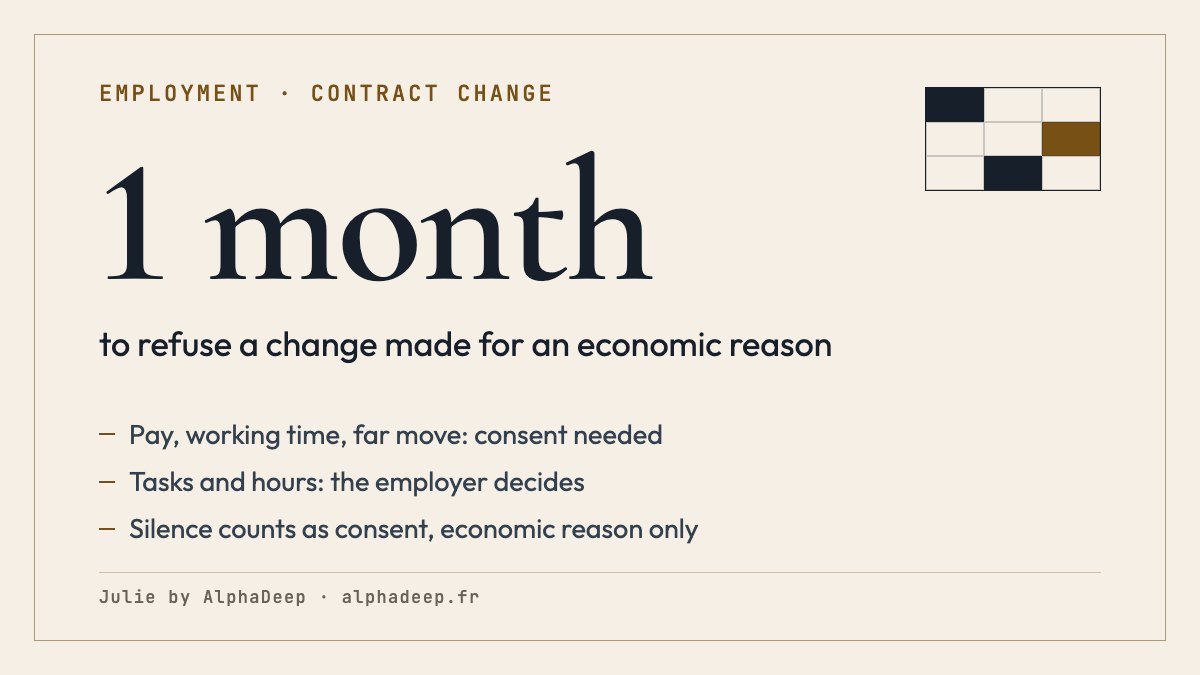
A French employer cannot change your contract without your consent: pay, the working time stated, qualification or a workplace outside the geographical sector (Cour de cassation). It can, however, change your working conditions: tasks within your qualification, the spread of hours, a workplace in the same sector. For an economic reason, you have one month to refuse, and silence counts as consent (article L1222-6).
Go to the tool: the checklist grid
Julie by AlphaDeep is an AI legal assistant for French law: it researches official references to help answer your questions (Légifrance, case law, service-public), analyses your documents and drafts your letters, for individuals and professionals alike.
General legal information with official references and dated checks. It is not personalised advice: for a decision that commits you, have your situation checked by a qualified professional.

Let’s look at your situation
Give what the employer wants to change, the reason given, the form of the letter and the date you received it.
Example questions
Your question carries over after signup. Maximum 400 characters. Avoid health data and names.
Change to the contract or to working conditions: how do you tell?
What counts is the actual change, not the word the employer uses.
| What changes | Classification | Source |
|---|---|---|
| Pay or how it is calculated, even slightly or presented as better | Change to the contract | Cass. soc., 19 May 1998 |
| Working time stated in the contract, even with a pay rise | Change to the contract | Cass. soc., 20 October 1998 |
| Fixed to variable, continuous to split, day to night hours | Change to the contract | Cass. soc., 14 November 2000; F2339 |
| Qualification, loss of responsibilities | Change to the contract | Sheet F2339 |
| Workplace outside the geographical sector, with no mobility clause | Change to the contract | Cass. soc., 4 May 1999 |
| New tasks within your qualification | Change of conditions | Cass. soc., 10 May 1999 |
| New spread of working hours | Change of conditions | Sheet F2339 |
| Workplace within the same geographical sector | Change of conditions | Sheet F2339 |
No distance in kilometres defines the geographical sector: the court judges it objectively, looking at the new site.
Sources: Cass. soc., 19 May 1998 · Cass. soc., 20 Oct. 1998 · Cass. soc., 14 Nov. 2000 · Cass. soc., 4 May 1999 · Cass. soc., 10 May 1999 · Service-public F2339
Can you refuse what your employer proposes?
Tick what changes, give the reason stated and the date you received the letter: the grid sorts each change, says whether it needs your consent and dates your reply when the law sets a deadline. The example: a cut in the variable pay and a transfer to another region, proposed for an economic reason by a letter received on 10 September 2026.
Fictional example · the proposal grid
Your consent is needed: you may refuse, by 10 October 2026 at the latest.
- Changes that need your consent
- 2
- Changes the employer can impose
- 0
- Reply by
- 10 October 2026 at midnight
- Effect of silence
- Counts as acceptance
2 · Consent needed0 · Can be imposed0 · To check
| Clause or point checked | Consent needed | Can be imposed | To check |
|---|---|---|---|
| Pay or how it is calculatedCass. soc., 19 May 1998 | Consent needed | ||
| Workplace outside the geographical sectorCass. soc., 4 May 1999 | Consent needed |
Indicative result: a protected employee, a fixed-term contract or your collective agreement can change the answer; the geographical sector is judged case by case.
What should you do, step by step, with a proposal?
Five steps, in order, before answering the employer.
Identify what really changes
Pay, working time, qualification or a workplace outside the sector: your consent is needed. Tasks within your qualification, the spread of hours, a nearby workplace: the employer decides.
Spot the reason and the form
An economic reason requires a registered letter telling you of the one-month deadline (article L1222-6); a collective performance agreement follows its own rules (article L2254-2).
Note the deadline
A full month, until midnight on the same date of the next month (Cass. soc., 3 March 2009); 15 days in receivership or liquidation.
Answer in writing
For an economic reason, silence counts as acceptance; otherwise it does not count as consent (sheet F2339), but a dated letter avoids any argument.
Anticipate what follows a refusal
The employer drops the change, or starts a procedure based on the reason for its proposal: the refusal alone does not justify dismissal (Cass. soc., 20 October 1998).
What is the risk of refusing?
This grid compares contractual terms and working conditions. A simple redistribution of hours with no other change belongs to the working-hours response guide, which examines clauses and notice periods.
Refusing a change to the contract is not a ground for dismissal in itself: the employer keeps the contract as it is, or dismisses on the reason that led it to make the proposal, for example an economic one (Cass. soc., 20 October 1998, no. 96-40.614).
Refusing a mere change of working conditions can, however, justify dismissal for real and serious cause, but is not in itself gross misconduct (Cass. soc., 23 February 2005, no. 03-42.018).
Sources: Cass. soc., 20 Oct. 1998 · Cass. soc., 23 Feb. 2005
By when must you answer?
For an economic reason, the registered letter gives you one month from receipt, fifteen days if the company is in receivership or liquidation; with no answer from you, the change is deemed accepted (article L1222-6).
With a collective performance agreement, the refusal is made in writing within a month of being informed (article L2254-2). In other cases there is no legal deadline: the time given must be reasonable, the administration advises 15 days, and silence does not count as consent (sheet F2339).
Sources: C. trav. L1222-6 · C. trav. L2254-2 · Service-public F2339
Can a sanction change the contract?
A disciplinary demotion or transfer that changes the contract needs your consent: the employer must tell you that you may accept or refuse it (Cass. soc., 28 April 2011, no. 09-70.619).
Such a sanction cannot be imposed on you; if you refuse, the employer may impose another sanction instead (Cass. soc., 16 June 1998, no. 95-45.033).
Sources: Cass. soc., 28 Apr. 2011 · Cass. soc., 16 June 1998
What do employees ask when their employer proposes a change?
Can the employer cut my pay, even slightly?
Not without your consent, nor change how your pay is calculated, even if presented as better (Cass. soc., 19 May 1998, no. 96-41.573).
What if my contract has a mobility clause?
It may allow a transfer outside the geographical sector; its validity and how it is used are checked separately, clause by clause.
My hours are changing: must I accept?
A new spread of hours is in principle the employer’s call; a switch from fixed to variable, continuous to split or day to night hours needs your consent (sheet F2339).
Can the employer add hours to my contract?
Not without your consent: the working time stated in the contract is part of it, even if the increase comes with a pay rise (Cass. soc., 20 October 1998).
What does article L1222-6 of the French Labour Code say?
The procedure when the change is proposed for an economic reason.
Lorsque l’employeur envisage la modification d’un élément essentiel du contrat de travail pour l’un des motifs économiques énoncés à l’article L. 1233-3, il en fait la proposition au salarié par lettre recommandée avec avis de réception.
La lettre de notification informe le salarié qu’il dispose d’un mois à compter de sa réception pour faire connaître son refus. Le délai est de quinze jours si l’entreprise est en redressement judiciaire ou en liquidation judiciaire.
A défaut de réponse dans le délai d’un mois, ou de quinze jours si l’entreprise est en redressement judiciaire ou en liquidation judiciaire, le salarié est réputé avoir accepté la modification proposée.
In English, briefly (our summary, not an official translation): When the employer plans to change an essential element of the employment contract for one of the economic reasons in article L1233-3, it proposes the change to the employee by registered letter with acknowledgement of receipt. The letter tells the employee they have one month from receipt to state their refusal, fifteen days if the company is in receivership or liquidation. With no answer within that time, the employee is deemed to have accepted the proposed change. Our note: the Cour de cassation ends that month at midnight on the day of the next month with the same date as receipt of the letter (Cass. soc., 3 March 2009, no. 07-42.850).
Which texts and rulings does the distinction rest on?
- Labour Code, article L1222-6 (change for an economic reason)Légifrance
- Labour Code, article L2254-2 (collective performance agreement)Légifrance
- Labour Code, article L1233-3 (economic reason)Légifrance
- Cour de cassation, social chamber, 19 May 1998, no. 96-41.573 (pay)Légifrance
- Cour de cassation, social chamber, 20 October 1998, no. 96-40.614 (working time, refusal)Légifrance
- Cour de cassation, social chamber, 10 May 1999, no. 96-45.673 (tasks within the qualification)Légifrance
- Cour de cassation, social chamber, 4 May 1999, no. 97-40.576 (geographical sector)Légifrance
- Cour de cassation, social chamber, 14 November 2000, no. 98-43.218 (variable hours)Légifrance
- Cour de cassation, social chamber, 23 February 2005, no. 03-42.018 (refusing new conditions)Légifrance
- Cour de cassation, social chamber, 28 April 2011, no. 09-70.619 (sanction changing the contract)Légifrance
- Cour de cassation, social chamber, 3 March 2009, no. 07-42.850 (counting the month)Légifrance
- Cour de cassation, social chamber, 16 June 1998, no. 95-45.033 (refused sanction)Légifrance
- Changing an employee’s contract (sheet F2339)Service-public.fr · checked on 13 June 2024
Texts cited last checked: 27 September 2026