The checklist gridAudit grid · Training repayment
French training-repayment clause: the conditions of validity, the exits that trigger it and the amount to repay
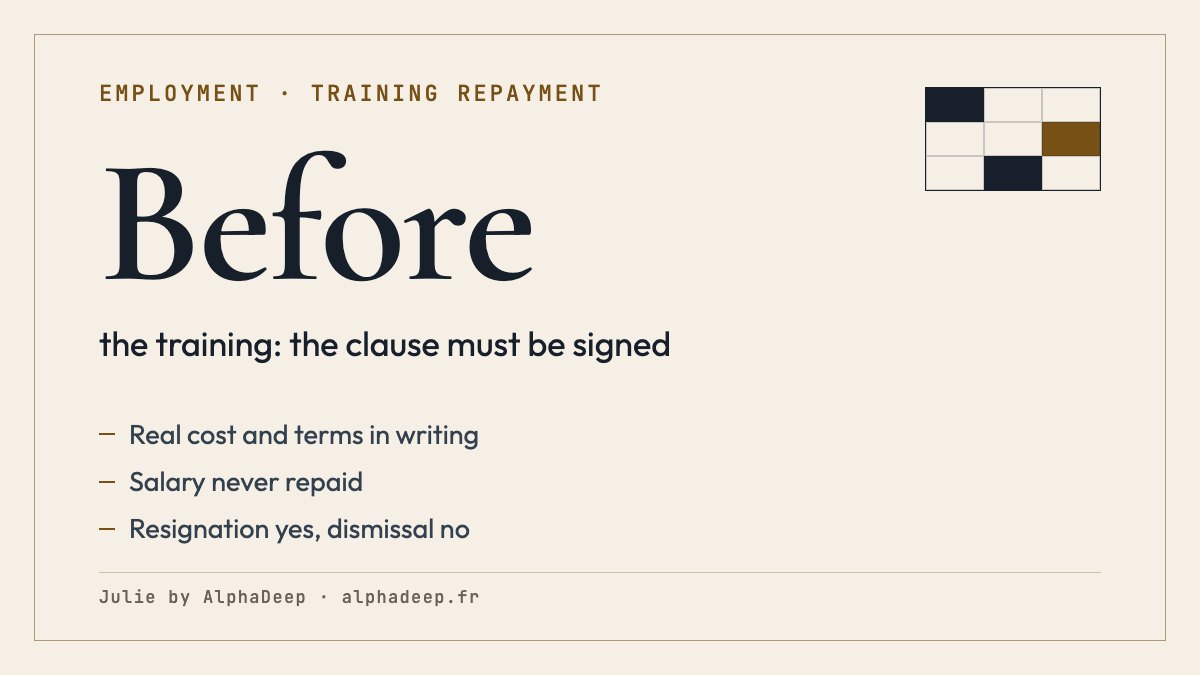
A French training-repayment clause (dédit-formation) only makes you repay if it was signed before the training, stating its date, nature, length and real cost, for costs beyond the employer’s legal or collective-agreement duties and for a proportionate sum (Cour de cassation, 21 May 2002 and 4 February 2004). It applies on resignation, not on dismissal or mutual termination.
Go to the tool: the checklist grid
Julie by AlphaDeep is an AI legal assistant for French law: it researches official references to help answer your questions (Légifrance, case law, service-public), analyses your documents and drafts your letters, for individuals and professionals alike.
General legal information with official references and dated checks. It is not personalised advice: for a decision that commits you, have your situation checked by a qualified professional.

Let’s look at your situation
Give the training taken, the signing and training dates, the clause and how you are leaving the company.
Example questions
Your question carries over after signup. Maximum 400 characters. Avoid health data and names.
Which exits trigger the repayment?
The clause only applies if the departure comes from you and is not caused by the employer.
| Exit | Does the clause apply? | Source |
|---|---|---|
| Resignation | Yes, if the clause is valid | Service-public F1687 |
| You end the trial period | Yes | Service-public F1687 |
| Dismissal, even for gross misconduct | No | Cass. soc., 10 May 2012 |
| Mutual termination (rupture conventionnelle) | No, even at your request | Service-public F1687 |
| Prise d’acte or resignation caused by the employer | No, the exit is the employer’s doing | Cass. soc., 11 January 2012 |
| Professionalisation contract | Never: the clause is void | Labour Code, article L6325-15 |
Service-public gives a commitment of 2 to 5 years depending on the training’s length and cost: a benchmark, not a legal scale.
Sources: Service-public F1687 · Cass. soc., 10 May 2012 · Cass. soc., 11 Jan. 2012 · Cass. soc., 23 Oct. 2013
What should you check in the clause, and in which order?
Check the five conditions against the signed agreement and evidence of the cost. An unanswered condition needs checking; it does not establish that the clause is void.
Signed before the training starts
A separate agreement, made before the training; general or late information is not enough (Cass. soc., 4 February 2004).
What the agreement states
The date, nature and length of the training, its real cost to the employer, and the amount and terms of repayment.
Costs beyond the employer’s duties
Adapting you to your job is a legal duty (article L6321-1): its cost cannot be recovered (Cass. soc., 21 May 2002).
Salary excluded
A clause making you repay the pay received during the training is void (Cass. soc., 23 October 2013).
A proportionate sum and length
The sum follows the costs incurred and must not take away your freedom to resign.
Is your clause valid, and how much would you repay?
Give the signing and training dates, what the clause says, how the contract ends and the commitment period: the grid checks each condition, then works out the amount under the written sliding scale. The example: a €6,000 training, a commitment from 1 January 2026 to 1 January 2028 and a resignation on 1 January 2027.
Fictional example · the clause grid
The clause looks valid: €3,000.00 at most to repay.
- Conditions met
- 8 of 8
- Real costs borne by the employer
- €6,000.00
- Commitment time left
- 365 days of 730
- Most you would repay
- €3,000.00
8 · Met0 · Not met0 · To check
| Clause or point checked | Met | Not met | To check |
|---|---|---|---|
| Written agreement signed before the trainingCass. soc., 4 February 2004 | Met | ||
| Date, nature, length, real cost and terms in writingCass. soc., 4 February 2004 | Met | ||
| Costs beyond legal or collective-agreement dutiesCass. soc., 21 May 2002; article L6321-1 | Met | ||
| Training salary excludedCass. soc., 23 October 2013 | Met | ||
| Not a professionalisation contractarticle L6325-15 | Met | ||
| Proportionate sum and lengthCass. soc., 21 May 2002 | Met | ||
| Departure on your initiative, not caused by the employersheet F1687 | Met | ||
| Departure before the commitment endsthe contract clause | Met |
Indicative result: your collective agreement may set more precise rules, and only the court decides whether the sum and length are proportionate.
When is the clause valid?
A training-repayment clause is lawful if it is the counterpart of training with real costs beyond what the law or the collective agreement imposes, if the sum is proportionate to the costs incurred and if it does not take away the employee’s freedom to resign (Cass. soc., 21 May 2002, no. 00-42.909).
It must be in a separate agreement made before the training starts, stating its date, nature, length, real cost, and the amount and terms of repayment (Cass. soc., 4 February 2004, no. 01-43.651). It can be added during the contract by an amendment (sheet F1687).
Sources: Cass. soc., 21 May 2002 · Cass. soc., 4 Feb. 2004 · Service-public F1687
Does the departure come from you or from the employer?
The departures that trigger it are those that come from the employee and are not caused by the employer: resignation, or ending the trial period on your initiative (sheet F1687).
The clause does not apply on dismissal, even for gross misconduct (Cass. soc., 10 May 2012), nor on mutual termination, nor when a prise d’acte takes effect as a dismissal (Cass. soc., 11 January 2012).
Sources: Service-public F1687 · Cass. soc., 10 May 2012 · Cass. soc., 11 Jan. 2012
What can you be made to repay?
The real training costs the employer bore, under the amount and sliding scale written in the clause, never more. Funding paid by a third party is not a cost to the employer.
Not your salary: a clause providing for repayment of the pay received during the training is void (Cass. soc., 23 October 2013, no. 11-26.318). And nothing in a professionalisation contract (Labour Code, article L6325-15).
Sources: Cass. soc., 23 Oct. 2013 · C. trav. L6325-15
What does article L6325-15 of the French Labour Code say?
The Labour Code text that bans the clause in a professionalisation contract.
Est nulle, toute clause prévoyant le remboursement à l’employeur par le titulaire d’un contrat de professionnalisation des dépenses de formation en cas de rupture du contrat de travail.
In English, briefly (our summary, not an official translation): Any clause providing that the holder of a professionalisation contract repays the employer the training costs if the employment contract ends is void. Our note: outside that case, the conditions of validity come from Cour de cassation case law, based on the binding force of contracts.
What do employees bound by a training-repayment clause ask?
Can the clause be signed during the contract?
Yes, by an amendment, provided it is signed before the training starts and states its real cost (sheet F1687; Cass. soc., 4 February 2004).
Can the employer charge for training that adapts you to your job?
No: the employer must adapt employees to their job (article L6321-1), and only costs beyond its duties can be covered.
Does « libre de tout engagement » on the work certificate cancel the clause?
Not on its own: that wording does not prove that the employer gave up applying the clause (sheet F1687).
Can it sit alongside a non-compete clause?
Yes, both clauses can be in the same contract (sheet F1687), each with its own conditions.
Which texts and rulings does the training-repayment clause rest on?
- Cour de cassation, social chamber, 21 May 2002, no. 00-42.909 (conditions of validity)Légifrance
- Cour de cassation, social chamber, 4 February 2004, no. 01-43.651 (prior agreement)Légifrance
- Cour de cassation, social chamber, 11 January 2012, no. 10-15.481 (exit caused by the employer)Légifrance
- Cour de cassation, social chamber, 10 May 2012, no. 11-10.571 (dismissal for gross misconduct)Légifrance
- Cour de cassation, social chamber, 23 October 2013, no. 11-26.318 (salary excluded)Légifrance
- Labour Code, article L6325-15 (professionalisation contract)Légifrance
- Labour Code, article L6321-1 (adapting employees to their job)Légifrance
- What is a training-repayment clause? (sheet F1687, in French)Service-public.fr · checked on 6 February 2026
Texts cited last checked: 27 September 2026