The filing deskEmployee in post · equal treatment
Workplace discrimination in France: what you must prove, and how long you have to act
An employee in France cannot be sanctioned, dismissed or disadvantaged, in pay, promotion, training or appraisal, because of a criterion such as sex, pregnancy, origin, age or health (Labour Code, article L1132-1). The employee presents facts that suggest discrimination; the employer must then prove objective reasons (article L1134-1). The claim is time-barred 5 years after the discrimination is revealed (article L1134-5).
Go to the tool: the filing desk
Julie by AlphaDeep is an AI legal assistant for French law: it researches official references to help answer your questions (Légifrance, case law, service-public), analyses your documents and drafts your letters, for individuals and professionals alike.
General legal information with official references and dated checks. It is not personalised advice: for a decision that commits you, have your situation checked by a qualified professional.

Let’s look at your situation
Describe the decision you dispute, its dates and what makes you think of discrimination, without names or health data.
Example questions
Your question carries over after signup. Maximum 400 characters. Avoid health data and names.
Is your situation discrimination, and until when can you act?
Choose the ground you suspect, the decision at issue and the dates: the desk says whether the criterion is protected, which routes are open and until when. The example: a promotion refused on 15 January 2025 and again on 20 January 2026 after a return from maternity leave.
Fictional example · discrimination desk
Discrimination possible: employment tribunal until 15 January 2030.
Days left: to be calculated
- Criterion protected by article L1132-1 of the Labour Code: pregnancy or maternity, return from leave included
- Before the employment tribunal, you present facts that suggest discrimination; the employer then proves that its decision rests on objective factors (article L1134-1)
- Void measure, and compensation for the whole loss for the whole duration of the discrimination (articles L1132-4 and L1134-5)
- Criminal complaint possible: 1 year’s imprisonment and a €3,750 fine (article L1146-1 of the Labour Code)
Discrimination revealed: the 5-year time limit starts
Last discriminatory act
Indicative deadline to go to the employment tribunal: 5 years, article L1134-5 of the Labour Code
Indicative deadline to file a criminal complaint for the last act: 6 years, article 8 of the Code of Criminal Procedure
Documents to gather
- A dated chronology of the facts: decisions, meetings, refusals, before and after the event that changed everything
- The written records: emails, meeting minutes, appraisals, job postings
- Your payslips and your grade, over the whole period
- A comparison with colleagues on the same grade, hired around the same date, if you know any
- Statements from colleagues or witnesses
Referring the matter to the rights ombudsman (Défenseur des droits) is free, but it does not stop these time limits: the employment tribunal must be seized in time.
What must you prove to have discrimination recognised?
This guide concerns an employee already in post. A refusal before hiring belongs to recruitment discrimination, with evidence specific to the application.
Not the discrimination itself: before the employment tribunal, you present facts that suggest it; it is then for the employer to prove that its decision rests on objective factors unrelated to any discrimination (Labour Code, article L1134-1).
A comparison with colleagues helps but is not essential (Cour de cassation, 10 November 2009, no. 07-42.849). If the evidence is in the employer’s hands, the judge can order, before any trial, disclosure of the payslips of comparable colleagues when it is essential to the proof (8 March 2023, no. 21-12.492).
Sources: C. trav. L1134-1 · Cass. soc. 07-42.849 · Cass. soc. 21-12.492
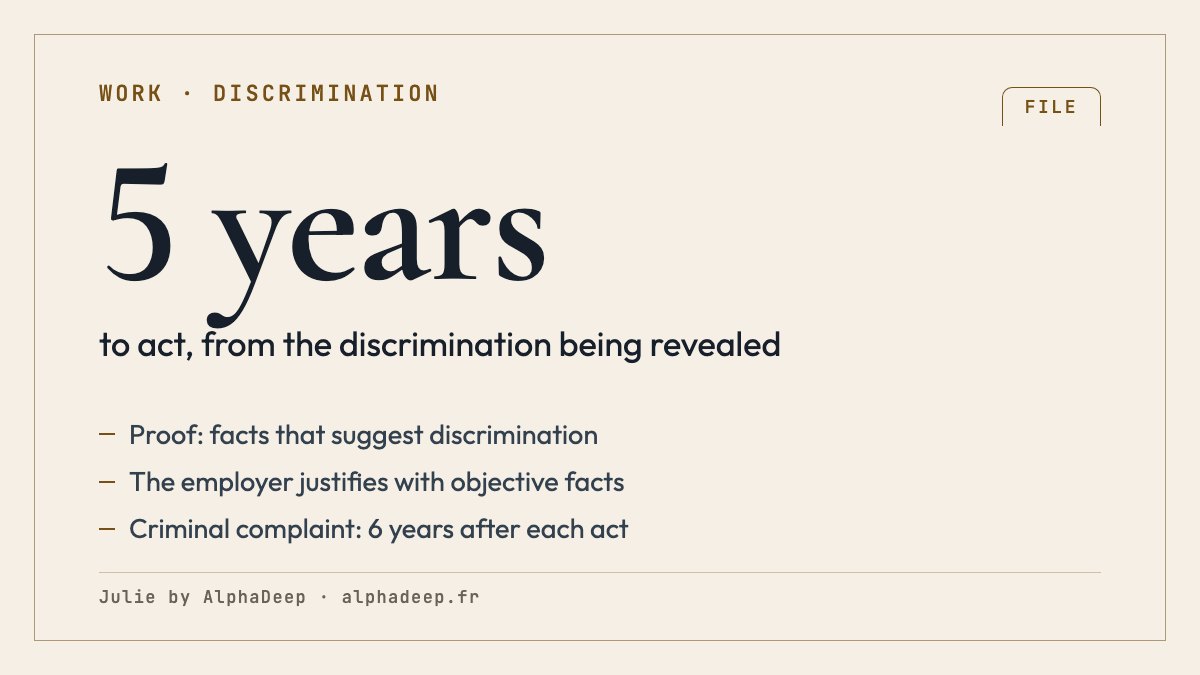
How long do you have to act against discrimination at work?
Five years from the discrimination being revealed, before the employment tribunal, and damages cover the whole loss for its whole duration (Labour Code, article L1134-5). The 2-year and 12-month time limits of article L1471-1 do not apply to these claims.
A criminal complaint remains possible for 6 years from each act (Code of Criminal Procedure, article 8), when the measure is an offence. Referring the case to the French rights ombudsman (Défenseur des droits) is free, but it neither interrupts nor suspends these time limits (article 6 of the organic law of 29 March 2011).
Sources: C. trav. L1134-5 · CPP art. 8 · LO 2011-333, art. 6
What can you obtain if the discrimination is recognised?
The measure is void (Labour Code, article L1132-4): sanction cancelled, back pay, and the judge can order your regrading at the level you would have reached without the discrimination (Cour de cassation, 23 November 2005, no. 03-40.826). A discriminatory dismissal is void: reinstatement, or at least the last 6 months’ salary, without the compensation scale (article L1235-3-1).
Sources: C. trav. L1132-1 · C. trav. L1235-3-1
Which remedies apply to each discriminatory decision?
The civil route is always open; the criminal route depends on the measure and the criterion.
| Decision | Employment tribunal | Criminal complaint, 6 years | Effect |
|---|---|---|---|
| Promotion, pay or training refused because of sex or pregnancy | 5 years after it is revealed | Offence: 1 year and €3,750 (L1146-1) | Measure void, back pay, regrading |
| Same measure for another criterion: age, origin, health | 5 years after it is revealed | No, except for union activity: €3,750 (L2146-2) | Measure void, damages |
| Discriminatory disciplinary sanction | 5 years after it is revealed | Offence: 3 years and €45,000 (Criminal Code, 225-2) | Sanction cancelled |
| Discriminatory dismissal | 5 years after it is revealed | Offence: 3 years and €45,000 (Criminal Code, 225-2) | Reinstatement or at least 6 months’ salary |
In criminal proceedings, full proof of the discrimination is required; the adjusted burden of proof of article L1134-1 only applies before the civil judge.
Sources: C. pén. 225-2 · C. trav. L1146-1 · C. trav. L1235-3-1
What does article L1134-5 of the Labour Code say about the time limit?
The time limit specific to discrimination, longer than for other employment disputes.
L’action en réparation du préjudice résultant d’une discrimination se prescrit par cinq ans à compter de la révélation de la discrimination.
Ce délai n’est pas susceptible d’aménagement conventionnel.
Les dommages et intérêts réparent l’entier préjudice résultant de la discrimination, pendant toute sa durée.
In English, briefly (our summary, not an official translation): A claim for damages arising from discrimination is time-barred five years after the discrimination is revealed. This time limit cannot be changed by agreement. Damages cover the whole loss resulting from the discrimination, for its whole duration. Discrimination that continued throughout a career therefore remains compensable even if it began long ago (Cour de cassation, 31 March 2021, no. 19-22.557).
What do employees who believe they face discrimination ask?
Can maternity leave justify a postponed promotion?
No. A planned promotion cannot be refused because maternity leave occurred, unless the employer gives another explanation for the refusal (Cour de cassation, 16 December 2008, no. 06-45.262). Sex and pregnancy cannot be taken into account for any measure (Labour Code, article L1142-1).
Must you write to the employer before going to the rights ombudsman?
No. For discrimination, referral to the rights ombudsman (Défenseur des droits) is free and requires no prior step; it does not, however, interrupt the time limits for going to court (article 6 of organic law no. 2011-333 of 29 March 2011).
Is unequal pay without a discrimination criterion penalised?
It falls under equal treatment, not discrimination: back pay is claimed within 3 years (Labour Code, article L3245-1), without the 5-year extension of article L1134-5.
Can you be dismissed for taking legal action against discrimination?
No. A dismissal without real and serious cause that follows a legal action for discrimination, and results from it, is void; reinstatement is a right (Labour Code, article L1134-4).
What has changed for workplace discrimination since 2022?
A criterion added, a class action reshaped and a change to the employment tribunal application.
Being a whistleblower, a facilitator or a relative of a whistleblower joins the protected criteria (law no. 2022-401 of 21 March 2022, Labour Code article L1132-1 and Criminal Code article 225-1).
Sources: C. trav. L1132-1 · C. pén. 225-2
The discrimination class action follows a common regime: representative unions and approved associations, after a prior request to the employer (law no. 2025-391 of 30 April 2025, article 16).
Source: Law 2025-391, art. 16
The application to the employment tribunal comes with the latest payslip related to the dispute, the documents being listed on a bordereau (decree no. 2026-683 of 27 July 2026).
Source: C. trav. R1452-2
Which texts set these rules of proof and time limits?
- Labour Code, articles L1132-1 and L1132-4 (criteria, measures, nullity)Légifrance, in French
- Labour Code, article L1134-1 (adjusted burden of proof)Légifrance, in French
- Labour Code, article L1134-5 (5-year time limit)Légifrance, in French
- Labour Code, article L1235-3-1 (void dismissal, at least 6 months’ salary)Légifrance, in French
- Code of Criminal Procedure, article 8 (time limit for offences: 6 years)Légifrance, in French
- Cour de cassation, social chamber, 10 November 2009, no. 07-42.849Légifrance, in French
- Cour de cassation, social chamber, 8 March 2023, no. 21-12.492Légifrance, in French
- Criminal Code, articles 225-1 and 225-2 (offence of discrimination)Légifrance, in French
- Labour Code, articles L1142-1, L1146-1 and L2146-2 (sex, pregnancy, union activity)Légifrance, in French
- Organic law no. 2011-333 of 29 March 2011 on the rights ombudsman (Défenseur des droits), article 6Légifrance, in French
- Cour de cassation, social chamber, 31 March 2021, no. 19-22.557Légifrance, in French
- Labour Code, article R1452-2 (employment tribunal application, version of 1 October 2026)Légifrance, in French
- Law no. 2025-391 of 30 April 2025, article 16 (class action)Légifrance, in French
- Discrimination at work (fiche F1642)Service-public.fr, in French · checked by the publisher on 20 October 2025
Texts cited last checked: 25 September 2026