The exhibit listExhibit list · Undeclared work
Undeclared work in France: proving the employer’s intent, working out the 6 months’ pay and acting within 2 years
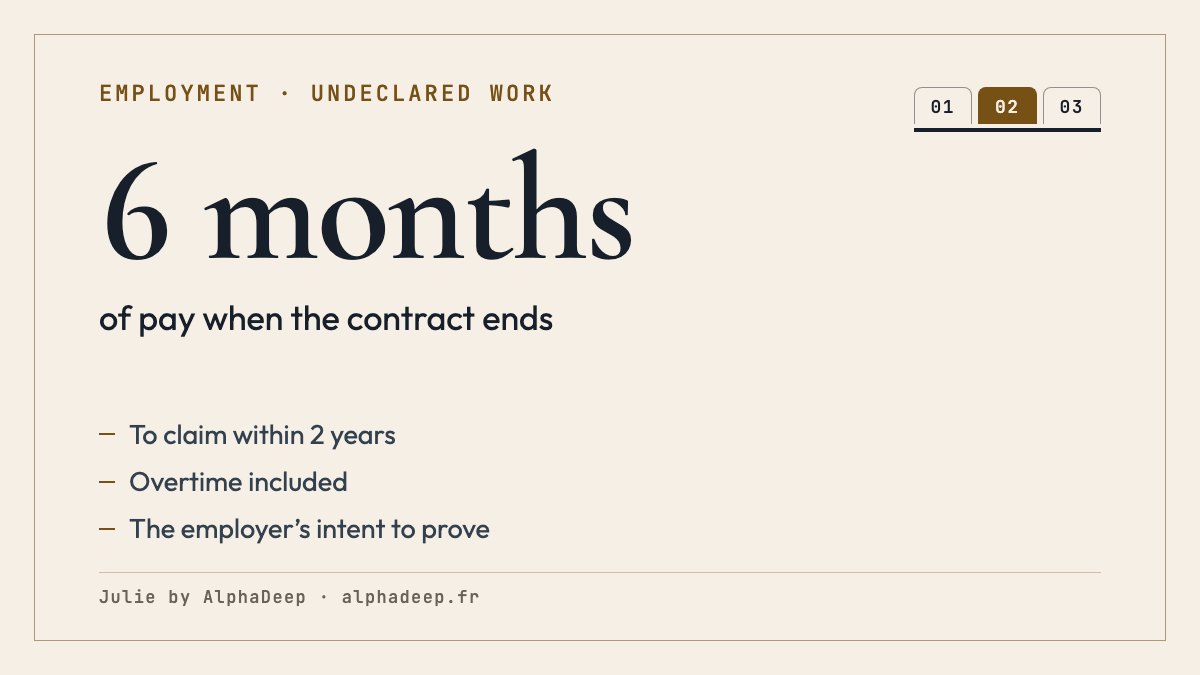
Work is concealed in France when the employer intentionally avoids the pre-hiring declaration or the payslip, declares fewer hours than were worked, or leaves pay out of the declarations (Labour Code, article L8221-5). When the contract ends, the employee is entitled to a flat payment of 6 months’ pay (article L8223-1), to be claimed within 2 years. Intent is proved with documents.
Go to the tool: the exhibit list
Julie by AlphaDeep is an AI legal assistant for French law: it researches official references to help answer your questions (Légifrance, case law, service-public), analyses your documents and drafts your letters, for individuals and professionals alike.
General legal information with official references and dated checks. It is not personalised advice: for a decision that commits you, have your situation checked by a qualified professional.

Let’s look at your situation
Say what the employer did not declare, since when, the documents you have and whether the contract has ended.
Example questions
Your question carries over after signup. Maximum 400 characters. Avoid health data and names.
Whom should you contact, and with which documents?
Several doors open; only the judge sets what the employer owes you.
- Document 1
The labour inspectorate
You can contact it without telling the employer or a staff representative, and no sanction can be taken against you for doing so (fiche F107).
- Document 2
The employment tribunal (prud’hommes)
The claim puts a figure on the 6 months’ pay and the back pay; it goes with the exhibit list and a €50 contribution, unless you receive legal aid (fiche F2360).
- Document 3
The public prosecutor
Concealed work is an offence punishable by 3 years’ imprisonment and a €45,000 fine (article L8224-1): a criminal complaint is possible.
- Document 4
Your career record
It shows the periods and pay declared, or the lack of them.
Which evidence do you have, and what can you claim?
Give what the employer did not declare, the documents you have, your monthly pay overtime included and the date the contract ended: the exhibit list numbers the documents, flags the missing ones, works out the flat payment and dates the deadline. The example: hours worked beyond the payslip, schedules and unanswered written alerts, €2,400 gross a month, contract ended on 30 June 2026.
Fictional example · the exhibit list
Flat payment: €14,400.00 gross, that is 6 months’ pay, to claim by 30 June 2028 at the latest.
- Flat payment
- €14,400.00
- Claim by
- 30 June 2028
- Wages claimable from
- 30 June 2023
| No. | Exhibit | What it proves | Status |
|---|---|---|---|
| 01 | Career record or Urssaf certificate | That the job or pay was not declared | Optional |
| 02 | Payslips, transfers or receipts | The pay declared and the pay actually received | In the file |
| 03 | Dated personal record of hours | The hours actually worked (article L3171-4) | In the file |
| 04 | Schedules, messages, badge records | That the employer knew those hours | In the file |
| 05 | Written alerts left unanswered | The intent not to declare | In the file |
Indicative result: the flat payment requires the judge to find the employer’s intent; bonuses and benefits can change the reference pay.
What can you claim, and by when?
Each claim has its own deadline; the flat payment only arises when the contract ends.
| Claim | Amount or rule | Deadline | Text |
|---|---|---|---|
| Flat payment | 6 months’ pay, overtime of the last 6 months included | 2 years after the contract ends | Article L8223-1; Cour de cassation, 4 September 2024 |
| Back pay and hours | The hours proved, at the rate due | 3 years, or the 3 years before the end of the contract | Article L3245-1 |
| Termination payments | They come on top of the flat payment | 12 months to challenge the termination | Article L1471-1; Cour de cassation, 6 February 2013 |
| Criminal complaint | 3 years’ imprisonment and a €45,000 fine incurred | 6 years, as a rule, for an offence of this class | Article L8224-1; Code of Criminal Procedure, article 8 |
The flat payment requires the employer’s intent: it cannot be inferred from overtime missing on the payslips alone (Cour de cassation, 29 June 2005).
Sources: C. trav. L8223-1 · Cass. soc., 4 sept. 2024, n° 22-22.860 · C. trav. L3245-1 · C. trav. L8224-1 · CPP 8 · Cass. soc., 6 févr. 2013, n° 11-23.738 · C. trav. L1471-1 · Cass. soc., 29 June 2005, no. 04-40.758
What counts as undeclared work?
An employer intentionally avoiding the pre-hiring declaration or the payslip, stating fewer hours on it than were actually worked, or leaving pay or contributions out of the declarations (French Labour Code, article L8221-5).
Hiring can only take place after the employer’s named declaration to the social security bodies (article L1221-10). Pay in cash is not concealed in itself: the Code allows it below an amount set by decree, at the employee’s request (article L3241-1).
Sources: C. trav. L8221-5 · C. trav. L1221-10 · C. trav. L3241-1
How do you prove the employer’s intent?
The payslip is not enough: intent cannot be inferred from overtime missing on the payslips alone (Cour de cassation, 29 June 2005, no. 04-40.758). Show that the employer knew the real hours: schedules, messages, badge records, written alerts left unanswered.
On hours, proof is shared: the employer gives the judge the evidence of the hours actually worked, and the judge decides in the light of the employee’s evidence too (article L3171-4). A dated personal record helps you.
Sources: Cass. soc., 29 June 2005, no. 04-40.758 · C. trav. L3171-4
How is the 6 months’ pay worked out?
On the end of the working relationship, the employee is entitled to a flat payment equal to 6 months’ pay (article L8223-1). The calculation includes the overtime worked in the 6 months before the end (Cour de cassation, 18 October 2006, no. 05-40.464).
It is a civil penalty: it adds to the termination payments of every kind (6 February 2013, no. 11-23.738).
Sources: C. trav. L8223-1 · Cass. soc., 18 oct. 2006, n° 05-40.464 · Cass. soc., 6 févr. 2013, n° 11-23.738
By when must you claim the flat payment?
Within 2 years: the claim, which arises when the contract ends, falls under the two-year limitation of article L1471-1, not the 12 months for challenging a dismissal (Cour de cassation, 4 September 2024, no. 22-22.860).
Back pay follows its own deadline: 3 years, or the 3 years before the end of the contract (article L3245-1).
Sources: Cass. soc., 4 sept. 2024, n° 22-22.860 · C. trav. L1471-1 · C. trav. L3245-1
What do undeclared employees in France ask?
Can I claim the flat payment while the contract continues?
No: it is due when the working relationship ends (article L8223-1); during the contract, claim the wages and the regularisation.
Does it add to the dismissal payment?
Yes: the Cour de cassation allows it on top of the termination payments of every kind (6 February 2013, no. 11-23.738).
Is reporting to the labour inspectorate enough?
Not to get paid: the inspectorate can check, but the claim goes to the employment tribunal, within the deadlines.
Which penalty does the employer face?
Three years’ imprisonment and a €45,000 fine for an individual (Labour Code, article L8224-1).
What does article L8223-1 of the French Labour Code say?
The text of the 6 months’ pay.
En cas de rupture de la relation de travail, le salarié auquel un employeur a eu recours dans les conditions de l’article L. 8221-3 ou en commettant les faits prévus à l’article L. 8221-5 a droit à une indemnité forfaitaire égale à six mois de salaire.
In English, briefly (our summary, not an official translation): When the working relationship ends, an employee whom an employer used in the conditions of article L8221-3, or by committing the acts listed in article L8221-5, is entitled to a flat payment equal to six months’ pay. Our note: article L8221-5 covers concealed employment; article L8221-3 covers a concealed business, when the employer operates while intentionally avoiding registration or its social and tax declarations.
Which texts is the flat payment for undeclared work based on?
- Labour Code, article L8221-1 (undeclared work prohibited)Légifrance
- Labour Code, article L8221-5 (concealed employment)Légifrance
- Labour Code, article L8223-1 (6 months’ pay)Légifrance
- Labour Code, article L1471-1 (2-year limitation)Légifrance
- Labour Code, article L3245-1 (3 years of wages)Légifrance
- Labour Code, article L8224-1 (criminal penalty)Légifrance
- Labour Code, article L1221-10 (pre-hiring declaration)Légifrance
- Labour Code, article L3171-4 (proof of hours)Légifrance
- Labour Code, article L3241-1 (paying wages)Légifrance
- Cour de cassation, employment chamber, 29 June 2005, no. 04-40.758 (intent)Légifrance
- Cour de cassation, employment chamber, 18 October 2006, no. 05-40.464 (overtime included)Légifrance
- Cour de cassation, employment chamber, 6 February 2013, no. 11-23.738 (cumulation)Légifrance
- Cour de cassation, employment chamber, 4 September 2024, no. 22-22.860 (2-year limitation)Légifrance
- When to contact the labour inspectorate (fiche F107, in French)Service-public.fr · checked on 19 June 2026
- Going to the employment tribunal (fiche F2360, in French)Service-public.fr · checked on 3 March 2026
- Code of Criminal Procedure, article 8 (limitation for offences, version in force until 31 December 2028)Légifrance
- Labour Code, article L8221-3 (concealed business)Légifrance
Texts cited last checked: 27 September 2026