The gazetteBirth · 1 July 2026
Paternity leave in France in 2026: the 25 days, the compulsory period, splitting, the one-month notice, the daily pay and the supplementary birth leave
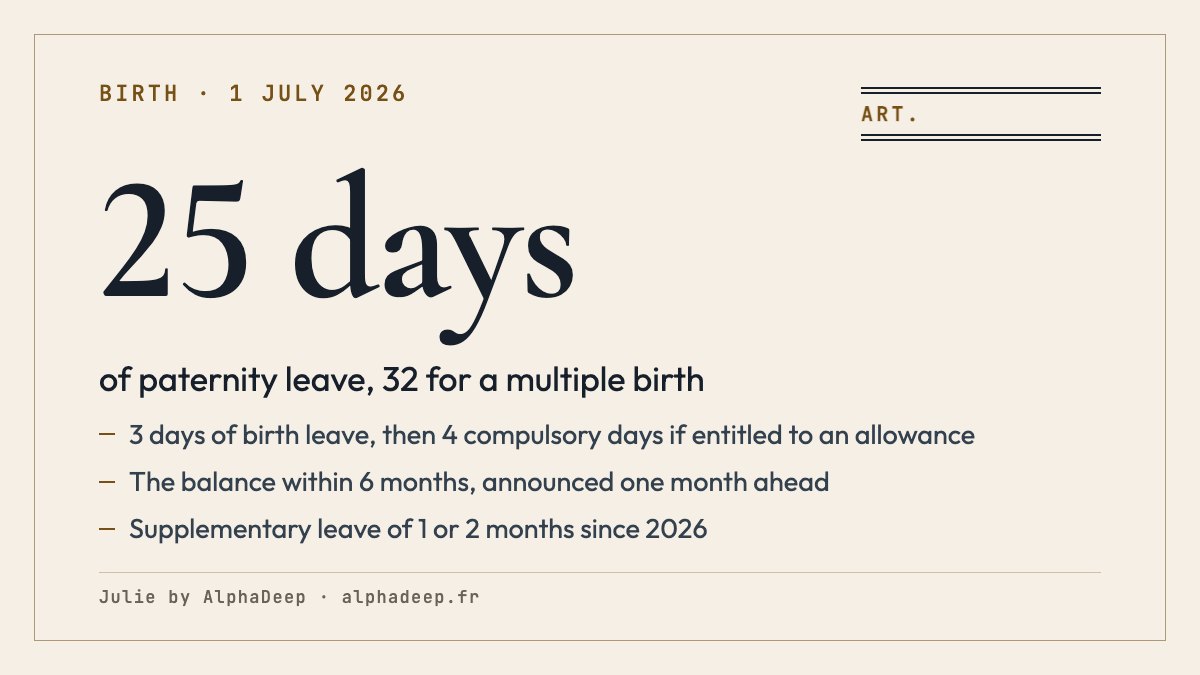
After a birth, an employee in France gets 3 working days of birth leave paid by the employer, then 25 calendar days of paternity leave, 32 for a multiple birth: 4 compulsory days if entitled to an allowance, then 21 days to take within 6 months, at once or in two periods, announced one month ahead. For a child born since 1 January 2026, 1 or 2 months of supplementary birth leave come on top.
Julie by AlphaDeep is an AI legal assistant for French law: it researches official references to help answer your questions (Légifrance, case law, service-public), analyses your documents and drafts your letters, for individuals and professionals alike.
General legal information with official references and dated checks. It is not personalised advice: for a decision that commits you, have your situation checked by a qualified professional.

Let’s look at your situation
Give the date of birth, actual or expected, your status, the dates you want and your salary.
Example questions
Your question carries over after signup. Maximum 400 characters. Avoid health data and names.
How many days of paternity leave in France in 2026?
The father who is an employee, or the mother’s spouse, civil partner (Pacs) or cohabiting partner who is an employee, gets 25 calendar days of paternity and partner leave, 32 for a multiple birth, with no length-of-service or contract condition (Labour Code, article L1225-35; fiche F3156). For a female couple, the mother who did not give birth is entitled after a joint advance recognition (reconnaissance conjointe anticipée) (fiche F3156).
These days come on top of the 3 working days (jours ouvrables) of birth leave, paid by the employer, which start on the day of birth or the next working day, as the employee chooses (articles L3142-1, L3142-2 and L3142-4).
Sources: Labour Code L1225-35 · Service-public F3156 · Labour Code L3142-1 · Labour Code L3142-2 · Labour Code L3142-4
Which part of the leave is compulsory, and when do you take the rest?
The 4 calendar days that follow the birth leave at once are compulsory: the employer cannot make the employee work during these two leaves, even if the notice period was not respected (articles L1225-35 and L1225-35-1). The four-day employment prohibition does not apply if the employee is not entitled to an allowance. If the birth occurs during paid or family-event leave, that prohibition starts when the existing leave ends (article L1225-35-1). If the baby is hospitalised at birth in a specialised care unit, the 4 days are extended during the hospital stay, up to 30 consecutive days (article D1225-8-1).
The remaining 21 days, 28 for a multiple birth, are taken within 6 months of the birth, at once or in two periods of at least 5 days; the time limit is extended if the child is in hospital or the mother dies (article D1225-8).
Sources: Labour Code L1225-35 · Labour Code L1225-35-1 · Labour Code D1225-8-1 · Labour Code D1225-8
When and how should you tell your employer?
The employee tells the employer the expected date of birth at least one month ahead, then the dates and length of each period of the balance at least one month before it starts; if the baby is born early and the employee wants to leave within the month, they tell the employer without delay (article D1225-8).
Writing is not required, but a registered letter with acknowledgement of receipt, or a letter handed over against a receipt, serves as proof (fiche F3156). During the 10 weeks after the birth, the employer can only dismiss for serious misconduct or for a reason unrelated to the child’s arrival (article L1225-4-1).
Sources: Labour Code D1225-8 · Service-public F3156 · Labour Code L1225-4-1
How much is the daily paternity pay?
The Assurance maladie pays a daily allowance for the 25 or 32 days, provided all salaried work stops: the last 3 gross salaries, each capped at €4,005 in 2026, divided by 91.25, less 21%, that is between €11.12 and €104.02 a day, paid every 14 days (Social Security Code, article L331-8; fiche F3156).
You must have been registered for at least 6 months and have worked at least 150 hours in the 3 months before the leave, or have paid enough contributions (fiche F3156). A collective agreement may do better, up to full salary.
Sources: Social Security Code L331-8 · Service-public F3156
What does the supplementary birth leave change?
For a child born or adopted since 1 January 2026, each employed parent can take, after their maternity, paternity or adoption leave, 1 or 2 months of supplementary birth leave, possibly in two periods of one month (loi n° 2025-1403, article 99; Labour Code, article L1225-46-2). It starts within 9 months of the birth; for a child born in the first half of 2026, between 1 July 2026 and 31 March 2027 (article D1225-11-3; fiche F39685).
The employer is told one month ahead, or 15 days ahead if the leave follows the paternity leave at once and starts within the month of the birth (article D1225-11-4). The pay is 70% of net salary in the first month and 60% in the second, within the social security ceiling (fiche F39685; Social Security Code, article R331-5-1).
Sources: Loi n° 2025-1403, article 99 · Labour Code L1225-46-2 · Labour Code D1225-11-3 · Service-public F39685 · Labour Code D1225-11-4 · Social Security Code R331-5-1
What has changed for French paternity leave?
The 25 days of 2021, the supplementary birth leave of 2026 and this year’s amounts.
Paternity and partner leave (congé de paternité et d’accueil de l’enfant) counts 25 calendar days, 32 for a multiple birth, including 4 days that follow the birth leave at once (Labour Code, article L1225-35, version in force since that date).
Source: Labour Code L1225-35
The 2026 social security budget law creates the supplementary birth leave (congé supplémentaire de naissance) for children born or adopted from 1 January 2026 (loi n° 2025-1403, article 99; Labour Code, article L1225-46-2).
Sources: Loi n° 2025-1403, article 99 · Labour Code L1225-46-2
The monthly social security ceiling rises to €4,005: an employee’s daily paternity pay ranges from €11.12 to €104.02, and the flat daily pay of a self-employed parent reaches €65.84 (fiches F3156 and F39686; Social Security Code, article D623-2).
Sources: Service-public F3156 · Service-public F39686 · Social Security Code D623-2
The supplementary birth leave opens: 1 or 2 months per parent, paid at 70% of net salary in the first month and 60% in the second (fiche F39685; Social Security Code, article R331-5-1).
Sources: Service-public F39685 · Social Security Code R331-5-1
End of the supplementary-leave window for children born between 1 January and 30 June 2026 (fiche F39685).
Source: Service-public F39685
When should you take your paternity leave, and for what pay?
Enter the date of birth, actual or expected, the start of the balance and your salary: the gazette places the birth leave, the 4 compulsory days if you are entitled to an allowance and the balance, excluding exceptional calendars, the notice dates and the supplementary leave. The example: a birth on 16 November 2026, the balance from 14 December and a €3,000 salary.
Fictional example · gazette of your leave
25 days of paternity leave after 3 days of birth leave, to take by 15 May 2027 at the latest.
- Birth leave
- from 16 November 2026 to 18 November 2026
- Compulsory period
- from 19 November 2026 to 22 November 2026
- Balance
- from 14 December 2026 to 3 January 2027
- Tell the employer by
- 14 November 2026
- Pay, estimated total
- €1,948.00
Child born until 31 December 2025
- Paternity leave: 25 days, 32 for a multiple birth
- Preceded by 3 days of birth leave
- No supplementary birth leave
Child born since 1 January 2026
- Paternity leave unchanged: 25 or 32 days
- Then 1 or 2 months of supplementary leave, open since 1 July 2026
- Paid at 70% then 60% of net salary
Applicable provisions
In view of the birth, the Labour Code and the Social Security Code:
- Birth leave: 3 working days, from 16 November 2026 to 18 November 2026, paid by the employer (Labour Code, articles L3142-1, L3142-2 and L3142-4).
- Compulsory period: 4 calendar days, from 19 November 2026 to 22 November 2026; the employment prohibition during birth leave extends to these four days if you meet the allowance eligibility conditions (articles L1225-35 and L1225-35-1).
- Balance: 21 calendar days, from 14 December 2026 to 3 January 2027 (articles L1225-35 and D1225-8).
- Time limit: the leave is taken within 6 months of the birth, that is by 15 May 2027 at the latest, unless postponed for the child’s hospital stay or the mother’s death (article D1225-8).
- Tell the employer: the expected date of birth by 16 October 2026 at the latest, and each period of the balance one month ahead, that is by 14 November 2026 (article D1225-8).
- Daily allowance: €3,000.00 × 3 ÷ 91.25, less 21%, that is €77.92 a day, between €11.12 and €104.02, for 25 days: €1,948.00 paid by the Assurance maladie (Social Security Code, article L331-8; fiche F3156).
- Child born since 1 January 2026: each parent can then take 1 or 2 months of supplementary birth leave, to start by 15 August 2027 at the latest, telling the employer one month ahead, or 15 days ahead if it follows the paternity leave at once and starts within the month of the birth (articles L1225-46-2, D1225-11-3 and D1225-11-4).
- Protection: no dismissal during the 10 weeks after the birth, except for serious misconduct or a reason unrelated to the child’s arrival (article L1225-4-1).
Indicative estimate for a private-sector employee: the Assurance maladie calculates the allowance on your actual salaries, and a collective agreement may keep your full salary.
What calendar for a birth on 16 November 2026?
The steps of the example, from the first letter to the employer to the supplementary leave.
| Step | Length or time limit | Dates in the example | Text |
|---|---|---|---|
| Tell the employer the expected date of birth | One month ahead | By 16 October 2026 at the latest | Article D1225-8 |
| Birth leave | 3 working days | From 16 to 18 November 2026 | Article L3142-4 |
| Compulsory paternity leave | 4 calendar days | From 19 to 22 November 2026 | Article L1225-35 |
| Tell the employer the dates of the balance | One month ahead | By 14 November 2026 at the latest | Article D1225-8 |
| Balance of paternity leave | 21 calendar days | From 14 December 2026 to 3 January 2027 | Article D1225-8 |
| End of the 6-month limit | Within 6 months of the birth | 15 May 2027 | Article D1225-8 |
| Supplementary birth leave | 1 or 2 months | To start by 15 August 2027 at the latest | Article D1225-11-3 |
Birth leave counts in working days, Monday to Saturday except public holidays; the 4 days and the balance count in calendar days.
Sources: Labour Code D1225-8 · Labour Code L3142-4 · Labour Code L1225-35 · Labour Code D1225-11-3 · Service-public F3156
What does article L1225-46-2 of the French Labour Code say?
The text that creates, after paternity leave, the supplementary birth leave.
Le salarié qui a bénéficié, en application du présent chapitre, d’un congé de maternité, de paternité et d’accueil de l’enfant ou d’adoption bénéficie, après avoir épuisé ce droit à congé, d’un congé supplémentaire de naissance.
La durée de ce congé est soit d’un mois, soit de deux mois, au choix du salarié. Ce congé peut être fractionné en deux périodes d’un mois chacune, selon des modalités définies par décret.
In English, briefly (our summary, not an official translation): An employee who has had maternity, paternity and partner, or adoption leave under this chapter is entitled, once that leave is used up, to a supplementary birth leave. It lasts one or two months, as the employee chooses, and can be split into two periods of one month each, as set by decree. The same article leaves the notice period, between fifteen days and one month, and the time limit to a decree; the paternity leave of article L1225-35 stays at twenty-five calendar days.
What do future fathers ask about their leave?
Is paternity leave compulsory in France?
In part: the birth leave and the 4 days that follow are, as the employer cannot make the employee work, except for the 4 days if the employee cannot be paid an allowance; the balance is optional (Labour Code, article L1225-35-1).
Can the employer refuse paternity leave?
No, if the employee respected the one-month notice; after a refusal, the employee can go to the employment tribunal (conseil de prud’hommes), and the employer risks a €1,500 fine (fiche F3156).
Does paternity leave count towards length of service?
Yes: it counts as actual working time for length of service, and the employee then returns to the same job or a similar one with at least the same pay (fiche F3156).
Is a self-employed parent entitled to paternity leave?
Yes: 25 paid days, 32 for a multiple birth, including at least 7 days from the birth, in three periods of at least 5 days within 6 months, at €65.84 a day in 2026 (Social Security Code, article D623-2; fiche F39686).
Can you resign during paternity leave?
Yes, the employee can resign during the leave; the employer, for its part, cannot dismiss, except for serious misconduct or a reason unrelated to the birth (fiche F3156; Labour Code, article L1225-4-1).
Which texts is this paternity-leave calendar based on?
- Labour Code, article L1225-35 (paternity and partner leave)Légifrance, in French
- Labour Code, article L1225-35-1 (ban on work)Légifrance, in French
- Labour Code, article D1225-8 (time limits, splitting, notice)Légifrance, in French
- Labour Code, article D1225-8-1 (child in hospital)Légifrance, in French
- Labour Code, article L3142-4 (3 days for each birth)Légifrance, in French
- Labour Code, article L3142-1 (birth leave)Légifrance, in French
- Labour Code, article L3142-2 (pay kept)Légifrance, in French
- Labour Code, article L1225-46-2 (supplementary birth leave)Légifrance, in French
- Labour Code, article D1225-11-3 (9-month time limit)Légifrance, in French
- Labour Code, article D1225-11-4 (notice for the supplementary leave)Légifrance, in French
- Social Security Code, article L331-8 (daily paternity allowance)Légifrance, in French
- Social Security Code, article R331-5-1 (70% then 60%)Légifrance, in French
- Labour Code, article L1225-4-1 (10-week protection)Légifrance, in French
- Loi n° 2025-1403 of 30 December 2025, the social security budget law for 2026, article 99Légifrance, Journal officiel, in French
- Paternity and partner leave of a private-sector employee (fiche F3156)Service-public.fr, in French · checked on 1 June 2026
- Supplementary birth leave of a private-sector employee (fiche F39685)Service-public.fr, in French · checked on 3 June 2026
- Social Security Code, article D623-2 (self-employed)Légifrance, in French
- Supplementary birth leave for a self-employed worker (fiche F39686)entreprendre.service-public.fr, in French · checked on 2 September 2026
Texts cited last checked: 26 September 2026