The calculation sheetPrivate-sector employees
Sick pay in France: how much you will receive
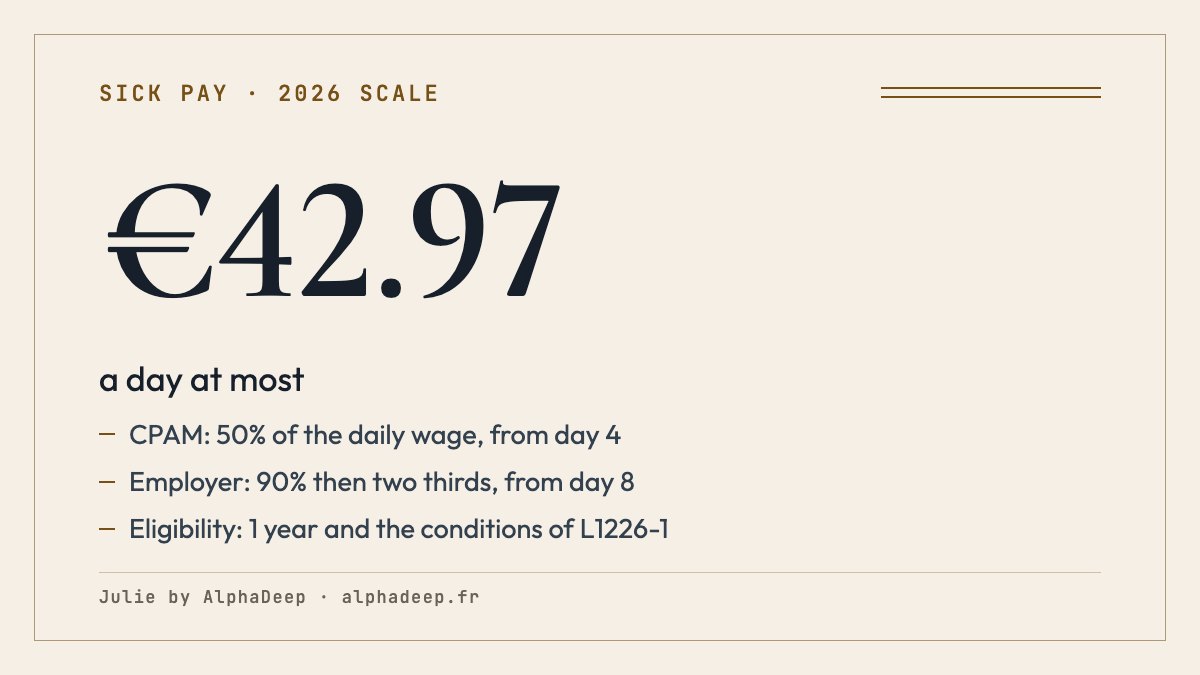
For an eligible monthly-paid employee in the ordinary case, sickness benefits are 50% of the basic daily wage: three capped gross salaries divided by 91.25, after three waiting days. The July 2026 daily cap is €42.97. Subject to L1226-1’s conditions and exclusions, after one year of service the employer’s top-up brings the total to 90% of the pay that would have been earned, from day eight (Labour Code D1226-1).
Go to the tool: the calculation sheet
Julie by AlphaDeep is an AI legal assistant for French law: it researches official references to help answer your questions (Légifrance, case law, service-public), analyses your documents and drafts your letters, for individuals and professionals alike.
General legal information with official references and dated checks. It is not personalised advice: for a decision that commits you, have your situation checked by a qualified professional.

Let’s look at your situation
Describe the dates and your work situation, without any medical diagnosis.
Example questions
Your question carries over after signup. Maximum 400 characters. Avoid health data and names.
How much will you receive during your sick leave?
Enter the three salaries used for benefits, the pay you would have earned during the absence and the eligibility conditions. The simulation spreads that pay uniformly across the absence; it does not certify payroll. The example uses €2,400 gross a month, 20 days off and 6 years of service.
Fictional example · indicative payslip
Your employer tops up to 90% from day 8. At the start of this leave, with no previous top-up history, the reference is 40 days at 90% left, then 40 days at two thirds.
- Basic daily wage (3 capped salaries ÷ 91.25)
- €78.90
- CPAM daily benefit (50%)
- €39.45
- CPAM benefit (17 days, after 3 waiting days)
- €670.65
- Employer top-up to 90% (13 days)
- €423.15
- Employer top-up to two thirds (0 days)
- €0.00
- Indicative gross total for the leave
- €1,093.80
- Gross pay that would have been earned over the same period
- €1,600.00
Gross simulation using the July 2026 benefit cap, for ordinary monthly-paid non-occupational sick leave. Verify social-security coverage, proof within 48 hours (subject to statutory exceptions), treatment in France/EU/EEA and the exclusions for home, seasonal, intermittent and temporary workers and notified proven fraud. Cases with deductible employer-funded insurance benefits are outside this simulation. Extensions, waiting-period exemptions (including ALD), local Alsace-Moselle rules, reduced benefits or prior absences affecting the 360-benefit limit are not calculated here: choose “No or a special case” when another calculation is needed. The three reference payroll periods must be complete, with no reconstruction needed. The entered current-period pay is spread uniformly across the absence; payroll must check the actual allocation and deductions.
How many days does the employer top up, by years of service?
With 1 to 5 years of service, the employer pays 90% of gross salary for 30 days, then two thirds for 30 days. Each period grows by 10 days for every further full 5 years of service, up to 90 days (Labour Code, article D1226-2).
| Years of service | Days at 90% | Days at two thirds | Longest top-up |
|---|---|---|---|
| Under 1 year | 0 | 0 | No legal top-up |
| 1 to 5 years | 30 | 30 | 60 days |
| 6 to 10 years | 40 | 40 | 80 days |
| 11 to 15 years | 50 | 50 | 100 days |
| 16 to 20 years | 60 | 60 | 120 days |
| 21 to 25 years | 70 | 70 | 140 days |
| 26 to 30 years | 80 | 80 | 160 days |
| 31 years or more | 90 | 90 | 180 days |
Under the general L1226-1 scheme, these periods run over a rolling 12 months: days already topped up during earlier sick leave are deducted (article D1226-4). A collective agreement (convention collective) or a company agreement can give longer periods or full pay. The local Alsace-Moselle rules require a separate assessment.
Sources: Labour Code D1226-1 ff. · Labour Code L1226-23
How does the CPAM work out your daily sickness benefit?
The CPAM adds up your last 3 gross monthly salaries before the leave, each counted up to 1.4 times the monthly minimum wage (Smic), and divides the total by 91.25: that is your basic daily wage. The daily benefit (indemnité journalière, IJ) is half of it (Social Security Code, articles R323-4 and R323-5).
For leave that began on or after 1 July 2026, the salary counted is capped at €2,613.83 gross a month according to the Assurance maladie, so the benefit never exceeds €42.97 a day, whatever you earn. It is paid for every day of the leave, weekends included, from day 4.
Sources: Social Security Code R323-1 ff. · ameli.fr, employees
When does your employer have to top up the benefit?
The legal top-up is owed to an employee with at least one year of service who sent proof of the leave within 48 hours (subject to the statutory L169-1 exception), is covered by French social security and is treated in France or in another EU or EEA country (Labour Code, article L1226-1).
It does not apply to home workers, seasonal, intermittent or temporary employees, nor where the employer has been told of proven benefit fraud. The top-up brings the total to 90% of gross pay, then to two thirds: it is not a percentage added on top of the CPAM benefit.
Sources: Labour Code L1226-1 · Labour Code D1226-1 ff.
Why 3 waiting days for the CPAM but 7 for the employer?
The CPAM’s 3 waiting days and the employer’s 7 are two separate periods. The CPAM pays from day 4 of the incapacity (Social Security Code, article R323-1). The employer’s legal top-up starts after 7 days off, so from day 8, except for a work accident or an occupational disease, excluding commuting accidents (Labour Code, article D1226-3).
In the ordinary case, excluding statutory waiting-period exemptions, between day 4 and day 7 you therefore receive only the CPAM benefit, unless your collective agreement or a company agreement removes or shortens the employer’s waiting period. The first 3 days are paid by neither under the law.
Sources: Social Security Code R323-1 ff. · Labour Code D1226-1 ff.
What do you actually receive, gross and net?
The calculator gives gross figures. According to the Assurance maladie, the daily benefit bears 6.2% CSG and 0.5% CRDS, and income tax is withheld at source, except for leave linked to a long-term illness on the exempt list.
If your employer uses subrogation, it receives the CPAM benefit in your place and pays you the topped-up salary on your payslip: the total is the same, only the payment route changes. Without subrogation, the CPAM pays the benefit to you about every 14 days.
Source: ameli.fr, employees
What makes the amount of your sick pay change?
Five factors to check when comparing sick pay for two absences of the same length.
Your years of service on the first day off
Under one year: no legal top-up from the employer. After that, each further full 5 years adds 10 days at 90% and 10 days at two thirds.
The 1.4 Smic cap
Above €2,613.83 gross a month, the CPAM benefit stops rising: it is capped at €42.97 a day, and the employer’s top-up takes over up to 90%.
The two waiting periods
In the ordinary case: 3 days without CPAM benefit and 7 days without the legal employer top-up. Extensions and statutory exemptions, including successive absences for the same ALD, must be distinguished from new sick leave.
Days already topped up in 12 months
Every sick leave uses up the top-up periods: a new one within the year starts from what is left (Labour Code, article D1226-4).
Your collective agreement and insurance cover
They can remove the waiting days, keep 100% of your pay or extend the top-up. The employer-funded share of group insurance (prévoyance) is deducted from the top-up (article D1226-5).
What does article L1226-1 of the French Labour Code say?
Article L1226-1 creates the top-up paid by the employer. Its rates and periods are in articles D1226-1 to D1226-8.
Tout salarié ayant une année d’ancienneté dans l’entreprise bénéficie, en cas d’absence au travail justifiée par l’incapacité résultant de maladie ou d’accident constaté par certificat médical et contre-visite s’il y a lieu, d’une indemnité complémentaire à l’allocation journalière prévue à l’article L. 321-1 du code de la sécurité sociale, à condition :
1° D’avoir justifié dans les quarante-huit heures de cette incapacité, sauf si le salarié fait partie des personnes mentionnées à l’article L. 169-1 du même code ;
2° D’être pris en charge par la sécurité sociale ;
3° D’être soigné sur le territoire français ou dans l’un des autres Etats membres de la Communauté européenne ou dans l’un des autres Etats partie à l’accord sur l’Espace économique européen.
[…] Ces dispositions ne s’appliquent pas en cas de fraude avérée du salarié afin d’obtenir le versement des indemnités journalières mentionnées à l’article L. 321-1 dudit code ou au 2° de l’article L. 431-1 du même code dont l’employeur a été informé en application du VI de l’article L. 114-9 du même code.
In English, briefly (our summary, not an official translation): An employee with one year of service who is off work because of illness or accident, certified by a doctor, receives a top-up to the social security daily benefit, subject to the statutory exclusions, proof within 48 hours except for persons covered by L169-1, French social-security cover and treatment in France, the EU or the EEA. Since 27 June 2026 no top-up is due where the employer has been told of proven benefit fraud.
What has changed for sick pay in France since 2025?
Five dated changes affect the calculation or the right to the top-up, oldest first.
The salary used to work out the daily benefit is capped at 1.4 times the Smic instead of 1.8 times, for sick leave starting on or after this date (decree no. 2025-160 of 20 February 2025).
Source: Decree 2025-160
A sick note issued on paper must use the secure official form: the CPAM rejects scans, photocopies and old forms.
Source: ameli.fr, employees
Article L1226-1 excludes the employer’s top-up where proven fraud on daily benefits has been reported to the employer (article 20 of law no. 2026-534 of 25 June 2026).
Source: Labour Code L1226-1
With the Smic in force on 1 June 2026, the salary counted is capped at €2,613.83 a month and the maximum daily benefit rises to €42.97 for sick leave starting on or after this date.
Sources: ameli.fr, employees · ameli.fr, maximum amounts
Decree no. 2026-866 reduces the longest benefit period for certain non-exempt ALDs to one year: it applies to leave prescribed from 15 October 2026 and leave in progress that day reaching 6 months from that date. Beneficiaries already recognised on 15 October keep the former 3-year period until its end; exempt ALDs remain at 3 years (article 3 and R323-1).
Sources: Social Security Code R323-1 ff. · Decree 2026-866, art. 3
What else should you know about sick pay in France?
Is the daily sickness benefit paid at weekends?
Yes. The daily benefit is due for every calendar day, working or not (Social Security Code, article L323-1): 20 days of ordinary sick leave give 17 days of benefit after the 3 waiting days, Saturdays and Sundays included.
My doctor sent the sick note online: do I still tell my employer?
Yes. The doctor sends the leave to the CPAM, but you must send your employer the printed copy within 48 hours of the leave date, however short it is, according to the Assurance maladie. The same 48-hour limit is a condition of the legal top-up, subject to the exception for the persons covered by L169-1 (article L1226-1).
Is sick pay taxed in France?
Yes. According to the Assurance maladie, daily sickness benefit is subject to income tax, withheld at source on each payment, except benefit paid for leave linked to a long-term illness on the exempt list.
If my sick leave is extended, do the waiting days start again?
Not for the CPAM, as long as no more than 48 hours of work separate the first leave from the extension, according to the Assurance maladie. For the same ALD, the waiting period applies only to the first absence in the benefit period (R323-1). The employer’s 7-day waiting period applies to each new sick leave (article D1226-3), not to an extension.
What happens after 360 days of benefit?
For an illness that is not a long-term illness, the CPAM pays at most 360 daily benefits over any 3 years (Social Security Code, article R323-1). Beyond that, no benefit is paid for these absences. A long-term illness on the exempt list can be paid for up to 3 years.
Which texts is this sick pay calculation based on?
- French Labour Code, article L1226-1 (version in force since 27 June 2026)Légifrance, in French
- Labour Code, articles D1226-1 to D1226-5 (rates, periods, waiting days, 12 months, deductions)Légifrance, in French
- Social Security Code, articles R323-1, R323-4, R323-5 and R323-9Légifrance, in French
- Decree no. 2025-160 of 20 February 2025 on the earnings cap used for the daily benefitLégifrance, Journal officiel, in French
- Maximum amounts of the daily benefit (IJ)Assurance maladie, ameli.fr, in French
- Sick leave: the daily benefit for employeesAssurance maladie, ameli.fr, in French
- Decree no. 2026-866, article 3 (application from 15 October 2026 and preserved rights)Légifrance, Journal officiel, in French
- Labour Code, article L1226-23 (salary maintenance in Alsace-Moselle)Légifrance, in French
- Sick leave: daily benefit paid to employees (fiche F3053)Service-public.fr, in French
Texts cited last checked: 24 September 2026