The checklist gridAudit grid · Collective agreement
French collective agreement: how to identify the one that applies to your job, what the payslip must show and whether your pay meets the grid
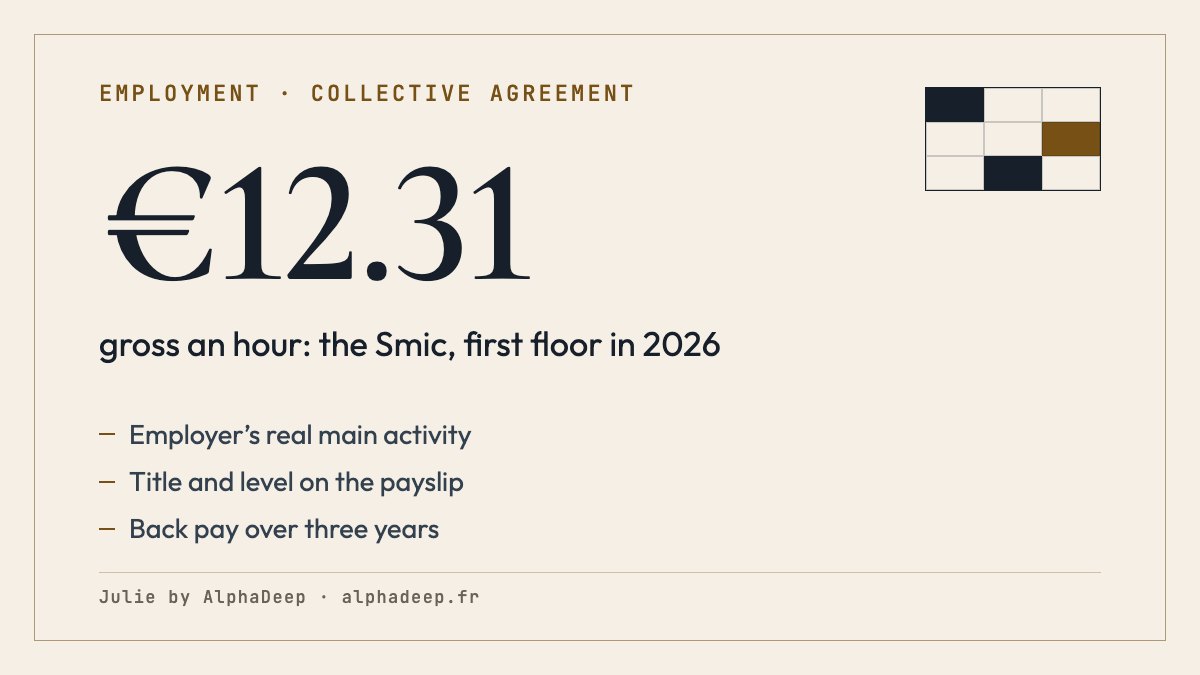
The collective agreement that applies in France is the one for the employer’s real main activity (Labour Code, article L2261-2); the APE code is only a clue. Your payslip must show its title and your level or coefficient (article R3243-1). Your pay must reach both the minimum for your classification and the Smic, €12.31 gross an hour in 2026.
Go to the tool: the checklist grid
Julie by AlphaDeep is an AI legal assistant for French law: it researches official references to help answer your questions (Légifrance, case law, service-public), analyses your documents and drafts your letters, for individuals and professionals alike.
General legal information with official references and dated checks. It is not personalised advice: for a decision that commits you, have your situation checked by a qualified professional.

Let’s look at your situation
Give the employer’s activity, the agreement and level on your payslip, your working hours and your gross pay.
Example questions
Your question carries over after signup. Maximum 400 characters. Avoid health data and names.
How do you identify your agreement, in order?
Five checks, from the simplest to the most delicate.
Read the payslip
It shows the title of the branch agreement and your place in the classification, level or coefficient (article R3243-1).
Compare the real main activity
The agreement that applies is the one covering the employer’s main activity, not the one it announces (article L2261-2).
Treat the APE code as a clue
The APE or NAF code points to an agreement; if it points to several, read the scope of each (sheet F78).
Find the text by its IDCC
Each agreement has an IDCC number to find it on Légifrance or on the Code du travail numérique.
Compare your pay with both floors
The grid minimum for your level, and the Smic: the higher of the two applies, on the same hourly basis.
Do your payslip and pay follow the agreement?
Give what your payslip shows, whether the agreement fits the real activity and your duties, your working hours, the minimum for your level and your pay: the grid checks each point and works out the monthly shortfall. The example: €1,850 gross for 35 hours, against a €1,950 grid minimum.
Fictional example · the agreement grid
Pay below the floor: €100.00 gross missing each month.
- Gross monthly Smic for these hours
- €1,867.02
- Minimum for your level
- €1,950.00
- Floor that applies
- €1,950.00
- Monthly shortfall to claim
- €100.00
- Back pay possible
- Over three years at most, month by month
5 · Compliant2 · Not compliant0 · To check
| Clause or point checked | Compliant | Not compliant | To check |
|---|---|---|---|
| Title of the agreement on the paysliparticle R3243-1, 3° | Compliant | ||
| Level or coefficient on the paysliparticle R3243-1, 4° | Compliant | ||
| Agreement of the real main activityarticle L2261-2 | Compliant | ||
| APE code consistent with the agreementa clue, sheet F78 | Compliant | ||
| Classification matching the real dutiesthe agreement’s grid | Compliant | ||
| Pay at least the grid minimumcollective agreement | Not compliant | ||
| Pay at least the Smicsheet F2300 | Not compliant |
Indicative result: the pay items counted for the Smic and for the grid are not always the same, and each past month is recalculated with the amounts then in force.
How do you know which agreement applies?
The applicable agreement is the one covering the main activity the employer carries on (Labour Code, article L2261-2). Where there are several activities, reciprocal clauses in the agreements concerned may settle which one applies.
The APE or NAF code given by Insee is only a clue; an employer under no obligation may also apply an agreement voluntarily, by custom or commitment (sheet F78). The employer gives you a written document on the texts that apply at the latest one month after hiring.
Sources: C. trav. L2261-2 · Service-public F78
What must the payslip show?
Where relevant, the title of the branch collective agreement that applies, and your place in its classification, defined in particular by your level or hierarchical coefficient (article R3243-1, 3° and 4°).
The text requires the title, not the IDCC number: an IDCC shown helps find the text, but does not prove on its own that it is the right agreement.
Sources: C. trav. R3243-1 · Service-public F78
Your pay is below the minimum: what can you claim?
The difference between your pay and the higher of the two floors, the minimum for your classification and the Smic (sheet F2300), month by month, with the amounts in force for each period.
A claim for pay is time-barred three years after you knew the facts; after the contract ends, it covers the three years before the end (article L3245-1).
Sources: Service-public F2300 · C. trav. L3245-1
Which pay floors apply in 2026?
The Smic at 1 June 2026 and the rule that combines it with the agreement’s minimum.
| Reference | Amount or rule | Source |
|---|---|---|
| Gross hourly Smic | €12.31 | Sheet F2300 |
| Gross monthly Smic, 35 hours | €1,867.02 | Sheet F2300 |
| Gross yearly Smic | €22,404.20 | Sheet F2300 |
| Agreement minimum | By your level or coefficient in the grid in force | Your agreement |
| Floor that applies | The higher of the two, on the same basis | Sheet F2300 |
| Back pay | Three years at most | Article L3245-1 |
Minors with under 6 months’ experience, apprentices, professionalisation contracts and Mayotte have specific amounts.
Sources: Service-public F2300 · C. trav. L3245-1
What do employees ask about their collective agreement?
Is the APE code enough to identify the agreement?
No: it is a clue to the main activity; if it points to several agreements, check the scope of each (sheet F78).
My employer applies another agreement: is that allowed?
It may voluntarily apply an agreement that does not bind it (sheet F78); if an agreement is required by its main activity, that one applies (article L2261-2).
Where can I read my agreement?
On Légifrance or the Code du travail numérique, using its IDCC number; the employer must also keep an up-to-date copy available to you (sheet F78).
How long do I have to claim back pay?
Three years from when you knew the facts, for the last three years (Labour Code, article L3245-1).
What does article L2261-2 of the French Labour Code say?
The test for which agreement applies: the employer’s main activity.
La convention collective applicable est celle dont relève l’activité principale exercée par l’employeur.
En cas de pluralité d’activités rendant incertaine l’application de ce critère pour le rattachement d’une entreprise à un champ conventionnel, les conventions collectives et les accords professionnels peuvent, par des clauses réciproques et de nature identique, prévoir les conditions dans lesquelles l’entreprise détermine les conventions et accords qui lui sont applicables.
In English, briefly (our summary, not an official translation): The collective agreement that applies is the one covering the main activity carried on by the employer. Where several activities make that test uncertain for attaching a company to an agreement’s scope, the collective agreements and professional agreements may, by reciprocal clauses of the same kind, set how the company determines the agreements that apply to it. Our note: the text targets the activity really carried on; neither the APE code nor the payslip mention replaces it.
Which texts decide which agreement applies?
- Labour Code, article L2261-2 (main activity)Légifrance
- Labour Code, article R3243-1 (payslip entries)Légifrance
- Labour Code, article L3245-1 (time bar on pay)Légifrance
- Collective agreement (sheet F78, in French)Service-public.fr · checked on 30 April 2025
- Smic, the national minimum wage (sheet F2300, in French)Service-public.fr · checked on 1 June 2026
- Find your collective agreement and company agreements (in French)Ministry of Labour
Texts cited last checked: 27 September 2026