The letterPrivate-sector employees · Claim letter
Unpaid bonus or 13th-month pay in France: when your employer owes it, how to claim it in writing, and the time limit
A bonus or 13th-month pay is owed in France if the contract, an agreement, a company practice or a written employer commitment provides it. That source sets amount, payment and pro rata on leaving. If the employer alone had to set targets and never did, the variable pay provided for the period is owed in full. The claim period is 3 years from the payment due date (French Labour Code, article L3245-1).
Julie by AlphaDeep is an AI legal assistant for French law: it researches official references to help answer your questions (Légifrance, case law, service-public), analyses your documents and drafts your letters, for individuals and professionals alike.
General legal information with official references and dated checks. It is not personalised advice: for a decision that commits you, have your situation checked by a qualified professional.

Let’s look at your situation
Give the bonus, its source, its gross amount, its payment date and your dates in the company.
Example questions
Your question carries over after signup. Maximum 400 characters. Avoid health data and names.
Which letter should you send to claim your bonus?
Give the source of the bonus, its gross amount, its period, its payment date and your dates in the company: the tool says whether it is owed, works out monthly pro rata when that method is confirmed by the source, dates the time limit and drafts the letter, in French, as your employer reads it. The example: a 13th-month payment of €3,600 in the contract, due on 31 December 2025, for an employee who left on 30 September 2025.
Fictional example · the claim letter
Bonus owed pro rata: €2,700.00 gross for 9 months out of 12.
- Amount entered
- €3,600.00
- Time in the company over the period
- 9 months out of 12
- To claim
- €2,700.00
- Time limit to act
- until 31 December 2028
Lettre recommandée avec accusé de réception
[Vos nom et prénom][Votre adresse]
[Nom de l’employeur]Service des ressources humaines[Adresse de l’employeur]
À [ville], le [date]
ObjetRéclamation d’une prime de 2 700,00 € brut payable le 31 décembre 2025
Madame, Monsieur,
Selon mon contrat de travail, une prime de 3 600,00 € brut m’était due pour la période du 1er janvier 2025 au 31 décembre 2025, payable le 31 décembre 2025. Elle ne m’a pas été versée.
J’ai quitté l’entreprise le 30 septembre 2025, soit 9 mois de présence sur 12 ; mon contrat de travail prévoyant un versement au prorata, la somme due est de 2 700,00 € brut.
Je vous demande de me verser la somme de 2 700,00 € brut, avec un bulletin de paie rectifié, dans un délai de 15 jours à compter de la réception de ce courrier.
À défaut, je saisirai le conseil de prud’hommes ; l’action en paiement du salaire se prescrit par trois ans, soit jusqu’au 31 décembre 2028 (article L3245-1 du Code du travail).
Je vous prie d’agréer, Madame, Monsieur, l’expression de mes salutations distinguées.[Signature]
Pièces jointes : la clause ou le texte qui prévoit la prime ; les bulletins de paie de la période
Indicative estimate: the exact amount depends on the clause, agreement or practice, and on your payslips. The letter is in French because your employer and the tribunal work in French.
What does article L3245-1 of the French Labour Code say on the time limit?
The limitation period for pay, which applies to a bonus that is owed.
L’action en paiement ou en répétition du salaire se prescrit par trois ans à compter du jour où celui qui l’exerce a connu ou aurait dû connaître les faits lui permettant de l’exercer. La demande peut porter sur les sommes dues au titre des trois dernières années à compter de ce jour ou, lorsque le contrat de travail est rompu, sur les sommes dues au titre des trois années précédant la rupture du contrat.
In English, briefly (our summary, not an official translation): A claim for payment or repayment of pay is time-barred three years after the day the person bringing it knew or should have known the facts allowing it. The claim may cover the sums owed for the last three years from that day or, once the employment contract has ended, the sums owed for the three years before it ended. Our summary: for a bonus due on a fixed date, time runs from that date, so a 13th-month payment due on 31 December 2025 can be claimed until 31 December 2028; a court claim, even for urgent interim relief, stops the clock, a letter, even by recorded delivery, does not (French Civil Code, articles 2240 and 2241).
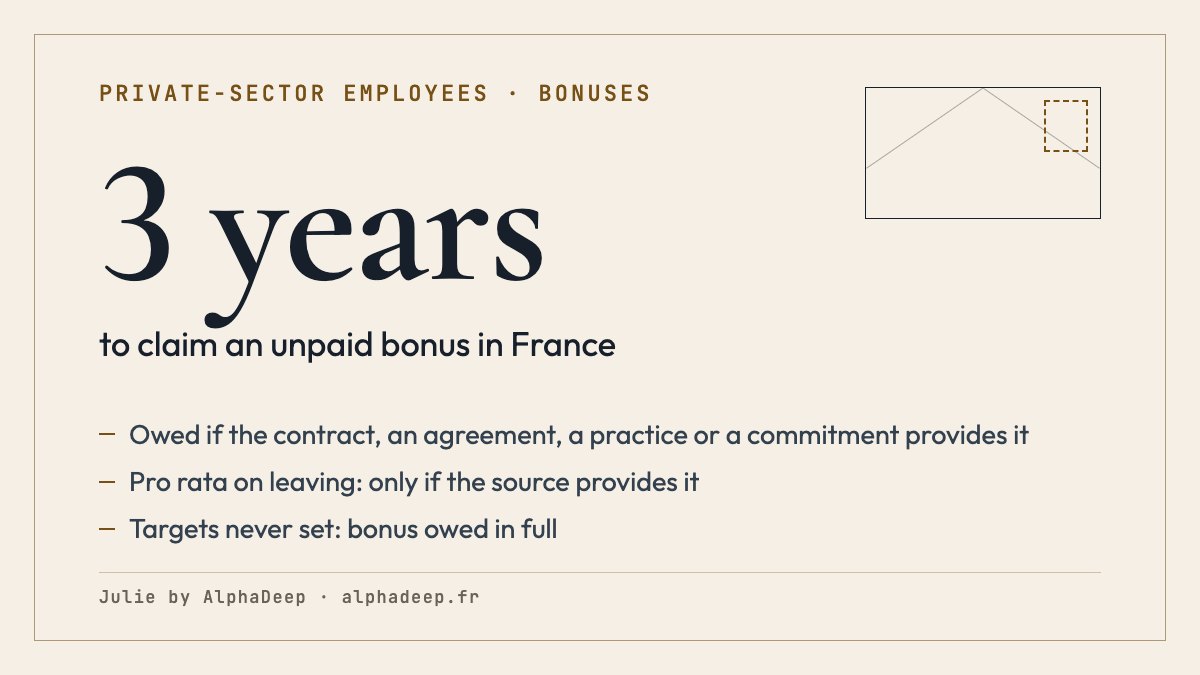
When must a French employer pay a bonus?
A bonus claim requires finding its contractual or customary basis and conditions. If your claim concerns ordinary monthly wages, use the unpaid-wages guide.
The employer must pay a bonus or premium when the employment contract, a collective agreement, an established company practice (usage) or a written unilateral commitment provides it. A purely discretionary payment, decided each time with no rule or regularity, cannot be claimed (service-public F2301; French Civil Code, article 1103).
The name decides nothing: a "13th month" is not necessarily one month of salary, and a "bonus" can be compulsory. The source sets the amount, the reference period, the payment date and any condition, such as still being employed on that date.
Sources: Service-public F2301 · C. civ. 1103
How do you prove that a bonus has become a company practice?
A company practice needs three conditions together: the bonus goes to all staff or a whole category (general), at every due date (constant), with a fixed amount or method (fixed). The employee must prove them (service-public F311; Cour de cassation, social chamber, 27 May 1987, n° 82-42.115).
Payslips over several years, yours and colleagues’ in the same category, and internal memos are the usual evidence. To end a practice, the employer must inform the staff representatives and each employee in writing, with reasonable notice; otherwise the bonus remains owed (service-public F311).
Sources: Service-public F311 · Cass. soc., 27 May 1987
Do you get a pro-rata 13th month if you leave before it is paid?
Only if the contract, the collective agreement, a company agreement or a company practice provides it: otherwise an employee who leaves before the payment date has no right to a share of the 13th month (Cour de cassation, full court, 5 March 1993, n° 89-43.464).
The pro rata follows the unit the source sets, most often the time worked: for 9 months out of 12, €3,600 × 9 / 12 = €2,700 gross. Also read the clause on being employed on the payment date: if it makes that a condition, the answer changes.
Source: Cass. full court, 5 March 1993
What can you claim if your employer never set your targets?
When variable pay depends on targets the employer must set alone and it never set them, the variable pay is owed in full; the court cannot simply apply an earlier year’s targets (Cour de cassation, social chamber, 7 June 2023, n° 21-23.232).
Targets given too late, or that cannot be held against the employee, have the same effect: in a 2020 case the Court applied the maximum bonus of the plan (Cour de cassation, social chamber, 25 November 2020, n° 19-17.246). So work out the variable pay from the pay plan itself.
Sources: Cass. soc., 7 June 2023 · Cass. soc., 25 November 2020
Who has to prove that the bonus was paid, or not?
The employee proves the bonus is owed: the clause, agreement, commitment or practice, and that its conditions are met. The employer that says it has paid must prove the payment; handing over a payslip is not enough on its own (French Civil Code, article 1353; Cour de cassation, social chamber, 16 June 2021, n° 19-25.344).
If the bonus appears on a final settlement receipt (reçu pour solde de tout compte) you signed, the receipt clears the employer for the sums it lists 6 months after signature: challenge it in writing before then (French Labour Code, article L1234-20).
Sources: C. civ. 1353 · Cass. soc., 16 June 2021 · C. trav. L1234-20
Which source makes your bonus compulsory, and what must you show?
The source decides whether the bonus is owed, how much and until when; it is the one to cite in the letter.
| Source | What makes it binding | What you show | Withdrawal by the employer |
|---|---|---|---|
| Employment contract or amendment | The clause signed by both parties (French Civil Code, article 1103) | The contract and its amendments | Only with your consent |
| Collective or company agreement | The text that applies to the company | The agreement and the collective agreement code on your payslip | By revising or terminating the agreement, under its rules |
| Company practice (usage) | General, constant and fixed, all three | Past payments, to you and to your category | Informing the representatives and each employee, with notice |
| Written unilateral commitment | The memo or letter in which the employer promises the bonus | That document and its conditions | Ended in the same way as a practice |
| Discretionary gift | Nothing: the employer decides each time | Nothing to claim, unless it has become a practice | No obligation |
On leaving, a pro rata applies only if one of these sources provides it (Cour de cassation, full court, 5 March 1993).
Sources: Service-public F2301 · Service-public F311 · C. civ. 1103 · Cass. full court, 5 March 1993
What do employees waiting for a bonus ask?
Does a one-off exceptional bonus become compulsory?
No: without regularity and a fixed rule, a single payment stays a gift and creates no company practice (service-public F311).
Should you claim the bonus gross or net?
Gross, as on the payslip: contributions and income tax withholding are taken off when it is paid. Also ask for a corrected payslip.
Can you go to the employment tribunal without writing to the employer first?
Yes: the written claim helps as evidence but is not required, and the employment tribunal (conseil de prud’hommes) can be seized directly, without a lawyer (service-public F2360).
Is there a fee to claim a bonus at the employment tribunal?
A €50 legal aid contribution is due from the party bringing the claim, unless that party has legal aid (French Tax Code, article 1635 bis Q).
Does a recorded-delivery letter stop the 3-year clock?
No: a court claim, even for urgent interim relief, or the employer acknowledging the debt interrupts the limitation period (French Civil Code, articles 2240 and 2241).
Which texts is a bonus claim in France based on?
- French Labour Code, article L3245-1 (three-year limitation)Légifrance
- French Labour Code, article L1234-20 (final settlement receipt)Légifrance
- French Civil Code, article 2240 (acknowledgement of the claim)Légifrance
- French Civil Code, article 2241 (court claim)Légifrance
- French Civil Code, article 1103 (binding force of contracts)Légifrance
- French Civil Code, article 1353 (proof of payment)Légifrance
- Pay, bonuses and benefits (fiche F2301, in French)Service-public.fr · checked 1 June 2026
- What is a company practice? (fiche F311, in French)Service-public.fr · checked 22 April 2026
- Taking a case to the employment tribunal (fiche F2360, in French)Service-public.fr
- Cour de cassation, social chamber, 27 May 1987, n° 82-42.115 (company practice)Légifrance
- Cour de cassation, full court, 5 March 1993, n° 89-43.464 (pro-rata 13th month)Légifrance
- Cour de cassation, social chamber, 7 June 2023, n° 21-23.232 (targets never set)Légifrance
- Cour de cassation, social chamber, 25 November 2020, n° 19-17.246 (targets not binding)Légifrance
- Cour de cassation, social chamber, 16 June 2021, n° 19-25.344 (proof of payment)Légifrance
- French Tax Code, article 1635 bis Q (€50 legal aid contribution)Légifrance
Texts cited last checked: 27 September 2026