The statement of sumsStatement · Deposits
Deposits in France, arrhes or acompte: who can cancel, what each side loses or repays, and a statement of your payment
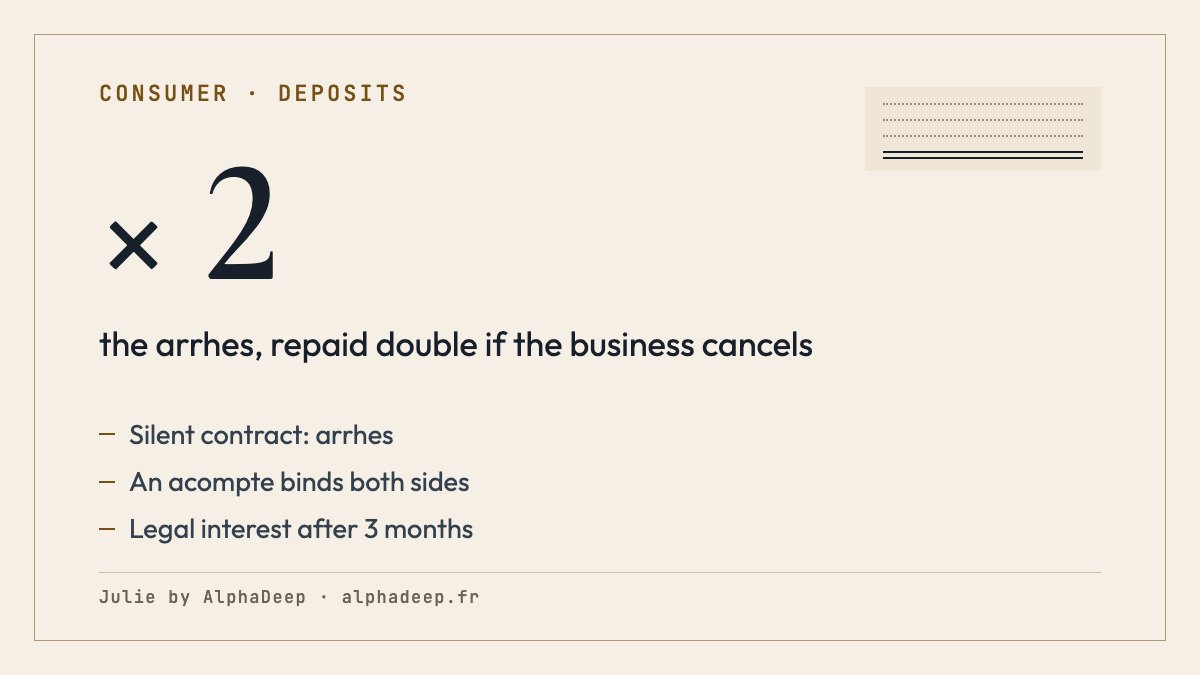
Unless the contract says otherwise, a sum paid in advance to a French business is arrhes (Code de la consommation, article L214-1): you can walk away by losing it, the business by repaying you double. An acompte, by contrast, binds both sides. Whatever it is called, the payment earns legal interest from 3 months after it was made, until delivery or refund (article L214-2).
Go to the tool: the statement of sums
Julie by AlphaDeep is an AI legal assistant for French law: it researches official references to help answer your questions (Légifrance, case law, service-public), analyses your documents and drafts your letters, for individuals and professionals alike.
General legal information with official references and dated checks. It is not personalised advice: for a decision that commits you, have your situation checked by a qualified professional.

Let’s look at your situation
Give the order form, the sum paid and its date, who cancels and why.
Example questions
Your question carries over after signup. Maximum 400 characters. Avoid health data and names.
What happens to the payment if either party cancels?
Five checks to classify the payment and the consequences of cancellation.
Read the order form
The word used decides: with no detail, the sum paid in advance is presumed to be arrhes (Code de la consommation, article L214-1).
Separate other cancellation rights
A valid withdrawal, usually within 14 days, returns the payment in full (sheet F31187). Its scope and rescission for non-delivery are checked in their own guides, not determined by this statement.
Work out the sum due
Double the arrhes, or the acompte, plus legal interest from 3 months after payment (articles L214-1 and L214-2).
Match the evidence
Keep the contract, order form, payment proof and the statement identifying who cancels: they connect the account to your situation.
Separate the account from a court decision
Enforcement of the sale and damages require separate assessment (Civil Code, article 1217): this statement does not calculate compensation a judge might award.
How much are you owed, or how much do you lose?
Give the word in the contract, who cancels, the price, the sum paid, its date and the refund date: the statement applies the arrhes or acompte rules and adds legal interest after 3 months. The example: €500 paid on 4 May 2026 on a €3,000 order, a silent order form, and a business that cancels; statement at 28 September 2026. This statement assumes any selected withdrawal right is already established; it determines neither that right nor rescission for non-delivery.
Fictional example · the payment statement
The business owes you €1,005.15: double the arrhes and the interest.
- Qualification applied
- arrhes
- Interest from
- 4 August 2026
- Arrhes paidarticle L214-1, presumed arrhes€500.00€500.00
- Sum equal to the arrhesarticle L214-1, repaid double€500.00€1,000.00
- Interest from 4 August 2026 to 28 September 2026article L214-2, legal rate€5.15€1,005.15
Sum to be returned to you€1,005.15
Indicative result: a contract between a business and a consumer; a cancellation clause or an amicable agreement can change the result.
Arrhes or acompte: what happens on cancellation?
The same sum paid has a different fate depending on its name.
| Situation | Arrhes or advance | Acompte |
|---|---|---|
| The contract says nothing | Presumed arrhes | Only if the contract says so |
| You cancel | You lose the arrhes | The business can claim the balance or enforcement |
| The business cancels | It repays you double | It refunds, and you can seek enforcement and damages |
| Withdrawal used in time | Full refund | Full refund |
| Legal interest | From 3 months after payment | From 3 months after payment |
| Order on quotation or made to measure | Outside these rules: the contract decides | Outside these rules: the contract decides |
These rules do not apply to property sales either (sheet F31187).
Sources: C. conso. L214-1 · C. conso. L214-2 · C. conso. L214-3 · Service-public F31187
Arrhes or acompte: how can you tell?
Look at the word used in the contract, the terms of sale or the order form. Unless stated otherwise, in a contract between a business and a consumer, sums paid in advance are arrhes (Code de la consommation, article L214-1).
An advance is treated as arrhes; these rules apply neither to property sales nor to special orders on quotation or made to measure (article L214-3; sheet F31187).
If relying on withdrawal, first check the online withdrawal scope and exceptions guide (in French). For a missing delivery, follow the non-delivery rescission and refund guide (in French). This statement concerns the character of the advance and the consequences of an already identified cancellation.
Sources: C. conso. L214-1 · C. conso. L214-3 · Service-public F31187
What happens if the business cancels?
With arrhes, it repays you double: €1,000 for €500 paid (article L214-1; sheet F31187).
With an acompte, it refunds you, and you can seek enforcement of the sale as well as damages (sheet F31187; Civil Code, article 1217).
Sources: C. conso. L214-1 · Service-public F31187 · C. civ. 1217
And if you cancel?
With arrhes, you lose them, unless the contract provides for a refund (sheet F31187).
With an acompte, the sale is firm: the business can claim the balance of the price or seek enforcement in court, save a withdrawal right (sheet F31187).
Source: Service-public F31187
What does article L214-1 of the French Code de la consommation say?
The presumption of arrhes and the right to walk away.
Sauf stipulation contraire, pour tout contrat de vente ou de prestation de services conclu entre un professionnel et un consommateur, les sommes versées d’avance sont des arrhes, au sens de l’article 1590 du code civil. Dans ce cas, chacun des contractants peut revenir sur son engagement, le consommateur en perdant les arrhes, le professionnel en les restituant au double.
In English, briefly (our summary, not an official translation): Unless stated otherwise, for any contract of sale or services between a business and a consumer, sums paid in advance are arrhes within the meaning of article 1590 of the Civil Code. In that case, each party can go back on its commitment, the consumer by losing the arrhes, the business by repaying them double. Our note: interest on these sums runs from the end of a 3-month period after payment (article L214-2).
What do customers who paid in advance in France ask?
How much is double the arrhes?
Twice the sum paid in total: for €500 of arrhes, the business that withdraws owes you €1,000, not €1,500 (sheet F31187).
Do sums paid in advance earn interest?
Yes, at the legal rate, from 3 months after payment until delivery, performance of the service or refund, whatever they are called (article L214-2; sheet F31187).
Does an illness let you cancel a paid stay?
Not as force majeure: a client who could not enjoy the service cannot obtain rescission of the contract by invoking it (Cass. 1re civ., 25 November 2020, no. 19-21.060).
Is the amount of an acompte capped?
No: the seller sets it freely, and it can be negotiated before signing (sheet F31187).
Which texts do arrhes and acompte rest on?
- Code de la consommation, article L214-1 (presumption of arrhes)Légifrance
- Code de la consommation, article L214-2 (interest on sums paid in advance)Légifrance
- Code de la consommation, article L214-3 (special orders)Légifrance
- Acompte, advance, arrhes and credit note: the differences (sheet F31187, in French)Service-public.fr · checked on 5 August 2025
- Civil Code, article 1590 (arrhes)Légifrance
- Civil Code, article 1217 (remedies for non-performance)Légifrance
- Cour de cassation, first civil chamber, 25 November 2020, no. 19-21.060 (force majeure invoked by the client)Légifrance
- Working out legal interest (sheet F783, in French)Service-public.fr · checked on 1 July 2026
Texts cited last checked: 27 September 2026