The exhibit listExhibit list · Car rental
Rental car damage dispute in France: damage billed at return, the excess, the card debit and the documents to gather
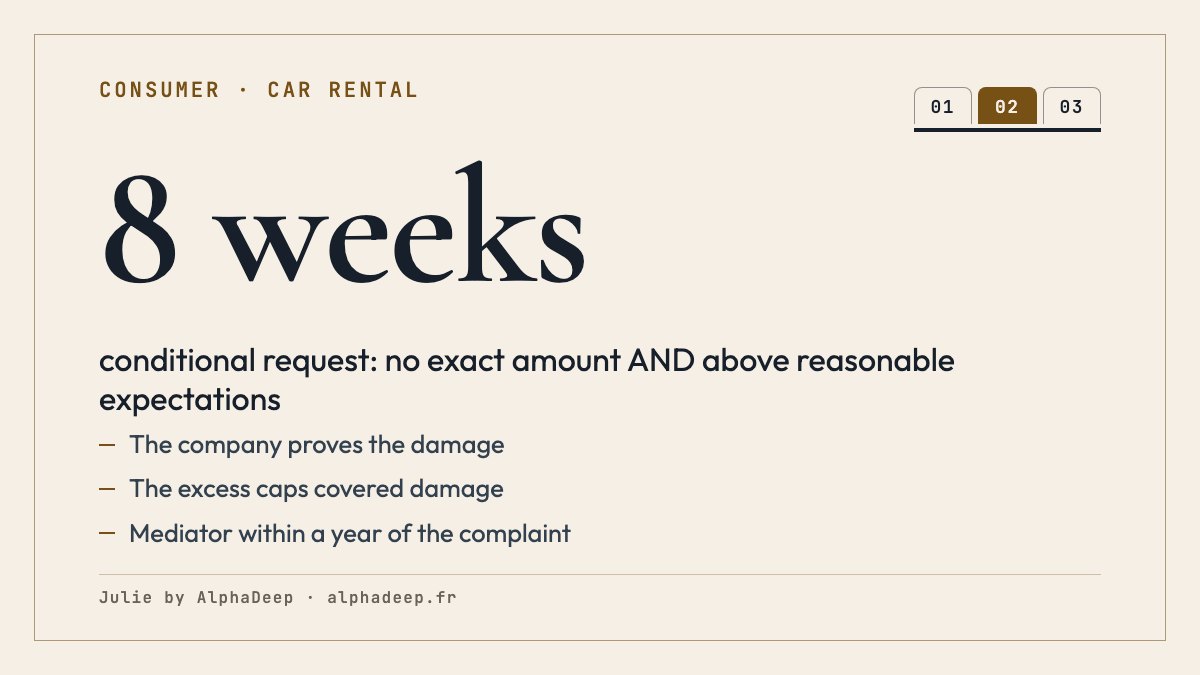
The rental company must prove the damage, its absence at pickup and its cost (Civil Code, article 1353). Your excess caps covered damage. For a debit authorised without an exact amount AND above what you could reasonably expect, request a refund before the end of 8 weeks (CMF L133-25): the bank refunds or explains refusal within 10 working days. The rental dispute remains separate.
Go to the tool: the exhibit list
Julie by AlphaDeep is an AI legal assistant for French law: it researches official references to help answer your questions (Légifrance, case law, service-public), analyses your documents and drafts your letters, for individuals and professionals alike.
General legal information with official references and dated checks. It is not personalised advice: for a decision that commits you, have your situation checked by a qualified professional.

Let’s look at your situation
Give the rental company, the rental dates, the sum billed, the contract’s excess and what was noted at return.
Example questions
Your question carries over after signup. Maximum 400 characters. Avoid health data and names.
In what order should you act after the rental company’s bill?
Complain in writing, then go to the bank if the card was debited, then to the mediator: each step has its deadline.
- Document 1
The written complaint
To the rental company’s customer service: dispute each item, ask for the original photos, the pickup report and the itemised estimate; this letter later opens the mediator (article L612-2).
- Document 2
The card debit
Authorised without an exact amount and higher than foreseeable: a refund request to the bank within 8 weeks, answered within 10 working days (article L133-25).
- Document 3
The unauthorised debit
Report it to the bank without delay, at the latest 13 months after the debit (article L133-24); it refunds by the end of the next working day at the latest, unless it suspects fraud (article L133-18).
- Document 4
The consumer mediator
Free, the one the rental company names (articles L612-1 and L616-1), to be contacted at the latest one year after your written complaint (article L612-2).
What is the most you owe, and which documents to dispute it?
Give the sum claimed, the estimate supplied, the excess left for you to pay and what you have in hand: the exhibit list works out the maximum for covered damage, sorts the documents into ready or missing and dates your remedies. The example: €1,800 claimed, a €1,250 estimate, an excess cut to €300 by a waiver, a debit on the card imprint on 18 September 2026.
Fictional example · the dispute file
For covered and proven damage, your share does not exceed €300.00; the €1,500.00 claimed above it is to dispute.
- Sum claimed
- €1,800.00
- Estimate supplied
- €1,250.00
- Most you owe, covered damage
- €300.00
- Sum to dispute above it
- €1,500.00
- Return check
- Made without you: for the company to prove
- Contact the mediator by
- 21 September 2027
Clarify the banking conditions: no automatic refund.
| No. | Exhibit | What it proves | Status |
|---|---|---|---|
| 01 | Contract, terms and price list | The excess, the waiver and the charges set before the rental | In the file |
| 02 | Pickup report | The damage already noted at pickup | In the file |
| 03 | Dated photos at pickup | The real state of the car handed over | Optional |
| 04 | Return report signed with you present | What was noted together, or that nothing was | To obtain |
| 05 | Dated photos at return, mileage and fuel | The state of the car returned | In the file |
| 06 | The company’s itemised estimate or invoice | The sum claimed, item by item | In the file |
| 07 | Bank statement showing the debit | The date and amount taken | In the file |
| 08 | Copy of your written complaint | The step required before the mediator | In the file |
Indicative result: the excess, its exclusions and the extra charges depend on your contract; the tool decides neither whether the damage is real nor whether a clause is valid.
Who must prove the damage: the rental company or you?
The rental company, since it claims payment: whoever claims performance of an obligation must prove it (Civil Code, article 1353). It must show that the damage is new, that it dates from the rental and what it costs.
A clause letting the professional alone decide whether the returned car is in order, or putting on you a burden of proof that is theirs, is banned (Consumer Code, article R212-1, 4° and 12°). Your dated photos at pickup and return remain the best defence.
Sources: C. civ. 1353 · C. conso. R212-1
Does the excess cap the sum claimed?
For damage covered by the contract’s protection, your share is the stated excess, reduced by an excess waiver if you bought one: the contract binds both parties (Civil Code, article 1103). An exclusion relied on must be in the contract, and an unclear clause is read in your favour (Consumer Code, article L211-1).
Fuel, cleaning, loss of use or admin fees do not merge into the excess: each must be in the price list given before the rental (article L111-1). A manifestly disproportionate penalty is presumed unfair (article R212-2, 3°).
Sources: C. civ. 1103 · C. conso. L211-1 · C. conso. L111-1 · C. conso. R212-2
Can you get a card debit back?
Yes, if your authorisation did not set the exact amount and the debit exceeds what you could reasonably expect: the bank refunds or gives reasons for refusing within 10 working days of a request made within 8 weeks of the debit (Monetary and Financial Code, article L133-25).
A debit you never authorised is reported without delay, within 13 months at the latest (article L133-24). The card imprint secures a payment; it proves neither the damage nor its amount.
Sources: CMF L133-25 · CMF L133-24 · CMF L133-18
What must the rental company justify for each charge?
Each line of the bill is discussed separately: the excess only covers protected damage.
| Item billed | What the company must show | Text |
|---|---|---|
| Damage to the car | New damage, absent from the pickup report, and its costed repair | Civil Code, article 1353 |
| Excess | The contract amount, after any waiver, for covered damage | Civil Code, article 1103 |
| Fuel, cleaning | A price given before the rental, and the fact that triggers it | Consumer Code, article L111-1 |
| Loss of use of the car | A contract clause, for a penalty that is not disproportionate | Consumer Code, article R212-2 |
| Fine from the rental | The offence notice; the fine itself remains due by the renter | Highway Code, articles L121-2 and L121-3 |
| Debit on the card imprint | Debit authorised without an exact amount AND above reasonable expectations: request within 8 weeks, refusal possible | Monetary and Financial Code, article L133-25 |
No text sets a legal amount for an excess, a card imprint, cleaning or admin fees: the contract and the accepted price list set them.
Sources: C. civ. 1353 · C. civ. 1103 · C. conso. L111-1 · C. conso. R212-2 · C. route L121-2 · C. route L121-3 · CMF L133-25
What does article 1353 of the French Civil Code say?
The rule of proof, which puts the burden on the rental company that claims.
Celui qui réclame l’exécution d’une obligation doit la prouver.
Réciproquement, celui qui se prétend libéré doit justifier le paiement ou le fait qui a produit l’extinction de son obligation.
In English, briefly (our summary, not an official translation): Whoever claims the performance of an obligation must prove it. Conversely, whoever claims to be released must justify the payment or the fact that extinguished the obligation. Our note: applied to a rental, the company proves the damage and its amount; you prove, where needed, the state of the car you returned.
What do renters ask after returning a car?
Can the rental company debit my deposit without my agreement?
The card imprint secures a payment, not a debt: the debit must match a proven sum. If authorisation did not set the exact amount AND the debit exceeds reasonable expectations, request a refund before the end of 8 weeks. The bank refunds or explains refusal within 10 working days (article L133-25).
What if the car was checked without me?
The company must then prove that the damage is new and dates from the rental (Civil Code, article 1353); answer with your dated photos and the pickup report, and ask for its own original photos.
Who pays a fine received after the rental?
The renter: the financial liability falls on them (Highway Code, articles L121-2 and L121-3). The rental company, as a legal entity, names the driver within 45 days of the notice (article L121-6).
Which mediator can you turn to against a rental company?
The one the company must tell you about (article L616-1), free of charge (article L612-1), at the latest one year after your written complaint (article L612-2).
Which texts does the dispute rest on?
- Civil Code, article 1353 (burden of proof)Légifrance
- Civil Code, article 1103 (binding force of the contract)Légifrance
- Consumer Code, article L211-1 (clear clauses, interpretation)Légifrance
- Consumer Code, article L111-1 (information before the contract)Légifrance
- Consumer Code, article L212-1 (unfair terms)Légifrance
- Consumer Code, article R212-1 (banned terms)Légifrance
- Consumer Code, article R212-2 (terms presumed unfair)Légifrance
- Consumer Code, article L612-1 (free mediation)Légifrance
- Consumer Code, article L612-2 (one-year deadline)Légifrance
- Consumer Code, article L616-1 (mediator’s details)Légifrance
- Monetary and Financial Code, article L133-25 (payment without an exact amount)Légifrance
- Monetary and Financial Code, article L133-24 (13-month deadline)Légifrance
- Monetary and Financial Code, article L133-18 (refund of an unauthorised debit)Légifrance
- Highway Code, article L121-2 (parking, tolls)Légifrance
- Highway Code, article L121-3 (renter’s financial liability)Légifrance
- Highway Code, article L121-6 (naming the driver)Légifrance
- Bank card fraud (sheet F31324, in French)Service-public.fr · checked on 13 February 2026
Texts cited last checked: 30 September 2026