The checklist gridAudit grid · Unfair terms
Unfair terms in a French consumer contract: the black list, the grey list, the exceptions and what happens to the contract
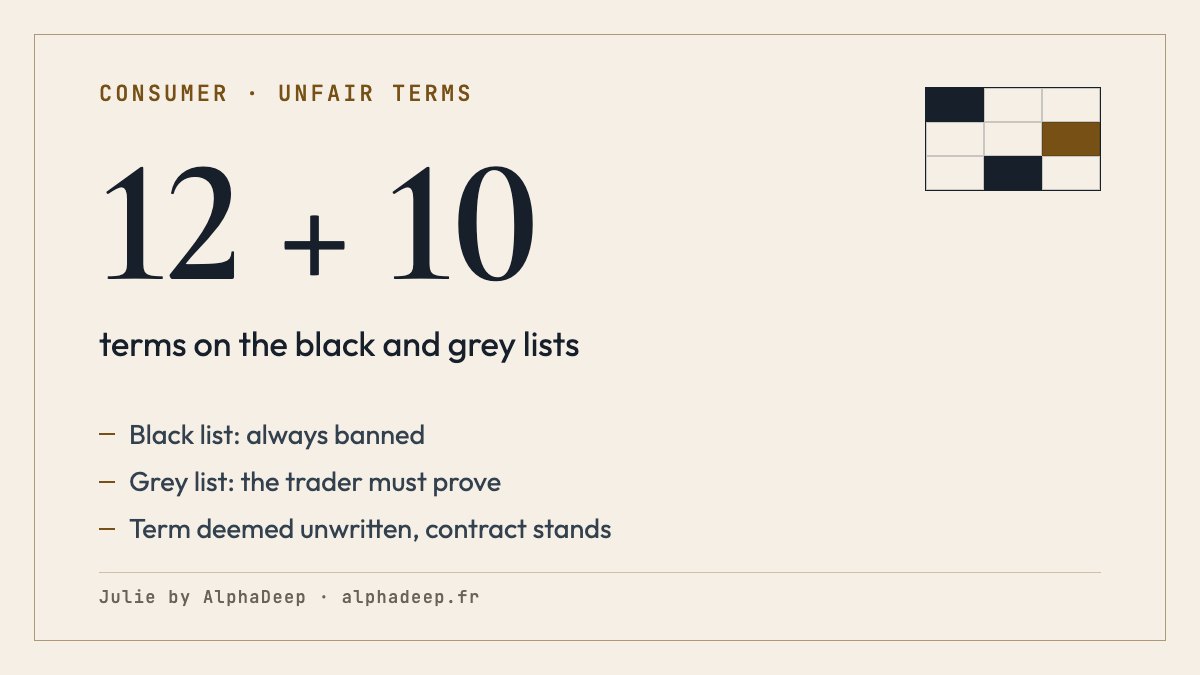
Between a trader and a consumer in France, a term is unfair if it creates a significant imbalance to your detriment (Consumer Code, article L212-1). Subject to the specific exceptions in articles R212-3 and R212-4, the 12 black-list types are banned without contrary proof (article R212-1); the 10 of the grey list are presumed unfair unless the trader proves otherwise (article R212-2). An unfair term is deemed unwritten.
Go to the tool: the checklist grid
Julie by AlphaDeep is an AI legal assistant for French law: it researches official references to help answer your questions (Légifrance, case law, service-public), analyses your documents and drafts your letters, for individuals and professionals alike.
General legal information with official references and dated checks. It is not personalised advice: for a decision that commits you, have your situation checked by a qualified professional.

Let’s look at your situation
Give the type of contract, the trader and the term that bothers you, or attach the contract.
Example questions
Your question carries over after signup. Maximum 400 characters. Avoid health data and names.
Which terms are on the black and grey lists?
The 22 types of term set by decree, in the order of articles R212-1 and R212-2.
| List | No. | The term that |
|---|---|---|
| Black | 1° | binds you to terms missing from the contract, or in a document you did not know |
| Black | 2° | limits the trader’s duty to honour commitments made by its staff or agents |
| Black | 3° | lets the trader alone change the term, the features or the price |
| Black | 4° | lets the trader alone decide whether the goods or service conform, or interpret a clause |
| Black | 5° | makes you perform while the trader does not deliver or provide the service |
| Black | 6° | removes or reduces your right to compensation when the trader fails |
| Black | 7° | bars you from ending the contract when the trader does not perform |
| Black | 8° | lets the trader terminate at will, without giving you the same right |
| Black | 9° | lets it keep payment for services not provided when it terminates at will |
| Black | 10° | imposes, in an open-ended contract, longer notice on you than on the trader |
| Black | 11° | makes your ending an open-ended contract subject to paying a fee |
| Black | 12° | puts on you a burden of proof that normally falls on the trader |
| Grey | 1° | binds you firmly while its service depends on its will alone |
| Grey | 2° | lets it keep your money if you withdraw, with no equivalent compensation, or twice the arrhes, if it withdraws |
| Grey | 3° | imposes a manifestly disproportionate penalty if you do not perform |
| Grey | 4° | lets it terminate without reasonable notice |
| Grey | 5° | lets it transfer the contract without your consent at the risk of reducing your rights |
| Grey | 6° | lets it change your rights and duties alone, outside black-list 3° |
| Grey | 7° | sets only an indicative performance date, outside the cases the law allows |
| Grey | 8° | makes ending the contract harder for you than for the trader |
| Grey | 9° | unduly limits your means of proof |
| Grey | 10° | removes or hinders your court remedies, for example by imposed arbitration |
Articles R212-3 and R212-4 lift black-list 3° and 8° and grey-list 4° and 6° in set cases: financial products tied to a market rate, currency, financial services, price of an open-ended contract with notice, technical progress.
Sources: C. conso. R212-1 · C. conso. R212-2 · C. conso. R212-3 · C. conso. R212-4
Are the terms of your contract unfair?
Give the contract’s special situation, if any, and tick the terms you find in it: the grid sorts each one into banned, presumed unfair or judged case by case, with its article. The example: an open-ended subscription with a price clause and reasonable notice allowing cancellation, a very heavy late-payment penalty and a burden of proof put on you.
Fictional example · the contract grid
1 black-list clause: deemed unwritten, with no proof to the contrary possible.
- Black list, banned
- 1
- Grey list, presumed unfair
- 1
- Judged case by case
- 1
- Effect of an unfair term
- Deemed unwritten; the rest stands if it can survive without it
1 · Banned1 · Presumed unfair1 · Case by case
| Clause or point checked | Banned | Presumed unfair | Case by case |
|---|---|---|---|
| Price, term or features the trader alone can changeR212-1, 3°, exception declared applicable: R212-4 | Case by case | ||
| Burden of proof put on youR212-1, 12° | Banned | ||
| Manifestly disproportionate penaltyR212-2, 3° | Presumed unfair |
Selecting an exception is not proof of its application. Check its exact scope and every condition separately for each clause; a price exception does not cover an unrelated term or feature change. If the exception does not apply, the black/grey presumption remains. Even an applicable exception does not establish fairness.
Guidance by type of clause, not a decision: the court weighs the exact wording, the circumstances at signing and the contract’s other clauses.
What is an unfair term?
A term that, by its purpose or effect, creates to the consumer’s detriment a significant imbalance between the parties’ rights and duties (Consumer Code, article L212-1), whatever the medium: order form, invoice, ticket or general terms.
It is judged at the time of signing, in the light of all the circumstances and the other terms, including those of legally linked contracts. The assessment covers neither the main subject of the contract nor the level of the price, if those terms are clear and understandable.
Source: C. conso. L212-1
Black list or grey list: what is the difference?
A black-list term is irrebuttably presumed unfair: it is banned, and the trader cannot prove otherwise (article R212-1). A grey-list term is presumed unfair, but the trader may show that it is not (article R212-2).
Before concluding, check the exceptions in articles R212-3 and R212-4: they lift four types of term in set cases, without making the term necessarily fair.
Sources: C. conso. R212-1 · C. conso. R212-2 · C. conso. R212-3 · C. conso. R212-4
What happens to a contract containing an unfair term?
The unfair term is deemed unwritten; the contract stays in force in its other provisions if it can survive without it (article L241-1). It is not automatically cancelled as a whole; its survival depends on whether it can continue without that term.
Before the court, the term is set aside of the court’s own motion when its unfairness emerges from the case, after hearing the parties (article R632-1).
Sources: C. conso. L241-1 · C. conso. R632-1
Which terms should you look for first?
Five terms to look for first, because they concern the price, getting out of the contract or your remedies.
Price or term the trader alone can change
Black list (article R212-1, 3°), subject to the specific exceptions in articles R212-3 and R212-4, for example an open-ended contract that warns you in time to cancel.
A fee for ending an open-ended contract
Black list (article R212-1, 11°): your cancellation cannot depend on paying a fee.
A manifestly disproportionate penalty
Grey list (article R212-2, 3°): the trader must prove it is justified.
Your right to compensation removed or reduced
Black list (article R212-1, 6°): the trader stays liable for its failures.
Your court remedies hindered
Grey list (article R212-2, 10°): imposed arbitration or an exclusive out-of-court route.
What do consumers ask about a doubtful term?
Can you dispute a price because it seems too high?
Not on this ground: the test does not cover whether the price matches the goods or service, if the term is clear and understandable (article L212-1).
Can the trader change the price of my subscription?
In an open-ended contract, a term may allow it if you are warned in reasonable time to be able to cancel (article R212-4); outside applicable statutory exceptions, a one-sided price-change term is on the black list (article R212-1, 3°).
Must I cite the right article before the court?
The court sets aside of its own motion a term whose unfairness emerges from the case (article R632-1), but producing the contract and explaining the term’s effect still helps.
Where can you report an unfair term?
On SignalConso, free of charge: the company is told and the DGCCRF may take it up, though the report does not settle your dispute; the written complaint, the mediator and the court remain.
What does article L212-1 of the French Consumer Code say?
The definition of an unfair term, and what the test does not cover.
Dans les contrats conclus entre professionnels et consommateurs, sont abusives les clauses qui ont pour objet ou pour effet de créer, au détriment du consommateur, un déséquilibre significatif entre les droits et obligations des parties au contrat.
L’appréciation du caractère abusif des clauses au sens du premier alinéa ne porte ni sur la définition de l’objet principal du contrat ni sur l’adéquation du prix ou de la rémunération au bien vendu ou au service offert pour autant que les clauses soient rédigées de façon claire et compréhensible.
In English, briefly (our summary, not an official translation): In contracts between traders and consumers, terms are unfair when their purpose or effect is to create, to the consumer’s detriment, a significant imbalance between the parties’ rights and duties. The assessment covers neither the definition of the main subject of the contract nor whether the price or pay matches the goods sold or the service offered, provided the terms are drafted clearly and understandably. Our note: the same article leaves the black and grey lists to a decree; they are articles R212-1 and R212-2.
Which texts does the unfair-terms test rest on?
- Consumer Code, article L212-1 (definition)Légifrance
- Consumer Code, article R212-1 (black list)Légifrance
- Consumer Code, article R212-2 (grey list)Légifrance
- Consumer Code, article R212-3 (financial exceptions)Légifrance
- Consumer Code, article R212-4 (other exceptions)Légifrance
- Consumer Code, article L241-1 (term deemed unwritten)Légifrance
- Consumer Code, article R632-1 (the court’s own motion)Légifrance
- SignalConso, a public service for consumersDGCCRF
Texts cited last checked: 27 September 2026