The legal briefSales between individuals · scam
Scammed on Leboncoin, Vinted or elsewhere in France: the platform, the bank, the THESEE complaint and the time limits
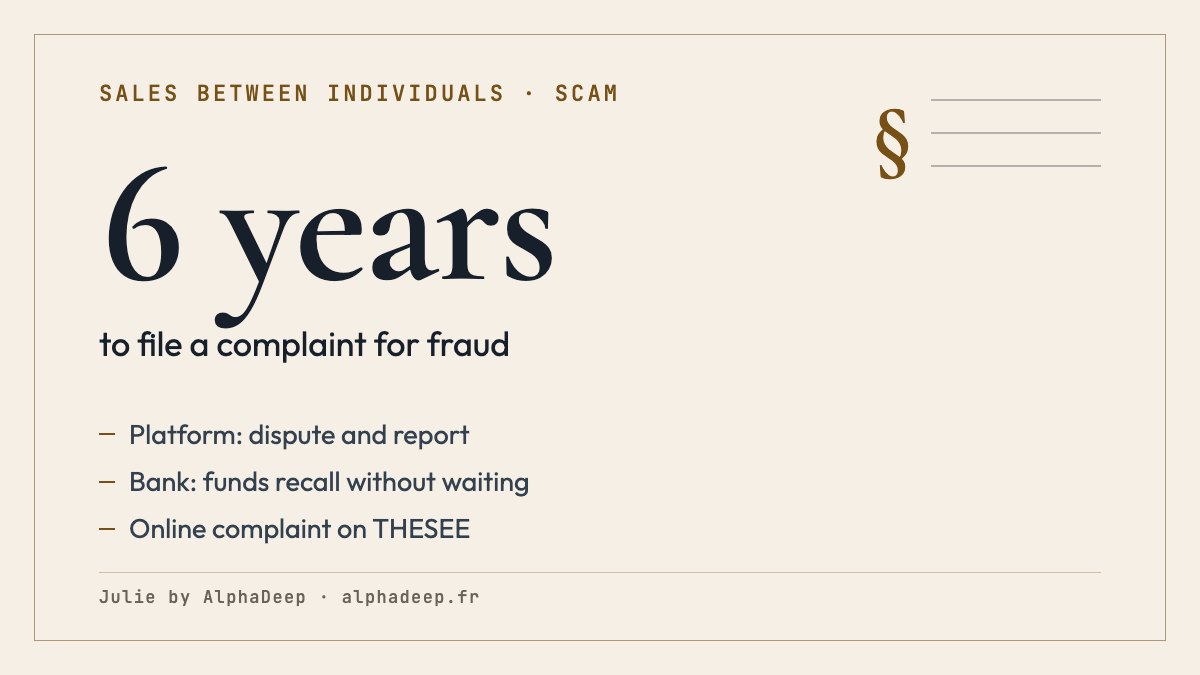
Keep the listing, messages and payment or shipping evidence, contact the platform’s dispute service and report the account. Call your bank immediately: recovery of an executed transfer is not guaranteed, and scheduled or agreed revocation has specific rules (L133-8). THESEE complaints require an adult individual and the applicable fraud conditions, including an unreachable seller for non-delivery. The ordinary criminal limitation is 6 years from the last fraudulent act, subject to starting-point, interruption and suspension rules.
Go to the tool: the legal brief
Julie by AlphaDeep is an AI legal assistant for French law: it researches official references to help answer your questions (Légifrance, case law, service-public), analyses your documents and drafts your letters, for individuals and professionals alike.
General legal information with official references and dated checks. It is not personalised advice: for a decision that commits you, have your situation checked by a qualified professional.

Let’s look at your situation
Describe the listing, the exchange with the fraudster, the payment or the shipping and what the platform told you.
Example questions
Your question carries over after signup. Maximum 400 characters. Avoid health data and names.
Which remedies against your scam?
Describe the scam, the payment method, your situation and the last fraudulent act and, for an unauthorised payment, its separate debit date and bank territory: the brief concludes, remedy by remedy. The example: an adult individual who paid by transfer an unreachable seller never met, on 12 September 2026, and received nothing.
Fictional example · brief on your scam
Three remedies to pursue together: the platform, the bank and the online complaint.
- THESEE online complaint
- possible
For these reasons
In view of your answers, the service-public fiches and the Monetary and Financial Code:
- Platform: tell the seller, then call in the site’s dispute service and report the account (fiche F34000).
- Bank: an ordinary immediate transfer cannot normally be revoked once your bank receives it; a future-dated order can be revoked by the end of the preceding business day, and later revocation requires agreement (article L133-8); call it at once to ask for the funds to be returned, with no guarantee.
- Complaint: file it online on THESEE, as the relationship stayed online only, with the IBAN used for the payment.
- Time limit: for a délit such as fraud, prosecution is time-barred after 6 years normally from the last act of fraud, which you date as 12 September 2026; a last message alone does not establish that date and interruption, suspension or postponed starting rules can require review (Code of Criminal Procedure, article 8).
Indicative analysis: the platform, the bank and investigators assess the facts and the documents in your file.
What should you do right after a scam on a site for sales between individuals?
Keep the listing, the profile, the messages, the proof of payment or shipping and the IBAN you were given, before they disappear. Tell the other party about the problem, then call in the dispute service of the site where the sale took place (service-public fiche F34000).
Cybermalveillance advises reading the terms of use to know what recourse the platform offers, preferring its secure payment and delivery options and being wary of invitations to continue the exchange outside the site.
This route concerns evidence of a fake seller or buyer: a deceptive profile, disappearance, forged payment proof or extorted fees. Late delivery or an ordinary commercial disagreement alone does not establish fraud. For a standard undelivered order, use the ordinary non-delivery guide in French.
Sources: Service-public F34000 · Cybermalveillance
Can the bank cancel a transfer sent to the fraudster?
An ordinary immediate order cannot normally be revoked once your bank receives it. A scheduled order can be revoked by the end of the preceding business day; later revocation requires agreement, and some payee-initiated orders also require payee consent (article L133-8). A transfer you ordered yourself is not an unauthorised payment: it is not refunded automatically.
Call the bank at once to ask for the funds to be returned from the payee’s bank, with no guarantee of success. A payment made without your knowledge, with your card details for example, is instead covered by the refund of unauthorised payments (article L133-18).
Sources: CMF L133-8 · CMF L133-18
Can you file a complaint online on THESEE?
Yes if you are an adult individual: THESEE takes complaints about classified-ad scams, fake seller, fake buyer or fake rental, and the IBAN used for the payment must be entered. A professional goes to a police or gendarmerie station.
The relationship must have stayed online only. With a fake seller, the order never arrived, the seller cannot be reached and asked you for money (fiche F34000); with a fake buyer, you sent the item without being paid or they made you advance fees (fiche F34019).
Sources: THESEE · Service-public F34000 · Service-public F34019
How long do you have to act?
Fraud (escroquerie), punishable by 5 years’ imprisonment and a €375,000 fine (Penal Code, article 313-1), is a délit: the ordinary criminal limitation is 6 full years from the offence, in particular the last fraudulent act (article 8). Postponed starting rules for concealed offences, interruption and suspension require separate examination (articles 9-1 to 9-3).
Report an unauthorised payment without delay: the ordinary limit is 13 months from debit, with the information exception and professional agreement to check (L133-24). Non-EEA-payee card transactions can use 70 days, contractually up to 120 (L133-1-1). A refund under L133-18 requires a qualifying report and remains subject to its exceptions. Asking for a transfer’s funds to be returned is done without waiting.
Sources: C. pén. 313-1 · CPP art. 8 · CMF L133-24 · CMF L133-1-1 · CPP 9-1 · CPP 9-2 · CPP 9-3
Which evidence should you keep before it disappears?
Keep the promise (listing and messages), payment (bank proof) and outcome (no delivery or item received) separately. They document different facts; filing a complaint does not guarantee repayment.
- Document 1
The listing and the profile
Screenshots with the page address, the username and the account’s reviews.
- Document 2
The messages
Those on the platform, and those exchanged elsewhere: phone number, messaging app, email.
- Document 3
Proof of payment or shipping
The transfer order, the receipt, the shipping slip and the parcel tracking number.
- Document 4
The IBAN you were given
The THESEE online complaint form requires it.
- Document 5
The fake proofs you received
Payment screenshots, emails or cheques shown by a fake buyer.
What does article 313-1 of the Penal Code say about fraud?
The text that defines the offence your complaint is about.
L’escroquerie est le fait, soit par l’usage d’un faux nom ou d’une fausse qualité, soit par l’abus d’une qualité vraie, soit par l’emploi de manoeuvres frauduleuses, de tromper une personne physique ou morale et de la déterminer ainsi, à son préjudice ou au préjudice d’un tiers, à remettre des fonds, des valeurs ou un bien quelconque, à fournir un service ou à consentir un acte opérant obligation ou décharge. L’escroquerie est punie de cinq ans d’emprisonnement et de 375 000 euros d’amende.
In English, briefly (our summary, not an official translation): Fraud (escroquerie) is deceiving a person by using a false name or status, by abusing a genuine status or by fraudulent schemes, and so leading them, to their own detriment or a third party’s, to hand over funds, securities or any property, to provide a service or to agree to an act creating an obligation or a discharge. It is punishable by five years’ imprisonment and a €375,000 fine. As a délit, the ordinary limitation is 6 full years from the last act of fraud (article 8, version since 12 May 2024), subject to postponed-starting, interruption and suspension rules in articles 9-1 to 9-3 of the Code of Criminal Procedure.
Which remedy for which kind of scam?
The platform, the bank and the complaint play different roles depending on the situation.
| Situation | Platform | Bank | Complaint |
|---|---|---|---|
| Fake seller: you paid, received nothing | Dispute and account report | Transfer: funds recall, no guarantee | THESEE if also seller unreachable, adult individual, online-only relationship |
| Fake buyer: item sent without payment | Account report | Check the real credit on your account | THESEE for a qualifying adult individual and online-only relationship |
| Fake buyer: fees to advance | Account report | Pay nothing; fees already paid: funds recall | THESEE for a qualifying adult individual and online-only relationship |
| Payment made without your knowledge | Account report | Report without delay; verify territory, information and applicable period; refund conditional under L133-18 | Police, gendarmerie or public prosecutor |
The THESEE online complaint is for adult individuals; a minor can make an online report.
Sources: Service-public F34000 · Service-public F34019 · CMF L133-8 · CMF L133-24 · THESEE
What do victims of a scam between individuals ask?
Is a report the same as a complaint?
No: a report (signalement) is not a complaint; it only informs investigators, and you are not told what follows (fiches F34000 and F34019). The online report is open to adults and minors alike.
A buyer sends proof of payment: should you ship?
Not before seeing the credit on your account or with the payment service: Cybermalveillance advises checking that payment or shipping proofs are genuine with the relevant service, and describes the buyer who makes you advance delivery fees.
Must the platform refund you?
Not automatically: its dispute service can step in and its terms of use set its commitments. Very large online platforms must gather professional sellers’ details and give them to you if needed so that you can hold them liable (fiche F34000).
What if it was a fake rental?
THESEE also covers classified-ad scams for fake rentals: the same reflexes apply, evidence, account report, a call to the bank without waiting, then a complaint.
What if the card was used without you?
Block the card and dispute the payment with the bank. If you still have the card and neither you nor its usual user made the online purchases, report them on Perceval, the service-public service: its receipt supports your refund request (fiche F31324).
Which texts and fiches is this brief based on?
- Internet scams: fake site, fraudulent listing (fiche F34000)Service-public.fr, in French · checked by the publisher on 16 October 2024
- Sites for sales between individuals: 20 tips to avoid scamsCybermalveillance.gouv.fr, in French · updated on 26 February 2026
- Monetary and Financial Code, article L133-8 (irrevocable order)Légifrance, in French
- Monetary and Financial Code, article L133-18 (refund of an unauthorised payment)Légifrance, in French
- THESEE: filing an online complaint for an internet scamMinistry of the Interior, in French · information updated on 31 August 2026
- Fraud by a fake buyer (fiche F34019)Service-public.fr, in French · checked by the publisher on 16 October 2024
- Penal Code, article 313-1 (fraud)Légifrance, in French
- Code of Criminal Procedure, article 8 (limitation for délits)Légifrance, in French
- Monetary and Financial Code, article L133-24 (dispute within 13 months)Légifrance, in French
- Bank card fraud and the Perceval report (fiche F31324)Service-public.fr, in French · checked by the publisher on 13 February 2026
- Monetary and Financial Code, article L133-6 (consent to the payment)Légifrance, in French
- Monetary and Financial Code, article L133-1-1 (specific territorial card scope)Légifrance, in French
- Code of Criminal Procedure, article 9-1 (concealed-offence starting rules)Légifrance, in French
- Code of Criminal Procedure, article 9-2 (interruption of criminal limitation)Légifrance, in French
- Code of Criminal Procedure, article 9-3 (suspension of criminal limitation)Légifrance, in French
Texts cited last checked: 26 September 2026