The gazetteCold calling · 11 August 2026
Cold calling in France: prior consent has replaced Bloctel since 11 August 2026
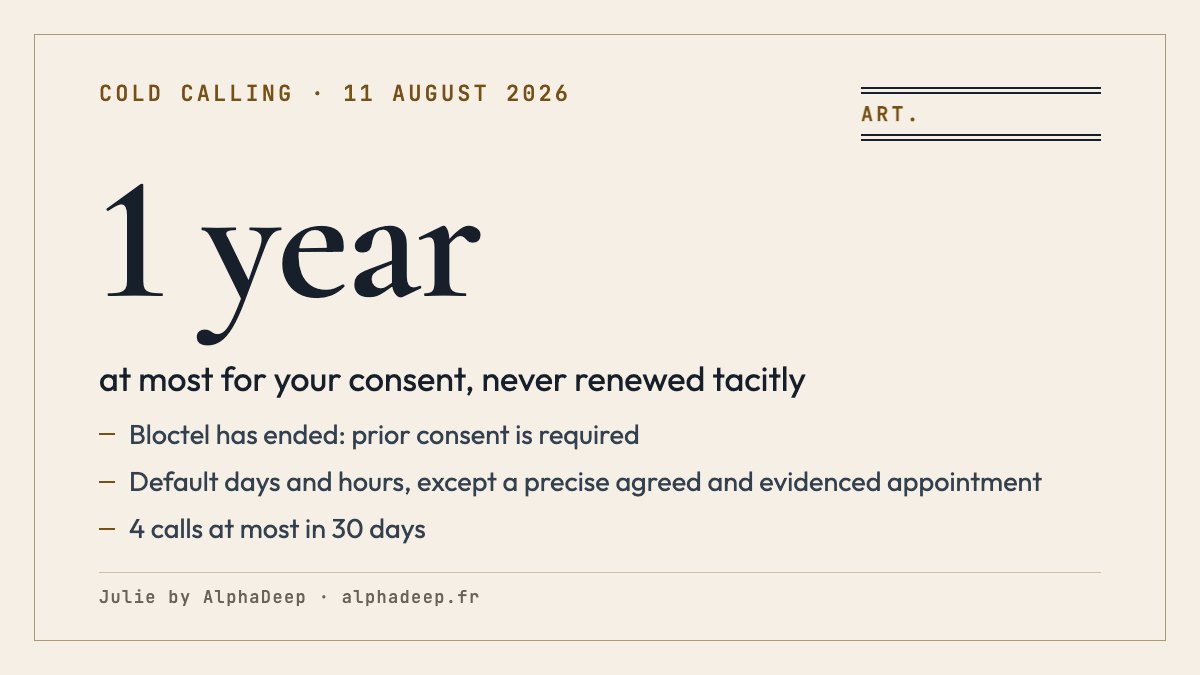
Since 11 August 2026, sales calls require prior consent, proved by the business, revocable and valid for one year at most. Authorised calls remain limited to 4 in 30 days. Default hours: Monday to Friday except holidays, 10 am to 1 pm and 2 pm to 8 pm. A precise, explicitly agreed and evidenced appointment may override day/time restrictions (L223-1 and D223-9).
Julie by AlphaDeep is an AI legal assistant for French law: it researches official references to help answer your questions (Légifrance, case law, service-public), analyses your documents and drafts your letters, for individuals and professionals alike.
General legal information with official references and dated checks. It is not personalised advice: for a decision that commits you, have your situation checked by a qualified professional.

Let’s look at your situation
Give the date and time of the call, the business, the subject and whether you had given it your consent.
Example questions
Your question carries over after signup. Maximum 400 characters. Avoid health data and names.
What changed for cold calling in France, and when?
The dates that matter, from the calling-hours rule to the end of Bloctel.
Sales calls are limited to Monday to Friday except public holidays, 10 am to 1 pm and 2 pm to 8 pm, and to 4 calls or attempts per business in 30 days; the rule has been carried over unchanged since 11 August 2026 (article D223-9).
Sources: D223-9, former version · Consumer Code D223-9
Act no. 2025-594 against all fraud involving public aid rewrites the cold-calling rules: its article 13 replaces the Bloctel opt-out with prior consent, from 11 August 2026.
Source: Act no. 2025-594
Decree no. 2026-662 sets what the consent request must contain, its length of 1 year at most, proof kept for 3 years and withdrawal, which can be oral (articles R223-1 to R223-3).
Sources: Decree no. 2026-662 · Consumer Code R223-1 · Consumer Code R223-2 · Consumer Code R223-3
Entry into force: a sales call requires your prior consent, the Bloctel service ends, and the ban on cold calling for energy renovation extends to adapting a home for old age or disability (article L223-1).
Sources: Consumer Code L223-1 · Bloctel
Refusal during a call: the business hangs up at once and never calls you again (article L221-16), where the old rule only required 60 days without a call (article D223-9, version in force until 10 August 2026).
Sources: Consumer Code L221-16 · D223-9, former version
Was this sales call allowed?
Give the call’s date and time, any prior agreement to that precise appointment and its evidence, its subject and your link with the business: the gazette applies the rule of the day of the call. The example: consent given on 20 August 2026, but a call at lunchtime, the 5th in 30 days.
Fictional example · gazette of your call
Irregular call: outside the permitted hours, beyond 4 calls in 30 days.
- Rule on the day of the call
- prior consent
- Reason for the call
- allowed
- Day and time
- outside the permitted hours
- Consent valid until, at most
- 20 August 2027
- Calls in 30 days
- 5, of 4 allowed
Until 10 August 2026
- Call allowed unless registered on Bloctel
- Energy saving: banned, except under a current contract
- After a refusal, 60 days without a call
Since 11 August 2026
- Call banned without prior consent, proved by the business
- Energy and home adaptation: banned even with consent
- After a refusal, never called again
Applicable provisions
In view of your call and the Consumer Code:
- Your consent of 20 August 2026 is valid until 20 August 2027 at most, never renewed tacitly (article R223-1): the call is allowed in principle (article L223-1).
- The call came outside 10 am to 1 pm and 2 pm to 8 pm (article D223-9), unless you expressly accepted that day and time.
- 5 calls or attempts in 30 days: a single business is limited to 4 (article D223-9).
- Ask for the call to end: the business must not call you again (article L221-16). Report the calls on SignalConso (fiche F33267); a contract signed after unlawful cold calling is void (article L223-1).
Indicative analysis: the business must prove consent; scam calls are a matter for a criminal complaint, not cold-calling rules.
When can a business still call you without your consent?
In two cases: the call concerns a current contract with it, including an add-on or an upgrade to that contract, or it offers newspapers, periodicals or magazines (articles L223-1 and L223-5). Default days and hours still apply unless a precise appointment was explicitly agreed and can be evidenced; the limit of 4 calls in 30 days still applies (article D223-9).
For energy-saving, renewable-energy or home-adaptation work for old age or disability, cold calling stays banned even with your consent, except under a current contract. Only a callback you asked for is allowed, within 5 working days and for that product alone (articles L223-1 and R223-4).
Sources: Consumer Code L223-1 · Consumer Code L223-5 · Consumer Code D223-9 · Consumer Code R223-4
What must your consent contain, and how do you withdraw it?
The request states who will call, for which products or services, for how long, 1 year at most, and how to withdraw; consent is never renewed tacitly. A pre-written statement or simply continuing to browse a website is not consent (article R223-1). When a business collects your number, it must tell you that any sales call requires your consent (article L223-2).
The business keeps proof of your consent for 3 years and gives it to you free on request (article R223-2). You can withdraw consent at any time, including orally, in a way no harder than the way it was collected (article R223-3).
Sources: Consumer Code R223-1 · Consumer Code L223-2 · Consumer Code R223-2 · Consumer Code R223-3
What should you do about an unlawful sales call?
Ask for the call to end: the business hangs up at once and must not call you again (article L221-16). Ask it for proof of your consent, then report calls that continue on SignalConso; the CNIL, France’s data protection authority, deals with misuse of your personal data (fiche F33267; fiche R58969).
A contract signed after unlawful cold calling is void (article L223-1), and an offer made by phone binds you only once signed and accepted on a durable medium (article L221-16). The business faces a fine of up to €75,000, or €375,000 for a legal entity (articles L242-16 and L242-12).
Sources: Consumer Code L221-16 · Consumer Code R223-2 · Service-public F33267 · Service-public R58969 · Consumer Code L223-1 · Consumer Code L242-16 · Consumer Code L242-12
Which rules applied before and after 11 August 2026?
The old rule and the rule in force, point by point.
| Question | Until 10 August 2026 | Since 11 August 2026 |
|---|---|---|
| Principle | Call allowed unless registered on Bloctel | Call banned without prior consent |
| Proof | Call lists checked against Bloctel | Consent proved by the business, kept 3 years |
| Length of consent | Not applicable | 1 year at most, never renewed tacitly |
| Current contract | Call allowed | Call allowed |
| Newspapers and magazines | Allowed, even if on Bloctel | Allowed without consent |
| Energy saving, renewable energy | Banned, except under a current contract | Banned even with consent, except under a current contract |
| Adapting a home for old age or disability | Allowed if not on Bloctel | Banned even with consent, except under a current contract |
| Days and hours | Monday to Friday, 10 am to 1 pm and 2 pm to 8 pm | Unchanged |
| Frequency | 4 calls in 30 days | 4 calls in 30 days |
| Refusal during the call | No call for 60 days | Call ends, never called again |
| Maximum fine | €75,000, or €375,000 for a legal entity | €75,000, or €375,000 for a legal entity |
The hours are those of the consumer’s time zone; outside them, a call is allowed only if you explicitly agreed to a precise date and time and the business can evidence it (articles D223-9 and L223-1).
Sources: L223-1, former version · Consumer Code L223-1 · Consumer Code R223-2 · Consumer Code R223-1 · Consumer Code L223-5 · D223-9, former version · Consumer Code D223-9 · Consumer Code L221-16 · Consumer Code L242-16
What does article L223-1 of the Consumer Code say?
The text that bans calls without prior consent, in force since 11 August 2026.
Il est interdit de démarcher par téléphone, directement ou par l’intermédiaire d’un tiers agissant pour son compte, un consommateur qui n’a pas exprimé préalablement son consentement à faire l’objet de prospections commerciales par ce moyen. Pour l’application du présent article, on entend par consentement toute manifestation de volonté libre, spécifique, éclairée, univoque et révocable par laquelle une personne accepte, par un acte positif clair, que des données à caractère personnel la concernant soient utilisées à des fins de prospection commerciale par voie téléphonique. Il appartient au professionnel d’apporter la preuve que le consentement du consommateur a été recueilli dans les conditions prévues au deuxième alinéa.
In English, briefly (our summary, not an official translation): It is forbidden to cold call, directly or through a third party acting on one’s behalf, a consumer who has not given prior consent to being canvassed by this means. Consent means any freely given, specific, informed, unambiguous and revocable indication by which a person accepts, by a clear positive act, that personal data about them be used for telephone canvassing. It is for the business to prove that the consumer’s consent was collected on those terms. Until 10 August 2026, the same article only protected consumers registered on the Bloctel opt-out list; Act no. 2025-594 of 30 June 2025 reversed the rule.
What do consumers ask about cold calling in France?
Do you still need to register on Bloctel?
No: the service ended on 11 August 2026, and protection no longer depends on registering, since a call now requires your prior consent (article L223-1; fiche F33267).
Does a ticked box on a website count as consent?
Only if you ticked it yourself: a pre-ticked box is not enough (fiche F33267), nor is a pre-written statement or continuing to browse (article R223-1).
Can my phone operator call me about a new offer?
Yes, without prior consent, if the call concerns your current contract, for example an extra service or an upgrade to your plan (article L223-1; fiche F33267).
How can you recognise a cold call?
Canvassing platforms call from reserved numbers, starting in mainland France with 01 62, 01 63, 02 70, 02 71, 03 77, 03 78, 04 24, 04 25, 05 68, 05 69, 09 48 or 09 49, and not with 06 or 07 (fiche F33267).
Is a contract signed after an unlawful call valid?
No: it is void, and an offer made by phone binds you only after you sign and accept it on a durable medium (articles L223-1 and L221-16).
Which texts is this gazette based on?
- Consumer Code, article L223-1 (cold calling)Légifrance, in French
- Consumer Code, article L223-1, version of 26 July 2020 to 10 August 2026 (Bloctel)Légifrance, in French
- Act no. 2025-594 of 30 June 2025 against all fraud involving public aid, article 13Légifrance, Journal officiel, in French
- Decree no. 2026-662 of 23 July 2026 (collecting, keeping and withdrawing consent)Légifrance, Journal officiel, in French
- Consumer Code, article R223-1 (consent request and validity)Légifrance, in French
- Consumer Code, article R223-2 (proof kept 3 years)Légifrance, in French
- Consumer Code, article R223-3 (withdrawing consent)Légifrance, in French
- Consumer Code, article R223-4 (callback requested by the consumer)Légifrance, in French
- Consumer Code, article L223-5 (newspapers and magazines)Légifrance, in French
- Consumer Code, article D223-9 (days, hours and frequency)Légifrance, in French
- Consumer Code, article D223-9, version of 1 March 2023 to 10 August 2026Légifrance, in French
- Consumer Code, article L221-16 (sales call and refusal)Légifrance, in French
- Consumer Code, article L242-16 (administrative fine)Légifrance, in French
- Consumer Code, article L242-12 (fine under article L221-16)Légifrance, in French
- Unwanted cold calls, voice or text spam: what to do (fiche F33267)Service-public.fr, in French · checked by the publisher on 12 August 2026
- End of Bloctel, notice from the opt-out list servicebloctel.gouv.fr, in French
- SignalConso: reporting a problem with a business (fiche R58969)Service-public.fr, in French · checked by the publisher on 10 January 2024
- Consumer Code, article L223-2 (information when a number is collected)Légifrance, in French
Texts cited last checked: 26 September 2026