The letterBanking · Written complaint
Wrong bank transfer in France: getting back money sent to a wrong IBAN or overpaid, and what your bank must do
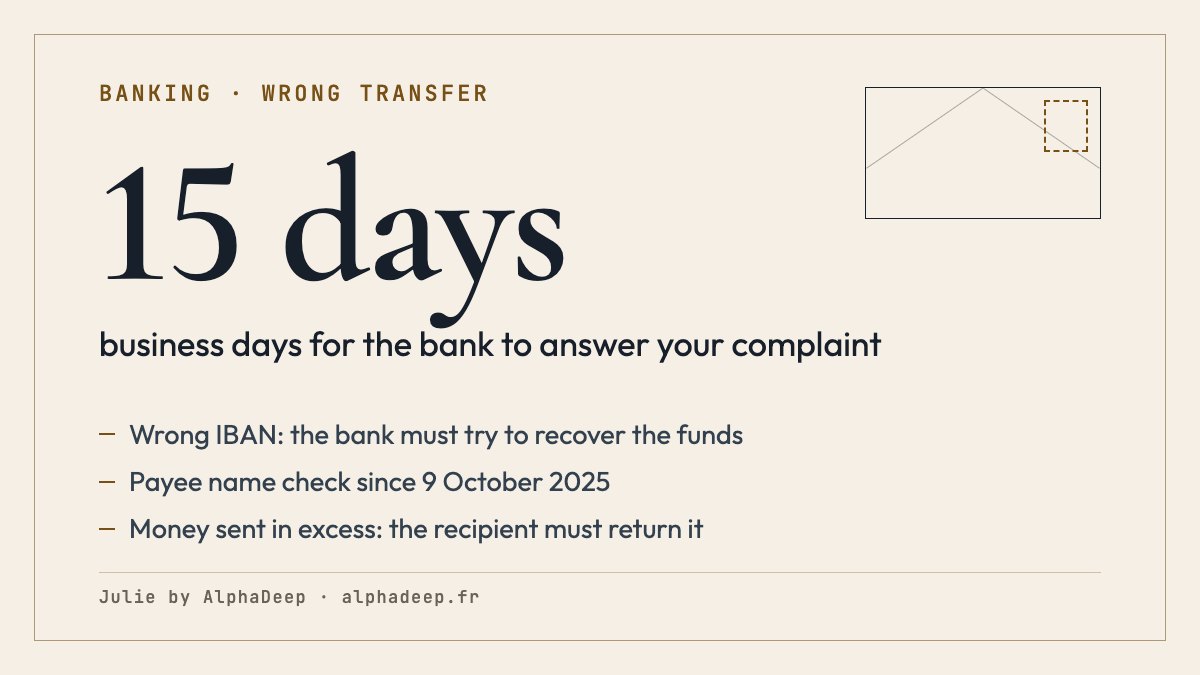
A euro SEPA transfer between EU banks executed to the IBAN entered counts as correctly executed: the bank is not liable, but must try to recover the funds and, if that fails, provide information for a court claim (French Monetary and Financial Code, article L133-21). Since 9 October 2025, the French bank must check the payee before confirmation. The recipient must return any excess payment.
Julie by AlphaDeep is an AI legal assistant for French law: it researches official references to help answer your questions (Légifrance, case law, service-public), analyses your documents and drafts your letters, for individuals and professionals alike.
General legal information with official references and dated checks. It is not personalised advice: for a decision that commits you, have your situation checked by a qualified professional.

Let’s look at your situation
Give the date and amount of the transfer, its type, the mistake and what the payee check showed.
Example questions
Your question carries over after signup. Maximum 400 characters. Avoid health data and names.
Must your French bank refund a transfer sent to a wrong IBAN?
As a rule, no: an order executed in line with the IBAN the customer gave is deemed correctly executed, and the bank is not liable if that IBAN was wrong (French Monetary and Financial Code, article L133-21). It must still make reasonable efforts to recover the funds, and the payee’s bank must give it all useful information.
If recovery fails, your bank gives you, on request, the information it holds that can support a court claim against the recipient. It may charge recovery fees if your account agreement provides for them (same article).
Source: C. mon. fin. L133-21
What has the payee name check changed since 9 October 2025?
Before you confirm a transfer, instant or ordinary, your bank checks free of charge that the payee’s name matches the IBAN and gives you one of four results: exact match, close match with the name held for the IBAN, no match, or check impossible. You stay free to confirm, correct or cancel (service-public.fr; EU regulation 2024/886).
If you confirmed despite a warning, the IBAN rule applies and nothing is refunded automatically. If the bank offered no check when it had to, and that failure led to the transfer going to the wrong account, you can ask it for a refund.
Source: Service-public A18474
Can you cancel a transfer already sent?
A transfer order can no longer be revoked once your bank has received it (French Monetary and Financial Code, article L133-8, I): for an instant transfer the money is in practice already in the other account, and only a recovery request is left.
A transfer scheduled for a set date can be revoked until the end of the business day before that date (article L133-8, III). After that, revocation is possible only if your bank agrees.
Source: C. mon. fin. L133-8
What if you transferred too much money?
Article L133-21 covers only a wrong identifier: for an amount typed in error, the bank carried out what you authorised. The recipient must return what they received without being entitled to it (French Civil Code, article 1302-1), and only the excess if they were owed part of the sum.
Ask them in writing first, and ask your bank to contact theirs. Otherwise, the claim for repayment is time-barred 5 years after the day you learned of the error (French Civil Code, article 2224).
Sources: C. civ. 1302-1 · C. civ. 2224
Is a transfer obtained through a scam an unauthorised payment?
Not automatically: a transfer you confirmed yourself, even when deceived, is not in itself “unauthorised”. For a euro transfer between EU providers, with the payer’s provider in metropolitan France, a truly unauthorised payment must be reported without delay and at the latest 13 months after the debit, unless the bank failed to provide or make the transaction information available. A different period may be agreed for professional use. Refund is due by the end of the next business day at the latest, unless the bank has good reasons to suspect customer fraud and communicates them in writing to Banque de France (French Monetary and Financial Code, articles L133-24 and L133-18).
If a fake bank adviser had you confirm the payment, the guide on that case sets out the claim against the bank and the police complaint.
Sources: C. mon. fin. L133-24 · C. mon. fin. L133-18
Which complaint should you send your French bank after a wrong transfer?
Confirm the euro SEPA scope between EU banks, then give the date, the amount, the type of transfer, the mistake and what the payee check showed: the tool names the rule that applies, dates the deadlines and drafts the complaint, in French, for your French bank. The example: €850 sent by instant transfer on 12 March 2026 to a wrong IBAN, with no payee check offered.
Fictional example · the letter to your bank
No check offered: establish the applicable obligation and its role in the mistake; ask for recovery and assessment of a possible refund.
- Rule that applies
- Payee check not offered (EU regulation 2024/886)
- Bank’s answer
- 15 business days after the complaint, 35 at most
- Mediator, at the latest
- 13 March 2027
- Claim against the recipient
- until 12 March 2031
Réclamation écrite : lettre recommandée avec accusé de réception, ou messagerie sécurisée de la banque
[Vos nom et prénom][Votre adresse]
[Nom de votre banque]Service réclamations[Adresse de l’agence ou du service]
À [ville], le [date]
ObjetVirement erroné du 12 mars 2026 de 850,00 € : demande de récupération des fonds
Madame, Monsieur,
Le 12 mars 2026, j’ai ordonné depuis mon compte n° [numéro de compte] un virement instantané de 850,00 € vers l’IBAN [IBAN saisi], au lieu de l’IBAN [IBAN voulu]. L’IBAN saisi était erroné.
Conformément à l’article L133-21 du Code monétaire et financier, je vous demande de récupérer les fonds auprès de la banque du bénéficiaire, qui doit vous communiquer toutes les informations utiles. Si la récupération échoue, je vous demande de me transmettre les informations que vous détenez pouvant documenter un recours en justice.
Aucune vérification du bénéficiaire ne m’a été proposée avant l’autorisation de ce virement. Je vous demande de vérifier l’obligation applicable (règlement (UE) 2024/886), les contrôles réalisés et leur rôle dans cette erreur, puis de m’indiquer si les conditions d’un remboursement de 850,00 € sont réunies et d’y procéder le cas échéant.
Je vous remercie de me répondre dans les quinze jours ouvrables suivant la réception de cette réclamation (article L133-45 du Code monétaire et financier).
Je vous prie d’agréer, Madame, Monsieur, l’expression de mes salutations distinguées.[Signature]
Pièces jointes : la copie de l’ordre de virement ; le relevé de compte où il apparaît
Indicative result: recovery depends on the money still being in the recipient’s account; keep the screenshot of the payee check and the statement. The complaint is in French because your French bank works in French.
What has changed for transfers since October 2025?
The payee name check changes the bank’s liability for euro transfers.
Every bank in the euro area checks, before an instant or ordinary transfer is executed, that the name typed matches the IBAN, free of charge; the customer sees the result and decides to confirm, correct or cancel (EU regulation 2024/886; service-public.fr, news item of 29 September 2025).
Source: Service-public A18474
Depending on your mistake, what can you get, and from whom?
The remedy depends on what was typed wrongly and on what the bank showed you before you confirmed.
| Situation | Rule | What you ask for | From whom |
|---|---|---|---|
| Wrong IBAN, before 9 October 2025 | Transfer deemed correctly executed (article L133-21) | Recovery of the funds, then the information to sue | Your bank |
| Wrong IBAN, mandatory payee check not offered | Failure to perform an applicable check (EU regulation 2024/886) | A refund if that failure caused the transfer to the wrong account; recovery of the funds | Your bank |
| Wrong IBAN despite a no-match warning | IBAN rule, nothing automatic | Recovery of the funds, then repayment | Your bank, then the recipient |
| Amount too high | Repayment of what was not owed (Civil Code, article 1302-1) | Repayment of the excess | The recipient, through the banks |
| Scheduled transfer, date not yet reached | Revocation until the business day before (article L133-8) | Revocation of the order | Your bank |
| Name misspelt, IBAN right | The IBAN decides which account is credited | Nothing: the money reached the intended account | Nobody |
Your bank must answer a written complaint within 15 business days, 35 at most in exceptional circumstances (Monetary and Financial Code, article L133-45).
Sources: C. mon. fin. L133-21 · C. mon. fin. L133-8 · C. civ. 1302-1 · C. mon. fin. L133-45 · Service-public A18474
What does article L133-21 of the French Monetary and Financial Code say?
The text that shares out the burden of a wrong IBAN between the customer and the two banks.
Un ordre de paiement exécuté conformément à l’identifiant unique fourni par l’utilisateur du service de paiement est réputé dûment exécuté pour ce qui concerne le bénéficiaire désigné par l’identifiant unique.
Si l’identifiant unique fourni par l’utilisateur du service de paiement est inexact, le prestataire de services de paiement n’est pas responsable de la mauvaise exécution ou de la non-exécution de l’opération de paiement.
Toutefois, le prestataire de services de paiement du payeur s’efforce de récupérer les fonds engagés dans l’opération de paiement.
In English, briefly (our summary, not an official translation): A payment order executed in line with the unique identifier given by the user is deemed correctly executed as regards the payee that identifier designates. If the unique identifier given is wrong, the payment service provider is not liable for defective execution or non-execution. The payer’s provider must nevertheless make efforts to recover the funds. Our summary of the rest: the payee’s bank must pass on useful information, and on failure the payer’s bank gives the payer the information that can support a court claim; for a transfer, the unique identifier is the IBAN.
What do customers ask after a wrong transfer?
Can my bank give me the recipient’s name and address?
If recovery fails and you ask, it must give you the information it holds that can support a court claim; the text does not list it (Monetary and Financial Code, article L133-21).
Can the bank charge for tracing the money?
Yes, if your account agreement provides for recovery fees (article L133-21).
How long does the bank have to answer my complaint?
15 business days after receiving it; in exceptional circumstances it sends a holding reply giving reasons, and the final answer comes 35 business days after at the latest (Monetary and Financial Code, article L133-45).
When can I go to my bank’s mediator?
After a written complaint without a satisfactory answer, and no later than 1 year after it; mediation is free for a private customer (Consumer Code, article L612-2, and Monetary and Financial Code, article L316-1).
Does a recipient who refuses to return the money break the law?
They must return what they received without being entitled to it (Civil Code, article 1302-1); otherwise you can sue them within 5 years (article 2224).
Which texts are these remedies after a wrong transfer based on?
- Monetary and Financial Code, article L133-8 (revoking an order)Légifrance
- Monetary and Financial Code, article L133-18 (unauthorised payment)Légifrance
- Monetary and Financial Code, article L133-21 (wrong unique identifier)Légifrance
- Monetary and Financial Code, article L133-24 (reporting within 13 months)Légifrance
- Civil Code, article 1302-1 (returning what was not owed)Légifrance
- Civil Code, article 2224 (5-year limitation)Légifrance
- Monetary and Financial Code, article L133-45 (answering complaints)Légifrance
- Monetary and Financial Code, article L316-1 (bank mediator)Légifrance
- Consumer Code, article L612-2 (mediator within the year)Légifrance
- Bank transfer: payee verification from 9 October 2025 (news item A18474, in French)Service-public.fr · published 29 September 2025
- Bank mediator: how to use it (fiche F20523, in French)Service-public.fr
- Monetary and Financial Code, article L133-1 (provider territory and currency)Légifrance
Texts cited last checked: 27 September 2026