Fines, complaints and courts · Debt · enforcement
You received a commandement de payer in France: how long you have and what to do
In France, a commandement de payer is a formal demand served by a commissaire de justice (judicial officer). For unpaid rent, you have six weeks to pay or ask a judge for time, or the lease’s termination clause can take effect (law of 6 July 1989, article 24). If it prepares a seizure and sale of your belongings, seizure can start after eight days. The Swiss commandement de payer shares the name but is a different procedure.
- Official texts cited
- Sources checked on
- Drafted with AI assistance, our method
General legal information with official references and dated checks. It is not personalised advice: for a decision that commits you, have your situation checked by a qualified professional.
Julie by AlphaDeep
You have received a commandement de payer: tell me who served it and for what debt, and I will tell you which deadline is running and what you can do before it ends.
3 free questions at signup. Avoid names and sensitive information.
How long do you have left after a commandement de payer?
Say who handed you the document, what it is for and when it was served: the worksheet shows which deadline applies and the date it ends. It applies the texts; it does not say whether the debt is owed or what a judge will decide.
Fictional example · Your deadline
Rent demand: the lease termination clause can only take effect six weeks after the demand if it stays unpaid (article 24 of the law of 6 July 1989). Before that date, pay the arrears or ask a judge for time, and contact the housing solidarity fund (FSL) whose address appears on the document.
- Six-week period ends
- 2026-11-13
- Latest service on the guarantor
- 2026-10-17
- If the date falls on a Saturday, Sunday or public holiday, the French deadline runs to the next working day (article 642 of the Code of civil procedure).
- Pay, or file your request for time, before 2026-11-13, and resume paying the full current rent.
- If your guarantor was not served by 2026-10-17, they owe no penalties or late interest.
- Keep a copy of the document and every proof of sending or payment.
Dates are computed from the date entered only. Weekend and public holiday extensions are flagged, not computed.
Which deadlines and thresholds frame a commandement de payer?
According to article 24 of the French law of 6 July 1989 as in force, a tenant has had six weeks to pay a rent demand since July 2023.
- Time to pay a rent demand citing the termination clause (two months before July 2023)
- 6 weeks
- since 29 July 2023 · Law no. 89-462 of 6 July 1989, article 24
- Wait before a seizure and sale can start
- 8 days
- in force since 2012 · Code of civil enforcement procedures, article R221-10
- Time to serve the rent demand on the guarantor
- 15 days
- since 29 July 2023 · Law no. 89-462 of 6 July 1989, article 24
- Principal below which a seizure in the home needs the enforcement judge’s permission
- 535 €
- in force since 2012 · Code of civil enforcement procedures, article R221-2
- Maximum court-granted time to pay, general law
- 2 years
- since 1 October 2016 · Civil Code, article 1343-5
- Maximum time to pay for rent arrears
- 3 years
- since 29 July 2023 · Law no. 89-462 of 6 July 1989, article 24
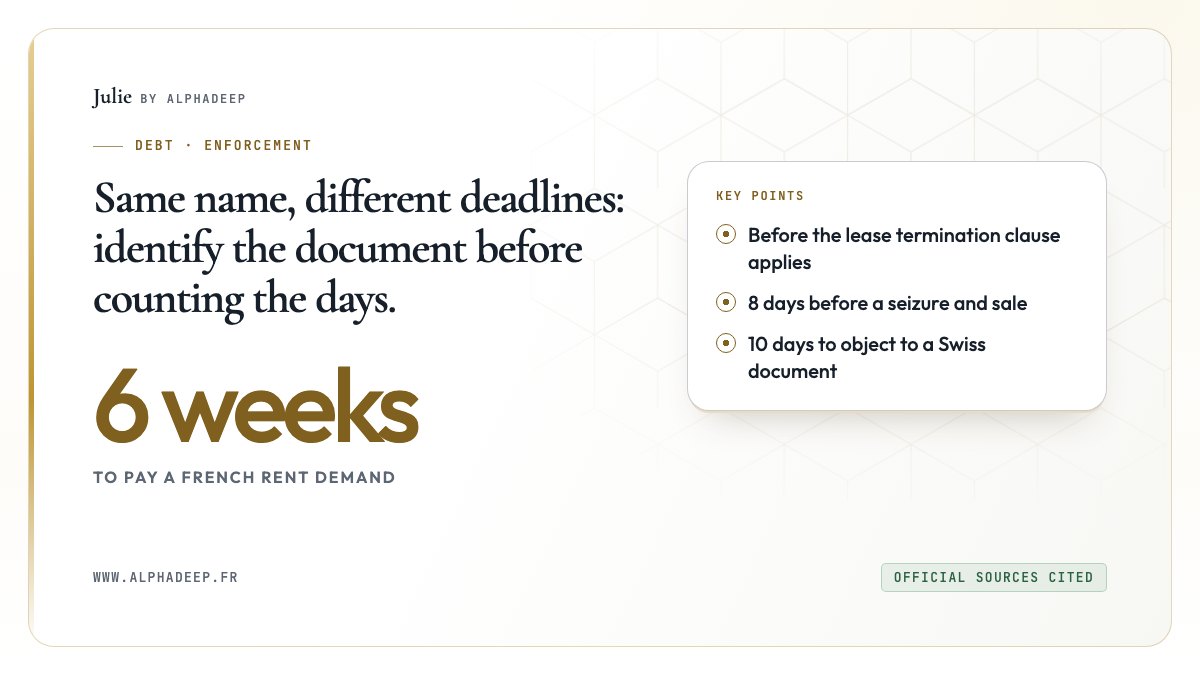
Rent or seizure: which commandement de payer have you received?
The deadline printed on the document tells you which one you have: six weeks to pay means a rent demand that triggers the lease termination clause (clause résolutoire); eight days means a demand before a seizure and sale of your belongings (commandement aux fins de saisie-vente), based on a court judgment or another enforceable title (titre exécutoire). Both are served by a judicial officer (commissaire de justice), but they lead to different places.
The rent demand prepares the end of the lease. It must state the six-week deadline, the monthly rent, a breakdown of the debt, the housing solidarity fund and your right to ask a judge for time (article 24 of the law of 6 July 1989). The seizure demand prepares the seizure of your furniture and other movables: it names the judgment or deed relied on, itemises principal, costs and interest, and orders payment within eight days (article R221-1 of the Code of civil enforcement procedures, CPCE).
Loi n° 89-462 du 6 juillet 1989 (law of 6 July 1989): article 24Code des procédures civiles d’exécution: article R221-1
What happens if you do not pay within six weeks?
If you neither pay nor ask for time within six weeks, the lease termination clause takes effect and the lease can be treated as ended by operation of law (article 24 of the law of 6 July 1989). You are not evicted that day. The landlord must sue to have the termination recorded by a judge, and the claim is notified to the prefect (préfet) at least six weeks before the hearing so that a social and financial assessment can be carried out.
The hearing still matters. The judge can grant up to three years to pay if you are able to settle the debt and have resumed paying the full current rent before the hearing. While that time runs, the clause is suspended; if you keep to the schedule, the clause is treated as never having applied. At the first missed payment, it takes full effect again.
- Pay the full current rent again, even if the arrears remain.
- Keep proof of every payment.
- Answer the social worker in charge of the assessment.
Loi n° 89-462 du 6 juillet 1989 (law of 6 July 1989): article 24
French or Swiss commandement: how do the two acts differ?
| Document | Who serves it | Deadline | What follows |
|---|---|---|---|
| Rent demand citing the termination clause (commandement visant la clause résolutoire) | A judicial officer, for the landlord | 6 weeks to pay or ask a judge for time | The clause can take effect; the landlord sues to have the lease termination recorded |
| Demand before seizure and sale (commandement aux fins de saisie-vente) | A judicial officer, for a creditor holding an enforceable title | 8 days to pay | Your belongings can be seized and sold, under the enforcement judge’s control |
| Swiss commandement de payer | The debt enforcement office, at the creditor’s request | 10 days to object, 20 days to pay | With an objection: lawsuit or mainlevée; without one: enforcement continues |
| Court payment order (injonction de payer) | A judge, then served by a judicial officer | 1 month to object | Without an objection, the order becomes an enforceable title |
In France, a deadline ending on a Saturday, Sunday or public holiday runs to the next working day.
Loi n° 89-462 du 6 juillet 1989 (law of 6 July 1989): article 24Code des procédures civiles d’exécution: article R221-1Code des procédures civiles d’exécution (Code of civil enforcement procedures): article R221-10Code de procédure civile (Code of civil procedure): article 642Swiss Debt Enforcement and Bankruptcy Act (LP), art. 69 (in French)Swiss Debt Enforcement and Bankruptcy Act (LP), art. 74 (in French)Swiss Debt Enforcement and Bankruptcy Act (LP), art. 75 (in French)Code de procédure civile: article 1416Code de procédure civile: article 1422
What does article 24 of the French law of 6 July 1989 say?
I. - Tout contrat de bail d'habitation contient une clause prévoyant la résiliation de plein droit du contrat de location pour défaut de paiement du loyer ou des charges aux termes convenus ou pour non-versement du dépôt de garantie. Cette clause ne produit effet que six semaines après un commandement de payer demeuré infructueux.
Le commandement de payer contient, à peine de nullité :
1° La mention que le locataire dispose d'un délai de six semaines pour payer sa dette ;
[…]
4° L'avertissement qu'à défaut de paiement ou d'avoir sollicité des délais de paiement, le locataire s'expose à une procédure judiciaire de résiliation de son bail et d'expulsion ;
5° La mention de la possibilité pour le locataire de saisir le fonds de solidarité pour le logement de son département, dont l'adresse est précisée, aux fins de solliciter une aide financière ;
6° La mention de la possibilité pour le locataire de saisir, à tout moment, la juridiction compétente aux fins de demander un délai de grâce sur le fondement de l'article 1343-5 du code civil.
In plain English: The lease clause that ends the tenancy for unpaid rent only takes effect six weeks after an unanswered demand. The demand must state that deadline, the risk of eviction, the housing solidarity fund’s help and your right to ask a judge for time, or it is void.
The guarantor must be served within fifteen days, or owes no penalties or late interest.
How do you ask a French judge for time to pay?
You ask the judge for time to pay (délais de grâce), at any point, by showing you can repay on a realistic schedule. Under general law, a judge can postpone or spread a debt over two years at most (article 1343-5 of the Civil Code). For rent arrears, the judge can go up to three years, provided you have resumed paying the full current rent before the hearing (article 24 of the law of 6 July 1989).
After a seizure demand, the enforcement judge (juge de l’exécution) can grant time to pay once the document has been served (article R121-1 CPCE). The judge’s decision suspends enforcement already under way, and late-payment penalties do not accrue during the period granted.
Bring a household budget, your last three payslips or benefit statements, and a monthly figure you can actually pay.
Code civil (Civil Code): article 1343-5Loi n° 89-462 du 6 juillet 1989 (law of 6 July 1989): article 24Code des procédures civiles d’exécution: article R121-1
How do you challenge a commandement before a seizure and sale?
You challenge a seizure demand before the enforcement judge, who alone hears disputes arising from enforcement, even on the merits of the debt (article L213-6 of the Code of judicial organisation). Act quickly: seizure can start once the eight-day period has expired (article R221-10 CPCE).
Check the document first. It is void if it does not name the enforceable title, give a separate breakdown of principal, costs and interest with the interest rate, or order payment within eight days (article R221-1 CPCE). Then check that the creditor really holds an enforceable title for a debt that is certain, quantified and due (article L221-1 CPCE). Finally, for a non-maintenance debt under 535 € in principal, a seizure inside your home needs the judge’s permission unless a seizure of your bank account or wages is impossible (article R221-2 CPCE).
Code de l’organisation judiciaire (Code of judicial organisation): article L213-6Code des procédures civiles d’exécution (Code of civil enforcement procedures): article R221-10Code des procédures civiles d’exécution: article R221-1Code des procédures civiles d’exécution: article L221-1Code des procédures civiles d’exécution: article R221-2
Is a Swiss commandement de payer the same procedure?
No. A Swiss commandement de payer is issued by the debt enforcement office (office des poursuites) at the creditor’s request, without any check of the debt, while the French one is a judicial officer’s document based on a lease or an enforceable title. The deadlines and the right response are different.
In Switzerland, the document orders payment within twenty days and warns that you can object (opposition) within ten days of service (article 69 of the Swiss Debt Enforcement and Bankruptcy Act, LP). You object orally or in writing, with no reasons needed (articles 74 and 75 LP), and the objection suspends the enforcement. The creditor must then go to court or apply for the objection to be lifted (mainlevée, article 79 LP). Without an objection, the creditor can ask for enforcement to continue after twenty days (article 88 LP). If you live in France and receive a Swiss one, count the ten days from service and use the Swiss mode of the worksheet.
Swiss Debt Enforcement and Bankruptcy Act (LP), art. 69 (in French)Swiss Debt Enforcement and Bankruptcy Act (LP), art. 74 (in French)Swiss Debt Enforcement and Bankruptcy Act (LP), art. 75 (in French)Swiss Debt Enforcement and Bankruptcy Act (LP), art. 79 (in French)Swiss Debt Enforcement and Bankruptcy Act (LP), art. 88 (in French)
What else do tenants and debtors ask about a French commandement de payer?
Six weeks or two months: which deadline applies to a rent commandement in France?
A rent demand citing the termination clause of a French residential lease gives six weeks. The law of 27 July 2023 replaced the former two-month period; the current wording of article 24 of the law of 6 July 1989 has applied since 29 July 2023. Some older pages still say two months.
Loi n° 89-462 du 6 juillet 1989 (law of 6 July 1989): article 24
Does your guarantor also have to receive the commandement de payer?
Yes. When a French lease is backed by a guarantor (caution), the commandement de payer must be served on them within fifteen days of being served on the tenant. Otherwise the guarantor cannot be made to pay penalties or late interest, though they still answer for the guaranteed debt (article 24 of the law of 6 July 1989).
Loi n° 89-462 du 6 juillet 1989 (law of 6 July 1989): article 24
Can the French housing solidarity fund (FSL) pay the debt?
Yes, the housing solidarity fund (fonds de solidarité pour le logement, FSL) of your French département can help pay rent arrears and judicial officer fees. Help is not automatic, depends on income and may be a loan or a grant. You usually apply through a social worker, the family allowance office (Caf) or the town’s social services (CCAS). The demand must give the FSL’s address.
Service-Public.fr: Fonds de solidarité pour le logement (FSL), what help it gives (in French)Loi n° 89-462 du 6 juillet 1989 (law of 6 July 1989): article 24
What is the difference between a commandement de payer and an injonction de payer?
A commandement de payer is a judicial officer’s demand for payment based on a lease or an enforceable title. An injonction de payer is a court order made without a hearing at the creditor’s request: you have one month after it is served to object (article 1416 of the French Code of civil procedure). Without an objection, it becomes an enforceable title.
Code de procédure civile: article 1416Code de procédure civile: article 1422
You live in France and get a Swiss commandement de payer: what now?
A Swiss commandement de payer received while living in France is a Swiss debt enforcement document. You have ten days from service to object at the office named on it, orally or in writing and without reasons (articles 74 and 75 LP). Ask for written confirmation, which is free. The objection suspends the Swiss enforcement until the creditor goes to court or obtains mainlevée (article 79 LP).
Swiss Debt Enforcement and Bankruptcy Act (LP), art. 74 (in French)Swiss Debt Enforcement and Bankruptcy Act (LP), art. 75 (in French)Swiss Debt Enforcement and Bankruptcy Act (LP), art. 79 (in French)
Which official texts set these deadlines?
- Loi n° 89-462 du 6 juillet 1989 (law of 6 July 1989): article 24French Republic / DILA: Légifrance
- Code des procédures civiles d’exécution: article R221-1French Republic / DILA: Légifrance
- Code des procédures civiles d’exécution (Code of civil enforcement procedures): article R221-10French Republic / DILA: Légifrance
- Code de procédure civile (Code of civil procedure): article 642French Republic / DILA: Légifrance
- Swiss Debt Enforcement and Bankruptcy Act (LP), art. 69 (in French)Swiss Confederation: Fedlex
- Swiss Debt Enforcement and Bankruptcy Act (LP), art. 74 (in French)Swiss Confederation: Fedlex
- Swiss Debt Enforcement and Bankruptcy Act (LP), art. 75 (in French)Swiss Confederation: Fedlex
- Code de procédure civile: article 1416French Republic / DILA: Légifrance
- Code de procédure civile: article 1422French Republic / DILA: Légifrance
- Code civil (Civil Code): article 1343-5French Republic / DILA: Légifrance
- Code des procédures civiles d’exécution: article R121-1French Republic / DILA: Légifrance
- Code de l’organisation judiciaire (Code of judicial organisation): article L213-6French Republic / DILA: Légifrance
- Code des procédures civiles d’exécution: article L221-1French Republic / DILA: Légifrance
- Code des procédures civiles d’exécution: article R221-2French Republic / DILA: Légifrance
- Swiss Debt Enforcement and Bankruptcy Act (LP), art. 79 (in French)Swiss Confederation: Fedlex
- Swiss Debt Enforcement and Bankruptcy Act (LP), art. 88 (in French)Swiss Confederation: Fedlex
- Service-Public.fr: Fonds de solidarité pour le logement (FSL), what help it gives (in French)French Republic / DILA: Service-Public.fr
Texts cited last checked: 30 October 2026