Fines, complaints and courts · Judgment · reading
Understanding a French court judgment: what it decides, your deadlines and what applies now
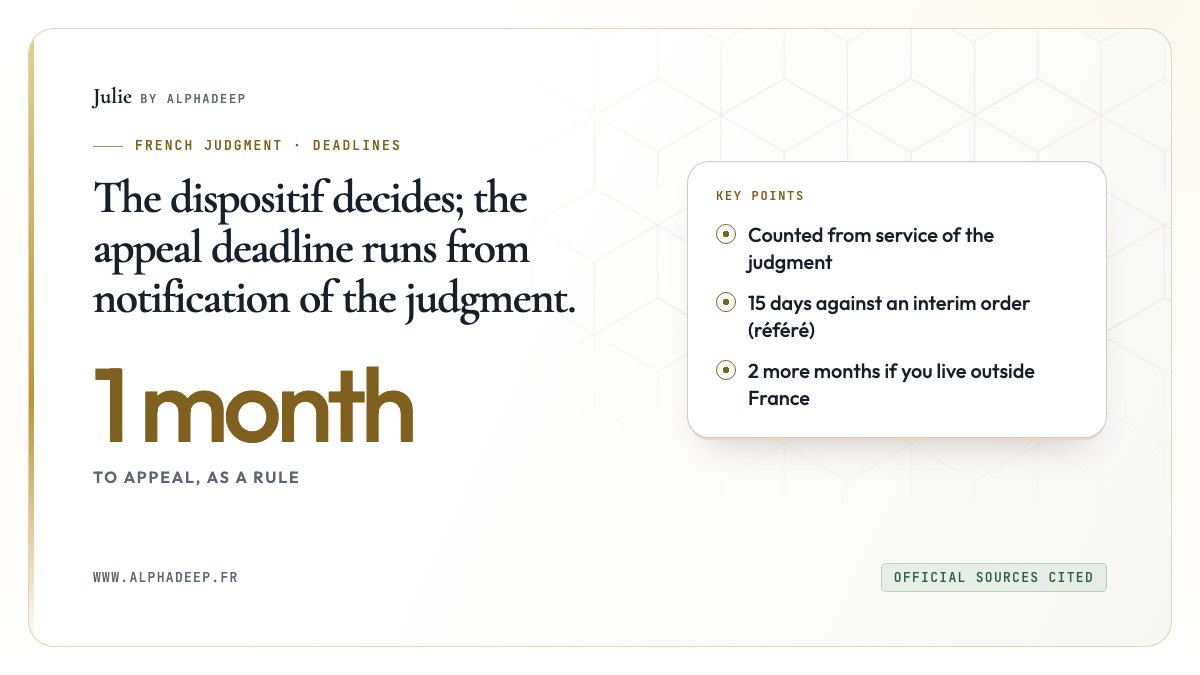
A French judgment is read first from its dispositif, the final part that usually follows the words “PAR CES MOTIFS”: that part decides the case and carries res judicata, not the reasons. The appeal deadline, one month as a rule, runs from notification, most often formal service by a commissaire de justice. For cases started since 1 January 2020, a first-instance judgment can as a rule be enforced even if you appeal.
- Official texts cited
- Sources checked on
- Drafted with AI assistance, our method
General legal information with official references and dated checks. It is not personalised advice: for a decision that commits you, have your situation checked by a qualified professional.
Julie by AlphaDeep
You have received a French judgment: tell me what worries you, and I will help you read the dispositif, find your deadline and see what already applies.
3 free questions at signup. Avoid names and sensitive information.
How do you read a French judgment: heading, reasons and dispositif?
Read a French judgment in three steps: the heading says who decided, when and between whom; the reasons (motifs) set out the judge’s reasoning; the operative part (dispositif), the final section that usually follows the words « PAR CES MOTIFS », states what is decided. Article 455 of the Code of Civil Procedure requires a judgment to set out each party’s claims and arguments, to give reasons and to state the decision « sous forme de dispositif ».
Start with the dispositif. It is the part that decides, and article 480 gives it res judicata effect (autorité de la chose jugée) from the day the judgment is delivered: the reasons explain the decision, but what binds you is what the dispositif orders. Find each verb (« condamne », orders to pay; « fixe », sets; « déboute », dismisses; « ordonne », orders) and note who owes what to whom, and from when. Then go back to the reasons to see why, and to the heading to check your name, the date and the label « contradictoire », « réputé contradictoire » or « par défaut ».
Code de procédure civile (Code of Civil Procedure): article 455Code de procédure civile (Code of Civil Procedure): article 480
What does each part of a French civil judgment contain?
| Part | Where to find it | What it tells you | What to check |
|---|---|---|---|
| Heading | First page, under « République française, au nom du peuple français » | The court, the date, the judges, the court clerk, the parties and their lawyers (article 454) | Your name, your address, the date and the case number |
| Label of the decision | In the heading or at the start of the dispositif | « Contradictoire », « réputé contradictoire » or « par défaut », first instance or last resort (article 473) | The remedy open to you: appeal, opposition or pourvoi |
| Summary of the dispute | After the heading, often under « Faits et procédure » | Each party’s claims and arguments, sometimes by reference to their dated written submissions (article 455) | That each of your claims appears |
| Reasons (motifs) | Under « Motifs de la décision » or « Sur ce » | The judge’s reasoning, claim by claim (article 455) | Why each claim was granted or dismissed |
| Operative part (dispositif) | At the end, after « PAR CES MOTIFS » | What is decided and has res judicata effect: orders, amounts, measures, costs (article 480) | Each verb (« condamne », « fixe », « déboute ») and whether provisional enforcement is set aside |
| Enforcement clause (formule exécutoire) | On the enforceable copy, after the signatures | The order to enforcement officers and the police to assist with enforcement | Without an enforceable copy, no forced enforcement is possible |
Code de procédure civile (Code of Civil Procedure): article 454Code de procédure civile (Code of Civil Procedure): article 473Code de procédure civile (Code of Civil Procedure): article 455Code de procédure civile (Code of Civil Procedure): article 480Service-public.fr: Exécution d’une décision du juge civil (in French)
What is your deadline, and does the judgment already apply?
Enter the decision you received, its label and where you live: the worksheet gives the remedy open to you, an indicative last day and what already applies. It applies the French Code of Civil Procedure; it does not assess your chances on appeal.
Fictional example · Your deadline and what applies
Family judge: appeal within one month. Orders on parental authority, maintenance, child support and contribution to marriage expenses apply by law, even if you appeal (article 1074-1). Other orders apply during the appeal only if the dispositif orders provisional enforcement.
- Deadline starts from
- 2026-09-14
- Last day to appeal
- 2026-12-14
- Read the dispositif line by line and list each order, its amount and who benefits.
- Compare the date above with the deadline stated on the service document; if it falls on a Saturday, Sunday or French public holiday, it moves to the next working day (article 642).
- If you are considering a challenge, contact a lawyer admitted in France well before the last day.
- Keep paying the maintenance set by the judgment, even if you appeal.
Indicative dates for a court in mainland France, counted from the date you enter. The worksheet does not replace the service document, which states the deadline that applies, or advice from a lawyer.
When does the deadline to appeal a French judgment start?
The deadline to appeal a French judgment runs from the day it is notified to you, not from the hearing or the day it was delivered, unless a text says otherwise (article 528 of the Code of Civil Procedure). Notification is most often formal service (signification) by a commissaire de justice, the French court enforcement officer; some decisions are notified by the court office (greffe) by registered letter with acknowledgment of receipt. The deadline is one month for a contested judgment and fifteen days in non-contentious matters (matière gracieuse) (article 538), and fifteen days against an interim order (ordonnance de référé) (article 490).
The day of notification does not count, and a deadline in months ends on the same date of the last month (article 641): a judgment served on 14 September 2026 can be appealed until midnight on 14 October 2026. A deadline that would end on a Saturday, Sunday or public holiday moves to the next working day (article 642). Before a court in mainland France, add one month if you live in an overseas territory and two months if you live abroad (article 643).
Code de procédure civile (Code of Civil Procedure): article 528Service-public.fr: Exécution d’une décision du juge civil (in French)Code de procédure civile (Code of Civil Procedure): article 538Code de procédure civile (Code of Civil Procedure): article 490Code de procédure civile (Code of Civil Procedure): article 641Code de procédure civile (Code of Civil Procedure): article 642Code de procédure civile (Code of Civil Procedure): article 643
Does a French judgment apply if you appeal?
Yes, as a rule, for cases started on or after 1 January 2020: first-instance decisions are provisionally enforceable by law (« de droit exécutoires à titre provisoire »), unless the law or the decision says otherwise (article 514 of the Code of Civil Procedure). An appeal therefore does not stop the other side from enforcing. The judge can set provisional enforcement (exécution provisoire) aside; if so, the dispositif says it. During the appeal, the first president of the court of appeal can stop it where there is a serious ground for annulment or reversal and a risk of manifestly excessive consequences.
Two courts follow their own rules. At the employment tribunal (conseil de prud’hommes), only some orders are enforceable by law, including delivery of the work certificate and payslips and pay awards up to nine months’ average salary (article R1454-28 of the Labour Code). Before the family judge (juge aux affaires familiales), orders on parental authority and child or spousal maintenance apply by law, the rest only if the judge orders it (article 1074-1). For a case started before 2020, an appeal suspends enforcement unless provisional enforcement was ordered.
Code de procédure civile (Code of Civil Procedure): article 514Service-public.fr: Exécution d’une décision du juge civil (in French)Code du travail (Labour Code): article R1454-28Code de procédure civile (Code of Civil Procedure): article 1074-1
What do the 2025 French civil justice figures show?
According to the French Ministry of Justice (Chiffres clés 2026), 95 % of the civil cases closed by courts of appeal in 2025 ended within 41.9 months.
- Decisions in civil and commercial matters (excluding special procedures)
- 1,887,786
- 2025 · French Ministry of Justice, Les chiffres clés de la Justice 2026
- Of which interim orders (référés)
- 192,459
- 2025 · French Ministry of Justice, Les chiffres clés de la Justice 2026
- Appeal rate on merits judgments of the tribunaux judiciaires
- 13.2 %
- judgments of 2024 · French Ministry of Justice, Les chiffres clés de la Justice 2026
- Appeal rate on merits judgments of employment tribunals
- 61.0 %
- judgments of 2024 · French Ministry of Justice, Les chiffres clés de la Justice 2026
- Appeal rate on merits judgments of commercial courts
- 10.2 %
- judgments of 2024 · French Ministry of Justice, Les chiffres clés de la Justice 2026
- Time within which half of civil cases end in the courts of appeal
- 9.2 months
- 2025 · French Ministry of Justice, Les chiffres clés de la Justice 2026
What do “contradictoire”, “réputé contradictoire” and “par défaut” mean?
These labels say whether the defendant took part and which challenge remains open. « Contradictoire » (defended) means the parties appeared in person or through a representative (article 467 of the Code of Civil Procedure). When the defendant does not appear, the judgment is « réputé contradictoire » (deemed defended) if it can be appealed or if the summons was handed to the defendant in person, and « par défaut » (in default) if it is given in last resort and the summons was not delivered to the defendant in person (article 473).
A defended or deemed-defended judgment is challenged by appeal (appel), unless it was given in last resort. A default judgment is challenged by opposition (opposition), an ordinary remedy open for one month in contested matters (article 538). A default judgment, or one deemed defended only because it can be appealed, lapses if it is not notified within six months of its date (article 478): check that date on the service document.
Code de procédure civile (Code of Civil Procedure): article 467Code de procédure civile (Code of Civil Procedure): article 473Code de procédure civile (Code of Civil Procedure): article 538Code de procédure civile (Code of Civil Procedure): article 478
What if the judgment contains an error or an unclear sentence?
A clerical mistake is fixed by a request for correction (rectification), and an unclear sentence by a request for interpretation (interprétation), both made to the court that gave the judgment. Correction covers clerical errors and omissions, such as a misspelt name, a miscopied amount or a wrong date, and remains possible even once the judgment is final (article 462 of the Code of Civil Procedure). Interpretation lets the judge clarify what the decision means, as long as it is not under appeal (article 461).
Neither request reopens the case: the judge corrects or clarifies what was decided, but does not change the decision. If you disagree with the reasoning or the result, the route is an appeal, within its one-month deadline from notification. Attach to your request a copy of the judgment and the document that shows the correct information, such as a birth certificate, a payslip or the contract.
Code de procédure civile (Code of Civil Procedure): article 462Code de procédure civile (Code of Civil Procedure): article 461Code de procédure civile (Code of Civil Procedure): article 538
What does article 480 of the French Code of Civil Procedure say?
Le jugement qui tranche dans son dispositif tout ou partie du principal, ou celui qui statue sur une exception de procédure, une fin de non-recevoir ou tout autre incident a, dès son prononcé, l'autorité de la chose jugée relativement à la contestation qu'il tranche.
Le principal s'entend de l'objet du litige tel qu'il est déterminé par l'article 4.
In plain English: What the dispositif decides is settled between the parties from the day the judgment is delivered: the same claim cannot be argued again before another judge, except through the remedies the law provides. « Le principal » means what the parties asked the judge to decide.
The reasons (motifs) do not carry this effect, which is why a French judgment is read from its dispositif first.
What else do people ask after receiving a French judgment?
You live outside France: do you get more time to appeal?
Yes. If you live outside France and the judgment was given by a court in mainland France, the deadlines for appeal, opposition and pourvoi en cassation are extended by two months (article 643 of the Code of Civil Procedure), or by one month if you live in a French overseas territory. A contested judgment therefore leaves you three months from service, and the two-month pourvoi deadline (article 612) becomes four months.
Code de procédure civile (Code of Civil Procedure): article 643Code de procédure civile (Code of Civil Procedure): article 612
Can a French judgment be enforced against you before it is served?
No, unless you comply voluntarily: forced enforcement of a French judgment requires that it was first notified or served on you, otherwise the enforcement can be challenged. For some urgent orders, the judge may allow enforcement on presentation of the original (minute), which then counts as notification. A provisionally enforceable judgment must therefore still be served before any seizure.
Service-public.fr: Exécution d’une décision du juge civil (in French)
How long can the other side enforce a French judgment?
A French civil judgment can be enforced for ten years. Each forced-enforcement step, such as a bank account seizure or a formal demand to pay (commandement de payer), interrupts that period and starts a new ten-year period. After that, the other side can no longer seize assets on the basis of the judgment.
Service-public.fr: Exécution d’une décision du juge civil (in French)
Does interest go up if you do not pay after a French judgment?
Yes. An order to pay a sum of money carries interest at the French statutory rate (taux de l’intérêt légal). If you have not paid two months after the judgment became enforceable, even provisionally, that rate rises by five percentage points (article L313-3 of the Monetary and Financial Code). The enforcement judge (juge de l’exécution) can, on request, remove or reduce the increase.
Code monétaire et financier (Monetary and Financial Code): article L313-3
Where do you get a copy of a French judgment?
You get a copy of a French judgment from the court office (greffe) of the court that gave it. Each party can obtain the enforceable copy (copie exécutoire), the one bearing the enforcement clause, free of charge, and a second copy for a legitimate reason such as loss or several debtors. If the court office notified the judgment, the copy shows the notification dates.
Service-public.fr: Exécution d’une décision du juge civil (in French)
Which French texts support this reading of a judgment?
- Code de procédure civile (Code of Civil Procedure): article 455République française / DILA : Légifrance
- Code de procédure civile (Code of Civil Procedure): article 480République française / DILA : Légifrance
- Code de procédure civile (Code of Civil Procedure): article 528République française / DILA : Légifrance
- Service-public.fr: Exécution d’une décision du juge civil (in French)Service-public.fr (DILA, French Prime Minister’s office)
- Code de procédure civile (Code of Civil Procedure): article 538République française / DILA : Légifrance
- Code de procédure civile (Code of Civil Procedure): article 490République française / DILA : Légifrance
- Code de procédure civile (Code of Civil Procedure): article 641République française / DILA : Légifrance
- Code de procédure civile (Code of Civil Procedure): article 642République française / DILA : Légifrance
- Code de procédure civile (Code of Civil Procedure): article 643République française / DILA : Légifrance
- Code de procédure civile (Code of Civil Procedure): article 514République française / DILA : Légifrance
- Code du travail (Labour Code): article R1454-28République française / DILA : Légifrance
- Code de procédure civile (Code of Civil Procedure): article 1074-1République française / DILA : Légifrance
- Code de procédure civile (Code of Civil Procedure): article 467République française / DILA : Légifrance
- Code de procédure civile (Code of Civil Procedure): article 473République française / DILA : Légifrance
- Code de procédure civile (Code of Civil Procedure): article 478République française / DILA : Légifrance
- Code de procédure civile (Code of Civil Procedure): article 462République française / DILA : Légifrance
- Code de procédure civile (Code of Civil Procedure): article 461République française / DILA : Légifrance
- Code de procédure civile (Code of Civil Procedure): article 454République française / DILA : Légifrance
- Code de procédure civile (Code of Civil Procedure): article 612République française / DILA : Légifrance
- Code monétaire et financier (Monetary and Financial Code): article L313-3République française / DILA : Légifrance
Texts cited last checked: 30 October 2026