Employment law · Labour court · evidence
Your chances at a French employment tribunal: assessing your case claim by claim
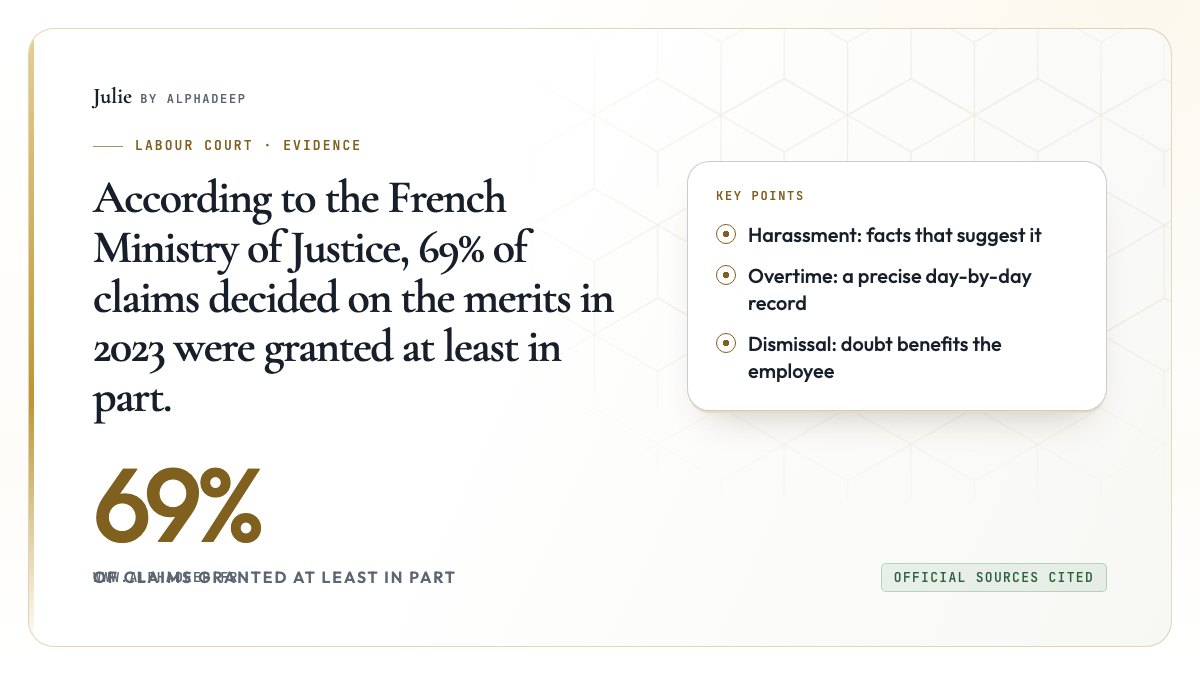
Your chances before a French employment tribunal (conseil de prud’hommes) depend on each claim. For harassment or discrimination, you only need facts that suggest it; the employer must then prove otherwise. For overtime, you present a precise record of hours and the employer answers with its own. In 2023, when the court ruled on the merits, 69% of claims were granted at least in part, according to the French Ministry of Justice.
- Official texts cited
- Sources checked on
- Drafted with AI assistance, our method
General legal information with official references and dated checks. It is not personalised advice: for a decision that commits you, have your situation checked by a qualified professional.
Julie by AlphaDeep
You are preparing a claim for a French labour court: I can go through each claim with you, check what French law requires and what your documents already prove.
3 free questions at signup. Avoid names and sensitive information.
How much does each document in your file weigh?
Pick the claim and tick the documents you have: the worksheet shows what the French Labour Code asks you to bring and what the employer must prove. It sorts your evidence; it does not predict the court’s decision.
Fictional example · What your documents bring
Evidence presented. Under article L1154-1, the judge looks at your documents together: if they suggest harassment, the employer must prove its decisions rest on objective grounds. Medical documents and a dated timeline strengthen the whole.
- Documents ticked
- 2
- Indicative deadline to file (5 years)
- 2031-09-15
- Sort each document by claim, with its date and what it shows.
- Write a dated timeline of the harassment or discrimination.
- Have a lawyer or union representative (défenseur syndical) review the file before the conciliation hearing.
The worksheet applies the French Labour Code’s rules of proof to your answers. It gives no chance of winning and does not replace a lawyer’s advice.
Who has to prove what in a French employment claim?
In a French employment claim, each side proves the facts its case needs, but the Labour Code (Code du travail) lightens that burden for the employee in several disputes. The general rule is article 9 of the Code of Civil Procedure (Code de procédure civile), adjusted claim by claim.
For harassment or discrimination, you present facts that suggest it; the employer must then prove its decisions rest on objective grounds. For overtime, the employer must give the judge evidence of the hours you actually worked, and the judge decides on both sides’ documents. For a dismissal, the judge assesses whether the employer’s stated grounds are real and serious on the evidence from both parties, and any remaining doubt benefits the employee.
If the lay judges cannot reach a majority, a professional judge decides at a tie-break hearing (départage): according to the French Ministry of Justice, this happened in 15.2% of cases closed after deliberation in 2024.
- Moral or sexual harassment: article L1154-1
- Discrimination: article L1134-1
- Working hours: article L3171-4
- Contested dismissal: article L1235-1
Code de procédure civile : article 9Code du travail : article L1154-1Code du travail : article L1134-1Code du travail : article L3171-4Code du travail : article L1235-1Références statistiques Justice, 2025 edition, 4.4: labour courts (in French)
How do you prove harassment or discrimination under French law?
To prove harassment (harcèlement moral) or discrimination in France, you do not have to establish it with certainty: you present precise, dated facts that, taken together, suggest it. The Cour de cassation, France’s highest civil court, requires the judge to examine every element relied on, medical documents included, and to check whether together they point to harassment; the employer must then prove otherwise.
In practice, gather dated emails, text messages or letters, statements from colleagues (attestations), medical certificates and sick notes, and a written timeline. For discrimination, add comparisons: the pay, promotions or training of colleagues in a similar position. The time limit to bring a harassment or discrimination claim is 5 years.
Code du travail : article L1154-1Code du travail : article L1134-1Cour de cassation, social chamber, 8 June 2016, no. 14-13.418Saisir le conseil de prud’hommes (CPH): time limits and 50 € contribution (in French)
Who carries the burden of proof for each claim?
| Claim | What you bring | What the employer must prove | Source |
|---|---|---|---|
| Moral or sexual harassment | Precise, dated facts that, taken together, suggest harassment | That the acts are not harassment and its decisions rest on objective grounds | Labour Code, art. L1154-1 |
| Discrimination | Facts suggesting direct or indirect discrimination, often by comparison | That its decision rests on objective grounds unrelated to discrimination | Labour Code, art. L1134-1 |
| Unpaid overtime | Sufficiently precise evidence of the unpaid hours (day-by-day record) | Evidence of the hours actually worked | Labour Code, art. L3171-4; Cass. soc., 18 March 2020 |
| Unfair dismissal | The dismissal letter and your evidence against its grounds | No sole burden: the judge decides on both sides, and doubt benefits the employee | Labour Code, art. L1235-1 |
| Gross misconduct (faute grave) | Your evidence contradicting the facts alleged or their seriousness | That the facts alleged happened and are serious, with doubt benefiting the employee | Labour Code, art. L1235-1 |
| Unpaid salary or bonus | The contract, payslips and the rule the sum is based on | Payment, or the fact that released it from paying | Civil Code, art. 1353; CPC, art. 9 |
These rules organise the evidence; they do not tell you in advance whether the court will be convinced.
Code de procédure civile : article 9Code du travail : article L1154-1Code du travail : article L1134-1Code du travail : article L3171-4Code du travail : article L1235-1Cour de cassation, social chamber, 18 March 2020, no. 18-10.919Code civil : article 1353
What do the official French labour-court figures show?
These figures describe all cases, not yours.
- Claims granted at least in part when the court ruled on the merits (19.4% in full, 49.6% in part)
- 69%
- 2023 · French Ministry of Justice, Références statistiques Justice, 2024 edition, chapter 8
- First-instance labour-court judgments on the merits that were appealed
- 61.0%
- judgments of 2024 · French Ministry of Justice, Les chiffres clés de la Justice, 2026 edition
- Time within which half of labour-court cases ended
- 11.1 months
- 2025 · French Ministry of Justice, Les chiffres clés de la Justice, 2026 edition
- Time within which three quarters of labour-court cases ended
- 19.2 months
- 2025 · French Ministry of Justice, Les chiffres clés de la Justice, 2026 edition
- Tie-break rate (cases decided with a professional judge), or 7,700 cases
- 15.2%
- 2024 · French Ministry of Justice, Références statistiques Justice, 2025 edition, 4.4
Is your own record enough to prove unpaid overtime?
Your own record of hours can be enough to start the case if it is precise enough for the employer to answer it with its own evidence. The Cour de cassation ruled so in 2020: the employee presents sufficiently precise evidence of the unpaid hours, the employer replies, and the judge decides on both.
A day-by-day table with start and finish times weighs more than a monthly total. It is stronger when backed by badge records, a diary, late emails or colleagues’ statements. The employer must produce evidence of your actual hours, and any automatic time-recording system must be reliable and tamper-proof. A claim for unpaid pay must be brought within 3 years.
Code du travail : article L3171-4Cour de cassation, social chamber, 18 March 2020, no. 18-10.919Saisir le conseil de prud’hommes (CPH): time limits and 50 € contribution (in French)
Can a secret recording or text messages be used as evidence?
A recording made without the employer’s knowledge is no longer excluded automatically: since a full-court ruling of 22 December 2023, a French judge may admit it if it is indispensable to the right to prove your case and the intrusion on the other side’s rights is strictly proportionate to that aim.
The judge therefore first asks whether you could have proved the point another way, through emails, witnesses or documents. A recording only helps if it fills a real gap in the file. Text messages and emails you received yourself are ordinary written evidence: keep them with their date, sender and context, and produce readable screenshots or a full export rather than a selection.
Cour de cassation, full court (assemblée plénière), 22 December 2023, no. 20-20.648Code de procédure civile : article 9
What does article L1154-1 of the French Labour Code say?
Lorsque survient un litige relatif à l'application des articles L. 1152-1 à L. 1152-3 et L. 1153-1 à L. 1153-4, le candidat à un emploi, à un stage ou à une période de formation en entreprise ou le salarié présente des éléments de fait laissant supposer l'existence d'un harcèlement.
Au vu de ces éléments, il incombe à la partie défenderesse de prouver que ces agissements ne sont pas constitutifs d'un tel harcèlement et que sa décision est justifiée par des éléments objectifs étrangers à tout harcèlement.
Le juge forme sa conviction après avoir ordonné, en cas de besoin, toutes les mesures d'instruction qu'il estime utiles.
In plain English: In a moral or sexual harassment dispute, the employee does not have to prove the harassment with certainty: they present facts that suggest it. The employer must then prove the acts are not harassment and its decisions rest on objective reasons. The judge may order any investigation needed.
The same mechanism applies to discrimination under article L1134-1 of the Labour Code.
What else should you know before filing at a French labour court?
Should you accept the payment offered at the conciliation hearing?
A payment offered at the French conciliation hearing (conciliation) should be compared with the scale in article D1235-21: from 2 months’ salary under 1 year of service to 24 months from 30 years, on top of statutory or agreed severance. Accepting ends the dispute: the signed record waives every claim linked to the end of the contract.
Code du travail : article L1235-1Code du travail : article D1235-21
Can you win at the labour court and lose on appeal?
Yes, you can win at a French labour court and lose on appeal. According to the French Ministry of Justice, 61.0% of labour-court judgments on the merits rendered in 2024 were appealed. In 2023, courts of appeal upheld 26% of decisions in full and 59% in part, and reversed 15%.
Les chiffres clés de la Justice, 2026 edition (in French)Références statistiques Justice, 2024 edition, chapter 8: labour cases (in French)
Does the Macron compensation scale apply to harassment cases?
No, the Macron compensation scale (barème Macron) does not apply to a dismissal declared void for moral or sexual harassment. Article L1235-3-1 of the French Labour Code sets the scale of article L1235-3 aside and, if the employee is not reinstated, grants at least 6 months’ salary. The same applies to discriminatory dismissals.
Code du travail : article L1235-3Code du travail : article L1235-3-1
Can you bring new evidence on appeal in France?
Yes, on appeal in France the parties may produce new documents and offer new evidence to support the claims already made before the labour court, under article 563 of the Code of Civil Procedure. Still, gather the essentials at first instance: in 2023, a labour appeal took 24.4 months on average.
Code de procédure civile : article 563Références statistiques Justice, 2024 edition, chapter 8: labour cases (in French)
What does “doubt benefits the employee” mean?
“Doubt benefits the employee” means that in a contested French dismissal, if the judge is still unsure after weighing both sides’ evidence on whether the grounds are real and serious, the judge rules for the employee. The rule is in article L1235-1 of the Labour Code; it does not excuse you from bringing evidence.
Which French texts and figures does this assessment rely on?
- Code de procédure civile : article 9République française / DILA : Légifrance
- Code du travail : article L1154-1République française / DILA : Légifrance
- Code du travail : article L1134-1République française / DILA : Légifrance
- Code du travail : article L3171-4République française / DILA : Légifrance
- Code du travail : article L1235-1République française / DILA : Légifrance
- Références statistiques Justice, 2025 edition, 4.4: labour courts (in French)French Ministry of Justice, SG, SSER
- Cour de cassation, social chamber, 8 June 2016, no. 14-13.418République française / DILA : Légifrance
- Saisir le conseil de prud’hommes (CPH): time limits and 50 € contribution (in French)Service-Public.fr (DILA)
- Cour de cassation, social chamber, 18 March 2020, no. 18-10.919République française / DILA : Légifrance
- Code civil : article 1353République française / DILA : Légifrance
- Cour de cassation, full court (assemblée plénière), 22 December 2023, no. 20-20.648République française / DILA : Légifrance
- Code du travail : article D1235-21République française / DILA : Légifrance
- Les chiffres clés de la Justice, 2026 edition (in French)French Ministry of Justice, SG, SSER
- Références statistiques Justice, 2024 edition, chapter 8: labour cases (in French)French Ministry of Justice, SG, SSER
- Code du travail : article L1235-3République française / DILA : Légifrance
- Code du travail : article L1235-3-1République française / DILA : Légifrance
- Code de procédure civile : article 563République française / DILA : Légifrance
Texts cited last checked: 30 October 2026