Employment law · Pay · classification
Doing a higher-graded job in France without the pay: classification and back pay
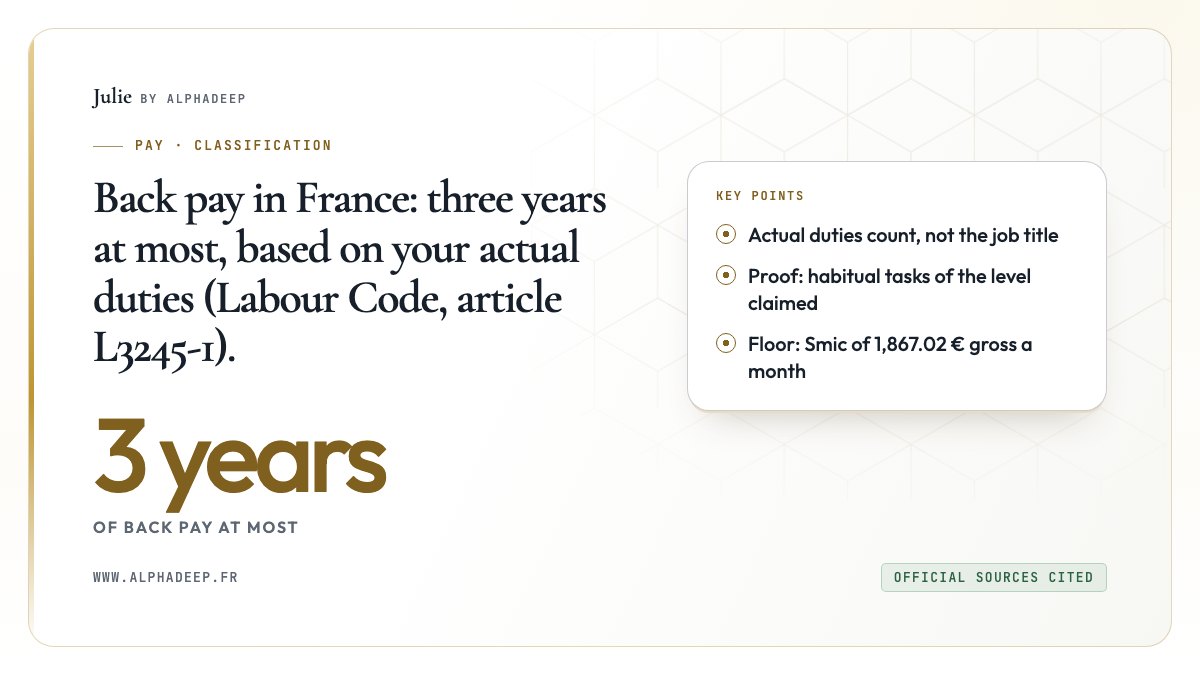
Under French law, your job classification depends on the duties you actually perform, not the title in your contract. If you carry the tasks and responsibilities of a higher level in your collective agreement permanently, not just occasionally, you can ask for that level and its minimum pay. A back-pay claim must be brought within three years and covers the last three years, or the three years before the contract ended (Labour Code, article L3245-1).
Text in force17 June 2013Sources checked30 October 2026
- Official texts cited
- Sources checked on
- Drafted with AI assistance, our method
General legal information with official references and dated checks. It is not personalised advice: for a decision that commits you, have your situation checked by a qualified professional.
Julie by AlphaDeep
You are doing a higher-graded job in France without a pay rise: I can compare your duties with your collective-agreement grid and estimate the back pay over three years.
3 free questions at signup. Avoid names and sensitive information.
How do you know if your classification matches your actual duties?
In principle your classification matches the duties you actually perform: France’s highest court, the Cour de cassation, ruled so on 12 January 2010 (No. 08-42.835), with one exception, when the employer deliberately and unequivocally grants you a higher grade. The job title in your contract or job description does not, on its own, set your level.
To check, start from the collective agreement (convention collective) that applies, the one covering your employer’s main activity (Labour Code, article L2261-2). Read how its grid defines each level or grade coefficient (coefficient): autonomy, responsibilities, supervision, required knowledge or experience. Compare that definition, point by point, with what you do each week, then note the minimum pay of the level that really describes your work.
- Your current level: contract and payslips
- The definition of the level you claim in the agreement’s grid
- Your actual tasks, with dated examples
Cour de cassation, social chamber, 12 January 2010, No. 08-42.835Code du travail (Labour Code): article L2261-2
Does covering for a departed or absent colleague entitle you to their pay?
Covering for a colleague does not automatically entitle you to their pay: it depends on whether the cover is lasting or temporary and on what your collective agreement says. If you take over a departed colleague’s duties for good, the actual-duties rule applies: you can ask for the level of the job and its agreement minimum pay (minimum conventionnel), not necessarily your predecessor’s personal salary.
For temporary cover (leave, sick leave), read your agreement’s article on replacement. In the case decided on 2 December 2020 (No. 19-19.296), the air-transport ground-staff agreement paid the grade coefficient of the job held during the cover; cover lasting more than six months then gave only a priority for the post, with no duty on the employer to promote the employee.
Cour de cassation, social chamber, 12 January 2010, No. 08-42.835Cour de cassation, social chamber, 2 December 2020, No. 19-19.296
Actual duties, cover, equal pay: which rule applies?
| Situation | Rule | Source |
|---|---|---|
| Higher-level duties performed habitually | Classification and agreement minimum of the level actually performed, to be proved by the employee | Cour de cassation, 12 January 2010 and 10 July 2024 |
| Temporary cover for an absent colleague | What the agreement provides during the cover; no automatic promotion | Cour de cassation, 2 December 2020 |
| Colleague paid more for the same work | Equal pay for equal work between employees in an identical situation | Cour de cassation, 29 October 1996 |
| Pay gap between a woman and a man | Equal pay for the same work or work of equal value | Labour Code, article L3221-2 |
| Grid minimum below the Smic | Top-up to the Smic, 1,867.02 € gross a month since 1 June 2026 | Service-public.fr, fiche F2300 |
| Contract has ended | Back pay for the three years before it ended, claim within three years | Labour Code, article L3245-1 |
| Employer argues a two-year limit | Rejected: a classification back-pay claim falls under the three-year rule | Cour de cassation, 30 June 2021 |
Cour de cassation, social chamber, 12 January 2010, No. 08-42.835Cour de cassation, social chamber, 2 December 2020, No. 19-19.296Cour de cassation, social chamber, 29 October 1996, No. 92-43.680 (Ponsolle)Code du travail (Labour Code): article L3221-2Smic (French minimum wage): amounts and rules, fiche F2300Code du travail (Labour Code): article L3245-1Cour de cassation, social chamber, 30 June 2021, No. 19-10.161
How much back pay could you claim?
This ledger adds up, month by month, the gap between the minimum pay of the level you claim and the gross pay you received, within the three-year limit of article L3245-1. It does not decide whether your duties belong to that level: your agreement’s grid and your evidence show that.
Fictional example · Your back-pay ledger
Contract still running: under article L3245-1 of the Labour Code, you can claim the last three years, and each month you wait can push an old month out of the period. Ask in writing for the level claimed and the costed back pay, with your evidence.
- Monthly gross gap
- 170.00 €
- Months counted (36 at most)
- 18
- Estimated gross back pay
- 3,060.00 €
- Copy the definition of the level claimed and its minimum for each year of the period: grids change by amendment.
- Check that the minimum used is never below the Smic for that month: the higher of the two applies.
- Sort your evidence month by month so it covers the whole period of the 3,060.00 € claim.
- Send the employer a written, costed claim by registered letter with acknowledgement of receipt (lettre recommandée avec accusé de réception).
A gross estimate from the figures you enter only: no grid or rate is assumed. It does not decide whether your duties belong to the level claimed.
Who has to prove the duties you performed, and with what documents?
You, the employee, must prove that you actually and habitually perform the tasks and responsibilities of the classification you claim (Cour de cassation, 10 July 2024, No. 23-15.453). In that case the employee claimed 7,280.04 € gross in back pay on the agreement minima from 24 April 2015 to 24 April 2018; the claim failed because nothing showed the duties of the level claimed.
Judges compare your concrete tasks with the agreement’s definition of the level. An isolated task or occasional help is not enough: you need to show a habitual practice over the whole period claimed.
- Emails, reports and signing authority in your name
- Organisation charts, rotas and internal notes presenting you in the role
- Annual review reports and the objectives set for you
- Written statements from colleagues or clients on what you do
Cour de cassation, social chamber, 10 July 2024, No. 23-15.453
How far back can you claim unpaid wages in France?
You can claim up to three years of unpaid wages: the claim must be brought within three years of the day you knew or should have known the facts, and it covers the last three years or, if the contract has ended, the three years before it ended (Labour Code, article L3245-1).
The two-year limit for other claims about how the contract was performed (article L1471-1) does not apply to claims for payment of wages. The Cour de cassation confirmed this for a classification claim: the limitation period depends on the nature of the debt, and back pay based on a classification dispute falls under the three-year rule (30 June 2021, No. 19-10.161).
While the contract continues, each month you wait can push an old month out of the period. If the contract ended on 30 April 2026, the period you can claim starts on 30 April 2023.
Code du travail (Labour Code): article L3245-1Code du travail (Labour Code): article L1471-1Cour de cassation, social chamber, 30 June 2021, No. 19-10.161
What does article L3245-1 of the French Labour Code say?
L'action en paiement ou en répétition du salaire se prescrit par trois ans à compter du jour où celui qui l'exerce a connu ou aurait dû connaître les faits lui permettant de l'exercer. La demande peut porter sur les sommes dues au titre des trois dernières années à compter de ce jour ou, lorsque le contrat de travail est rompu, sur les sommes dues au titre des trois années précédant la rupture du contrat.
In plain English: You have three years to act from the day you knew, or should have known, about the pay gap. The claim reaches back three years from that day; if the contract has ended, it covers the three years before it ended.
The two-year limit of article L1471-1 does not apply to claims for payment of wages.
Which figures frame a back-pay claim?
- Time limit for a back-pay claim, and period covered
- 3 years
- since 17 June 2013 · Labour Code, article L3245-1
- Gross monthly Smic for 35 hours, the floor under any grid
- 1,867.02 €
- since 1 June 2026 · Service-public.fr, fiche F2300
- Contribution to file with the labour court, unless on legal aid
- 50 €
- since 1 March 2026 · Code du travail numérique, French Ministry of Labour
- Limit for other claims on contract performance, not applied to wages
- 2 years
- since 1 April 2018 · Labour Code, article L1471-1
Where does your payslip show your classification?
Your payslip (bulletin de paie) must state the branch collective agreement that applies, your job and your position in the agreement’s classification, in particular the level or grade coefficient given to you (Labour Code, article R3243-1, points 3 and 4). These details usually appear in the header, near your name.
Note them on every payslip of the period claimed: a change of coefficient, or no change while your duties changed, shows when the gap began. Then compare your gross base salary with the minimum of the level claimed for that month, since grids are raised by amendment. According to service-public.fr (2026), the gross French minimum wage (Smic) has been 1,867.02 € a month for 35 hours since 1 June 2026: if the grid minimum is lower, the Smic is the floor.
Code du travail (Labour Code): article R3243-1Smic (French minimum wage): amounts and rules, fiche F2300
What else should you know before claiming classification back pay in France?
Your grid minimum is below the French minimum wage: which one applies?
If your agreement’s grid minimum is below the French minimum wage (Smic), the employer must pay a top-up to reach the Smic; if the agreement minimum is higher, it applies instead (service-public.fr, Smic fiche). Since 1 June 2026 the gross Smic has been 1,867.02 € a month for 35 hours. In a back-pay claim, use the higher of the two amounts for each month.
Is back pay taxed and subject to social contributions?
Yes, back pay is still wages: social contributions are due on it for the periods the income relates to (Social Security Code, article L242-1), and it is subject to income tax. If several years are paid at once, you can ask for the quotient system for deferred income (General Tax Code, article 163-0 A), which softens the progressive tax rates.
Code de la sécurité sociale (Social Security Code): article L242-1Code général des impôts (General Tax Code): article 163-0 A
Should you write to your employer before going to the labour court?
No prior letter is required before going to the French labour court (conseil de prud’hommes): the procedure starts with a conciliation attempt (Labour Code, article L1411-1), and the claim form lists each demand, with your last payslip attached (article R1452-2). A formal demand letter (mise en demeure) still helps: it records your claim and starts statutory interest running (Civil Code, article 1344-1). Filing costs 50 € since 1 March 2026, unless you receive legal aid.
Code du travail (Labour Code): article L1411-1Code du travail (Labour Code): article R1452-2Code civil (Civil Code): article 1344-1Labour court filing: a 50 € contribution since 1 March 2026 (in French)
Can you ask for your predecessor’s salary for the same job?
Not automatically: what you are owed first is the agreement minimum of the level you actually perform. The French principle of equal pay for equal work (à travail égal, salaire égal) compares employees in an identical situation (Cour de cassation, 29 October 1996, No. 92-43.680). A gap with your predecessor must rest on a real difference: in that ruling, seniority already paid through a bonus did not justify it.
Cour de cassation, social chamber, 29 October 1996, No. 92-43.680 (Ponsolle)Cour de cassation, social chamber, 12 January 2010, No. 08-42.835
Which French texts and rulings support this back-pay claim?
- Cour de cassation, social chamber, 12 January 2010, No. 08-42.835République française / DILA : Légifrance
- Code du travail (Labour Code): article L2261-2République française / DILA : Légifrance
- Cour de cassation, social chamber, 2 December 2020, No. 19-19.296République française / DILA : Légifrance
- Cour de cassation, social chamber, 29 October 1996, No. 92-43.680 (Ponsolle)République française / DILA : Légifrance
- Code du travail (Labour Code): article L3221-2République française / DILA : Légifrance
- Smic (French minimum wage): amounts and rules, fiche F2300République française / DILA : Service-Public.fr
- Code du travail (Labour Code): article L3245-1République française / DILA : Légifrance
- Cour de cassation, social chamber, 30 June 2021, No. 19-10.161République française / DILA : Légifrance
- Cour de cassation, social chamber, 10 July 2024, No. 23-15.453République française / DILA : Légifrance
- Code du travail (Labour Code): article L1471-1République française / DILA : Légifrance
- Labour court filing: a 50 € contribution since 1 March 2026 (in French)French Ministry of Labour: Code du travail numérique
- Code du travail (Labour Code): article R3243-1République française / DILA : Légifrance
- Code de la sécurité sociale (Social Security Code): article L242-1République française / DILA : Légifrance
- Code général des impôts (General Tax Code): article 163-0 ARépublique française / DILA : Légifrance
- Code du travail (Labour Code): article L1411-1République française / DILA : Légifrance
- Code civil (Civil Code): article 1344-1République française / DILA : Légifrance
- Code du travail (Labour Code): article R1452-2République française / DILA : Légifrance
Texts cited last checked: 30 October 2026