Fines, complaints and courts · Bailiff · fees
French bailiff (commissaire de justice) fees in 2026: the tariff for each act and who pays
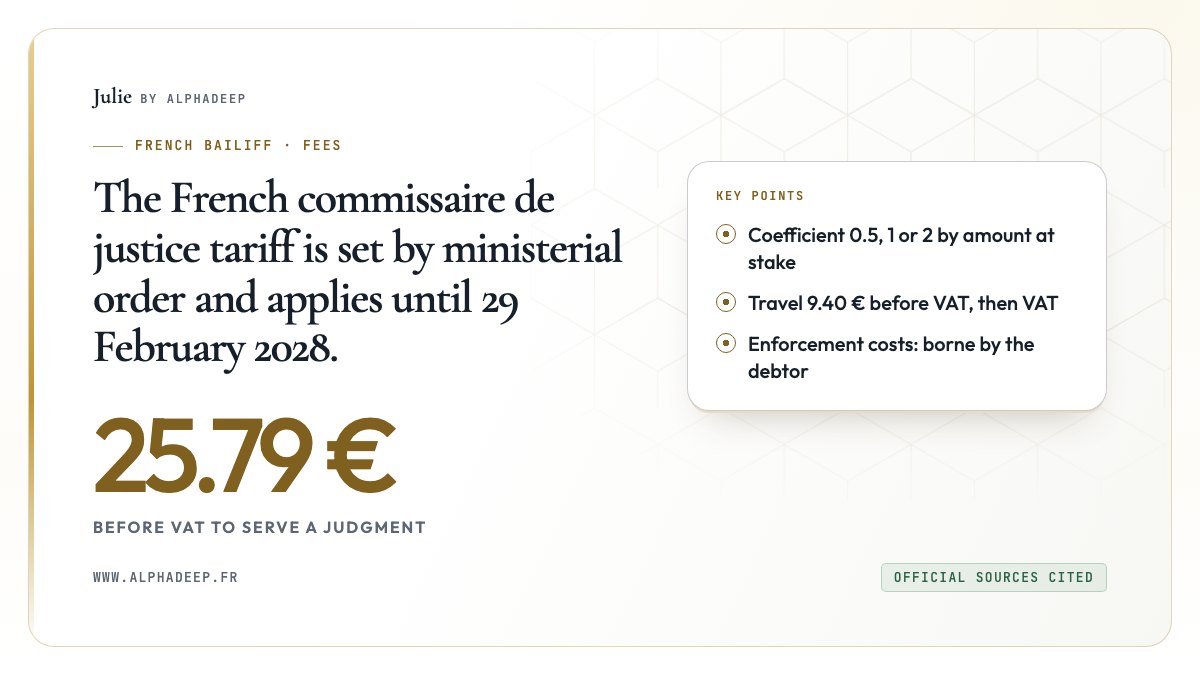
The fees of a French commissaire de justice (formerly huissier, often called a bailiff in English) are set by ministerial order and apply until 29 February 2028: 25.79 euros before VAT to serve a judgment, 44.05 euros for a bank-account seizure, 110.68 to 193.43 euros for a rental inventory. A coefficient based on the amount at stake, travel costs and VAT are added. Enforcement costs are in principle borne by the debtor.
- Official texts cited
- Sources checked on
- Drafted with AI assistance, our method
General legal information with official references and dated checks. It is not personalised advice: for a decision that commits you, have your situation checked by a qualified professional.
Julie by AlphaDeep
You received an act or a statement from a French commissaire de justice: I can check each line against the tariff with you and see who must pay it.
3 free questions at signup. Avoid names and sensitive information.
How much does each act cost in 2026?
| Act | Fee before VAT | Text | Good to know |
|---|---|---|---|
| Summons (assignation) | 18.28 euros | Commercial Code, art. A444-11 | Multiplied by 0.5, 1 or 2 depending on the sum claimed |
| Service of a judgment (signification) | 25.79 euros | Commercial Code, art. A444-11 | 51.58 euros if the award exceeds 1,280 euros |
| Urgent service (24 h, at the client’s request) | 90.18 euros | Commercial Code, art. A444-12 | Replaces the ordinary fee for a summons or judgment |
| Payment order for rent and charges (commandement de payer) | 25.79 euros | Commercial Code, art. A444-14 | Plus the enforcement opening fee (art. A444-15) |
| Bank-account seizure (saisie-attribution) | 44.05 euros | Commercial Code, art. A444-16 | 21.49 euros if the account is closed or overdrawn |
| Payment order before wage seizure | 37.08 euros | Commercial Code, art. A444-22-1 | Seizure report served on the employer: 55.62 euros |
| Eviction report (procès-verbal d’expulsion) | 153.67 euros | Commercial Code, art. A444-24 | 184.40 euros including VAT in mainland France |
| Rental inventory when the parties cannot agree | 110.68, 128.95 or 193.43 euros | Commercial Code, art. A444-27 | Depends on floor area; cost split in half |
On top come the coefficient in article A444-46 for acts about a sum of money, the overseas uplift, travel (9.40 euros before VAT per act) and VAT (20 % in mainland France). Amounts apply until 29 February 2028.
Code de commerce (French Commercial Code): article A444-11 (summons, service)Code de commerce (French Commercial Code): article A444-12 (urgent service)Code de commerce (French Commercial Code): article A444-14 (payment orders)Code de commerce (French Commercial Code): article A444-16 (seizures)Code de commerce (French Commercial Code): article A444-22-1 (wage seizure)Code de commerce (French Commercial Code): article A444-24 (eviction)Code de commerce (French Commercial Code): article A444-27 (rental inventory)Quel est le tarif d’un huissier (à présent appelé commissaire de justice) pour un litige locatif ? (fiche F32973, in French)Code de commerce (French Commercial Code): article A444-46 (0.5, 1 and 2 coefficients)Code de commerce (French Commercial Code): article A444-10 (overseas uplifts, tariff period)Code de commerce (French Commercial Code): article A444-48 (travel costs)
Which acts have a fixed tariff, and which are freely priced?
Acts that only a commissaire de justice may carry out have a tariff fixed by ministerial order: service of documents and judgments, enforcement (payment orders, seizures, eviction), a rental inventory drawn up when the parties cannot agree, and recovery on an enforceable title (titre exécutoire). The amounts are in articles A444-11 to A444-32 of the Commercial Code (Code de commerce). For these acts, no sum other than the tariff may be charged, apart from outlays paid to third parties (article R444-13).
Other services compete with unregulated professions and are freely priced under a written fee agreement: amicable debt collection, formal questioning of a party (sommation interpellative), notices ending a residential lease, reports of findings (constats) other than the rental inventory, and preparatory drafting of a summons (annexe 4-9 of the Commercial Code). For a constat, ask for a quote first.
Code de commerce (French Commercial Code): article A444-11 (summons, service)Code de commerce (French Commercial Code): article A444-16 (seizures)Code de commerce (French Commercial Code): article R444-13Code de commerce (French Commercial Code): annexe 4-9 (freely priced services)
Who pays the commissaire de justice: the debtor or the creditor?
Enforcement costs are borne by the debtor, unless they were clearly unnecessary when incurred (article L111-8 of the Code of Civil Enforcement Procedures). Costs of collecting a debt without an enforceable title, such as an amicable reminder, stay with the creditor, and any contract clause saying otherwise is void.
When a debt is recovered on a title, two recovery fees add up. Fee no. 128, borne by the debtor, is capped at 550 euros before VAT; fee no. 129, borne by the creditor, is capped at 5,540 euros. According to service-public.fr (page checked on 11 March 2026), for 4,000 euros recovered in mainland France the debtor bears 81.39 euros and the creditor 257.45 euros before VAT. The enforcement judge (juge de l’exécution) may put some of the creditor’s costs on a debtor acting in bad faith.
Code des procédures civiles d’exécution (Code of Civil Enforcement Procedures): article L111-8Qui doit payer l’huissier de justice (à présent appelé commissaire de justice) qui se charge de réclamer un impayé ? (fiche F33335, in French)Code de commerce (French Commercial Code): article A444-31 (recovery fee no. 128)Code de commerce (French Commercial Code): article A444-32 (recovery fee no. 129)
What will the act cost you, all included?
Pick the act, the amount at stake and the place: the worksheet applies the Commercial Code tariff (fee, coefficient, overseas uplift, travel, VAT, recovery fees) and shows who bears the cost. It does not settle a dispute, which is for the judge.
Fictional example · Regulated cost of the act
Service of a judgment: the fee follows article A444-11 (A444-12 if urgent), multiplied by the coefficient in article A444-46. Who bears it follows the court-costs order in the judgment, and any dispute goes to the enforcement judge.
- Fee before VAT after coefficient and uplift
- 51.58 euros
- Total before VAT, travel included
- 60.98 euros
- VAT
- 12.20 euros
- Total cost of the act, VAT included
- 73.18 euros
- Compare the line for the act with the computed total (73.18 euros including VAT); a gap may come from outlays (postage, court registry fees) reimbursed on top of the tariff.
- Ask the commissaire de justice for the detailed account: each act, its fee, travel, VAT and outlays.
- If the disagreement continues, apply to the enforcement judge (juge de l’exécution), who rules on disputes over costs (article L111-8 of the Code of Civil Enforcement Procedures).
Indicative calculation from the Commercial Code tariff in force until 29 February 2028. It leaves out outlays and the doubled rates for maintenance debts, and it does not settle a dispute.
How much does a rental inventory by a commissaire cost, and who pays?
A rental inventory (état des lieux) drawn up by a commissaire de justice, when landlord and tenant cannot do it together, costs 110.68, 128.95 or 193.43 euros before VAT depending on whether the home measures up to 50 m², 50 to 150 m² or over 150 m² (article A444-27 of the Commercial Code). The cost is split in half between the two parties.
According to service-public.fr (page checked on 9 March 2026), that comes to 132.82, 154.74 or 232.12 euros including VAT in mainland France, so 66.41, 77.37 or 116.06 euros each. The letters calling both parties are added, at 18.06 euros including VAT each according to the same page. No coefficient linked to a sum of money applies to this act.
Code de commerce (French Commercial Code): article A444-27 (rental inventory)Quel est le tarif d’un huissier (à présent appelé commissaire de justice) pour un litige locatif ? (fiche F32973, in French)
How do you read a commissaire de justice’s statement of account?
Read a commissaire de justice’s statement of account (décompte) line by line: the principal debt and interest, then the cost of each act, the enforcement opening fee, the recovery fee, travel, VAT and outlays. Each act’s cost should equal the tariff fee multiplied by the 0.5, 1 or 2 coefficient that depends on the amount at stake.
The enforcement opening fee (droit d’engagement des poursuites) comes with payment orders. It is proportional to the debt, capped at 268.13 euros, and may be charged only once for the same debt (article A444-15). A fee of 150 euros before VAT matches a debt of about 33,600 euros. It is later offset against recovery fee no. 128 or no. 129. Travel is a flat 9.40 euros before VAT per act (8.80 euros for electronic service only).
- Principal, interest and court costs set by the judgment
- Cost of each act: fee × coefficient, travel, VAT
- Enforcement opening fee: once only
- Fee no. 128: at most 550 euros before VAT
Code de commerce (French Commercial Code): article A444-46 (0.5, 1 and 2 coefficients)Code de commerce (French Commercial Code): article A444-15 (enforcement opening fee)Code de commerce (French Commercial Code): article A444-48 (travel costs)
Which figures frame the profession and its fees?
According to the French Ministry of Justice (Chiffres clés 2026), 3,739 commissaires de justice were practising on 1 January 2026. Their tariff, set by the Justice and Economy ministers, runs until 2028.
- Commissaires de justice in practice
- 3,739
- 1 January 2026 · Ministère de la Justice, Les chiffres clés de la Justice 2026
- End date of the current fee tariff
- 29 February 2028
- in force since 1 March 2026 · Code de commerce, article A444-10 (order of 25 February 2026)
- Average result-rate objective used to set the profession’s tariffs
- 33.84 %
- 2026 · Arrêté du 25 février 2026 (NOR ECOC2519621A), article 3
- Rental inventory by a commissaire, home up to 50 m², including VAT in mainland France, split in half
- 132.82 euros
- page checked on 9 March 2026 · Service-public.fr, fiche F32973
- Rental inventory by a commissaire, home over 150 m², including VAT in mainland France
- 232.12 euros
- page checked on 9 March 2026 · Service-public.fr, fiche F32973
- Cap on the recovery fee borne by the debtor (no. 128), before VAT
- 550 euros
- since 1 March 2024 · Code de commerce, article A444-31
What does article L111-8 of the French Code of Civil Enforcement Procedures say?
A l'exception des droits proportionnels de recouvrement ou d'encaissement qui peuvent être mis partiellement à la charge des créanciers dans des conditions fixées par décret en Conseil d'Etat, les frais de l'exécution forcée sont à la charge du débiteur, sauf s'il est manifeste qu'ils n'étaient pas nécessaires au moment où ils ont été exposés. Les contestations sont tranchées par le juge.
Les frais de recouvrement entrepris sans titre exécutoire restent à la charge du créancier, sauf s'ils concernent un acte dont l'accomplissement est prescrit par la loi au créancier. Toute stipulation contraire est réputée non écrite, sauf disposition législative contraire.
Cependant, le créancier qui justifie du caractère nécessaire des démarches entreprises pour recouvrer sa créance peut demander au juge de l'exécution de laisser tout ou partie des frais ainsi exposés à la charge du débiteur de mauvaise foi.
In plain English: Enforcement costs fall on the debtor unless they were clearly unnecessary. Costs of collecting a debt without an enforceable title stay with the creditor, whatever the contract says. The judge settles disputes and may make a debtor acting in bad faith bear some of the creditor’s costs.
The tariff itself is in articles A444-10 to A444-48 of the French Commercial Code.
How do you challenge the bill or the statement?
To challenge a bill or statement, first ask the commissaire de justice for a written breakdown of each line, then compare it with the tariff: for a regulated act, no sum other than the tariff and outlays may be charged (article R444-13 of the Commercial Code). Point out each discrepancy in writing, with the tariff article next to it.
If the disagreement continues, article L111-8 of the Code of Civil Enforcement Procedures leaves disputes over enforcement costs to the judge. The enforcement judge can strike out a cost that was clearly unnecessary or charged without an enforceable title. Paying the debt does not mean you accept the disputed costs: keep a written record of your objections.
Code de commerce (French Commercial Code): article R444-13Code des procédures civiles d’exécution (Code of Civil Enforcement Procedures): article L111-8
What else do people ask about French bailiff fees?
Did the tariffs change on 1 March 2026?
No, French commissaire de justice tariffs did not change on 1 March 2026. The order of 25 February 2026 extended the fees in force until 29 February 2028 (article A444-10 of the Commercial Code). The amounts date from 1 March 2024; wage-seizure fees date from 1 July 2025.
Code de commerce (French Commercial Code): article A444-10 (overseas uplifts, tariff period)Code de commerce (French Commercial Code): article A444-22-1 (wage seizure)
Does the 3 euro per m² cap apply to a commissaire’s inventory?
No, the 3 euro per m² cap does not cover a rental inventory drawn up by a commissaire de justice because the parties could not agree. That cap limits the tenant’s share when a third party such as a letting agent is instructed (décret n° 2014-890, article 2). A commissaire’s inventory follows article A444-27 of the Commercial Code, and its cost is split in half.
Décret n° 2014-890 of 1 August 2014: article 2Code de commerce (French Commercial Code): article A444-27 (rental inventory)Quel est le tarif d’un huissier (à présent appelé commissaire de justice) pour un litige locatif ? (fiche F32973, in French)
Can a debt-collection agency add management fees to your debt?
No, a debt-collection agency cannot pass its management fees on to the debtor for amicable collection in France. Article L111-8 of the Code of Civil Enforcement Procedures leaves collection costs incurred without an enforceable title with the creditor, and any clause saying otherwise is void. Only the enforcement judge can decide differently for a debtor acting in bad faith.
Code des procédures civiles d’exécution (Code of Civil Enforcement Procedures): article L111-8
Does the 14.89 euro flat tax on acts still exist?
No, the 14.89 euro flat tax on French bailiff acts no longer exists. Article 302 bis Y of the French Tax Code was repealed for acts drawn up from 1 January 2021. A « flat tax » (taxe forfaitaire) line on a recent commissaire de justice act should therefore be challenged.
Code général des impôts (French Tax Code): article 302 bis Y (repealed)
Are fees higher in the French overseas departments?
Yes, commissaire de justice fees are higher in the French overseas territories: +29 % in Guadeloupe, +28 % in Martinique, +24 % in French Guiana, +37 % in La Réunion, +30 % in Mayotte, Saint-Pierre-et-Miquelon and Wallis and Futuna (article A444-10 of the Commercial Code). VAT, however, is 8.5 % in Guadeloupe, Martinique and La Réunion, against 20 % in mainland France.
Code de commerce (French Commercial Code): article A444-10 (overseas uplifts, tariff period)Qui doit payer l’huissier de justice (à présent appelé commissaire de justice) qui se charge de réclamer un impayé ? (fiche F33335, in French)
Which French texts set the commissaire de justice tariff?
- Code de commerce (French Commercial Code): article A444-11 (summons, service)French Republic / DILA: Légifrance
- Code de commerce (French Commercial Code): article A444-12 (urgent service)French Republic / DILA: Légifrance
- Code de commerce (French Commercial Code): article A444-14 (payment orders)French Republic / DILA: Légifrance
- Code de commerce (French Commercial Code): article A444-16 (seizures)French Republic / DILA: Légifrance
- Code de commerce (French Commercial Code): article A444-22-1 (wage seizure)French Republic / DILA: Légifrance
- Code de commerce (French Commercial Code): article A444-24 (eviction)French Republic / DILA: Légifrance
- Code de commerce (French Commercial Code): article A444-27 (rental inventory)French Republic / DILA: Légifrance
- Quel est le tarif d’un huissier (à présent appelé commissaire de justice) pour un litige locatif ? (fiche F32973, in French)French Republic / DILA: Service-public.fr
- Code de commerce (French Commercial Code): article A444-46 (0.5, 1 and 2 coefficients)French Republic / DILA: Légifrance
- Code de commerce (French Commercial Code): article A444-10 (overseas uplifts, tariff period)French Republic / DILA: Légifrance
- Code de commerce (French Commercial Code): article A444-48 (travel costs)French Republic / DILA: Légifrance
- Qui doit payer l’huissier de justice (à présent appelé commissaire de justice) qui se charge de réclamer un impayé ? (fiche F33335, in French)French Republic / DILA: Service-public.fr
- Code de commerce (French Commercial Code): annexe 4-9 (freely priced services)French Republic / DILA: Légifrance
- Code de commerce (French Commercial Code): article R444-13French Republic / DILA: Légifrance
- Code des procédures civiles d’exécution (Code of Civil Enforcement Procedures): article L111-8French Republic / DILA: Légifrance
- Code de commerce (French Commercial Code): article A444-15 (enforcement opening fee)French Republic / DILA: Légifrance
- Code de commerce (French Commercial Code): article A444-31 (recovery fee no. 128)French Republic / DILA: Légifrance
- Code de commerce (French Commercial Code): article A444-32 (recovery fee no. 129)French Republic / DILA: Légifrance
- Décret n° 2014-890 of 1 August 2014: article 2French Republic / DILA: Légifrance
- Code général des impôts (French Tax Code): article 302 bis Y (repealed)French Republic / DILA: Légifrance
Texts cited last checked: 30 October 2026