Fines, complaints and courts · Access to law · free
Free legal advice in France: which service fits your problem, and how to make the most of it
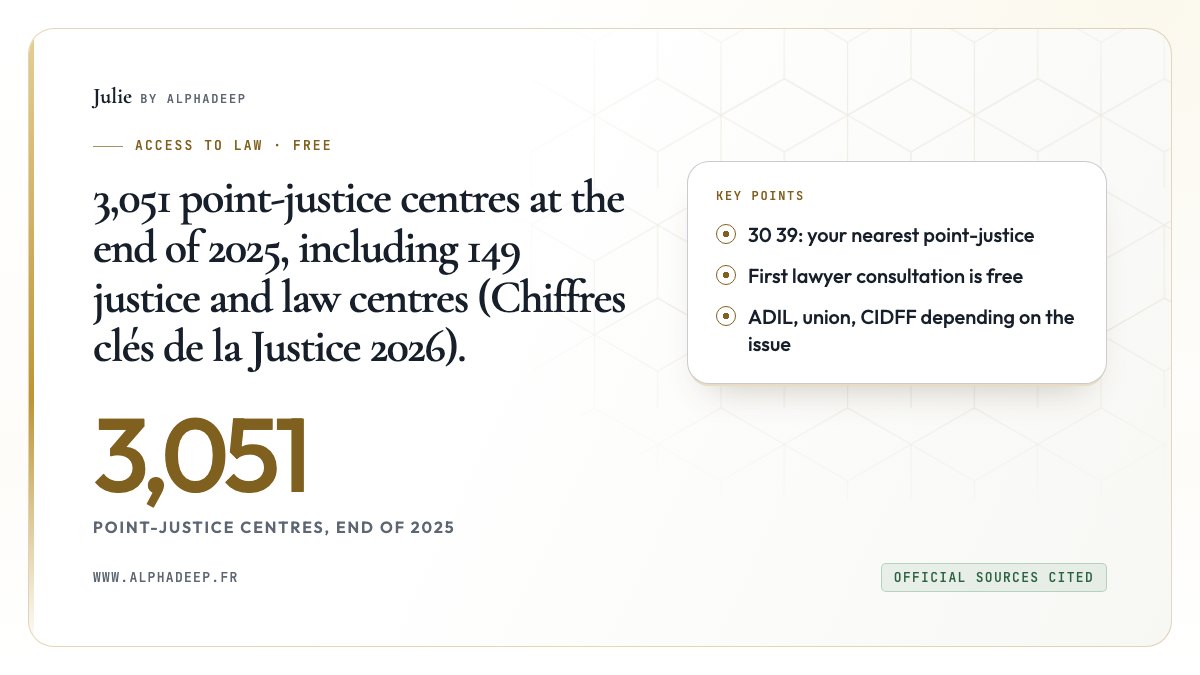
For free legal advice in France, start with a point-justice: there were 3,051 of them at the end of 2025, including 149 maisons de justice et du droit, and the 30 39 helpline points you to the nearest. Lawyers, notaries, conciliators or associations see you there free of charge. Depending on the problem, a specialised service can go further: ADIL for housing, a union for work, the Défenseur des droits against an administration.
- Official texts cited
- Sources checked on
- Drafted with AI assistance, our method
General legal information with official references and dated checks. It is not personalised advice: for a decision that commits you, have your situation checked by a qualified professional.
Julie by AlphaDeep
You are looking for free legal advice in France: tell me your problem, and I will point you to the free service that fits and help you prepare the appointment.
3 free questions at signup. Avoid names and sensitive information.
What is a point-justice, and who will you see there?
A point-justice is a free, confidential advice centre where you get information on your rights and obligations in France, or are directed to the right body. According to the French Ministry of Justice (Chiffres clés 2026), France had 3,051 point-justice centres at the end of 2025, including 149 justice and law centres (maisons de justice et du droit).
Depending on the place, you see a lawyer, a notary, a volunteer court conciliator (conciliateur de justice), an association’s legal adviser or a delegate of the rights ombudsman (Défenseur des droits). Justice and law centres sit under the president of the local court and the public prosecutor; they also handle victim support and amicable settlement (article R131-1 of the Judicial Organisation Code). This free help is the access-to-law service defined by article 53 of the law of 10 July 1991. To find the nearest, call 30 39, free and anonymous, or search by town in the ministry’s directory.
French Ministry of Justice: point-justice directory, 30 39 and 116006 lines (in French)Les chiffres clés de la Justice, 2026 edition (PDF, in French)Code de l’organisation judiciaire (Judicial Organisation Code), article R131-1Loi n° 91-647 du 10 juillet 1991 (Legal Aid Act), article 53
Where should you start, step by step?
The order that avoids wasting a free appointment, based on the rules of the French public access-to-law services.
1. Spot the deadline
A hearing, an appeal deadline or a limitation period sets the urgency. With a deadline close, see a lawyer at once: a complaint to the Défenseur des droits does not pause deadlines.
2. The specialised service
ADIL for housing, a union for work, a CIDFF for family matters, a Défenseur des droits delegate against a public body: they know your type of dispute.
Code de la construction et de l’habitation (Housing Code), article L366-1Loi n° 71-1130 du 31 décembre 1971, article 64Loi organique n° 2011-333 du 29 mars 2011 (Défenseur des droits), article 4
3. A point-justice through 30 39
Free, confidential information and routing; lawyers, notaries and conciliators hold sessions there. From abroad: +33 9 70 82 31 90.
French Ministry of Justice: point-justice directory, 30 39 and 116006 lines (in French)
4. The free lawyer consultation
At a point-justice, the bar or a town hall. Only the first one is free: prepare it so you ask the right questions.
Comment consulter gratuitement un avocat ? (F20706, checked 22 July 2026, in French)Cour de cassation, 1st civil chamber, 5 June 2019, n° 18-13.843
5. Paying for what follows
Legal-expenses insurance first, then legal aid if your resources are too low.
Code des assurances (Insurance Code), article L127-1Loi n° 91-647 du 10 juillet 1991, article 2
Which free service fits your situation?
Pick your area and situation: the sheet lists the free services in order, what each does and does not do, and what to prepare. It does not say whether your claim is well founded.
Fictional example · The free services for your case
Start with the specialised service for your area, then a point-justice through 30 39. Only the first lawyer consultation is free: bring a timeline, your documents and three precise questions.
- Contact first
- Your département’s ADIL (housing information agency): free advice on leases, charges, deposits and purchases. It never goes to court for you.
- Next
- A point-justice through 30 39 (free, anonymous)
- Insurance
- Check your home, car and bank-card contracts for a legal-expenses cover
- Write a one-page timeline: dates, people, amounts, what you have already done.
- Gather contract, letters, emails, decisions and summonses, sorted by date.
- Prepare three precise questions, most important first. If your French is limited, bring someone who can interpret.
- At the end, ask which service or professional can take over, and at what cost.
General routing based on your answers, with no view on the merits. Opening hours and sessions vary by town: check them on 30 39 or in the Ministry of Justice directory.
How do you get a free appointment with a lawyer in France?
To get a free appointment with a lawyer in France, go through a point-justice (30 39), your local bar’s free session (permanence d’avocats) or a town-hall (mairie) consultation. Service-public.fr says these are open whatever your situation and nationality, but only the first consultation is free.
Each bar (barreau) publishes its session calendar and how to register on its website or by phone. In a town hall, any registered lawyer may give free consultations without prior authorisation from the bar, the Cour de cassation ruled on 5 June 2019. According to the Chiffres clés 2026, 36 % of the 2,865 France services centres also hosted access-to-law sessions at the end of 2025.
If you belong to a union or an approved association, ask it: they may advise their members on matters linked to their purpose. Sessions are in French; bring an interpreter if needed.
Comment consulter gratuitement un avocat ? (F20706, checked 22 July 2026, in French)Cour de cassation, 1st civil chamber, 5 June 2019, n° 18-13.843Les chiffres clés de la Justice, 2026 edition (PDF, in French)Loi n° 71-1130 du 31 décembre 1971, article 64Loi n° 71-1130 du 31 décembre 1971, article 63
Which free service fits your problem: housing, work, family, administration?
The right free service depends on the area: the ADIL for housing, a trade union for work, a CIDFF for family matters, the Défenseur des droits against a public body or discrimination, and 116006 if you are a victim.
These services often go further than a general session, but each has a limit. The ADIL (housing information agency) advises tenants and owners free of charge, but takes no court or commercial action (article L366-1 of the Housing Code). The Défenseur des droits defends your rights against public bodies and fights discrimination; a complaint is free but does not pause your deadlines. A court conciliator, a volunteer, seeks a settlement in neighbour or consumer disputes.
- Housing: the ADIL of your département
- Work: a union, then an employment lawyer
- Family, couple: a CIDFF or family-law session
- Public body, discrimination: a Défenseur des droits delegate
- Victim of an offence: 116006
Code de la construction et de l’habitation (Housing Code), article L366-1Loi organique n° 2011-333 du 29 mars 2011 (Défenseur des droits), article 4Loi organique n° 2011-333 du 29 mars 2011, article 6Décret n° 78-381 du 20 mars 1978 (conciliateurs de justice), article 1FNCIDFF: the CIDFF network (in French)French Ministry of Justice: point-justice directory, 30 39 and 116006 lines (in French)
What does each free service do, and where does it stop?
| Service | For what | Who you see | How to reach it | Limit |
|---|---|---|---|---|
| Point-justice, justice and law centre (maison de justice et du droit) | Information, routing, first consultation | Lawyer, notary, conciliator, legal adviser, ombudsman delegate | 30 39, or the ministry directory by town | Hours and sessions vary by place |
| Free lawyer session (bar, town hall) | Legal opinion on your situation | Lawyer registered with the bar | Bar website or switchboard, town hall | Only the first consultation is free |
| ADIL | Lease, charges, deposit, purchase | ADIL legal adviser | ADIL of the département, in person or by phone | No court action or steps taken for you |
| Trade union | Pay, contract, dismissal | Union legal adviser or lawyer | Workplace section or local union office | For the people its statutes defend, often members only |
| Défenseur des droits delegate | Public bodies, discrimination, children’s rights | Volunteer delegate of the ombudsman | Local session or online complaint | Does not pause any appeal or limitation deadline |
| Court conciliator (conciliateur de justice) | Neighbours, consumer, small disputes | Volunteer conciliator | Town hall, point-justice or court | Seeks an agreement, does not decide the dispute |
| CIDFF | Family, couple, violence, women’s rights | CIDFF legal adviser | Département centre or local session | Focused on women’s and family rights |
French Ministry of Justice: point-justice directory, 30 39 and 116006 lines (in French)Comment consulter gratuitement un avocat ? (F20706, checked 22 July 2026, in French)Code de la construction et de l’habitation (Housing Code), article L366-1Loi n° 71-1130 du 31 décembre 1971, article 64Loi organique n° 2011-333 du 29 mars 2011, article 6Décret n° 78-381 du 20 mars 1978 (conciliateurs de justice), article 1FNCIDFF: the CIDFF network (in French)
How many access-to-law centres are there, and how many people do they see?
According to the Chiffres clés de la Justice 2026, published by the French Ministry of Justice on 29 October 2026.
- Point-justice centres in France, including 149 justice and law centres
- 3,051
- at 31 December 2025 · French Ministry of Justice, Les chiffres clés de la Justice 2026, p. 9
- People received in justice and law centres
- 1.4 million
- 2025 · French Ministry of Justice, Les chiffres clés de la Justice 2026, p. 9
- Court conciliators in office
- 3,050
- at 1 January 2026 · French Ministry of Justice, Les chiffres clés de la Justice 2026, p. 9
- Settlement rate: 105,105 cases settled out of 233,673 referrals closed
- 45.0 %
- 2025 · French Ministry of Justice, Les chiffres clés de la Justice 2026, p. 9
- State access-to-law budget, down 10 % in one year
- €14.5m
- 2025 · French Ministry of Justice, Les chiffres clés de la Justice 2026, p. 9
Can the lawyer at a free session then take on your case?
Yes, the lawyer you meet at a free session can then take on your case, but that work is no longer free: only the first consultation is, and fees are then agreed with the lawyer, unless legal aid (aide juridictionnelle) or legal-expenses insurance pays (service-public.fr).
You do not have to choose that lawyer: you remain free to pick another one. If your resources are low, legal aid can cover all or part of the cost of a court case; it is refused when an insurance contract already covers those costs (article 2 of the law of 10 July 1991). The local access-to-law council (CDAD) may also leave part of a consultation’s cost to you, under a scale based on resources (article 58).
Comment consulter gratuitement un avocat ? (F20706, checked 22 July 2026, in French)Loi n° 91-647 du 10 juillet 1991, article 2Loi n° 91-647 du 10 juillet 1991, article 58
How do you prepare for a short free legal consultation?
To make a short free consultation count, arrive with a written timeline, your documents sorted by date and three precise questions. No law sets the length of the session: each bar or centre decides, and service-public.fr refers you to the bar to find out.
Start with the nearest deadline or hearing, if there is one: it decides what happens next. Sum up the facts in two minutes, show the key documents, then ask your questions in order of importance. Write down the answers and ask who can take over. If you do not read French well, bring someone who does.
- ID and, if relevant, the summons or decision you received
- Contract, lease, payslips or letters exchanged
- A one-page timeline with dates and amounts
- Three written questions
Comment consulter gratuitement un avocat ? (F20706, checked 22 July 2026, in French)French Ministry of Justice: point-justice directory, 30 39 and 116006 lines (in French)
What does article 53 of the French law of 10 July 1991 say?
L'aide à l'accès au droit comporte :
1° L'information générale des personnes sur leurs droits et obligations ainsi que leur orientation vers les organismes chargés de la mise en oeuvre de ces droits ;
[…]
3° La consultation en matière juridique ;
[…]
Les conditions dans lesquelles s'exerce l'aide à la consultation en matière juridique sont déterminées par le conseil départemental de l'accès au droit en conformité avec les règles de déontologie des personnes chargées de la consultation et dans le respect des dispositions du titre II de la loi n° 71-1130 du 31 décembre 1971 portant réforme de certaines professions judiciaires et juridiques.
In plain English: French law makes information on your rights, routing to the right body and legal consultation a public service: access-to-law aid (aide à l’accès au droit). Each département’s access-to-law council (CDAD) sets the terms of the consultations, within the ethics rules of lawyers and other professionals.
The same council may leave part of the cost to you, depending on your resources (article 58).
What else should you know before a free legal consultation in France?
Can you call the 30 39 helpline from outside France?
The 30 39 number is not the one to dial from outside mainland France: from abroad or a French overseas territory, the Ministry of Justice gives +33 9 70 82 31 90. French nationals living abroad cannot be excluded from access-to-law services; with no other link, the Paris access-to-law council handles their questions.
French Ministry of Justice: point-justice directory, 30 39 and 116006 lines (in French)Loi n° 91-647 du 10 juillet 1991, article 59
Is what you say at a point-justice confidential?
Yes, the French Ministry of Justice describes point-justice centres as free and confidential, and the 30 39 line is anonymous. In a justice and law centre, everyone who works there is bound by confidentiality, notably on personal data (article R131-9 of the Judicial Organisation Code). A lawyer is also bound by professional secrecy.
French Ministry of Justice: point-justice directory, 30 39 and 116006 lines (in French)Code de l’organisation judiciaire, article R131-9
Does a complaint to the Défenseur des droits pause your deadlines?
No, a complaint to the Défenseur des droits, the French rights ombudsman, does not pause your deadlines: article 6 of the organic law of 29 March 2011 says it neither interrupts nor suspends limitation periods or appeal deadlines. If a deadline is running, file your appeal or see a lawyer without waiting for its answer.
Loi organique n° 2011-333 du 29 mars 2011, article 6Loi organique n° 2011-333 du 29 mars 2011, article 37
Can legal-protection insurance pay the lawyer after the free session?
Yes, French legal-expenses insurance (protection juridique) can pay a lawyer’s fees after the free consultation, within the contract’s limits and caps (article L127-1 of the Insurance Code). You choose your lawyer freely, and the insurer may not suggest one without your written request (article L127-3). Look for this cover in your home, car or bank contracts.
Code des assurances (Insurance Code), article L127-1Code des assurances (Insurance Code), article L127-3Comment consulter gratuitement un avocat ? (F20706, checked 22 July 2026, in French)
Is a free consultation the same as French legal aid?
No. A free consultation gives one-off advice on your rights, with no means test. French legal aid (aide juridictionnelle) is different: it pays all or part of the cost of a court case and of the lawyer who defends you there, if your resources are too low (article 2 of the law of 10 July 1991). It is refused when insurance already covers those costs.
Loi n° 91-647 du 10 juillet 1991, article 2Comment consulter gratuitement un avocat ? (F20706, checked 22 July 2026, in French)
Which official texts and documents does this guide to free legal help rely on?
- French Ministry of Justice: point-justice directory, 30 39 and 116006 lines (in French)French Ministry of Justice
- Les chiffres clés de la Justice, 2026 edition (PDF, in French)French Ministry of Justice, SSER
- Code de l’organisation judiciaire (Judicial Organisation Code), article R131-1French Republic / DILA: Légifrance
- Comment consulter gratuitement un avocat ? (F20706, checked 22 July 2026, in French)Service-public.fr (DILA)
- Loi n° 91-647 du 10 juillet 1991 (Legal Aid Act), article 53French Republic / DILA: Légifrance
- Cour de cassation, 1st civil chamber, 5 June 2019, n° 18-13.843French Republic / DILA: Légifrance
- Code de la construction et de l’habitation (Housing Code), article L366-1French Republic / DILA: Légifrance
- Loi n° 71-1130 du 31 décembre 1971, article 64French Republic / DILA: Légifrance
- Loi organique n° 2011-333 du 29 mars 2011 (Défenseur des droits), article 4French Republic / DILA: Légifrance
- Loi organique n° 2011-333 du 29 mars 2011, article 6French Republic / DILA: Légifrance
- Décret n° 78-381 du 20 mars 1978 (conciliateurs de justice), article 1French Republic / DILA: Légifrance
- Loi n° 71-1130 du 31 décembre 1971, article 63French Republic / DILA: Légifrance
- FNCIDFF: the CIDFF network (in French)Fédération nationale des CIDFF
- Loi n° 91-647 du 10 juillet 1991, article 58French Republic / DILA: Légifrance
- Code des assurances (Insurance Code), article L127-1French Republic / DILA: Légifrance
- Code des assurances (Insurance Code), article L127-3French Republic / DILA: Légifrance
- Loi n° 91-647 du 10 juillet 1991, article 2French Republic / DILA: Légifrance
- Loi n° 91-647 du 10 juillet 1991, article 59French Republic / DILA: Légifrance
- Code de l’organisation judiciaire, article R131-9French Republic / DILA: Légifrance
- Loi organique n° 2011-333 du 29 mars 2011, article 37French Republic / DILA: Légifrance
Texts cited last checked: 30 October 2026