Fines, complaints and courts · Judgment · France and Switzerland
Enforcing a French judgment in Switzerland, and a Swiss judgment in France
Under the Lugano Convention on judgments, a French judgment is recognised in Switzerland without any procedure, but enforcement needs a declaration of enforceability (art. 38). First ask the registry of the French court that ruled for the Article 54 certificate. For a money claim, the Swiss judge lifting the debtor’s opposition can rule on enforceability as a preliminary question. In the other direction, apply to the registry of the French tribunal judiciaire.
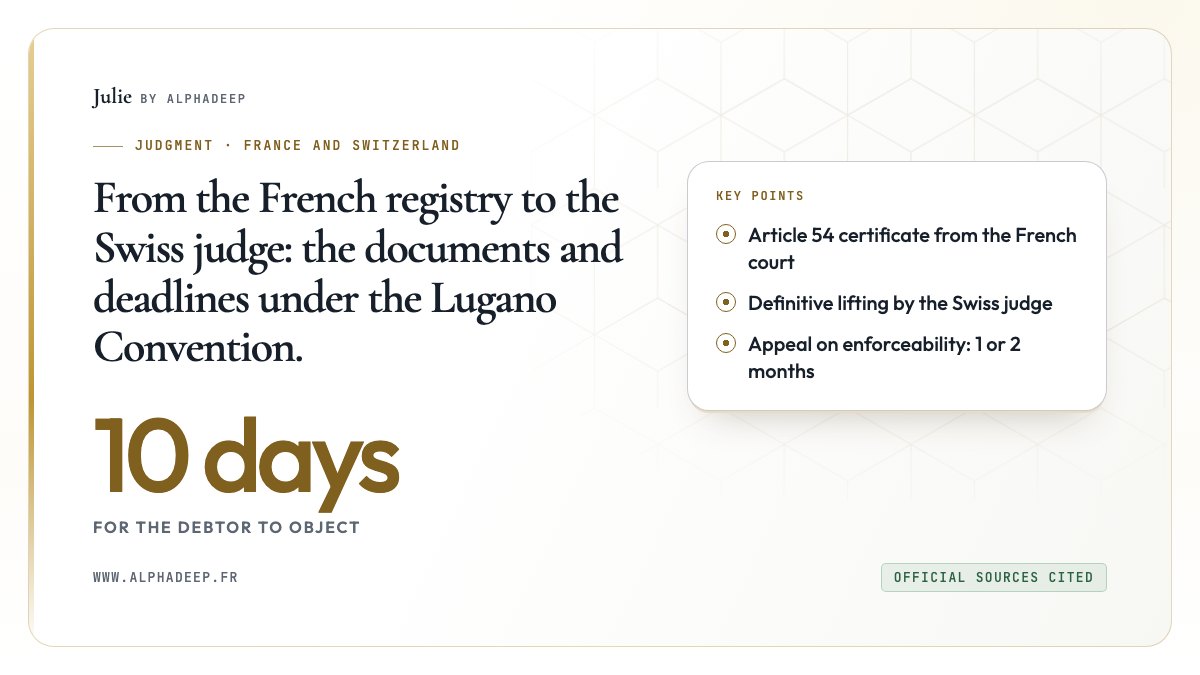
- Article 54 certificate from the French court
- Definitive lifting by the Swiss judge
- Appeal on enforceability: 1 or 2 months
- Official texts cited
- Sources checked on
- Drafted with AI assistance, our method
General legal information with official references and dated checks. It is not personalised advice: for a decision that commits you, have your situation checked by a qualified professional.
Julie by AlphaDeep
You have a judgment to enforce between France and Switzerland: tell me what it orders and where the debtor lives, and I will list the documents, the court and the deadlines.
3 free questions at signup. Avoid names and sensitive information.
Is a French judgment recognised in Switzerland without a procedure?
Yes for recognition, no for enforcement. A French judgment is recognised in Switzerland without any procedure (Lugano Convention, art. 33): it has res judicata effect and the debtor cannot reopen the case. To seize the debtor’s assets, however, you need a declaration of enforceability (déclaration constatant la force exécutoire), which any interested party can request (art. 38) from the cantonal enforcement court (tribunal cantonal de l’exécution) of the debtor’s domicile or the place of enforcement (art. 39 and Annex II).
The Convention covers civil and commercial matters, including maintenance (art. 5), but not personal status, matrimonial property, wills and succession or bankruptcy (art. 1). A « décision » means any judgment, order or ruling, even the registry’s assessment of costs (art. 32). Before doing anything in Switzerland, ask the head of the registry (directeur de greffe) of the French court that ruled for the Article 54 certificate (French Code of Civil Procedure, art. 509-1).
Lugano Convention of 30 October 2007 (SR 0.275.12): articles 32 and 33Lugano Convention: articles 38 to 42 and Annex IILugano Convention: articles 1 and 5Code de procédure civile (French Code of Civil Procedure): article 509-1
Which documents do you need before going to Switzerland?
| Document | Who issues it | What it is for | Source |
|---|---|---|---|
| Authentic copy of the judgment (expédition) | The registry of the French court that ruled | Proves the decision and its authenticity, with no legalisation | Lugano, art. 53 and 56 |
| Article 54 certificate (Annex V form) | The head of the registry of the court that ruled | States that the decision is enforceable in France and, for a default judgment, when the claim was served | Lugano, art. 54; French CPC, art. 509-1 |
| Proof of service of the claim (default judgment) | The French enforcement officer (commissaire de justice) who served it | Answers the refusal ground for a defendant not served in time | Lugano, art. 34(2) |
| Certified translation | A person qualified in a Convention State | Only if the Swiss authority asks for it | Lugano, art. 55(2) |
| Request for enforcement, amount in Swiss francs (réquisition de poursuite) | You, at the debt enforcement office of the debtor’s domicile | Has the payment order served on the debtor | LP, art. 46 and 67 |
| Application for definitive lifting (requête de mainlevée définitive) | You, to the judge at the place of enforcement | Lifts the objection; the judge also rules on enforceability | LP, art. 80, 81 and 84 |
If the certificate is missing, the Swiss authority may set a time limit to produce it, accept an equivalent document or do without it (Lugano, art. 55(1)).
Lugano Convention: articles 53 to 56 and Annex VCode de procédure civile (French Code of Civil Procedure): article 509-1Lugano Convention: articles 34, 35 and 43 to 47 and Annex IIISwiss Debt Enforcement and Bankruptcy Act (LP): articles 27, 46, 67, 74 and 88Swiss Debt Enforcement and Bankruptcy Act (LP): articles 80, 81 and 84
What does article 509-1 of the French Code of Civil Procedure say?
I. - Sont présentées au directeur de greffe de la juridiction qui a rendu la décision, homologué la convention ou visé le mandat de protection future :
1° Les requêtes aux fins de certification des titres exécutoires français en vue de leur reconnaissance et de leur exécution à l'étranger en application :
[…]
- de la convention concernant la compétence judiciaire, la reconnaissance et l'exécution des décisions en matière civile et commerciale, faite à Lugano le 30 octobre 2007 ;
In plain English: The certificate you need to enforce a French judgment in Switzerland is not issued by a Swiss judge: you ask the head of the registry of the French court that gave the decision or approved the settlement, under the Lugano Convention.
The article also lists several EU regulations; for Switzerland, only the Lugano Convention line matters.
How do the Swiss payment order and definitive lifting of opposition work?
For a money judgment, the Swiss debt enforcement office (office des poursuites) serves a payment order (commandement de payer) on the debtor; if the debtor objects, you ask the judge for definitive lifting of the objection (mainlevée définitive) on the strength of the French judgment. In practice, you file a request for enforcement (réquisition de poursuite) with the office of the debtor’s domicile (LP, art. 46). It states the amount in Swiss francs and the title, here the French judgment (art. 67): convert the euro award at the day’s rate. According to the Swiss fee ordinance (OELP, scale at 1 January 2026), the payment order costs CHF 90 for a claim of CHF 10,000 to 100,000.
The debtor has 10 days to object (opposition), orally or in writing, which stops the procedure (LP, art. 74). You then apply to the judge at the place of enforcement for definitive lifting (art. 80 and 84), attaching the judgment and the Article 54 certificate. Because the judgment is foreign, the judge also rules on its enforceability, unless a Swiss judge has already done so (art. 81(3)). The judge hears the debtor and gives a decision within 5 days. Once the objection is lifted, or if none was filed, you can ask the office to continue (seizure or bankruptcy) from 20 days after service of the payment order and within one year (art. 88).
Swiss Debt Enforcement and Bankruptcy Act (LP): articles 27, 46, 67, 74 and 88Swiss Federal Ordinance on Debt Enforcement Fees (OELP): articles 16 and 48Swiss Debt Enforcement and Bankruptcy Act (LP): articles 80, 81 and 84
Can the debtor challenge enforcement, and by when?
Yes, at three points, but never on the merits: the Swiss judge does not review the case decided in France (Lugano Convention, art. 45). First, the debtor can object to the payment order within 10 days (LP, art. 74). Before the judge lifting the objection, the debtor can then prove by document a payment or a respite granted after the judgment, plead limitation (LP, art. 81(1)) and raise the Convention’s grounds for refusal (art. 81(3)).
Those grounds are narrow (art. 34 and 35): manifest breach of Swiss public policy, a defaulting defendant not served in time to defend, a judgment irreconcilable with another, or breach of certain protective jurisdiction rules. Finally, the declaration of enforceability can be appealed within one month of service, or two months if the debtor is domiciled in another Convention State, with no extension for distance (art. 43(5)). In Switzerland, the appeal goes to the higher cantonal court (Annex III), which fully reviews the grounds for refusal; it suspends enforcement, but an attachment of assets remains possible (Swiss CPC, art. 327a). Against a decision lifting the objection, check the appeal route stated in the decision itself.
Lugano Convention: articles 34, 35 and 43 to 47 and Annex IIISwiss Debt Enforcement and Bankruptcy Act (LP): articles 27, 46, 67, 74 and 88Swiss Debt Enforcement and Bankruptcy Act (LP): articles 80, 81 and 84Swiss Civil Procedure Code (CPC): articles 327a, 335 and 339
Which steps apply to your case, and in what order?
Choose the direction, the type of decision and the debtor’s situation: the worksheet lists the steps in order and works out indicative deadlines. It applies the Lugano Convention and Swiss debt enforcement law; it does not predict whether a judge will lift the objection.
Fictional example · Your steps and deadlines
Money judgment and a debtor domiciled in Switzerland: file a request for enforcement with the office of the debtor’s domicile (article 46 LP); if the debtor objects within 10 days (article 74 LP), apply for definitive lifting. That judge rules on the enforceability of the French judgment as a preliminary question (article 81(3) LP): no separate prior declaration is needed.
- Debtor’s last day to object
- 2026-11-26
- Continuation can be requested from
- 2026-12-06
- Indicative end of the 10-year enforcement period in France
- 2036-03-12
- Ask the head of the registry of the French court that ruled for an authentic copy of the judgment and the Article 54 certificate.
- Convert the amount into Swiss francs and file the request for enforcement with the debt enforcement office of the debtor’s domicile.
- If the debtor objected by 2026-11-26, apply to the judge at the place of enforcement for definitive lifting, with the judgment and the certificate.
- Note 2036-03-12: after that date, the judgment can no longer support a seizure in France.
Indicative deadlines counted from the dates you enter; a deadline falling on a weekend or public holiday may move. The worksheet does not replace reading the judgment or advice from a lawyer.
Which deadlines and fees should you expect?
These deadlines and fees come from the texts in force, not from case statistics: no official figure counts enforcement requests between France and Switzerland.
- Period during which a judgment can be enforced in France
- 10 years
- in force since 1 June 2012 · French Code of Civil Enforcement Procedures, art. L111-4
- Deadline to appeal a declaration of enforceability (2 months if the debtor is domiciled in another Convention State)
- 1 month
- text consolidated at 8 April 2016 · Lugano Convention, art. 43(5)
- Deadline to object to a Swiss payment order
- 10 days
- as at 1 January 2026 · Swiss Debt Enforcement and Bankruptcy Act (LP), art. 74
- Fee for a payment order on a claim of CHF 10,000 to 100,000
- CHF 90
- scale at 1 January 2026 · Swiss Ordinance on Debt Enforcement Fees (OELP), art. 16
- Fee for a decision lifting an objection, amount in dispute CHF 10,000 to 100,000
- CHF 60 to 500
- scale at 1 January 2026 · Swiss Ordinance on Debt Enforcement Fees (OELP), art. 48
How do you enforce a Swiss judgment in France?
To enforce a Swiss judgment in France, apply to the head of the registry (directeur de greffe) of the tribunal judiciaire (French Code of Civil Procedure, art. 509-2), with an authentic copy of the judgment and the Article 54 certificate issued by the Swiss court that ruled (Lugano Convention, art. 53 and 54). The competent registry is the one for the debtor’s domicile or the place of enforcement (art. 39). The debtor is not heard at this stage (art. 41).
For a Swiss notarial deed, the application goes to the president of the chamber of notaries (chambre des notaires) instead (art. 509-3). A settlement reached before a Swiss judge follows the rules for authentic instruments (Lugano Convention, art. 58). Once the declaration is served, the debtor has one month to appeal, or two months if domiciled in Switzerland; in France, an appeal against a decision granting the application goes to the court of appeal (cour d’appel) (art. 43 and Annex III). When the decision is enforceable, a French enforcement officer (commissaire de justice) can carry out seizures.
Code de procédure civile (French Code of Civil Procedure): article 509-2Lugano Convention: articles 53 to 56 and Annex VLugano Convention: articles 38 to 42 and Annex IICode de procédure civile (French Code of Civil Procedure): article 509-3Lugano Convention: articles 57 and 58Lugano Convention: articles 34, 35 and 43 to 47 and Annex III
How long does the judgment stay enforceable in each country?
In France, a judgment can be enforced for 10 years, unless the claim it records is subject to a longer limitation period (French Code of Civil Enforcement Procedures, art. L111-4). The 20-year long-stop period of article 2232 of the French Civil Code does not apply here (same article, second paragraph).
In Switzerland, the question is the limitation period of the claim. A debt enforcement request interrupts limitation (Swiss Code of Obligations, art. 135(2)). After an interruption, where the debt has been established by a judgment, the new period is always 10 years (art. 137(2)). Each request for enforcement therefore restarts a 10-year period in Switzerland. Keep a record of the judgment date and of each enforcement step: a creditor who lets 10 years pass without acting in France can no longer seize assets on that judgment there.
Code des procédures civiles d’exécution (French Code of Civil Enforcement Procedures): article L111-4Swiss Code of Obligations (CO): articles 135 and 137
What else do creditors ask before acting in Switzerland?
Do you need a certified translation of the French judgment?
A translation of a French judgment is only needed if the Swiss authority asks for one, and it must then be certified by a person qualified in a Lugano Convention State (art. 55(2)). No legalisation is required (art. 56). In a French-speaking canton, proceedings are conducted in French, the canton’s official language (Swiss Civil Procedure Code, art. 129).
Lugano Convention: articles 53 to 56 and Annex VSwiss Civil Procedure Code (CPC): articles 68, 129 and 140
Can you freeze a debtor’s Swiss bank account with a French judgment?
Yes, an enforceable French judgment lets you ask for an attachment (séquestre) of a Swiss bank account: it counts as a title for definitive lifting (LP, art. 271(1)(6)). The judge of the place of enforcement or of the assets grants it if you show your claim and the assets are likely to exist (art. 272), and rules on enforceability at the same time (art. 271(3)). An appeal against enforceability does not prevent the attachment (Swiss CPC, art. 327a).
Swiss Debt Enforcement and Bankruptcy Act (LP): articles 271 and 272Swiss Civil Procedure Code (CPC): articles 327a, 335 and 339
How do you enforce French child support against a parent in Switzerland?
French child support can be enforced against a parent living in Switzerland: the Lugano Convention covers maintenance (art. 5(2)) and the Hague Convention of 2 October 1973 also provides for recognition (art. 1 and 4). For arrears, the parent who is owed money starts debt enforcement at the other parent’s Swiss domicile and applies for definitive lifting with the judgment and the Article 54 certificate.
Lugano Convention: articles 1 and 5Hague Convention of 2 October 1973 on the Recognition and Enforcement of Decisions relating to Maintenance Obligations (SR 0.211.213.02): articles 1 and 4Swiss Debt Enforcement and Bankruptcy Act (LP): articles 80, 81 and 84
Can a French default judgment be enforced in Switzerland?
A French default judgment can be enforced in Switzerland unless the document starting the proceedings was not served on the defendant in time and in a way that allowed a defence, and the defendant could not challenge the judgment in France (Lugano Convention, art. 34(2)). The Annex V certificate states the date of that service: check it before going to a Swiss judge.
Lugano Convention: articles 34, 35 and 43 to 47 and Annex IIILugano Convention: articles 53 to 56 and Annex V
Does a French court settlement or notarial deed work the same way in Switzerland?
Yes. A French court settlement and a French notarial deed are declared enforceable in Switzerland under the same procedure as judgments (Lugano Convention, art. 57 and 58). For a notarial deed, an appeal court can only refuse enforceability for manifest breach of Swiss public policy. A court settlement uses the Annex V certificate, issued by the registry of the court that approved it (French CPC, art. 509-1); a notarial deed uses the Annex VI certificate.
Lugano Convention: articles 57 and 58Code de procédure civile (French Code of Civil Procedure): article 509-1
Which French and Swiss texts support these steps?
- Lugano Convention of 30 October 2007 (SR 0.275.12): articles 32 and 33Swiss Confederation: Fedlex, Classified Compilation (in French)
- Lugano Convention: articles 38 to 42 and Annex IISwiss Confederation: Fedlex, Classified Compilation (in French)
- Lugano Convention: articles 1 and 5Swiss Confederation: Fedlex, Classified Compilation (in French)
- Code de procédure civile (French Code of Civil Procedure): article 509-1République française / DILA : Légifrance
- Lugano Convention: articles 53 to 56 and Annex VSwiss Confederation: Fedlex, Classified Compilation (in French)
- Swiss Debt Enforcement and Bankruptcy Act (LP): articles 27, 46, 67, 74 and 88Swiss Confederation: Fedlex, Classified Compilation (in French)
- Swiss Federal Ordinance on Debt Enforcement Fees (OELP): articles 16 and 48Swiss Confederation: Fedlex, Classified Compilation (in French)
- Swiss Debt Enforcement and Bankruptcy Act (LP): articles 80, 81 and 84Swiss Confederation: Fedlex, Classified Compilation (in French)
- Lugano Convention: articles 34, 35 and 43 to 47 and Annex IIISwiss Confederation: Fedlex, Classified Compilation (in French)
- Swiss Civil Procedure Code (CPC): articles 327a, 335 and 339Swiss Confederation: Fedlex, Classified Compilation (in French)
- Code de procédure civile (French Code of Civil Procedure): article 509-2République française / DILA : Légifrance
- Code de procédure civile (French Code of Civil Procedure): article 509-3République française / DILA : Légifrance
- Lugano Convention: articles 57 and 58Swiss Confederation: Fedlex, Classified Compilation (in French)
- Code des procédures civiles d’exécution (French Code of Civil Enforcement Procedures): article L111-4République française / DILA : Légifrance
- Swiss Code of Obligations (CO): articles 135 and 137Swiss Confederation: Fedlex, Classified Compilation (in French)
- Swiss Civil Procedure Code (CPC): articles 68, 129 and 140Swiss Confederation: Fedlex, Classified Compilation (in French)
- Swiss Debt Enforcement and Bankruptcy Act (LP): articles 271 and 272Swiss Confederation: Fedlex, Classified Compilation (in French)
- Hague Convention of 2 October 1973 on the Recognition and Enforcement of Decisions relating to Maintenance Obligations (SR 0.211.213.02): articles 1 and 4Swiss Confederation: Fedlex, Classified Compilation (in French)
Texts cited last checked: 30 October 2026