Family and couples · Family · Switzerland
Unpaid child support from a parent living in Switzerland: how to recover it from France
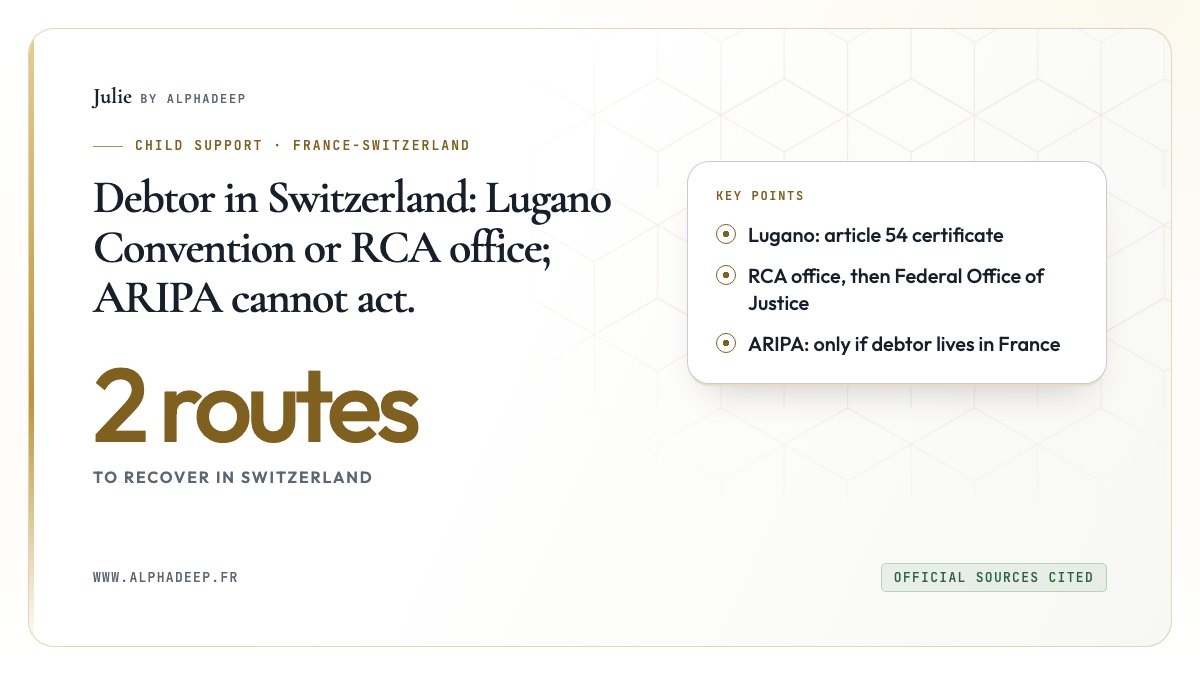
If the other parent lives in Switzerland, a French child support order can be enforced there under the Lugano Convention: ask the court registry for the article 54 certificate, then start Swiss debt collection. You can also go through the French foreign ministry’s RCA office, which passes the case to Switzerland’s Federal Office of Justice under the 1956 New York Convention. The French ARIPA service only collects when the paying parent lives in France (Social Security Code, article L582-1).
Text in force1 March 2022Sources checked30 October 2026
- Official texts cited
- Sources checked on
- Drafted with AI assistance, our method
General legal information with official references and dated checks. It is not personalised advice: for a decision that commits you, have your situation checked by a qualified professional.
Julie by AlphaDeep
The other parent lives in Switzerland and has stopped paying child support: tell me what fixes the support and where each of you lives, and I will point you to the recovery route and the documents to gather.
3 free questions at signup. Avoid names and sensitive information.
Is a French child support order valid in Switzerland?
Yes, a French child support order is recognised in Switzerland without any special procedure and is enforced once declared enforceable there, under the 2007 Lugano Convention, which binds France and Switzerland (articles 33 and 38).
In practice, first ask the head of the registry (directeur de greffe) of the court that made the order for the certificate provided for in article 54 of the Convention (article 509-1 of the Code of Civil Procedure), together with a copy of the judgment. In Switzerland, support is then collected through debt enforcement (poursuite): if the debtor objects to the payment order, the enforceable judgment gives final removal of the objection (mainlevée définitive, article 80 of the Swiss Debt Enforcement Act, LP). Swiss courts do not re-try the amount; they check that the order meets the Convention’s conditions.
Lugano Convention of 30 October 2007 (RS 0.275.12): articles 33, 38 and 54French Code of Civil Procedure (Code de procédure civile): article 509-1Swiss Debt Enforcement and Bankruptcy Act (LP/SchKG): article 80
Should you use the Lugano Convention or the French RCA office?
Use the Lugano Convention if you can act in Switzerland yourself, for instance with a local lawyer, and the RCA office if you cannot: both routes exist side by side, as the 1956 New York Convention adds to other remedies without replacing them (article 1).
The French foreign ministry’s office for the recovery of maintenance abroad (bureau du recouvrement des créances alimentaires à l’étranger, RCA) is the French authority that sends the request. In Switzerland, the Federal Office of Justice receives it and passes it to the competent cantonal authority, which acts for the creditor: it can settle, go to court and enforce the judgment (article 6). No fee may be charged for these services (article 9). According to the Swiss ordinance on recovery assistance, the cantonal office can report the debtor to his or her pension fund once 4 monthly payments are overdue (article 13 OAiR). The RCA route is slower to start but saves paying a Swiss lawyer up front.
- Lugano: you stay in control and pay the collection costs up front.
- RCA and Federal Office of Justice: free, but you depend on two administrations.
New York Convention of 20 June 1956 on the Recovery Abroad of Maintenance (RS 0.274.15): articles 1, 6 and 9French Ministry for Europe and Foreign Affairs: Recovery of maintenance abroad, overview (in French)Swiss Federal Office of Justice: Central authority for international maintenance recovery (in French)Swiss Ordinance on Help with Maintenance Recovery (OAiR, RS 211.214.32): article 13Lugano Convention of 30 October 2007 (RS 0.275.12): articles 33, 38 and 54
Which figures frame cross-border child support recovery?
Three reference points from French and Swiss texts.
- Maximum penalty for criminal non-payment of support after more than two months
- 2 years, €15,000
- in force since 1 March 2022 · French Criminal Code, article 227-3
- Overdue monthly payments after which a Swiss office may report the debtor to the pension fund
- 4 payments
- in force since 1 January 2022 · Swiss Ordinance on Help with Maintenance Recovery (OAiR), article 13
- End of the Swiss consultation on joining the 2007 Hague maintenance convention
- 13 Feb 2026
- consultation opened 29 October 2025 · Swiss Federal Office of Justice, press release of 29 October 2025
Lugano, New York Convention, ARIPA: which route fits your situation?
| Situation | Route | Who acts | Source |
|---|---|---|---|
| French judgment, debtor domiciled in Switzerland | Article 54 certificate, then enforcement and debt collection in Switzerland | You or a Swiss lawyer, with the French court registry | Article 509-1 CPC; Lugano Convention, art. 38 and 54; art. 80 LP |
| You cannot act in Switzerland yourself | Free request under the 1956 New York Convention | RCA office, then the Federal Office of Justice and the cantonal authority | New York Convention, art. 1, 6 and 9 |
| Debtor living in France, even if working in Switzerland | Financial intermediation of child support | CAF (ARIPA) | Article L582-1, Social Security Code |
| You raise the child alone in France and support goes unpaid | Family support allowance (ASF) paid as an advance | CAF | Articles L523-1 and L581-2, Social Security Code |
| More than two months without full payment | Criminal complaint for abandon de famille | Public prosecutor, police or gendarmerie | Article 227-3, Criminal Code |
| No title sets the support yet | Application to the judge where the child lives | Family judge (juge aux affaires familiales) | Lugano Convention, art. 5; article 373-2-2, Civil Code |
The routes can be combined: the ASF and a criminal complaint do not stop you enforcing the judgment in Switzerland.
French Code of Civil Procedure (Code de procédure civile): article 509-1Lugano Convention of 30 October 2007 (RS 0.275.12): articles 33, 38 and 54Swiss Debt Enforcement and Bankruptcy Act (LP/SchKG): article 80New York Convention of 20 June 1956 on the Recovery Abroad of Maintenance (RS 0.274.15): articles 1, 6 and 9French Social Security Code (Code de la sécurité sociale): article L582-1French Social Security Code: article L523-1French Social Security Code: article L581-2French Criminal Code (Code pénal): article 227-3Lugano Convention of 30 October 2007 (RS 0.275.12): articles 2 and 5French Civil Code (Code civil): article 373-2-2
Can the CAF and ARIPA collect child support from a parent in Switzerland?
No, ARIPA, the CAF’s child support collection agency, cannot set up financial intermediation (intermédiation financière) when the paying parent lives in Switzerland: article L582-1 of the Social Security Code requires the paying parent to meet the stable residence condition of article L512-1, which means living in France.
The CAF can still help you. If you are raising the child alone in France and the other parent does not pay support set by an enforceable title, the family support allowance (allocation de soutien familial, ASF) can be paid to you as an advance (articles L523-1 and L581-2). Applying for it gives the CAF a mandate to recover the rest of the debt (article L581-3). The texts do not say how the CAF recovers from a debtor living in Switzerland: ask it in writing, and start the Lugano or RCA route in parallel.
French Social Security Code (Code de la sécurité sociale): article L582-1French Social Security Code: article L512-1French Social Security Code: article L523-1French Social Security Code: article L581-2French Social Security Code: article L581-3
Which court sets or changes child support when one parent lives in Switzerland?
A French family judge (juge aux affaires familiales) can set or change child support when the child lives in France, even if the other parent lives in Switzerland: the Lugano Convention allows a claim before the court where the maintenance creditor is domiciled or habitually resident (article 5, point 2).
The paying parent can also be sued in the Swiss courts of his or her domicile (article 2). A support claim brought with divorce or parental responsibility proceedings can be decided by the court hearing those proceedings, unless its jurisdiction rests only on a party’s nationality. In France, support takes the form of a judgment, a court-approved agreement or one of the other titles listed in article 373-2-2 of the Civil Code. If the debtor asks a Swiss court to reduce the amount, keep copies of every decision: the most recent one is the one enforced.
Lugano Convention of 30 October 2007 (RS 0.275.12): articles 2 and 5French Civil Code (Code civil): article 373-2-2
Which country’s law sets the amount of child support?
As a rule, the law of the country where the child receiving support habitually lives sets the amount: French law for a child living in France, Swiss law for a child living in Switzerland.
The Hague Convention of 2 October 1973, in force in both Switzerland and France, sets this rule and switches to the new country’s law from the date the child moves (article 4). French courts apply the 2007 Hague Protocol, to which EU Regulation No 4/2009 refers (article 15) and which uses the same basic test. The New York Convention route is the exception: the action brought in Switzerland on your behalf is governed by the law of the debtor’s State, including its conflict-of-laws rules (article 6). For a child in France, the amount depends on both parents’ resources and the child’s needs.
Hague Convention of 2 October 1973 on the Law Applicable to Maintenance Obligations (RS 0.211.213.01): article 4Council Regulation (EC) No 4/2009 of 18 December 2008 on maintenance obligations: article 15New York Convention of 20 June 1956 on the Recovery Abroad of Maintenance (RS 0.274.15): articles 1, 6 and 9
Which recovery route fits your case?
Say where each of you lives, what sets the support and how many months are unpaid: the worksheet lists the recovery routes that apply and works out the arrears. It does not say whether the debtor will pay or what a court will decide.
Fictional example · The recovery routes that apply
The debtor lives in Switzerland and a French judgment sets the support: ask the court registry for the Lugano Convention article 54 certificate (article 509-1 of the Code of Civil Procedure), then enforce the judgment in Switzerland through debt collection (article 80 LP). If you cannot act in Switzerland, apply to the RCA office, which forwards the case free of charge to the Federal Office of Justice (1956 New York Convention). ARIPA cannot act while the debtor lives in Switzerland.
- Arrears to claim
- €1,500.00
- Months unpaid
- 5
- ARIPA intermediation
- No: the debtor does not live in France (article L582-1)
- Family support allowance (ASF)
- Apply to the CAF (articles L523-1 and L581-2)
- Criminal non-payment (abandon de famille)
- Complaint possible after more than two months without full payment (article 227-3 of the Criminal Code)
- Draw up a month-by-month arrears statement: €1,500.00 for 5 months at the amount ordered.
- Ask the registry of the court that ruled for the Lugano article 54 certificate and a copy of the judgment.
- Write to the RCA office of the French foreign ministry with the country and the debtor’s name: it sends the list of documents for Switzerland.
- Apply to the CAF for the family support allowance (ASF).
- Gather the debtor’s last known address in Switzerland, the employer’s details and proof of your own address.
An indicative result based on the texts cited. It does not say whether the debtor will pay or what a Swiss or French court will decide.
What does article L582-1 of the French Social Security Code say?
I. - Les organismes débiteurs des prestations familiales sont chargés de l'intermédiation financière des pensions alimentaires mentionnées à l'article 373-2-2 du code civil dans les conditions et selon les modalités suivantes.
[…]
Elle est mise en œuvre sous réserve que les conditions suivantes soient remplies :
a) Le parent créancier remplit la condition de stabilité de résidence et de régularité du séjour prévue à l'article L. 512-1 ;
b) Le parent débiteur remplit la condition de stabilité de résidence prévue au même article L. 512-1 ;
In plain English: The CAF (ARIPA) can collect and pass on child support only if both parents meet the residence condition of article L512-1. A paying parent living in Switzerland does not, so intermediation is ruled out and recovery goes through Lugano or the RCA office.
The family support allowance (ASF) remains open to a parent raising the child alone in France (articles L523-1 and L581-2).
What else do parents ask when the paying parent lives in Switzerland?
Can you claim the family support allowance (ASF) when the other parent pays nothing from Switzerland?
Yes, the family support allowance (allocation de soutien familial, ASF) can be paid when the other parent pays nothing from Switzerland, if you raise the child alone in France and a judgment or enforceable title sets the support. It is paid as an advance on the support (articles L523-1 and L581-2 of the Social Security Code), and applying gives the CAF a mandate to recover the rest (article L581-3).
French Social Security Code: article L523-1French Social Security Code: article L581-2French Social Security Code: article L581-3
Is Switzerland part of the 2007 Hague child support convention?
No, Switzerland is not yet a party to the 2007 Hague child support convention. The Federal Council wants to join it: the consultation opened on 29 October 2025 and closed on 13 February 2026. Until then, the Lugano Convention and the 1956 New York Convention remain the routes between France and Switzerland, with the Federal Office of Justice as the Swiss central authority.
Swiss Federal Office of Justice: the Federal Council wants to join the Hague maintenance convention, 29 October 2025 (in French)Swiss Federal Office of Justice: Central authority for international maintenance recovery (in French)
Is child support paid in euros or Swiss francs?
Child support is owed in the currency set by the judgment or agreement, which is euros for a French title. For debt collection in Switzerland, the request must state the claim in Swiss legal tender, so in Swiss francs (article 67 of the Swiss Debt Enforcement Act): convert the arrears and note the date of the exchange rate used.
Swiss Debt Enforcement and Bankruptcy Act (LP/SchKG): article 67
Can you garnish the wages of a cross-border worker employed in Switzerland?
Wages paid by a Swiss employer to a cross-border worker cannot be taken through the French direct payment procedure (paiement direct), which targets third parties owing money to the debtor (article L213-1 of the Code of Civil Enforcement Procedures); the texts do not extend it to an employer in Switzerland. The route is Swiss: enforce the judgment under the Lugano Convention, then use debt collection with final removal of objection (article 80 LP).
French Code of Civil Enforcement Procedures (Code des procédures civiles d’exécution): article L213-1Lugano Convention of 30 October 2007 (RS 0.275.12): articles 33, 38 and 54Swiss Debt Enforcement and Bankruptcy Act (LP/SchKG): article 80
Which texts govern child support recovery between France and Switzerland?
- Lugano Convention of 30 October 2007 (RS 0.275.12): articles 33, 38 and 54Confédération suisse : Fedlex
- French Code of Civil Procedure (Code de procédure civile): article 509-1République française / DILA : Légifrance
- Swiss Debt Enforcement and Bankruptcy Act (LP/SchKG): article 80Confédération suisse : Fedlex
- New York Convention of 20 June 1956 on the Recovery Abroad of Maintenance (RS 0.274.15): articles 1, 6 and 9Confédération suisse : Fedlex
- French Ministry for Europe and Foreign Affairs: Recovery of maintenance abroad, overview (in French)French Ministry for Europe and Foreign Affairs
- Swiss Federal Office of Justice: Central authority for international maintenance recovery (in French)Swiss Federal Office of Justice (FOJ)
- French Criminal Code (Code pénal): article 227-3République française / DILA : Légifrance
- Swiss Ordinance on Help with Maintenance Recovery (OAiR, RS 211.214.32): article 13Confédération suisse : Fedlex
- Swiss Federal Office of Justice: the Federal Council wants to join the Hague maintenance convention, 29 October 2025 (in French)Swiss Federal Office of Justice (FOJ)
- French Social Security Code (Code de la sécurité sociale): article L582-1République française / DILA : Légifrance
- French Social Security Code: article L523-1République française / DILA : Légifrance
- French Social Security Code: article L581-2République française / DILA : Légifrance
- Lugano Convention of 30 October 2007 (RS 0.275.12): articles 2 and 5Confédération suisse : Fedlex
- French Civil Code (Code civil): article 373-2-2République française / DILA : Légifrance
- French Social Security Code: article L512-1République française / DILA : Légifrance
- French Social Security Code: article L581-3République française / DILA : Légifrance
- Hague Convention of 2 October 1973 on the Law Applicable to Maintenance Obligations (RS 0.211.213.01): article 4Confédération suisse : Fedlex
- Council Regulation (EC) No 4/2009 of 18 December 2008 on maintenance obligations: article 15European Union: EUR-Lex
- Swiss Debt Enforcement and Bankruptcy Act (LP/SchKG): article 67Confédération suisse : Fedlex
- French Code of Civil Enforcement Procedures (Code des procédures civiles d’exécution): article L213-1République française / DILA : Légifrance
Texts cited last checked: 30 October 2026