Family and couples · Separated parents · school
Changing your child’s school in France without the other parent’s consent: what the law allows
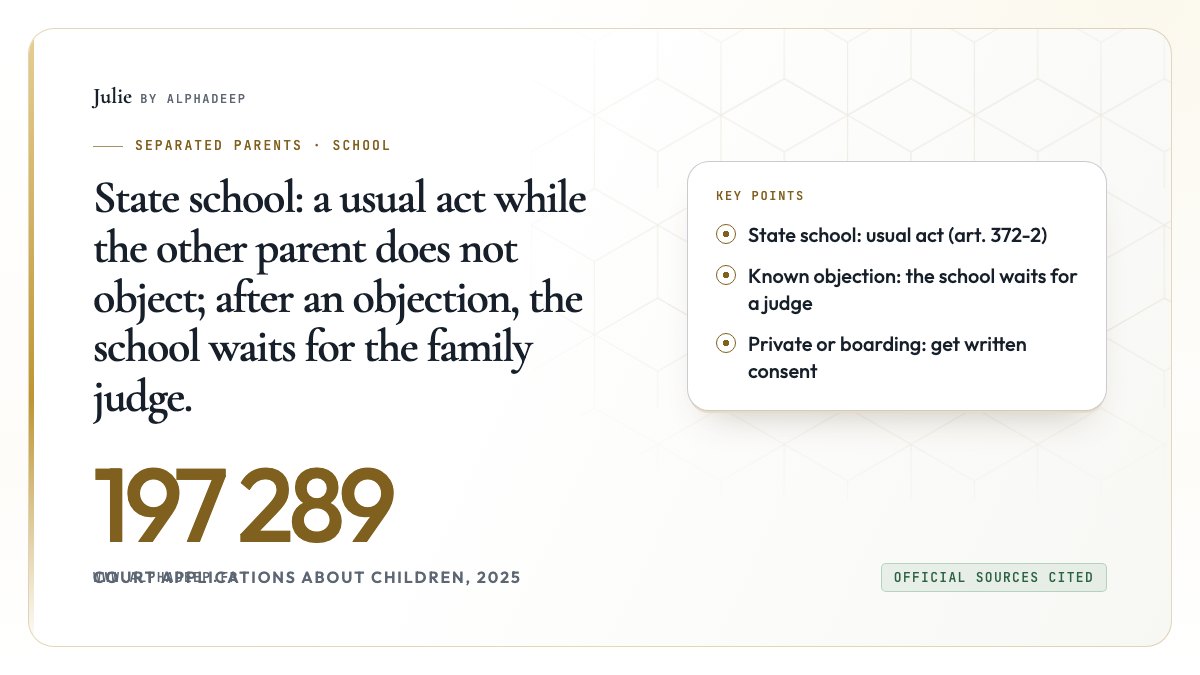
When separated parents in France share parental authority, enrolling a child in a state school or removing them from it is a usual act: the school may presume the other parent agrees (Civil Code, article 372-2). But once the other parent has made an objection known, the school waits for the family judge’s decision. No official text reserves private or religious schools to both parents’ agreement; if parents disagree, the judge decides in the child’s interest.
- Official texts cited
- Sources checked on
- Drafted with AI assistance, our method
General legal information with official references and dated checks. It is not personalised advice: for a decision that commits you, have your situation checked by a qualified professional.
Julie by AlphaDeep
The other parent wants to change your child’s school in France, or already has: I can check with you whether it is a usual act, what the school can do and how to go to the family judge.
3 free questions at signup. Avoid names and sensitive information.
Is enrolling or removing a child from school a usual act in France?
Yes: when separated parents share parental authority (autorité parentale), enrolling a child in a French state school or removing them from it is a usual act (acte usuel), which one parent can do alone. Article 372-2 of the Civil Code says that, towards third parties acting in good faith, each parent is deemed to act with the other’s agreement when doing a usual act alone. The school and the town hall (mairie) therefore do not need both signatures.
This presumption has two limits. In 2018 the Conseil d’État, France’s highest administrative court, held that the administration must assess, from the circumstances it knows, whether a request to change school really is a usual act. And once the other parent has made their disagreement known, the school is no longer acting in good faith: according to Service-public, the official French government information site, it must respect the objecting parent’s wishes, and the dispute goes to the family judge (juge aux affaires familiales).
French Civil Code (Code civil): article 372-2Service-public: parental authority when parents separate (F3133, in French)Conseil d’État (supreme administrative court), 13 April 2018, no. 392949 (in French)
Can you change the school without the other parent?
Tell us the change you have in mind, who holds parental authority and where the other parent stands: the worksheet says whether the presumption of agreement in article 372-2 can apply, what the school will do and the steps in order. It applies the French texts; it does not predict what the judge will decide.
Fictional example · What the law allows and what the school will do
The other parent has objected and the school knows: the presumption of agreement in article 372-2 of the Civil Code no longer applies. The head teacher will not issue the removal certificate and enrolment stays on hold until the family judge decides; the new school may take the child in without admitting them permanently. The next step is an application to the judge.
- Planned school change
- 2026-11-16
- Documents the town hall can require
- 3 at most: child’s identity, parents’ identity, proof of address
- Fee to apply to the judge
- 50 €, unless legal aid
- Tell the other parent in writing about the plan (school, date, reasons) before 2026-11-16, and keep proof of sending.
- Apply to the family judge with form Cerfa no. 11530 at the court where the child lives.
- Term starts soon: ask the judge for leave to summon at short notice, explaining the urgency (Code of Civil Procedure, article 1137).
- Prepare the three documents for the town hall: child’s identity, parents’ identity, address.
The worksheet applies the French Civil Code, Education Code and Code of Civil Procedure to your answers. It does not say what the judge will decide and does not replace reading the judgment that concerns you.
Who can decide a change of school, case by case?
| Situation | Can one parent act alone? | What the school does | Source |
|---|---|---|---|
| Enrolment in or removal from a state school, no known objection | Yes: usual act, the other parent’s agreement is presumed | Enrols the child, issues the removal certificate | Civil Code, art. 372-2; Service-public F3133 |
| Same step after an objection reported to the school | No: the presumption no longer applies | Neither removes nor enrols permanently; takes the child in pending the judge | Ministerial answer no. 66112; Service-public F10722 |
| New school after moving house | Yes for enrolment, but the move must be announced to the other parent | Enrols on the mayor’s certificate; formalities within 8 days | Civil Code, art. 373-2; Education Code, art. L131-5 |
| Private, religious or boarding school | No text decides: written agreement of both parents avoids a dispute | May presume agreement if in good faith; respects a known objection | Civil Code, art. 372-2; Conseil d’État, 13 April 2018 |
| Court decision setting residence or school | No, except with both parents’ agreement or a new decision | Applies the decision it receives | Civil Code, art. 373-2-6 |
| Parental authority exercised by one parent | Yes for that parent, who informs the other of important choices | Deals with the parent who holds authority | Civil Code, art. 373-2-1 |
A school acting in good faith may rely on one parent for a usual act; once it knows of a disagreement, it waits for the family judge.
French Civil Code (Code civil): article 372-2Service-public: parental authority when parents separate (F3133, in French)Assemblée nationale: written question no. 66112, ministerial answer, Journal officiel 24 February 2015 (in French)Service-public: changing school during the school year (F10722, in French)French Civil Code: article 373-2French Education Code (Code de l’éducation): article L131-5Conseil d’État (supreme administrative court), 13 April 2018, no. 392949 (in French)French Civil Code: article 373-2-6French Civil Code: article 373-2-1
What if the other parent changed the school without your consent?
Tell both head teachers, at the old school and the new one, in writing that you object, then apply to the family judge if the disagreement continues. Once the school knows of the objection, the head teacher can neither remove nor enrol the child without a court decision: enrolment stays on hold, and the new school takes the child in without admitting them permanently (ministerial answer of 24 February 2015).
You apply to the judge with form Cerfa no. 11530, at the court (tribunal judiciaire) where the parent the child usually lives with resides. In a duly justified emergency, such as term starting within days, the judge may allow a summons for a hearing at short notice (Code of Civil Procedure, article 1137). The parent who starts the case pays a 50 € contribution unless they receive legal aid (aide juridictionnelle).
If the change breaches an existing court decision, the judge can also order a penalty payment (astreinte) and, for deliberate, serious or repeated obstruction, a civil fine of up to 10 000 € (Civil Code, article 373-2-6).
Assemblée nationale: written question no. 66112, ministerial answer, Journal officiel 24 February 2015 (in French)Service-public: changing school during the school year (F10722, in French)Service-public: application to the family judge, form Cerfa no. 11530 (R15764, in French)French Code of Civil Procedure: article 1137French General Tax Code: article 1635 bis QFrench Civil Code: article 373-2-6
Private school, religious school or boarding: do both parents have to agree?
No official French text says that a private school, a religious school or a boarding school requires both parents’ agreement, and none says the opposite. The rule remains article 372-2: the school may presume the other parent agrees to a usual act if it acts in good faith. But the Conseil d’État asks for each change to be assessed on its circumstances, and a choice that involves fees, a religious orientation or boarding moves away from a simple enrolment in the local state school.
The safest course is to get the other parent’s written agreement before signing the school contract. If the other parent objects and the school knows it, the school must respect that objection, and only the family judge can settle the matter, in the child’s interest.
French Civil Code (Code civil): article 372-2Conseil d’État (supreme administrative court), 13 April 2018, no. 392949 (in French)Service-public: parental authority when parents separate (F3133, in French)
What does article 372-2 of the French Civil Code say?
A l'égard des tiers de bonne foi, chacun des parents est réputé agir avec l'accord de l'autre, quand il fait seul un acte usuel de l'autorité parentale relativement à la personne de l'enfant.
In plain English: A third party acting in good faith, such as a school, may treat a parent who does a usual act alone as acting with the other parent’s agreement. Once it knows the other parent objects, it is no longer in good faith and must wait for both parents’ agreement or a judge’s decision.
The article does not list usual acts: Service-public and the Conseil d’État treat state-school enrolment and removal as usual acts.
How does the French family judge choose the child’s school?
The French family judge chooses the school according to the child’s interest, using the criteria in article 373-2-11 of the Civil Code: how the parents organised things until now and any earlier agreements, the feelings expressed by a child capable of discernment, each parent’s ability to respect the other’s rights, and where relevant an expert report or a social inquiry.
In 2005 the Cour de cassation, France’s highest civil court, quashed a decision that set the children’s school for the father’s sake without looking for the children’s interest. In practice, give the judge facts that can be checked: journeys, where the child lives, continuity of schooling, special needs, costs. According to the French Ministry of Justice (Chiffres clés 2026), courts received 197 289 applications about children after their parents separated in 2025.
French Civil Code: article 373-2-11Cour de cassation (supreme court), 1st civil chamber, 8 November 2005, no. 02-18.360 (in French)French Ministry of Justice: Les chiffres clés de la Justice 2026 (key figures, in French)
Who pays private-school fees after a separation?
Each parent contributes to the child’s education in proportion to their own resources, the other parent’s resources and the child’s needs (Civil Code, article 371-2); private-school fees are not split automatically. After a separation this contribution takes the form of child maintenance (pension alimentaire), and the judgment or agreement may provide that it is paid wholly or partly by covering costs directly.
According to Service-public, once maintenance is fixed, exceptional costs need a judge’s decision, unless the order already lists certain costs, such as school fees or boarding, and how they are shared. A parent who enrols the child in a private school alone therefore cannot make the other pay half: they need written agreement or a decision from the judge setting the split.
French Civil Code: article 371-2Service-public: child maintenance (F991, in French)
Which figures and deadlines matter?
According to the French Ministry of Justice (Chiffres clés 2026), most applications to the judge about children after a separation come from unmarried parents.
- Applications about minor children after the parents separated
- 197 289
- 2025 · French Ministry of Justice, Les chiffres clés de la Justice 2026
- Of which from unmarried parents
- 157 105
- 2025 · French Ministry of Justice, Les chiffres clés de la Justice 2026
- Documents the town hall can require to put a child on the school list
- 3
- since 1 July 2020 · Education Code, article D131-3-1
- Time to redo enrolment after a change of residence
- 8 days
- in force since 1 September 2022 · Education Code, article L131-5
- Maximum civil fine on a parent who deliberately obstructs a court decision
- 10 000 €
- since 21 February 2024 · Civil Code, article 373-2-6
What else do separated parents ask about school in France?
Which documents can the town hall ask for to enrol a child?
To put a child on a French town’s school list, the town hall can require only three documents: proof of the child’s identity, proof of identity of the persons responsible for the child, and proof of their address (Education Code, article D131-3-1). Address can be shown by any means, including a sworn statement, and checking it cannot block enrolment.
Must you tell the other parent about a move that changes the school?
Yes: in France, any change of residence that alters how parental authority is organised must be announced to the other parent in advance and in good time (Civil Code, article 373-2). If they disagree, the family judge decides. The parent the children live with must also give their new address within one month to a parent with court-ordered visiting rights, or face 6 months’ imprisonment and a 7 500 € fine (Criminal Code, article 227-6).
French Civil Code: article 373-2French Criminal Code: article 227-6
Does the parent the child does not live with get the school reports?
Yes: French schools must keep parents regularly informed of the child’s progress and attendance, several times a year, through the school record book or report (Education Code, article D111-3). A separated parent who shares parental authority is entitled to them like the other. Even a parent without parental authority keeps the right to oversee the child’s education and must be told of important choices (Civil Code, article 373-2-1).
French Education Code: article D111-3French Civil Code: article 373-2-1
What does a parent risk by changing the school despite a court decision?
A parent in France who changes the child’s school against a family judge’s decision risks a penalty payment and, if they deliberately obstruct the decision in a serious or repeated way, a civil fine of up to 10 000 € (Civil Code, article 373-2-6). The other parent can also ask the judge to change the child’s residence or how parental authority is exercised.
Can the head teacher refuse the removal certificate?
Yes, if the other parent has told the school they object: the head teacher must then wait for the family judge’s decision before issuing the removal certificate (certificat de radiation), according to Service-public (F10722). With no known objection, removal is a usual act and one parent can obtain it. A 2010 Rouen administrative court decision, cited by the ministry, confirms that a head teacher who knows of the objection cannot remove or enrol without a court decision.
Service-public: changing school during the school year (F10722, in French)Assemblée nationale: written question no. 66112, ministerial answer, Journal officiel 24 February 2015 (in French)
Which French texts does this page on changing school rely on?
- French Civil Code (Code civil): article 372-2French Republic / DILA: Légifrance
- Service-public: parental authority when parents separate (F3133, in French)French Republic / DILA: Service-public.gouv.fr
- Conseil d’État (supreme administrative court), 13 April 2018, no. 392949 (in French)Conseil d’État
- Assemblée nationale: written question no. 66112, ministerial answer, Journal officiel 24 February 2015 (in French)Assemblée nationale (French National Assembly)
- Service-public: changing school during the school year (F10722, in French)French Republic / DILA: Service-public.gouv.fr
- French Civil Code: article 373-2French Republic / DILA: Légifrance
- French Education Code (Code de l’éducation): article L131-5French Republic / DILA: Légifrance
- French Civil Code: article 373-2-6French Republic / DILA: Légifrance
- French Civil Code: article 373-2-1French Republic / DILA: Légifrance
- Service-public: application to the family judge, form Cerfa no. 11530 (R15764, in French)French Republic / DILA: Service-public.gouv.fr
- French Code of Civil Procedure: article 1137French Republic / DILA: Légifrance
- French General Tax Code: article 1635 bis QFrench Republic / DILA: Légifrance
- French Civil Code: article 373-2-11French Republic / DILA: Légifrance
- Cour de cassation (supreme court), 1st civil chamber, 8 November 2005, no. 02-18.360 (in French)French Republic / DILA: Légifrance
- French Ministry of Justice: Les chiffres clés de la Justice 2026 (key figures, in French)French Ministry of Justice
- French Civil Code: article 371-2French Republic / DILA: Légifrance
- Service-public: child maintenance (F991, in French)French Republic / DILA: Service-public.gouv.fr
- French Education Code: article D131-3-1French Republic / DILA: Légifrance
- French Criminal Code: article 227-6French Republic / DILA: Légifrance
- French Education Code: article D111-3French Republic / DILA: Légifrance
Texts cited last checked: 30 October 2026