Family and couples · Children · parental authority
Sole parental authority in France: the grounds and the application
In France both parents normally exercise parental authority together, even after separating (article 373-2 of the Civil Code). The family judge may give it to one parent if the child’s interest requires it (article 373-2-1). The other parent then keeps visiting rights, unless there are serious reasons, and must be told of major decisions. They still contribute to the child’s upkeep.
- Official texts cited
- Sources checked on
- Drafted with AI assistance, our method
General legal information with official references and dated checks. It is not personalised advice: for a decision that commits you, have your situation checked by a qualified professional.
Julie by AlphaDeep
You are considering an application for sole parental authority in France: I can help you link the facts to the documents the judge looks at.
3 free questions at signup. Avoid names and sensitive information.
When does a French judge give parental authority to one parent?
When the child’s interest requires it: that is the only test the law sets. Joint exercise remains the rule, and the parents’ separation does not change it.
To decide, the judge looks in particular at how the parents handled things before, the feelings the child has expressed, each parent’s ability to meet their duties and respect the other’s rights, any expert and social reports, and pressure or violence by one parent on the other. Service-public mentions lack of interest in the child or putting the child’s safety at risk.
Code civil, article 373-2-1Code civil, article 372Code civil, article 373-2Code civil, article 373-2-11Service-public: visiting rights without parental authority
Is sole custody the same as sole parental authority?
Parental authority is the set of rights and duties used to take decisions about the child. “Custody”, the everyday word, mostly means where the child lives: shared or with one parent, with visiting rights for the other, it does not affect parental authority.
A parent the child does not live with therefore normally keeps joint authority. Conversely, sole authority does not take away the other parent’s visiting rights, which can only be refused for serious reasons.
Code civil, article 371-1Code civil, article 373-2-9Code civil, article 373-2-1
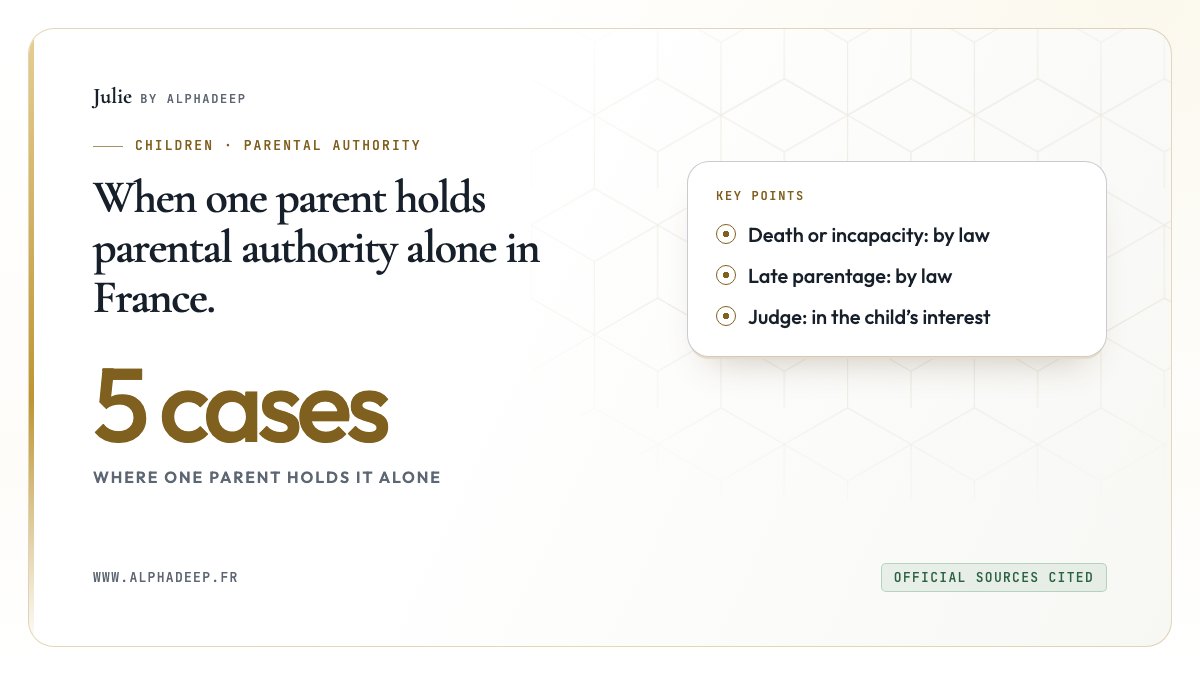
When does one parent hold authority alone, from automatic to contested?
Ranked from the most automatic case, which applies without a judge, to the most contested, which depends on the judge’s assessment.
The other parent’s death or incapacity
If one parent dies or cannot express their will, the other exercises parental authority alone, unless an earlier decision removed it. Nothing needs to be filed.
Parentage established over a year after birth
The parent whose parentage was established first keeps sole exercise. It becomes joint through a joint declaration to the court registry or a court decision.
Code civil, article 372Service-public: late recognition and parental authority
Prosecution for a crime against the other parent or the child
Prosecution or formal charges for a crime against the other parent, or a crime or incestuous sexual assault on the child, suspend exercise and visiting rights by law until a decision.
A criminal conviction
For those crimes and that assault, the criminal court orders full withdrawal unless it gives specific reasons otherwise. For a lesser offence against the child, it rules on full or partial withdrawal, or withdrawal of exercise.
A family judge’s decision
Outside those cases, sole exercise requires that the child’s interest calls for it. The judge decides case by case, using the factors set by the Civil Code.
Which ground fits your situation?
Choose the other parent’s situation: the tool shows the possible legal basis and the documents that support it.
Fictional example · possible legal basis
Possible basis: an application for sole exercise to the family judge, if the child’s interest requires it. The judge decides: the tool does not predict the outcome.
- Form cerfa 11530 or a letter to the court where the child lives; a lawyer is not compulsory
- Full birth certificates under 3 months old, proof of address, income and outgoings
- Dated evidence of the facts: the judge looks at each parent’s ability to respect the other’s rights and any pressure or violence
- 50 euro legal-aid contribution, unless you receive legal aid
- The other parent’s visiting rights can only be refused for serious reasons
- The other parent must still contribute to the child’s upkeep
A pointer to the legal basis, not a prediction: the judge weighs the child’s interest on the whole file.
Who decides what under joint or sole authority?
| Decision | Joint authority | Sole authority |
|---|---|---|
| Everyday acts | Either parent alone, presumed to have the other’s agreement | The parent who holds authority |
| Non-routine acts that shape the child’s future | Both parents agree, or the judge decides | The parent who holds authority; the other is told of major decisions |
| The other parent’s visiting rights | Set by agreement or by the judge | Refused only for serious reasons |
| A move that changes arrangements | Prior notice to the other parent, judge if they disagree | Prior notice to the other parent |
| Travel abroad | Everyday act, unless the judge has banned travel | Decided by the parent who holds authority, unless the judge has banned it |
| The child’s upkeep | Each parent according to their means | Each parent, including the one without authority |
Code civil, article 372-2Service-public: parental authority after separationCode civil, article 373-2-1Code civil, article 373-2Code civil, article 373-2-6Code civil, article 371-2
How do you apply to the family judge?
By an application to the court for the area where the child lives, on form cerfa 11530 or by letter, with the documents listed in the notice. A lawyer is not compulsory: parties may represent themselves or be assisted. The registry summons the other parent within fifteen days of the application.
A 50 euro legal-aid contribution is due, except for people on legal aid. The judgment can be appealed within one month, and a lawyer is then compulsory.
Service-public: late recognition and parental authorityNotice 50720 for court form cerfa 11530Code de procédure civile, article 1139Code de procédure civile, article 1138Code général des impôts, article 1635 bis QCode de procédure civile, article 538
Must the other parent keep paying child support?
Yes. Each parent contributes to the child’s upkeep and education in proportion to their means, the other parent’s means and the child’s needs, and this duty does not end automatically when parental authority or its exercise is removed.
The parent without the exercise also keeps the right and duty to oversee the child’s upkeep and education, and must be told of major decisions about the child’s life.
What does article 373-2-1 of the Civil Code say?
Si l’intérêt de l’enfant le commande, le juge peut confier l’exercice de l’autorité parentale à l’un des deux parents. L’exercice du droit de visite et d’hébergement ne peut être refusé à l’autre parent que pour des motifs graves.
Le parent qui n’a pas l’exercice de l’autorité parentale conserve le droit et le devoir de surveiller l’entretien et l’éducation de l’enfant. Il doit être informé des choix importants relatifs à la vie de ce dernier.
In plain English: If the child’s interest requires it, the judge may give the exercise of parental authority to one parent. Visiting rights can only be refused to the other parent for serious reasons. The parent without the exercise keeps the right and duty to oversee the child’s upkeep and education, and must be told of major decisions.
The same article lets the judge organise visits in a supervised contact centre, or have the child handed over with the help of a trusted third party, when the child’s interest requires it or a direct handover would be dangerous.
What else do parents ask?
The father recognised the child after its first birthday: does the mother already hold sole authority?
Yes, by law and without going to court: when the second parent’s parentage is established over a year after the birth, the first parent alone keeps the exercise of authority. A later marriage of the parents does not change this. Exercise becomes joint through a joint declaration, form cerfa 12785, or a court decision.
Code civil, article 372Service-public: late recognition and parental authority
Can you travel abroad with the child without the other parent’s agreement?
In principle yes: service-public treats leaving France as an everyday act when no judge has banned it. If a judge has banned travel without both parents’ consent, each parent declares their agreement to a police officer at least five days before departure.
Service-public: parental authority after separationCode civil, article 373-2-6Code de procédure civile, article 1180-4
Can a French court decide if the other parent lives abroad?
Yes, if the child habitually lives in France when the court is seised: under the EU regulation on parental responsibility, the courts of the Member State where the child habitually resides have jurisdiction. Where the other parent lives does not settle it on its own. If the child lives outside the EU, check which court is competent before filing.
Can the other parent get authority back later?
Yes. Decisions on the exercise of parental authority can be changed at any time by the judge, at a parent’s request. The notice for the court form states that a change requires new circumstances since the last decision.
Code civil, article 373-2-13Notice 50720 for court form cerfa 11530
Which texts is this register based on?
- Code civil, article 373-2-1Légifrance
- Code civil, article 372Légifrance
- Code civil, article 373-2Légifrance
- Code civil, article 373-2-11Légifrance
- Code civil, article 373-1Légifrance
- Code civil, article 373Légifrance
- Code civil, article 378-2Légifrance
- Code civil, article 378Légifrance
- Code civil, article 371-2Légifrance
- Code civil, article 373-2-13Légifrance
- Code civil, article 373-2-9Légifrance
- Code civil, article 371-1Légifrance
- Code de procédure civile, article 1138Légifrance
- Code de procédure civile, article 1139Légifrance
- Code de procédure civile, article 538Légifrance
- Code général des impôts, article 1635 bis QLégifrance
- Code civil, article 373-2-6Légifrance
- Code de procédure civile, article 1180-4Légifrance
- Code civil, article 372-2Légifrance
- Service-public: late recognition and parental authorityService-public.fr
- Service-public: visiting rights without parental authorityService-public.fr
- Service-public: parental authority after separationService-public.fr
- Notice 50720 for court form cerfa 11530Service-public.fr
- Regulation (EU) 2019/1111, article 7EUR-Lex
Texts cited last checked: 17 October 2026