The filing deskUnmarried parents · parentage
Recognising your child at a French town hall: before or after the birth, and what the date changes
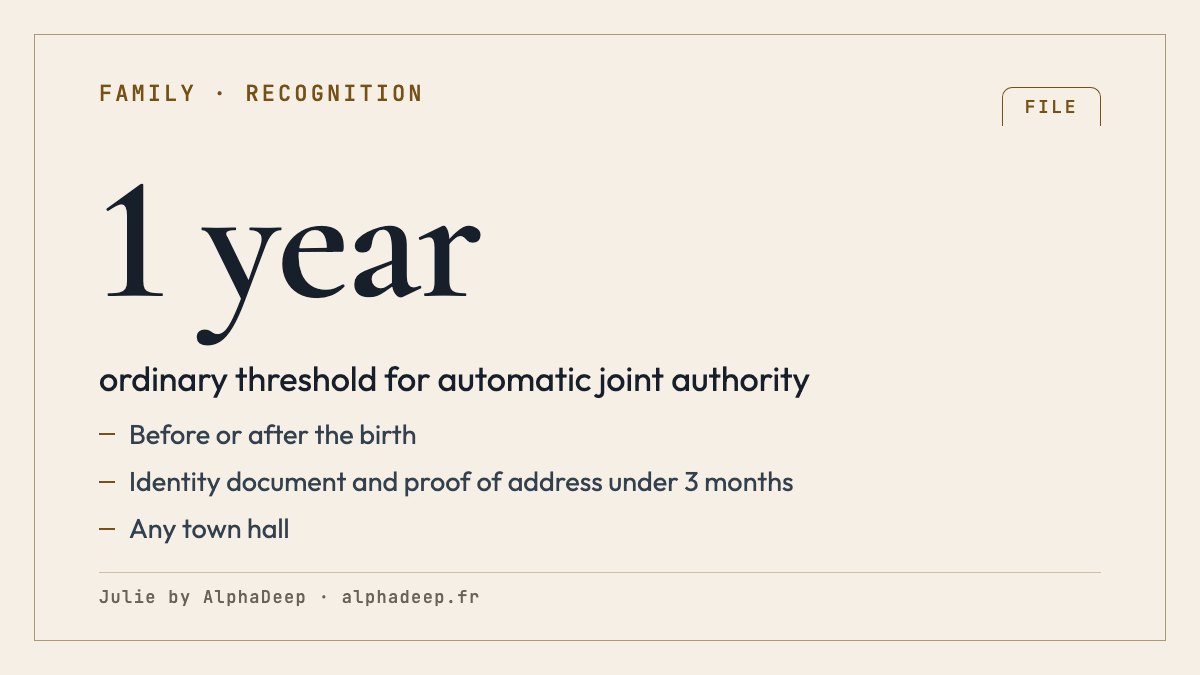
Recognition normally establishes an unmarried father’s filiation before or after birth, at a town hall or before a notary, with identity and address evidence (Civil Code 316). If maternal filiation already exists, establishing the second link more than a year after birth does not automatically give joint authority; a joint declaration or court decision can establish it. Surname depends on filiation and earlier common children. Excluded marital presumption, assisted reproduction, judgments and adult children require another route.
Go to the tool: the filing desk
Julie by AlphaDeep is an AI legal assistant for French law: it researches official references to help answer your questions (Légifrance, case law, service-public), analyses your documents and drafts your letters, for individuals and professionals alike.
General legal information with official references and dated checks. It is not personalised advice: for a decision that commits you, have your situation checked by a qualified professional.

Let’s look at your situation
Say whether you are married and, if the child is born, the date of birth, with no other personal detail.
Example questions
Your question carries over after signup. Maximum 400 characters. Avoid health data and names.
Must an unmarried father recognise the child?
Yes. Without marriage, paternity is not automatic: the father establishes it by a recognition, before or after the birth (Civil Code, article 316). For the mother, according to service-public, it is enough that her name appears in the birth certificate, although she can also recognise the child before the birth.
The recognition establishes the link only with the person who makes it, who is told of this divisible effect. For a married couple, the husband is presumed to be the father of a child conceived or born during the marriage (article 312).
Sources: C. civ. 316 · Service-public F887
What changes if the recognition comes more than a year after the birth?
Parental authority: when parentage is established for the second parent more than a year after the birth, the first parent alone continues to exercise it (Civil Code, article 372). Before that point, both parents exercise it jointly.
It can become joint again through a joint declaration by the parents to the head of the court registry of the judicial court (directeur des services de greffe du tribunal judiciaire), or through a decision of the family judge (juge aux affaires familiales).
Source: C. civ. 372
Which surname will the recognised child bear?
If both parentage links are established no later than the day the birth is declared, the parents choose the father’s name, the mother’s, or both joined together; without a choice, the child takes the name of the parent whose link came first, or the father’s if both links came at the same time (Civil Code, article 311-21).
Recognised later, the child keeps the first parent’s name; by a joint declaration to the civil registrar (officier de l’état civil), the parents can give the child the other parent’s name or join both, with the child’s consent if over 13 (article 311-23).
Source: C. civ. 311-21
Recognising before, at or after the birth: what are the differences?
The moment chosen changes the place, the document handed over and the rules on the surname.
| When | Where | What you receive | Child’s surname |
|---|---|---|---|
| Before the birth | Any town hall | A recognition certificate, to show when the birth is declared | Chosen by the parents at the declaration |
| When the birth is declared | Town hall of the place of birth, within 5 days | The recognition appears in the birth certificate | Chosen by the parents at the declaration |
| After the birth | Any town hall, or a notary | A note in the margin of the birth certificate and in the family record book | The first parent’s, unless a joint declaration is made |
If the civil registrar suspects a fraudulent recognition, they refer it to the public prosecutor, who decides within 15 days (Civil Code, article 316-1).
Sources: Service-public F887 · C. civ. 316-1
Which documents should you bring, and who will exercise parental authority?
Say whether you are married, when the recognition is made and, if the child is born, the dates: the desk lists the documents, the possible surname and the effect on parental authority. The example: a child born on 10 March 2025, recognised by the father on 5 October 2026. The result is indicative: confirm the ordinary-case conditions; a special case or unknown decisive fact prevents calculation.
Fictional example · recognition desk
Recognition after 10 March 2026: the first parent alone keeps parental authority, unless a joint declaration is made.
Documents to bring, to any town hall
- An official identity document with a photograph: identity card, passport or residence permit
- Proof of address or residence less than 3 months old, in your name
- Recommended after the birth: the child’s birth certificate or the family record book
Child’s surname: the child keeps the first parent’s name; by a joint declaration at the town hall, the parents can give the second parent’s name or join both. Over 13, the child must consent.
To exercise parental authority jointly: a joint declaration to the head of the court registry of the judicial court, or a decision of the family judge.
Before a notary, for example to keep it confidential, the recognition is charged: €75.46 excluding VAT according to service-public. It creates the link only with the person who makes it.
What does article 316 of the Civil Code say about recognition?
The text that sets the form of the recognition and the documents required.
Lorsque la filiation n’est pas établie dans les conditions prévues à la section I du présent chapitre, elle peut l’être par une reconnaissance de paternité ou de maternité, faite avant ou après la naissance.
La reconnaissance n’établit la filiation qu’à l’égard de son auteur.
Elle est faite dans l’acte de naissance, par acte reçu par l’officier de l’état civil ou par tout autre acte authentique.
In English, briefly (our summary, not an official translation): Where parentage is not established by the other means the chapter provides, it can be established by a recognition of paternity or maternity, made before or after the birth. The recognition establishes parentage only with its author. It is made in the birth certificate, by a deed received by the civil registrar or by any other authentic deed. The author proves their identity with an official document bearing a photograph, and their address with a document less than 3 months old.
What has changed for recognising a child since 2019?
Compulsory supporting documents, then joint recognition for female couples.
The author of the recognition must prove their identity and address, and the civil registrar can refer the matter to the prosecutor in case of doubt (law no. 2018-778 of 10 September 2018, Civil Code, article 316).
Sources: C. civ. 316 · C. civ. 316-1
A female couple using medically assisted reproduction recognises the child jointly when their consent is recorded; parental authority is then joint (law no. 2021-1017 of 2 August 2021, Civil Code, articles 342-11 and 372).
Sources: C. civ. 342-11 · C. civ. 372
What do parents ask before going to the town hall?
Must you go to the town hall of your home or of the place of birth?
No, any town hall will do, whatever the child’s place of birth, your address or your nationality, according to service-public. Check whether the town hall asks for an appointment.
Can a child be recognised before a notary?
Yes, the recognition can be made by any authentic deed (Civil Code, article 316). According to service-public, it is then charged, €75.46 excluding VAT, but it can remain confidential.
Can a minor recognise their child?
Yes, without assistance, as can an adult under guardianship or curatorship, according to service-public.
Can you recognise a child already recognised by another man?
No. According to service-public, the parentage established with the other man must first be challenged in court before a new recognition.
Which texts is this recognition desk based on?
- When the presumption of paternity is excludedLégifrance, in French
- Civil Code, article 316 (recognition and supporting documents)Légifrance, in French
- Civil Code, article 372 (exercise of parental authority)Légifrance, in French
- Civil Code, articles 311-21 and 311-23 (the child’s surname)Légifrance, in French
- Civil Code, articles 316-1 and 316-2 (fraudulent recognition)Légifrance, in French
- Recognising a child when the couple is not married: the procedure (fiche F887)Service-public.fr, in French · checked by the publisher on 27 January 2026
- Civil Code, article 342-11 (joint recognition)Légifrance, in French
Texts cited last checked: 25 September 2026