The legal briefFamily · moving house
Moving house with your child after a separation in France: telling the other parent, agreement, the family judge and travel costs
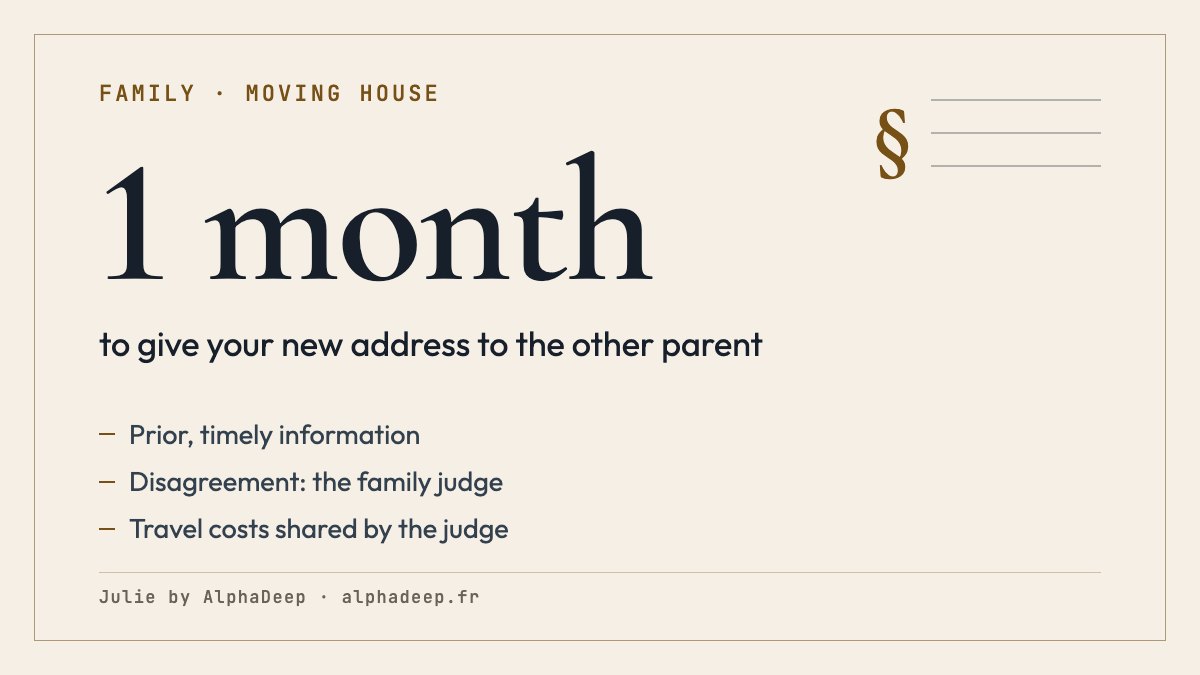
A move changing parental-authority arrangements requires advance information to the other parent in good time (Civil Code, article 373-2), without a general fixed notice period, subject to the protected-address exception. After moving, notify the new address within one month if the child ordinarily lives with you and the other person has contact or overnight-stay rights under a judgment or agreement covered by Penal Code article 227-6. The family judge resolves disagreement about arrangements.
Go to the tool: the legal brief
Julie by AlphaDeep is an AI legal assistant for French law: it researches official references to help answer your questions (Légifrance, case law, service-public), analyses your documents and drafts your letters, for individuals and professionals alike.
General legal information with official references and dated checks. It is not personalised advice: for a decision that commits you, have your situation checked by a qualified professional.

Let’s look at your situation
Describe the current custody, the move you plan, its date and the other parent’s reaction.
Example questions
Your question carries over after signup. Maximum 400 characters. Avoid health data and names.
What must you do before moving?
Say where the child lives, what the move changes, the other parent’s position and the planned date: the brief ends with its reasons. The example: the child lives with you, school and visits change, the other parent refuses, a move on 15 October 2026.
Fictional example · brief on your move
Moving is possible, after telling the other parent in advance.
- Prior information
- required
- New address, at the latest
- 15 November 2026
For these reasons
In view of your answers, the Civil Code and the Penal Code:
- Information: tell the other parent before moving and in good time, since school, travel or visits change (Civil Code, article 373-2); no distance or notice period is set, service-public advises as early as possible.
- Disagreement: whichever parent acts first applies to the family judge, on a form and with no lawyer required; the judge rules by the child’s interest, shares the travel costs and adjusts maintenance (article 373-2; fiche F11389).
- The judge’s criteria: in particular past practice, the feelings expressed by the child and each parent’s ability to respect the other’s rights (Civil Code, article 373-2-11).
- New address: give it to the other parent by 15 November 2026 at the latest, 1 month after the move; failing to do so is punishable by 6 months’ imprisonment and a €7,500 fine (Penal Code, article 227-6).
Indicative analysis: if the parents disagree, the family judge decides according to the child’s interest.
Which rules apply to moving with your child?
What the Civil Code, the Penal Code and service-public provide, from the plan to leave to afterwards.
| Rule | Content | Text |
|---|---|---|
| Freedom to move | The other parent cannot forbid it | Fiche F11389 |
| Telling the other parent | In advance and in good time, if the exercise of parental authority changes | Art. 373-2 Civil Code |
| Distance or notice period | None; as early as possible according to service-public | Art. 373-2 Civil Code; fiche F11389 |
| Parents’ agreement | An agreement the family judge can approve | Art. 373-2-7 Civil Code |
| Disagreement | The judge decides by the child’s interest, shares travel costs, adjusts maintenance | Art. 373-2 Civil Code |
| Lawyer before the judge | Not required for this procedure | Fiche F11389 |
| New address | To be notified within the month: 6 months’ imprisonment and a €7,500 fine otherwise | Art. 227-6 Penal Code |
| Moving abroad | A ban on leaving France is possible; parental abduction if the other’s rights are not respected | Art. 373-2-6 Civil Code; fiche F1191 |
A parent allowed by a protection order to hide their address does not have to tell the other parent targeted by that order (article 373-2).
Sources: Service-public F11389 · C. civ. 373-2 · C. civ. 373-2-7 · C. pén. 227-6 · C. civ. 373-2-6 · Service-public F1191
Can you move with your child without the other parent’s agreement?
Yes: moving house remains your right, for personal or work reasons, and the other parent cannot forbid it, whatever the custody arrangement (fiche F11389). Separation does not change the rules on exercising parental authority, and each parent must respect the child’s ties with the other (Civil Code, article 373-2).
But if the move changes how parental authority is exercised, for example because it makes visits impossible, you must tell the other parent in advance and in good time (article 373-2).
Sources: Service-public F11389 · C. civ. 373-2
When and how should you tell the other parent?
The text sets neither a distance nor a notice period: the information comes in advance and in good time, and service-public advises giving it as early as possible, to find a new organisation of residence and visits together (fiche F11389).
If the child ordinarily lives with you, notify your new address within one month to people entitled to contact or overnight stays under a judgment, a court-approved agreement or a divorce agreement under Civil Code article 229-1. Failing to do so is punishable by 6 months’ imprisonment and a €7,500 fine (Penal Code, article 227-6).
Sources: C. civ. 373-2 · Service-public F11389 · C. pén. 227-6
What happens if the other parent refuses?
Whichever parent acts first brings the matter before the family judge (juge aux affaires familiales), who rules according to the child’s interest (article 373-2); the application, on a form, goes to the court where the child lives, with no lawyer required (fiche F11389).
The judge can set the child’s residence with the other parent; they share the travel costs and adjust the maintenance (article 373-2; fiche F11389). If the parents agree, a parenting agreement can be approved by the judge (article 373-2-7).
This guide prioritises information before departure and address notification after the change. To prepare a parent-versus-parent application and documents, use the family-court application guide in French.
Sources: C. civ. 373-2 · Service-public F11389 · C. civ. 373-2-7
What if you move abroad?
Taking or keeping the child abroad without authorisation, or moving their residence without respecting the other parent’s rights, may amount to parental child abduction (fiche F1191).
The family judge can ban the child from leaving France without both parents’ authorisation; the ban is recorded in the wanted persons file (Civil Code, article 373-2-6).
Sources: Service-public F1191 · C. civ. 373-2-6
What does article 373-2 of the Civil Code say about moving?
The paragraph that requires telling the other parent and leaves a disagreement to the judge.
Tout changement de résidence de l’un des parents, dès lors qu’il modifie les modalités d’exercice de l’autorité parentale, doit faire l’objet d’une information préalable et en temps utile de l’autre parent. En cas de désaccord, le parent le plus diligent saisit le juge aux affaires familiales qui statue selon ce qu’exige l’intérêt de l’enfant. Le juge répartit les frais de déplacement et ajuste en conséquence le montant de la contribution à l’entretien et à l’éducation de l’enfant. Le présent alinéa ne s’applique pas au parent bénéficiaire d’une autorisation de dissimuler son domicile ou sa résidence prévue au 6° bis de l’article 515-11 si l’ordonnance de protection a été requise à l’encontre de l’autre parent.
In English, briefly (our summary, not an official translation): Any change of residence of one of the parents, where it changes how parental authority is exercised, must be the subject of prior and timely information to the other parent. In case of disagreement, whichever parent acts first refers the matter to the family judge, who rules as the child’s interest requires, shares the travel costs and adjusts the maintenance accordingly. This paragraph does not apply to a parent authorised to hide their address under 6° bis of article 515-11 where the protection order was sought against the other parent. The last sentence dates from loi no. 2024-233 of 18 March 2024.
What changed in 2024?
An exception for parents protected by a protection order.
A parent allowed to hide their address by a protection order sought against the other parent no longer has to tell them about a change of residence (Civil Code, article 373-2, loi no. 2024-233 of 18 March 2024).
Source: C. civ. 373-2
What do separated parents who move ask?
Is a travel authorisation enough to go and live abroad?
No: it covers a minor travelling without a holder of parental authority (Civil Code, article 371-6). Leaving to live abroad without authorisation, without respecting the other parent’s rights, may amount to parental abduction (fiche F1191).
Can the judge give the child’s residence to the other parent?
Yes: the judge rules according to the child’s interest and can set their residence with the other parent (fiche F11389), taking into account in particular past practice, the child’s feelings and each parent’s ability to respect the other’s rights (Civil Code, article 373-2-11).
Who pays for travel after the move?
If the parents disagree, the judge shares the travel costs and adjusts the maintenance accordingly (Civil Code, article 373-2); if they agree, the parenting agreement can provide for it.
What about domestic violence?
A parent allowed, by a protection order sought against the other parent, to hide their address does not have to tell them about a change of residence (article 373-2); they can elect domicile with a qualified legal entity (Civil Code, article 515-11, 6° bis).
Do you need a lawyer to go to the judge?
Not for this procedure: the application to the family judge is made on a form, sent to the court where the child lives (fiche F11389).
Which texts and fiches is this brief based on?
- Civil Code, article 373-2 (a parent’s change of residence)Légifrance, in French
- Can a separated parent move freely? (fiche F11389)Service-public.fr, in French · checked by the publisher on 28 May 2025
- Penal Code, article 227-6 (notifying the new address)Légifrance, in French
- Civil Code, article 373-2-7 (approval of the parenting agreement)Légifrance, in French
- Civil Code, article 373-2-6 (ban on leaving France)Légifrance, in French
- Parental abduction (fiche F1191)Service-public.fr, in French · checked by the publisher on 19 August 2026
- Civil Code, article 371-6 (travel authorisation)Légifrance, in French
- Civil Code, article 373-2-11 (the judge’s criteria)Légifrance, in French
- Civil Code, article 515-11 (protection order)Légifrance, in French
Texts cited last checked: 26 September 2026