The statement of sumsStatement · Indivision
Occupation indemnity in a French indivision: when it is owed, how to value it, how far back to go, and a statement of what the occupant owes
A co-owner (indivisaire) with exclusive use of jointly owned property in France owes, unless agreed otherwise, an indemnity (Civil Code, article 815-9). It is worked out on the rental value, often with a precariousness discount no text sets, goes to the indivision and is shared according to each person’s rights. A claim cannot reach back beyond 5 years (article 815-10), and property tax stays an indivision charge.
Go to the tool: the statement of sums
Julie by AlphaDeep is an AI legal assistant for French law: it researches official references to help answer your questions (Légifrance, case law, service-public), analyses your documents and drafts your letters, for individuals and professionals alike.
General legal information with official references and dated checks. It is not personalised advice: for a decision that commits you, have your situation checked by a qualified professional.

Let’s look at your situation
Give the property, how the shares are split, the dates of the occupation and what each person paid.
Example questions
Your question carries over after signup. Maximum 400 characters. Avoid health data and names.
How much does the person living in the property owe?
Give the monthly rental value, the discount applied, the dates of the occupation and of the claim, the occupant’s share and the property tax advanced: the statement leaves out the time-barred months, works out the indemnity owed to the indivision and the occupant’s net charge. The example: a house worth €1,200 a month, occupied since 1 January 2019, a 20% discount and a claim on 1 September 2026, in equal shares.
Fictional example · the occupation statement
€57,600.00 of indemnity owed to the indivision, of which €28,800.00 is the occupant’s net charge.
- Monthly indemnity applied
- €960.00
- Start of the time bar
- 1 September 2021
- Time-barred months, save interruption
- 32 months, that is €30,720.00
- Goes to the other co-owners
- €28,800.00
- Rental valuefrom 1 September 2021, that is 60 months€72,000.00€72,000.00
- Precariousness discount of 20%assessed by the judge(€14,400.00)€57,600.00
- Indemnity owed to the indivisionarticle 815-9 of the Civil Code€57,600.00€57,600.00
- Occupant’s share in the indivisiontheir rights, 50%(€28,800.00)€28,800.00
Occupant’s net charge€28,800.00
Indicative result: the judge sets the rental value and the discount; the qualifying act, its exact scope, any suspension and the continuation or ending of proceedings must be checked (articles 2240-2243). No automatic interruption is inferred from an ordinary letter or notarial request.
When is an occupation indemnity owed?
As soon as a co-owner has private use or enjoyment of the jointly owned property, unless agreed otherwise (Civil Code, article 815-9).
Use is private when the others cannot use the property, in law or in fact: being the only person holding the front-door keys is enough (Cass. 1re civ., 31 March 2016, no. 15-10.748).
Sources: C. civ. 815-9 · Cass. 1re civ., 31 March 2016
How is it worked out?
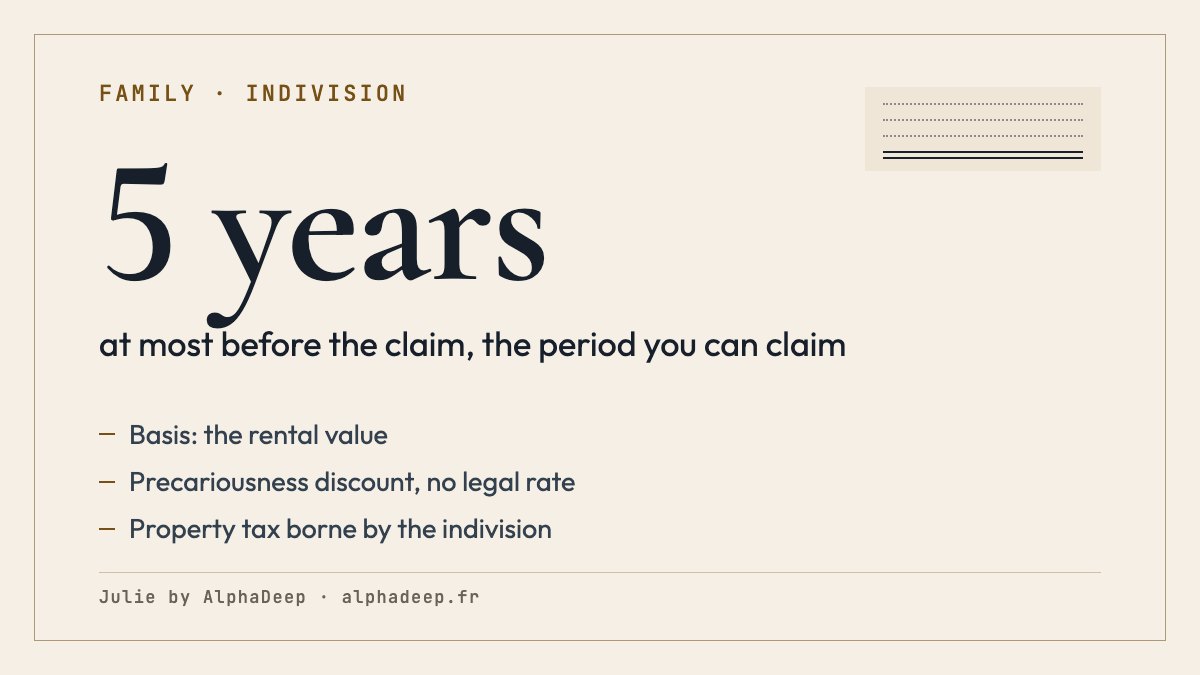
On the property’s rental value, which the judge can cut by a precariousness discount; no text sets the rate, and a 30% discount was left to the trial judges’ sovereign assessment (Cass. 1re civ., 24 June 2015, no. 14-17.795).
The indemnity goes to the indivision and is shared according to each person’s rights: the person living in the property thus bears the others’ share (article 815-10).
Sources: Cass. 1re civ., 24 June 2015 · C. civ. 815-10
How far back can you go?
No claim for fruits and income can be brought more than 5 years after the date they were or could have been received (article 815-10): a late claim only covers the 5 years before it, save interruption or suspension (Cass. 1re civ., 15 May 2008, no. 06-20.822).
Each month without a claim therefore drops an old month from the statement.
Sources: C. civ. 815-10 · Cass. 1re civ., 15 May 2008
What goes into the occupation account?
The base, the discount, the time bar, then the charges and the special cases.
| Item | Rule | Text |
|---|---|---|
| Exclusive use | The others cannot use the property, in law or in fact | Cass. 1re civ., 31 March 2016 |
| Basis of calculation | The property’s rental value | Article 815-9 |
| Precariousness discount | No legal rate; 30% accepted in a 2015 case | Cass. 1re civ., 24 June 2015 |
| Beneficiary | The indivision, then each person by their rights | Article 815-10 |
| Time bar | 5 years before the claim, save interruption or suspension | Article 815-10; Cass. 1re civ., 15 May 2008 |
| Property tax | An indivision charge until partition, even during occupation | Cass. 1re civ., 13 January 2016 |
| Preservation or improvement costs | Credited to the person who paid them | Article 815-13 |
| Surviving spouse | One year of free use of the home | Article 763 |
| Agreement to the contrary | The co-owners can set the indemnity aside | Article 815-9 |
The indemnity is not a rent: it offsets private use and goes to the indivision (articles 815-9 and 815-10).
Sources: Cass. 1re civ., 31 March 2016 · C. civ. 815-9 · Cass. 1re civ., 24 June 2015 · C. civ. 815-10 · Cass. 1re civ., 15 May 2008 · Cass. 1re civ., 13 January 2016 · C. civ. 815-13 · C. civ. 763
What do French co-owners ask about the use of the property?
Who pays property tax during the occupation?
The indivision, until partition, even during private use; the person who paid it from their own funds credits it to their account (Cass. 1re civ., 13 January 2016, no. 14-24.767; article 815-13).
Does the surviving spouse owe an indemnity?
Not in the first year: the person living in the home as their main residence at the death has free use of it for one year (article 763).
Can the indemnity be waived?
Yes, by an agreement between co-owners: the indemnity is only owed unless agreed otherwise (article 815-9).
Who decides if you disagree?
The court president can settle the use of the property provisionally (article 815-9); the indemnity is then valued in the indivision accounts.
What does article 815-9 of the French Civil Code say?
Each person’s right to the property, and the indemnity owed for private use.
Chaque indivisaire peut user et jouir des biens indivis conformément à leur destination, dans la mesure compatible avec le droit des autres indivisaires et avec l’effet des actes régulièrement passés au cours de l’indivision. A défaut d’accord entre les intéressés, l’exercice de ce droit est réglé, à titre provisoire, par le président du tribunal.
L’indivisaire qui use ou jouit privativement de la chose indivise est, sauf convention contraire, redevable d’une indemnité.
In English, briefly (our summary, not an official translation): Each co-owner can use and enjoy the jointly owned property according to its purpose, as far as is compatible with the rights of the other co-owners and with the effect of acts duly made during the indivision. Failing agreement, the exercise of this right is settled provisionally by the court president. The co-owner who has private use or enjoyment of the jointly owned property owes, unless agreed otherwise, an indemnity. Our note: fruits and income go to the indivision, and no claim is admissible more than 5 years after their date (article 815-10).
Which texts does the occupation indemnity rest on?
- Code civil, article 2240 (reconnaissance du droit)Légifrance
- Code civil, article 2241 (demande en justice)Légifrance
- Civil Code, article 815-9 (use and indemnity)Légifrance
- Civil Code, article 815-10 (fruits, income and the 5-year bar)Légifrance
- Civil Code, article 815-13 (costs and improvements)Légifrance
- Civil Code, article 763 (the surviving spouse’s home)Légifrance
- Cour de cassation, first civil chamber, 31 March 2016, no. 15-10.748 (private use)Légifrance
- Cour de cassation, first civil chamber, 24 June 2015, no. 14-17.795 (precariousness discount)Légifrance
- Cour de cassation, first civil chamber, 15 May 2008, no. 06-20.822 (the last five years)Légifrance
- Cour de cassation, first civil chamber, 13 January 2016, no. 14-24.767 (property tax)Légifrance
- Inheritance: indivision between heirs (sheet F1296, in French)Service-public.fr · checked on 16 April 2026
Texts cited last checked: 27 September 2026