The route finderInheritance · surviving spouse
Surviving spouse’s rights in France: usufruct, a quarter in ownership and the home
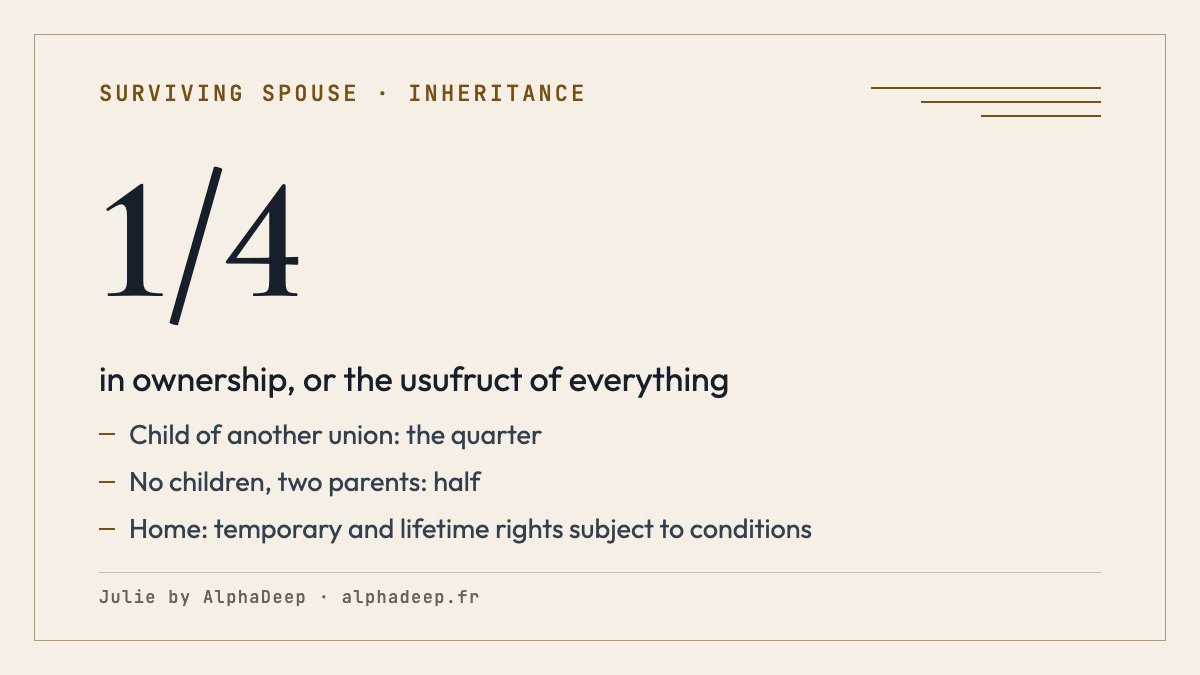
A surviving non-divorced spouse inherits according to the deceased’s family. With only common children, the choice is usufruct of everything or a quarter in ownership; with another-union child, only the quarter applies (Civil Code 757). A gift may broaden options according to its deed. Housing rights require principal residence and ownership conditions; an authentic will may exclude lifetime occupation. A Pacs partner does not inherit without a will.
Go to the tool: the route finder
Julie by AlphaDeep is an AI legal assistant for French law: it researches official references to help answer your questions (Légifrance, case law, service-public), analyses your documents and drafts your letters, for individuals and professionals alike.
General legal information with official references and dated checks. It is not personalised advice: for a decision that commits you, have your situation checked by a qualified professional.

Let’s look at your situation
Say whom the deceased leaves, your age and what the estate includes.
Example questions
Your question carries over after signup. Maximum 400 characters. Avoid health data and names.
What does the surviving spouse receive when the deceased had children?
If all the children were born of the couple, the spouse chooses between the usufruct of all the property and ownership of a quarter; if at least one child was born of another union, the spouse receives a quarter in full ownership, with no option (Civil Code, article 757). Only a spouse who is not divorced inherits (article 732).
Until the spouse has chosen, these rights cannot be transferred (article 758-1). Any heir can ask the spouse in writing to choose: without a written answer within 3 months, the spouse is deemed to have chosen the usufruct (article 758-3). The quarter is calculated on the property existing at death, notionally increased by reportable transfers to successors; it can only be exercised over property not already given or bequeathed, without prejudicing protected shares or rights of return (article 758-5).
Sources: C. civ. 757 · C. civ. 732 · C. civ. 758-3
Usufruct or a quarter in full ownership: what is each option worth?
For tax purposes, the usufruct is worth a share of full ownership that falls with age: 50% from 51 to 60, 40% from 61 to 70, 30% from 71 to 80, 20% from 81 to 90 (General Tax Code, article 669). At 72, the usufruct of an estate of €400,000 is thus worth €120,000, against €100,000 for the quarter.
The usufruct gives the use of the property and its income; the children receive full ownership when the spouse dies. It can be converted into a life annuity at the request of an heir or the spouse, or into capital by agreement (Civil Code, articles 759 and 761), but the court cannot impose the conversion of the usufruct of the home against the spouse’s wishes (article 760).
Sources: CGI 669 · C. civ. 759
What does the spouse receive if the deceased had no children?
Without children or descendants, with both of the deceased’s parents alive, the spouse receives half and each parent a quarter; with only one parent, the spouse receives three quarters (Civil Code, article 757-1). With no children, descendants, father or mother, the spouse takes the whole estate, subject to rights of return (article 757-2).
Two rights of return apply without descendants: when both parents died earlier, property received from ascendants by inheritance or gift and still found in kind goes half to siblings or their descendants who themselves descend from the parents responsible for the transfer (article 757-3). Living parents may take back property they gave up to their quarter; this return counts first against their inheritance share and, if return in kind is impossible, is paid in value within the estate assets (article 738-2). Without descendants, the spouse is a protected heir for a quarter (article 914-1).
Sources: C. civ. 757-1 · C. civ. 732
Can the spouse stay in the home after the death?
Yes, for one year if they actually occupied it as their main home at death: free use of a home owned by the spouses or wholly in the estate and its estate-owned furniture; for a rented home or one partly owned by the deceased in undivided shares, reimbursement of rent or occupation charges as they are paid (Civil Code, article 763, a public-policy rule). If the home belonged to the couple or to the deceased alone, the spouse can then ask, within a year of the death, for a lifelong right to live in and use it (articles 764 and 765-1).
Only a will drawn up before a notary can deprive the spouse of this lifelong right (article 764). Its value is deducted from the spouse’s share, and the spouse owes nothing if it exceeds that share (article 765); on division, the spouse is entitled to preferential allotment of the home actually occupied at death (articles 831-2 and 831-3).
Sources: C. civ. 763 · C. civ. 831-3 · Service-public F1725
What does a gift to the last survivor change?
Depending on its deed, a gift to the last survivor may widen the choice, even with children of another union: the disposable share in full ownership, that is half with one child, a third with two, a quarter with three or more; or a quarter in full ownership and three quarters in usufruct; or the usufruct of all the property (Civil Code, articles 913 and 1094-1).
Unless a clause provides otherwise, the spouse can also limit what they receive to part of the property, without this limitation being a gift to the other heirs (article 1094-1). Gifts received from the deceased are deducted from the spouse’s legal rights, and the spouse can claim the difference if they receive less (article 758-6).
Sources: C. civ. 1094-1 · C. civ. 758-3
Which options are open to you in the estate?
Give your link to the deceased, their children or parents, your age and, if you know it, the value of the estate: the route finder shows each option, its tax value and what it leaves the children. The example: a spouse aged 72, two common children, an estate of €400,000. The result is indicative: confirm the ordinary-case conditions; a special case or unknown decisive fact prevents calculation.
Fictional example · surviving spouse route finder
Two options to choose from: the usufruct of everything, worth 30% of the estate at your age, or a quarter in full ownership.
| Criterion | The usufruct of all the property | A quarter in full ownership |
|---|---|---|
| What you receive | The usufruct of all the property | A quarter in full ownership |
| Tax value at 72 | 30% of the estate | 25% of the estate |
| Estimated amount | €120,000 | €100,000 |
| The children receive | Bare ownership of all the property | Three quarters in full ownership |
| The home | Use of property subject to usufruct | Possible lifetime right: principal residence, ownership and no exclusion by authentic will; claim within one year |
At your age, the usufruct of all the property has the higher tax value; the choice also depends on your income and the home.
The temporary right concerns the principal residence actually occupied at death: free occupation or reimbursement of rent/occupation charges depending on ownership. A lifetime right requires a home owned by the spouses or wholly in the estate, with no exclusion by authentic will; claim within one year. The spouse is exempt from inheritance tax.
The tax value of the usufruct follows the scale of article 669 of the General Tax Code; it does not measure the income you will draw from the property.
Which share goes to the spouse depending on the deceased’s family?
The law sets the married spouse’s share; a will or a gift can increase it.
| The deceased leaves | Spouse’s share | Text |
|---|---|---|
| Children all born of the couple | Usufruct of everything or a quarter in full ownership, as chosen | C. civ. 757 |
| At least one child of another union | A quarter in full ownership | C. civ. 757 |
| No children or descendants, both parents | Half in full ownership | C. civ. 757-1 |
| No children or descendants, one parent | Three quarters in full ownership | C. civ. 757-1 |
| No children, descendants, father or mother | Everything, subject to return of ascendants’ property still in kind to qualifying siblings or descendants | C. civ. 757-2 and 757-3 |
| A gift to the last survivor, with children | Options provided by the deed: disposable share, a quarter plus three quarters in usufruct, or usufruct of everything | C. civ. 1094-1 |
| A Pacs partner or an unmarried partner | Nothing without a will | C. civ. 515-6; service-public F1621 |
The surviving spouse and the Pacs partner are exempt from inheritance tax (General Tax Code, article 796-0 bis).
Sources: C. civ. 757 · C. civ. 757-1 · C. civ. 1094-1 · C. civ. 515-6 · CGI 796-0 bis
What does article 757 of the Civil Code provide?
Article 757 is the text of the choice between usufruct and a quarter, in force since 2002.
Si l’époux prédécédé laisse des enfants ou descendants, le conjoint survivant recueille, à son choix, l’usufruit de la totalité des biens existants ou la propriété du quart des biens lorsque tous les enfants sont issus des deux époux et la propriété du quart en présence d’un ou plusieurs enfants qui ne sont pas issus des deux époux.
In English, briefly (our summary, not an official translation): If the spouse who died first leaves children or descendants, the surviving spouse receives, as they choose, the usufruct of all the existing property or ownership of a quarter of the property when all the children are born of both spouses, and ownership of a quarter when one or more children are not born of both spouses. Without a written choice within 3 months of an heir’s written request, the spouse is deemed to have chosen the usufruct (article 758-3).
What do widows and widowers ask when the estate is settled?
Does the surviving spouse pay inheritance tax?
No. The surviving spouse and the Pacs partner are exempt from inheritance tax, whatever the amount received (General Tax Code, article 796-0 bis). The inheritance tax return is still due if the gross assets reach €50,000 (article 800).
How long does the spouse have to choose an option?
The law sets no time limit, but any heir can ask the spouse in writing to choose: without a written answer within 3 months, the spouse is deemed to have opted for the usufruct (Civil Code, article 758-3). The choice can be proved by any means (article 758-2).
Can a spouse in need ask for an allowance?
Yes. The estate owes an allowance to a spouse in need, to be claimed within a year of the death or of the end of the help the heirs were giving; if the estate remains undivided, this period extends until division is completed (Civil Code, article 767).
Can a Pacs partner inherit?
Only by will. Without a will, the partner has no right to the deceased’s property, but keeps their own property, their share of the joint property and, subject to conditions, one year of free occupation of the principal residence actually occupied at the death: use of the home if it belonged to the deceased or the partners, or reimbursement of rent by the estate if rented. A will may exclude this right for a Pacs partner (Civil Code, article 515-6; service-public, fiches F1621 and F1725). A bequest to the partner is exempt from tax.
Does a gift received from the deceased reduce the spouse’s share?
It is deducted from the spouse’s rights in the estate. If it is worth less than the legal rights, the spouse can claim the difference, without exceeding what article 1094-1 allows (Civil Code, article 758-6).
Which texts are the surviving spouse’s rights based on?
- Civil Code 764: conditional lifetime housing rightLégifrance, in French
- Civil Code, article 757 (usufruct of everything or a quarter in ownership)Légifrance, in French
- Civil Code, articles 757-1 to 757-3 (deceased without descendants)Légifrance, in French
- Civil Code, articles 758-1 to 758-6 (exercising the option, calculating the quarter, deducting gifts)Légifrance, in French
- Civil Code, articles 763 to 765-1 (temporary and lifelong right to the home)Légifrance, in French
- Civil Code, articles 913 and 1094-1 (disposable share, gift between spouses)Légifrance, in French
- General Tax Code, article 669 (value of the usufruct by age)Légifrance, in French
- General Tax Code, article 796-0 bis (spouse and partner exempt)Légifrance, in French
- Civil Code, articles 759 to 761 (converting the usufruct into an annuity or capital)Légifrance, in French
- Civil Code, articles 732, 738-2 and 914-1 (spouse as heir, right of return, spouse’s protected share)Légifrance, in French
- Civil Code, article 515-6 (surviving Pacs partner and the home)Légifrance, in French
- Death of a Pacs partner: what are the inheritance rules? (fiche F1621)Service-public.fr, in French · checked by the publisher on 16 June 2026
- What are the spouse’s rights to the deceased’s home? (fiche F1725)Service-public.fr, in French · checked by the publisher on 27 January 2026
- Civil Code, article 767 (allowance owed to a spouse in need)Légifrance, in French
- Civil Code, article 831-3 (preferential allotment of the home)Légifrance, in French
Texts cited last checked: 25 September 2026