The legal briefCouple · Pacs or marriage
Pacs vs marriage in France: what is the same, what only marriage produces and how each union ends
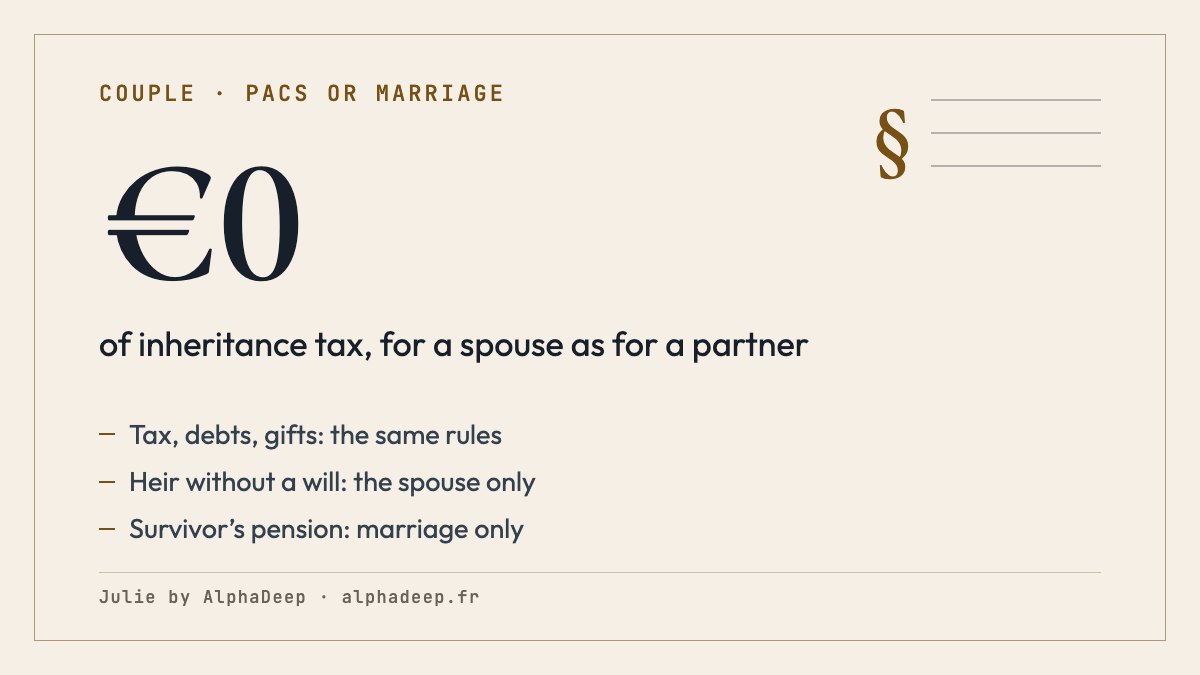
A French Pacs (pacte civil de solidarité, a registered partnership) and marriage give the same joint income taxation, the same liability for everyday household debts and the same inheritance tax exemption. Only marriage makes the survivor an heir without a will, opens the survivor’s pension, protects the family home and presumes the husband’s paternity. A Pacs can end by one partner’s decision, served on the other, without a judge (articles 757 and 515-7 of the Civil Code).
Go to the tool: the legal brief
Julie by AlphaDeep is an AI legal assistant for French law: it researches official references to help answer your questions (Légifrance, case law, service-public), analyses your documents and drafts your letters, for individuals and professionals alike.
General legal information with official references and dated checks. It is not personalised advice: for a decision that commits you, have your situation checked by a qualified professional.
Let’s look at your situation
Give your children, who owns the home and what matters to you: inheritance, survivor’s pension, nationality.
Example questions
Your question carries over after signup. Maximum 400 characters. Avoid health data and names.
Pacs or marriage: which rule for each question?
Each question, the Pacs rule and the marriage rule, with their texts.
| Question | Pacs | Marriage |
|---|---|---|
| Where you commit | Declaration at the town hall or before a notary | Ceremony at the town hall |
| Duties | Life together, material support, assistance | Respect, fidelity, support, assistance |
| Everyday household debts | Jointly liable | Jointly liable |
| Property, with no agreement or contract | Separate, co-ownership by option | Acquisitions shared |
| Home lease | Both, on a joint request | Both, by law |
| Selling the family home | The owner alone | Both must agree |
| Income tax | Joint taxation | Joint taxation |
| Gift between you | €80,724 allowance | €80,724 allowance |
| Inheritance without a will | Nothing | Heir by law |
| Inheritance tax | Exempt | Exempt |
| Home after a death | 1 year, unless a will says otherwise | 1 year, then a lifelong right |
| Survivor’s pension | No | Yes, depending on the scheme |
| Father of the child | Recognition | Presumption of paternity |
| The other’s surname, as a usage name | No | Yes |
| Nationality by declaration through the union | No route created by the Pacs alone | Declaration after 4 years |
| End of the union | Joint declaration or one partner’s decision | Divorce |
The gift allowance between partners is clawed back if the Pacs ends in the year it was concluded or the following year, for a reason other than marriage or death (article 790 F of the CGI).
Sources: Civil Code 515-3 · Civil Code 165 · Civil Code 515-4 · Civil Code 212 · Civil Code 220 · Civil Code 515-5 · Civil Code 515-5-1 · Civil Code 1400 · Civil Code 1401 · Civil Code 1751 · Civil Code 215 · Service-public F14485 · CGI 6 · CGI 790 E · CGI 790 F · Civil Code 732 · Civil Code 757 · Service-public F1621 · CGI 796-0 bis · Civil Code 763 · Civil Code 764 · Service-public F13104 · Civil Code 312 · Civil Code 316 · Civil Code 225-1 · Civil Code 21-2 · Service-public F1026 · Civil Code 515-7 · Civil Code 229
What does article 757 of the Civil Code say?
The text that makes the spouse, not the partner, an heir.
Si l’époux prédécédé laisse des enfants ou descendants, le conjoint survivant recueille, à son choix, l’usufruit de la totalité des biens existants ou la propriété du quart des biens lorsque tous les enfants sont issus des deux époux et la propriété du quart en présence d’un ou plusieurs enfants qui ne sont pas issus des deux époux.
In English, briefly (our summary, not an official translation): If the spouse who dies first leaves children or descendants, the surviving spouse takes, at their choice, the usufruct of the whole of the existing estate or full ownership of a quarter when all the children are born of both spouses, and full ownership of a quarter when one or more children are not born of both spouses. Article 732 reserves this status for the “surviving spouse who is not divorced”: a Pacs partner inherits only by will, within the freely disposable portion (article 913).
What do a Pacs and a marriage change in your situation?
Give your children, your home and what matters to you: the brief sorts each effect, the same or specific to one union, with its text. The example: 2 children of the couple, one owner, the survivor’s pension matters.
Fictional example · brief on your union
5 effects only marriage produces on your points, 4 the same, 1 only a Pacs has.
- Heir without a will
- the spouse, not the partner
- Spouse’s share by law
- usufruct of all or a quarter owned
- Largest bequest to a Pacs partner
- a third of the estate
- Effects only marriage produces
- 5
For these reasons
In view of your situation, the Civil Code, the CGI and the service-public fiches:
- On death: married, the survivor inherits without a will; with children all born of the couple, they choose the usufruct of the whole estate or a quarter in full ownership (article 757), and a gift between spouses can leave them more (article 1094-1). In a Pacs, they do not inherit: a will can leave them at most a third of the estate with 2 children (article 913). No inheritance tax in either case (article 796-0 bis of the CGI).
- Home owned by one of you: married, the owner cannot dispose of it, for example sell it, without the other’s consent (article 215); in a Pacs, the other has no right in the home (fiche F14485). On death: 1 year of rent-free occupation in both cases, which the owning partner can remove by will, not a spouse (articles 763 and 515-6; fiche F1621), then a lifelong right to live there for the spouse alone, unless an authentic will says otherwise (article 764).
- Survivor’s pension: you must have been married to the deceased, whatever the pension scheme, and a divorced former spouse is treated as a surviving spouse; a Pacs gives no survivor’s pension (fiche F13104).
- The same rules: joint income taxation (article 6 of the CGI), joint liability for everyday household debts (articles 220 and 515-4), a €80,724 allowance on gifts between you (articles 790 E and 790 F of the CGI), at least 4 days of leave to commit (article L3142-4 of the Labour Code).
- Ending the union: a Pacs ends by joint declaration or by one partner’s decision, served on the other, without a judge (article 515-7); a marriage ends by divorce, by a lawyers’ deed filed with a notary or pronounced by a judge (article 229).
Indicative analysis: it compares legal effects without ranking the unions; a Pacs agreement, a marriage contract or a will can change them.
What is the same in a Pacs and a marriage?
Both unions require the couple to support each other materially, in proportion to their means unless agreed otherwise, and make them jointly liable for everyday household debts, except manifestly excessive spending, instalment purchases and loans not agreed by both, save modest sums (articles 515-4, 214 and 220 of the Civil Code). Income is taxed jointly; in the year of the union, each may opt to be taxed separately on their own income for that year (article 6 of the CGI, the French tax code).
Gifts between you get an allowance of €80,724, and the survivor pays no inheritance tax (articles 790 E, 790 F and 796-0 bis of the CGI). A Pacs couple can adopt as a married couple can (article 343 of the Civil Code), and an employee gets at least 4 days of leave for a Pacs as for a marriage (article L3142-4 of the Labour Code).
Sources: Civil Code 515-4 · Civil Code 214 · Civil Code 220 · CGI 6 · CGI 790 E · CGI 790 F · CGI 796-0 bis · Civil Code 343 · Labour Code L3142-4
What does marriage change for property and the home?
Unless their agreement says otherwise, each Pacs partner remains sole owner of their property; the agreement can place later acquisitions in co-ownership (indivision) (articles 515-5 and 515-5-1). Spouses married without a contract share what they acquire during the marriage; what they owned before, and what they receive by gift or inheritance, remains their own (articles 1401 and 1405).
Neither spouse can, without the other, dispose of the rights that secure the family home, for example by selling it, even if it belongs to only one of them (article 215; fiche F14485). The lease belongs to both spouses by law, even if only one signed it before the marriage; to Pacs partners, only if they ask for it together (article 1751).
Sources: Civil Code 515-5 · Civil Code 515-5-1 · Civil Code 1401 · Civil Code 1405 · Civil Code 215 · Service-public F14485 · Civil Code 1751
What happens when a partner or a spouse dies?
A surviving spouse who is not divorced inherits without a will: with children all born of the couple, they choose the usufruct of the whole estate or a quarter in full ownership, and receive a quarter if a child is not the couple’s; with no child, they receive at least half the estate, and in principle all of it if the deceased has no father or mother left (articles 732, 757, 757-1 and 757-2). A gift between spouses can leave them more (article 1094-1).
A Pacs partner is not an heir: they receive only what a will leaves them, at most half, a third or a quarter of the estate as the deceased leaves 1, 2, 3 or more children (article 913; fiche F1621).
Both survivors may stay 1 year rent-free in the home; the partner who owns it can remove this right by will, never for a spouse, for whom it is a matter of public policy (articles 763 and 515-6; fiche F1621). The spouse then keeps a lifelong right to live there, unless an authentic will says otherwise (article 764), and only a spouse, even divorced, can claim a survivor’s pension (fiche F13104).
Sources: Civil Code 732 · Civil Code 757 · Civil Code 757-1 · Civil Code 757-2 · Civil Code 1094-1 · Civil Code 913 · Service-public F1621 · Civil Code 763 · Civil Code 515-6 · Civil Code 764 · Service-public F13104
What are the differences for children, surnames and nationality?
In a married opposite-sex couple, a child conceived or born during the marriage has the husband as father (article 312); outside marriage, Pacs included, the father establishes paternity by recognising the child, before or after birth (article 316). Each spouse may use the other’s surname as a usage name (article 225-1); a Pacs partner may not (fiche F14485).
A foreign national married to a French national receives, on conditions, a 1-year “vie privée et familiale” residence card (CESEDA, article L423-1) and can become French by declaration after 4 years of marriage, 5 in some cases (article 21-2 of the Civil Code). For a partner, the Pacs is only one element considered for that card, and a Pacs alone creates no acquisition or declaration route to nationality; naturalisation remains possible under its general conditions (fiche F1026).
Sources: Civil Code 312 · Civil Code 316 · Civil Code 225-1 · Service-public F14485 · CESEDA L423-1 · Civil Code 21-2 · Service-public F1026
What do couples ask when choosing between a Pacs and marriage?
Can you marry after a Pacs?
Yes: the marriage of the partners, or of one of them, dissolves the Pacs on that date; the town hall or notary that registered it, once informed of the marriage, records the dissolution (article 515-7 of the Civil Code).
Does a Pacs partner pay inheritance tax?
No: like a spouse, they are exempt (article 796-0 bis of the CGI), but they receive only what a will leaves them (fiche F1621).
Can a Pacs couple adopt a child?
Yes: adoption can be requested by two spouses, two Pacs partners or two cohabitants who show 1 year of life together or are each over 26 (article 343 of the Civil Code).
Does marriage mean paying less tax than a Pacs?
No: spouses and Pacs partners are taxed jointly on their income, under the same rules (article 6 of the CGI; fiche F14485).
Can one partner alone end a Pacs?
Yes: they have their decision served on the other, then send a copy to the town hall or notary that registered the Pacs; between the partners, the dissolution takes effect when it is recorded (article 515-7 of the Civil Code).
Which articles and fiches is this brief based on?
- Civil Code, article 757 (the spouse’s share with children)Légifrance, in French
- Civil Code, article 732 (the spouse as heir)Légifrance, in French
- Civil Code, article 913 (the children’s reserved share)Légifrance, in French
- Death of a Pacs partner: inheritance rules (fiche F1621)Service-public.fr, in French · checked by the publisher on 16 June 2026
- Civil Code, article 515-4 (support and debts in a Pacs)Légifrance, in French
- Civil Code, article 220 (spouses’ household debts)Légifrance, in French
- General Tax Code, article 6 (joint taxation)Légifrance, in French
- General Tax Code, article 790 E (allowance between spouses)Légifrance, in French
- General Tax Code, article 790 F (allowance between Pacs partners)Légifrance, in French
- General Tax Code, article 796-0 bis (exemption on death)Légifrance, in French
- Civil Code, article 343 (adoption by a couple)Légifrance, in French
- Labour Code, article L3142-4 (family event leave)Légifrance, in French
- Civil Code, article 515-5 (Pacs partners’ property)Légifrance, in French
- Civil Code, article 515-5-1 (opting for co-ownership)Légifrance, in French
- Civil Code, article 1401 (community property)Légifrance, in French
- Civil Code, article 1405 (separate property)Légifrance, in French
- Civil Code, article 215 (the family home)Légifrance, in French
- Civil Code, article 1751 (joint tenancy of the lease)Légifrance, in French
- Civil Code, article 763 (the home for 1 year)Légifrance, in French
- Civil Code, article 515-6 (rights of the surviving partner)Légifrance, in French
- Civil Code, article 764 (lifelong right to live in the home)Légifrance, in French
- Survivor’s pension from the Assurance retraite (fiche F13104)Service-public.fr, in French · checked by the publisher on 1 January 2026
- Civil Code, article 312 (presumption of paternity)Légifrance, in French
- Civil Code, article 316 (recognition of a child)Légifrance, in French
- Civil Code, article 225-1 (spouses’ usage name)Légifrance, in French
- Marriage, Pacs or cohabitation: the differences (fiche F14485)Service-public.fr, in French · checked by the publisher on 11 July 2025
- CESEDA, article L423-1 (card for the spouse of a French national)Légifrance, in French
- Civil Code, article 21-2 (nationality through marriage)Légifrance, in French
- Effects of a Pacs (fiche F1026)Service-public.fr, in French · checked by the publisher on 27 January 2026
- Civil Code, article 515-7 (ending a Pacs)Légifrance, in French
- Civil Code, article 229 (grounds for divorce)Légifrance, in French
- Civil Code, article 214 (contribution to household costs)Légifrance, in French
- Civil Code, article 1094-1 (gifts between spouses)Légifrance, in French
- Civil Code, article 757-1 (the spouse and the deceased’s parents)Légifrance, in French
- Civil Code, article 757-2 (the spouse as sole heir)Légifrance, in French
- Civil Code, article 515-3 (registering a Pacs)Légifrance, in French
- Civil Code, article 165 (celebration of a marriage)Légifrance, in French
- Civil Code, article 1400 (the default community regime)Légifrance, in French
- Civil Code, article 212 (spouses’ duties)Légifrance, in French
Texts cited last checked: 26 September 2026