The route finderDivorce · matrimonial regime
Dividing property after a divorce in France: own property, common property and the home
On divorce, the home’s division depends on the matrimonial regime, origin and proven funding. Under statutory community, acquisitions are common while earlier, gifted or inherited property normally remains separate; reimbursements adjust transfers between estates (Civil Code 1401, 1405 and 1469). Acquisition price is essential to estimate surviving profit. Joint ownership follows deed shares. Special clauses and debt exceeding value require a reviewed liquidation.
Go to the tool: the route finder
Julie by AlphaDeep is an AI legal assistant for French law: it researches official references to help answer your questions (Légifrance, case law, service-public), analyses your documents and drafts your letters, for individuals and professionals alike.
General legal information with official references and dated checks. It is not personalised advice: for a decision that commits you, have your situation checked by a qualified professional.

Let’s look at your situation
Give your matrimonial regime, the couple’s property and where it came from.
Example questions
Your question carries over after signup. Maximum 400 characters. Avoid health data and names.
Who keeps the home, and how much goes to each spouse?
Give your regime, where the home came from, its value, the loan outstanding and the own funds invested: the route finder classifies the property and works out each spouse’s share in this one home. Other assets and debts must be included separately in the full liquidation. The example: a house bought during the marriage for €300,000, including €60,000 of inheritance, now worth €400,000 with €120,000 of loan outstanding. The result is indicative: confirm the ordinary-case conditions; a special case or unknown decisive fact prevents calculation.
Fictional example · property division route finder
Common property, with a reward for the own funds invested: the spouse who contributed them takes them back first.
- Net value, loan deducted
- €280,000
- Reward
- €80,000
- Share of spouse A
- €180,000
- Share of spouse B
- €100,000
- Balancing payment if A keeps the home
- €100,000
- Sharing duty of 1.10%
- €3,080
Estimate for a single asset: the division covers all the property, and the reward uses the asset’s value on the day of the division. Spouse A is the one who contributed the own funds or who owns the property.
Which property is common and which stays your own?
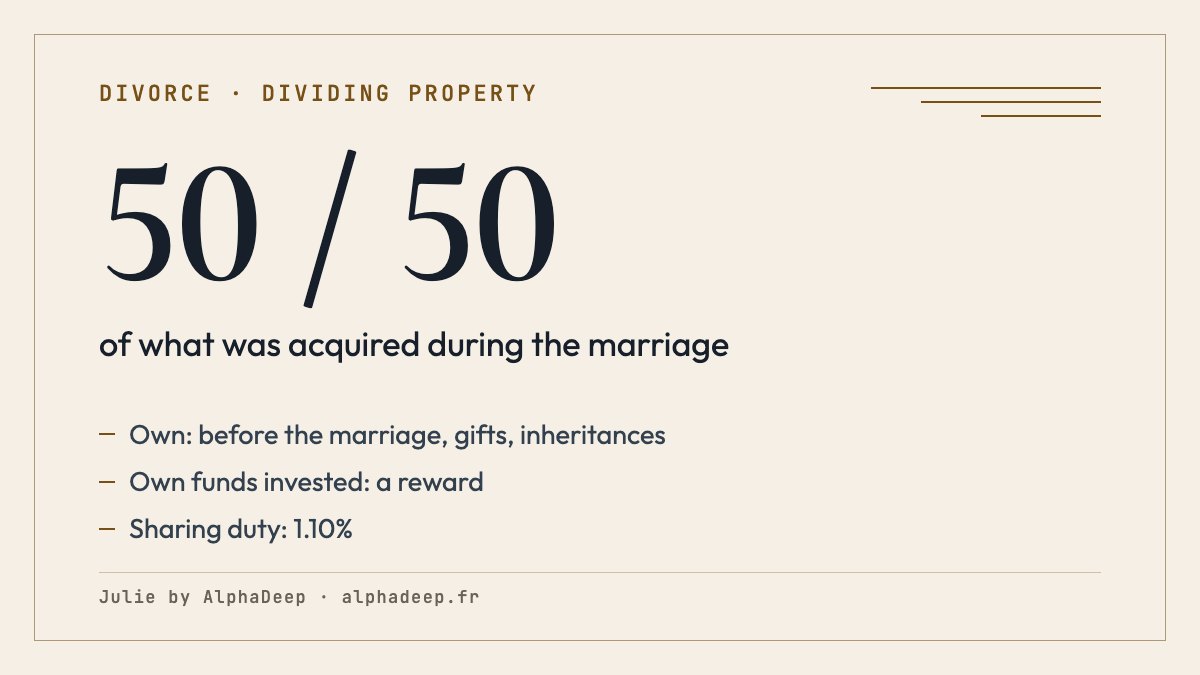
Under the default regime, acquests are common: property acquired during the marriage, together or separately, from earnings or from savings made on the income of own property (Civil Code, article 1401). All property is presumed common unless proved otherwise (article 1402); saved salaries and compensation for the end of an employment contract are included, according to service-public.
Property owned before the marriage stays own, as does property received during the marriage by gift, inheritance or bequest (article 1405), personal property by nature, such as clothes or compensation for a personal injury (article 1404), and property bought by reinvesting own funds (articles 1406 and 1434).
Sources: C. civ. 1401 · C. civ. 1405 · Service-public F36328
What happens to the house bought during the marriage?
The house bought during the marriage is common, and its net value, loan deducted, is split in half, even if only one spouse is on the deed or paid the instalments (Civil Code, articles 1401 and 1475). The spouse who keeps it pays the other a balancing payment (soulte), unless they leave the other spouse other property of the same value; both can also sell it or keep it in joint ownership, according to service-public.
If a spouse put own funds into it, for example an inheritance, the community owes that spouse a reward (article 1433). With a reinvestment statement in the deed and an own contribution at least equal to the community’s, the house stays that spouse’s own, and it is that spouse who owes a reward for the part financed jointly (articles 1434 and 1436).
Sources: C. civ. 1401 · C. civ. 1433 · Service-public F36328
How is a reward calculated?
In general, it equals the lower of two sums, the expense made and the surviving profit; but when the money was used to acquire or improve property still owned at the division, it cannot be less than the surviving profit (Civil Code, article 1469). A contribution of €60,000 to a house bought for €300,000 and now worth €400,000 thus gives a reward of €80,000.
Each spouse has a rewards account (article 1468). A spouse who is owed money takes it from the common property or is paid; a spouse who owes money pays it back into the common estate (article 1470). The rest is split in half (article 1475).
Source: C. civ. 1469
Who pays the debts and the loan after the divorce?
Debts arising during the marriage fall into the community; those for household upkeep and the children’s education bind both spouses jointly, unless the expense is manifestly excessive (Civil Code, articles 1409 and 220). The common mortgage still owed is divided in half, and the spouse who keeps the property can take over the other’s share of the loan, according to service-public.
Personal debts, from before the marriage or taken on in one spouse’s sole interest, remain that spouse’s, with a reward if the community paid them (article 1433; service-public). A spouse who hid a common debt must bear it alone, and one who diverted common property loses their share of it (article 1477).
Sources: C. civ. 1409 · C. civ. 1433 · Service-public F36328
On which date does property stop being common?
Between the spouses, a divorce by mutual consent takes effect on property on the date the agreement becomes enforceable; a court divorce, on the date of the divorce petition (Civil Code, article 262-1). The court can move this date back to the day the spouses stopped living and working together, on a request made during the proceedings.
Until the divorce petition, the spouse who stays alone in the family home owes no compensation for it, unless the court decides otherwise (article 262-1). Without agreement on the division, the court rules on the liquidation on the basis of the notary’s draft or the points of disagreement (article 267).
Source: C. civ. 262-1
In which order is the matrimonial regime wound up?
Five steps, generally led by a notary when there is real estate.
Draw up the inventory
All the property and all the debts at the date the divorce takes effect, with their origin and current value.
Take back own property
Each spouse takes back their own property in kind, or the property that replaced it (Civil Code, article 1467).
Draw up the rewards account
What the community owes each spouse and what each owes it (articles 1468 to 1470).
Split the rest in half
The balance of the common estate is divided in two; the spouse who receives more pays a balancing payment (article 1475; service-public).
Sign the statement of liquidation and pay the sharing duty
By notarial deed as soon as the division includes real estate (article 229-3 for divorce by mutual consent); the sharing duty is 1.10% (General Tax Code, article 746).
Who keeps what depending on the matrimonial regime?
The regime, chosen at the marriage or applied by default, decides what is divided.
| Regime | What is divided | What each spouse keeps | Text |
|---|---|---|---|
| Community of acquests, no contract | Property acquired during the marriage, in halves | Property from before the marriage, gifts and inheritances | C. civ. 1401, 1405, 1475 |
| Universal community | All property, present and future | Personal property by nature, unless a clause provides otherwise | C. civ. 1526 |
| Separation of property | Only property bought together, according to their shares | Everything in their own name, unless proved otherwise | C. civ. 1536, 1538 |
| All regimes, the family home | Sale, buy-out with a balancing payment, or joint ownership | A lease is possible for the non-owner spouse, until the youngest child comes of age | Service-public F36328 |
A division made after a divorce or the end of a Pacs bears a 1.10% duty on the net value divided, instead of 2.50% for other divisions (General Tax Code, article 746). The compensatory allowance on divorce answers a separate question; it is not calculated here.
Sources: C. civ. 1401 · C. civ. 1536 · CGI 746 · C. civ. 1476
What does article 1401 of the Civil Code provide?
Article 1401 is the text that defines the community of the default regime.
La communauté se compose activement des acquêts faits par les époux ensemble ou séparément durant le mariage, et provenant tant de leur industrie personnelle que des économies faites sur les fruits et revenus de leurs biens propres.
In English, briefly (our summary, not an official translation): The community is made up, on the assets side, of the acquests made by the spouses together or separately during the marriage, coming both from their own work and from savings made on the fruits and income of their own property. After the take-backs and the rewards, the remainder is split in half between the spouses (article 1475).
What do spouses ask when the time comes to divide?
Are savings in a personal account common?
Yes, if they come from salaries or income received during the marriage: the name on the account does not matter, and the savings are split in half even if only one spouse worked. Only savings from before the marriage or received by gift or inheritance stay own, provided their origin is proved (service-public, fiche F36328).
Can one of the spouses obtain the right to keep the house?
They can buy it out by paying a balancing payment, or ask for preferential allotment, which is never automatic after a divorce; the court can require the balancing payment to be paid in cash (Civil Code, article 1476).
Can the division be reopened after the divorce?
Yes: forgotten property leads to a supplementary division, with no time limit; a loss of more than a quarter opens a claim for a supplement within 2 years of the division, unless the division was approved or ordered by the court (service-public, fiche F2730).
Do you need a notary to divide the property?
In a divorce by mutual consent, yes as soon as the division includes real estate: the statement of liquidation is then drawn up as an authentic deed before a notary (Civil Code, article 229-3). In other divorces, the court rules on the basis of the draft of the notary it appointed (article 267).
What happens if the former spouse hid common property?
It is concealment of community property (recel): the spouse who diverted or hid it loses their share of that property, which goes entirely to the other spouse (Civil Code, article 1477), who can also claim damages, according to service-public.
Which texts is dividing property on divorce based on?
- Civil Code, articles 1401 and 1402 (community of acquests, presumption)Légifrance, in French
- Civil Code, articles 1404 to 1406 (own property)Légifrance, in French
- Civil Code, articles 1433, 1434 and 1436 (rewards, investment and reinvestment)Légifrance, in French
- Civil Code, articles 1467 to 1470 and 1475 (liquidation, calculating rewards, division in halves)Légifrance, in French
- Civil Code, articles 220, 1409 and 1477 (household debts, concealment)Légifrance, in French
- Civil Code, articles 262-1 and 267 (date of effect, liquidation by the court)Légifrance, in French
- Civil Code, articles 1526, 1536 and 1538 (universal community, separation of property)Légifrance, in French
- General Tax Code, article 746 (1.10% sharing duty)Légifrance, in French
- Divorce: what are the rules for dividing the spouses’ property? (fiche F36328)Service-public.fr, in French · checked by the publisher on 22 July 2025
- Civil Code, article 1476 (division, preferential allotment, balancing payment)Légifrance, in French
- Can the division of property be reopened after a divorce? (fiche F2730)Service-public.fr, in French · checked by the publisher on 21 March 2025
- Civil Code, article 229-3 (divorce by mutual consent agreement, statement of liquidation)Légifrance, in French
Texts cited last checked: 25 September 2026