The route finderUnmarried couple · separation
Separating without marriage in France, as unmarried or Pacs partners: dividing the property
For cohabitants or a Pacs with separate property, each partner keeps personal assets; jointly owned housing follows deed shares, which cannot be assumed equal when unknown. Funding the other partner’s property may support a reimbursement claim, to establish under the regime and agreements (Civil Code 515-5, 515-7 and 1303). Lease rights, rent solidarity and any contractual joint-property regime follow separate rules that need checking before departure.
Go to the tool: the route finder
Julie by AlphaDeep is an AI legal assistant for French law: it researches official references to help answer your questions (Légifrance, case law, service-public), analyses your documents and drafts your letters, for individuals and professionals alike.
General legal information with official references and dated checks. It is not personalised advice: for a decision that commits you, have your situation checked by a qualified professional.

Let’s look at your situation
Say whether you were in a Pacs or living together, and in whose name the home and the loans are.
Example questions
Your question carries over after signup. Maximum 400 characters. Avoid health data and names.
What happens to your home after the separation?
Say what kind of union you had, whether the home was bought or rented and in whose name: the route finder gives the way forward and, for a joint purchase, each share, the balancing payment and the sharing duty. The example: unmarried partners who bought a €260,000 flat half each, with €140,000 of loan outstanding. The result is indicative: confirm the ordinary-case conditions; a special case or unknown decisive fact prevents calculation.
Fictional example · separation route finder
Jointly owned home: one partner can buy out the other’s share, €60,000, or you can sell it; no one is bound to stay in joint ownership.
- Net value, loan deducted
- €120,000
- A’s share per the deed
- €60,000
- B’s share per the deed
- €60,000
- Balancing payment if A keeps the home
- €60,000
- Sharing duty, 2.50%
- €3,000
The partner who occupies the home alone while waiting for the sale or the buy-out owes an occupation indemnity in principle; upkeep or improvement expenses paid by one are credited to them at the division.
Estimate for the home only: an amicable division before a notary also settles the furniture, the accounts and the debts.
Which rules apply depending on the type of union?
The Pacs organises property and debts a little more than living together does, with nothing comparable to marriage.
| Question | Living together | Pacs partners | Text |
|---|---|---|---|
| Property bought alone | Personal | Personal, unless there is a joint-ownership agreement | C. civ. 515-5 and 515-5-1 |
| Property bought together | Joint ownership according to the deed | Joint ownership according to the deed; in halves under an agreed joint ownership | C. civ. 515-5-1; service-public F904 |
| Everyday debts | Personal, unless both signed | Joint and several, except manifestly excessive expenses | C. civ. 515-4; service-public F904 |
| Money paid for the other’s property | Unjust enrichment: the lower of the two values | A claim valued like a reward between spouses | C. civ. 1303 and 515-7 |
| Lease signed by one partner | Continues for a known partner (concubin notoire) after a year of living together, if the tenant leaves or dies | Continues for the partner | Law of 6 July 1989, art. 14 |
| Sharing duty | 2.50% | 1.10% | CGI 746 |
| Children | Parental authority unchanged, maintenance according to means | The same rules | C. civ. 373-2 and 371-2 |
Between former unmarried partners, no maintenance is owed, and the compensatory allowance belongs to divorce only (Civil Code, article 270; service-public).
Sources: C. civ. 515-5 · C. civ. 815 · C. civ. 515-7 · CGI 746 · Law of 6 July 1989, art. 14 · C. civ. 373-2 · Service-public F904
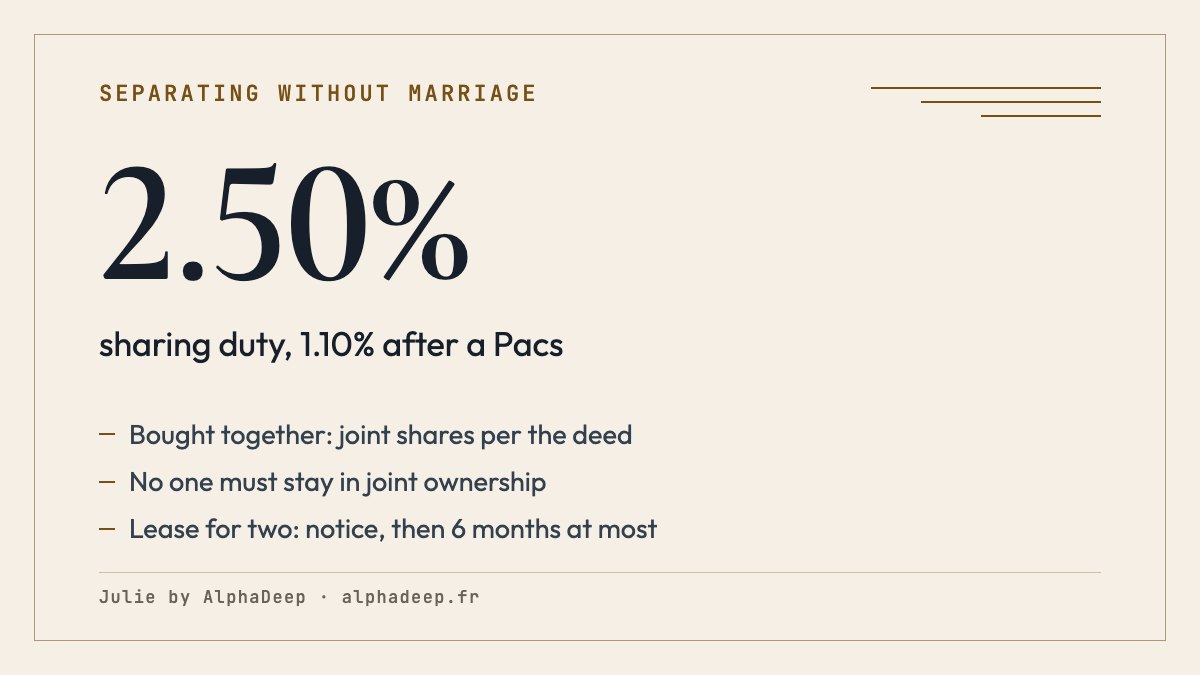
Who owns the property when you separate without being married?
Unmarried partners have separate estates: each keeps what they bought, and a joint purchase is held jointly, according to service-public; in a dispute, each proves ownership by any means, bank statements, loan or cheque. Living together is a de facto union, with no property regime (Civil Code, article 515-8).
Pacs partners have separate property by default: property that neither can prove belongs to them alone is held jointly in halves (article 515-5). If their Pacs agreement chose joint ownership, property acquired since then is held jointly in halves, with no claim for an unequal contribution, except property paid for with own funds mentioned in the deed (articles 515-5-1 and 515-5-2).
Sources: Service-public F904 · C. civ. 515-5
What happens to a home bought together?
A home bought together is held jointly in the shares set in the purchase deed, or in halves if the deed says nothing. No one can be forced to stay in joint ownership (Civil Code, article 815): the former partners can sell, one can buy out the other’s share by paying a balancing payment, or they can remain owners together under a joint-ownership agreement, according to service-public.
The partner who occupies the home alone owes the joint owners compensation in principle (article 815-9); the partner who paid with their own money for improvement works or upkeep expenses must be credited at the division (article 815-13). The division bears a 2.50% duty, reduced to 1.10% after the end of a Pacs (General Tax Code, article 746).
Sources: C. civ. 815 · CGI 746 · Service-public F904
And if the home is in only one partner’s name?
The other has no right to the home, according to service-public. If they financed part of it, the price or the loan, a Pacs partner can assert a claim, valued like a reward between spouses, on the value of the property on the day of the division (Civil Code, articles 515-7 and 1469).
An unmarried partner only has the action for unjust enrichment: the compensation is the lower of the two values of the enrichment and the impoverishment, and it is not due if the payment came from an obligation or an intention to give (articles 1303 and 1303-1).
Sources: Service-public F904 · C. civ. 515-7 · C. civ. 1303
Who keeps the lease of a rented home?
If both signed the lease, either can give notice and the lease continues with the other. Between unmarried partners, the solidarity of the one who leaves ends 6 months after the date their notice takes effect at the latest, sooner if a new co-tenant is on the lease (article 8-1 of the law of 6 July 1989); this rule does not cover a lease signed by partners already in a Pacs.
If only one signed, the other has a right only if the tenant abandons the home or dies: the lease then continues for the Pacs partner, or for a known partner who had lived with the tenant for at least a year (article 14 of the same law). Pacs partners who ask together are joint holders of the lease (Civil Code, article 1751).
Sources: Law of 6 July 1989, art. 14 · C. civ. 1751
When should accounts be settled after ending a Pacs?
By a joint declaration handed to the town hall or the notary that registered the Pacs, or by one partner’s decision served on the other; the dissolution takes effect between them on the date it is registered (Civil Code, article 515-7). The Pacs dissolution document file helps identify the recipient and documents; dividing the home remains a separate task.
The partners settle their rights and obligations themselves; failing agreement, the court rules on the financial consequences of the break-up. Their mutual claims can be offset against the advantages drawn from life together, for example when one did not contribute to everyday expenses in line with their means (article 515-7).
Source: C. civ. 515-7
What does article 815 of the Civil Code provide?
Article 815 is the text that allows each partner to leave the joint ownership of the home.
Nul ne peut être contraint à demeurer dans l’indivision et le partage peut toujours être provoqué, à moins qu’il n’y ait été sursis par jugement ou convention.
In English, briefly (our summary, not an official translation): No one can be forced to remain in joint ownership, and division can always be requested, unless it has been postponed by a judgment or an agreement. Selling the jointly owned property, on the other hand, requires the agreement of all the joint owners (article 815-3); failing that, division is requested in court.
What do unmarried couples ask when they separate?
Must you go before a judge to separate without being married?
No. Unmarried partners are free to separate at any time; a Pacs ends by a joint declaration or by a decision served on the other partner (Civil Code, article 515-7). The court steps in only if there is a disagreement, on the property or the children.
Who pays the loan on the joint home after the break-up?
Towards the bank, each remains bound by the loan agreement they signed: the separation does not change it. Between the former partners, expenses paid by one to preserve the jointly owned property are credited to them at the division (Civil Code, article 815-13).
Do children change anything in the division of property?
Not in the division, but the separation does not change parental authority (Civil Code, article 373-2), and each parent contributes to the children’s upkeep according to their own means and the other’s (article 371-2); if the parents disagree, the family judge sets the residence and the maintenance.
Can a former unmarried partner claim maintenance?
No: living together creates neither a duty of support nor a compensatory allowance, which exists only on divorce (service-public; Civil Code, article 270). For a Pacs, the court ruling on the break-up can compensate any harm suffered (article 515-7).
Can you sell the jointly owned home without the other’s agreement?
Not by agreement: selling jointly owned property requires the consent of all the joint owners (Civil Code, article 815-3). Failing that, each can ask the court for the division, since no one is bound to remain in joint ownership (article 815).
Which texts are these separation rules based on?
- Civil Code, articles 515-4 to 515-5-2 (Pacs: material support, solidarity, property regime)Légifrance, in French
- Civil Code, articles 815, 815-3, 815-9 and 815-13 (joint ownership)Légifrance, in French
- Civil Code, article 515-7 (dissolution of the Pacs, claims between partners)Légifrance, in French
- Civil Code, articles 1303 to 1303-4 (unjust enrichment)Légifrance, in French
- General Tax Code, article 746 (sharing duty of 2.50% and 1.10%)Légifrance, in French
- Law no. 89-462 of 6 July 1989, articles 8-1 and 14 (co-tenancy, abandoning the home)Légifrance, in French
- Civil Code, articles 371-2 and 373-2 (children after the separation)Légifrance, in French
- Civil Code, article 1751 (joint holding of the lease)Légifrance, in French
- Consequences of living together as an unmarried couple (fiche F904)Service-public.fr, in French · checked by the publisher on 27 April 2026
- Effects of a Pacs (fiche F1026)Service-public.fr, in French · checked by the publisher on 27 January 2026
Texts cited last checked: 25 September 2026