The letterCouples · Letter to the bank
Joint bank account in France after a separation: ending it without the other holder’s consent, and what happens to the overdraft
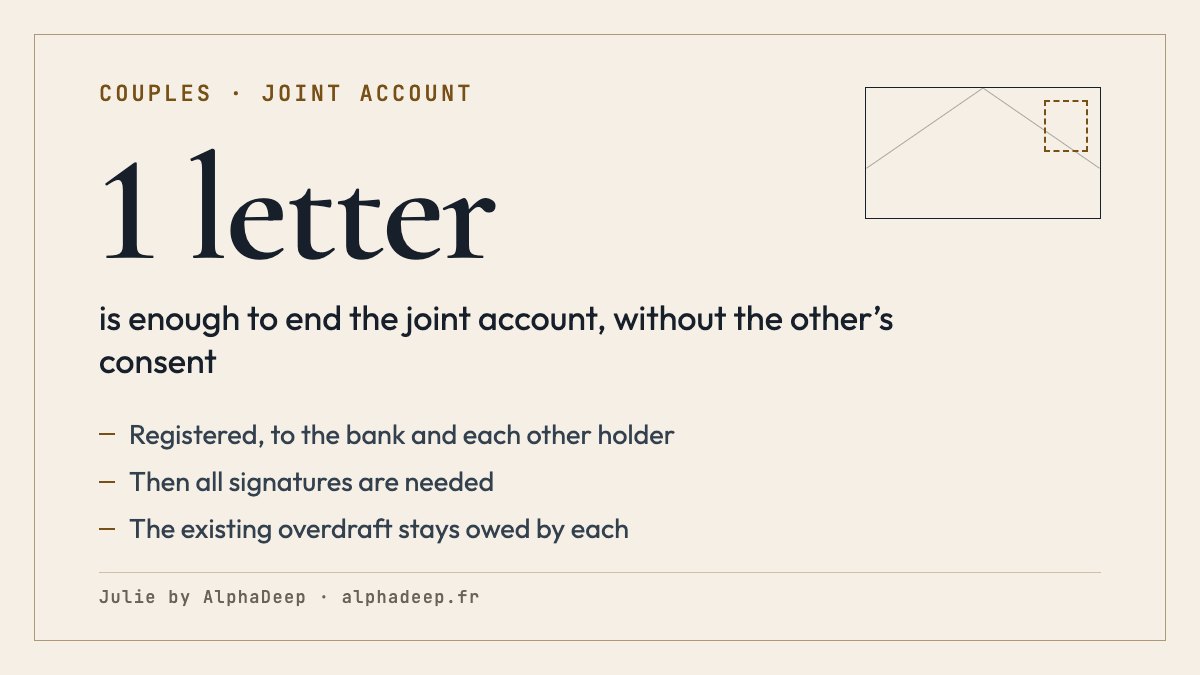
A separation or a divorce does not close a French joint account: each holder can still use it alone, and all owe the whole overdraft (fiche F10412). A single holder can end the joint operation (dénonciation) by registered letter to the bank and to each other holder: the account becomes undivided and operations generally need all signatures, unless a common mandate or another applicable exception allows otherwise. The overdraft existing on that date stays owed by each.
Julie by AlphaDeep is an AI legal assistant for French law: it researches official references to help answer your questions (Légifrance, case law, service-public), analyses your documents and drafts your letters, for individuals and professionals alike.
General legal information with official references and dated checks. It is not personalised advice: for a decision that commits you, have your situation checked by a qualified professional.

Let’s look at your situation
Say whether the account has been ended already, its balance, the cheques and debits under way, and where your separation stands.
Example questions
Your question carries over after signup. Maximum 400 characters. Avoid health data and names.
What can each holder do on a joint account until it is ended?
Each co-holder can operate the account alone, on their own signature: withdrawals, deposits, cheques, transfers, payments. In return, the co-holders are jointly and severally liable for the overdraft: the bank can claim all of it from any one of them, whoever caused it (fiche F10412).
That is joint and several liability under the French Civil Code: each debtor is bound for the whole debt, and the creditor chooses whom to ask (article 1313).
Sources: Service-public F10412 · C. civ. 1313 · C. civ. 1311
How do you end a joint account without the other holder’s consent?
Closing the account requires a request from all holders. On your own, you can make a dénonciation, by registered letter with acknowledgment of receipt to the bank and to each of the other holders (fiche F10412; models R20962 and R21134).
The dénonciation does not close the account: it turns it into an undivided account (compte indivis). Closing it afterwards still needs everyone’s agreement.
Sources: Service-public F10412 · Service-public R20962 · Service-public R21134
What happens to the overdraft, and to payments already made?
The holder who makes the dénonciation stays liable, with the others, for the debit balance on its date. The bank must no longer act on operations started by a single holder, but it may complete those already under way (Banque de France).
So leave funds for cheques already written. For debts arising later on the undivided account, the law provides no joint liability, but most account agreements add one: read yours (fiche F2812).
Sources: Banque de France · Service-public F2812
What does the dénonciation change for your account, and which letter should you send?
Say whether the dénonciation was sent and give its effective date confirmed by the bank, if known, the balance on that date, the cheques and direct debits under way, and what your agreement says: the letter shows what changes and drafts the dénonciation to the bank, in French, for a French bank. The example: dénonciation received on 12 September 2026, account €800 overdrawn, one cheque written before, one standing direct debit.
Fictional example · the dénonciation to the bank
Undivided account since 12 September 2026: all signatures in principle, unless a common mandate or applicable exception; the €800.00 overdraft stays owed by each.
- Signatures needed
- All in principle, unless a mandate or exception, since 12 September 2026
- Overdraft owed by each
- €800.00
- Cheques written before
- Can still be paid: leave the funds
- Standing orders and direct debits
- Cancelled by the dénonciation, subject to operations already under way
- New undivided-account debts after effective notice
- Read the account agreement
Lettre recommandée avec avis de réception, copie à chaque cotitulaire par le même moyen
[Vos nom et prénom][Votre adresse]
[Nom de la banque et de l’agence][Adresse]
À [ville], le [date]
ObjetDénonciation du compte joint n° [numéro du compte]
Madame, Monsieur,
Je suis cotitulaire du compte joint n° [numéro du compte], ouvert au nom de [noms de tous les cotitulaires].
Par la présente, je dénonce ce compte joint. À compter de sa prise d’effet, les opérations requièrent en principe la signature de tous les cotitulaires, sauf mandat commun ou autre exception applicable.
Je vous demande de ne plus exécuter aucun ordre donné par un seul cotitulaire, d’annuler les ordres de virement permanents et les autorisations de prélèvement, et de neutraliser les cartes attachées au compte.
Je vous remercie de me confirmer par écrit que la dénonciation a pris effet le 12 septembre 2026, et de m’indiquer le solde du compte à cette date.
J’adresse le même jour une copie de cette lettre, en recommandé avec avis de réception, à [nom de chaque autre cotitulaire].
Je vous prie d’agréer, Madame, Monsieur, l’expression de mes salutations distinguées.[Signature]
Pièces jointes : ma carte de paiement attachée au compte
Indicative result: the dénonciation works for the future; the effective date is the one the bank confirms, and the account agreement may set other rules. The letter is in French because your French bank works in French.
Before and after the dénonciation, what changes?
The dénonciation changes how the account works from then on, not the debts already owed.
| Point | Joint account, before the dénonciation | Undivided account, after the dénonciation |
|---|---|---|
| Who can make an operation | Each holder alone | All holders together, or an appointed agent |
| Existing overdraft | Owed in full by each | Still owed in full by each |
| New debts | Owed in full by each | Depends on the agreement’s joint-liability clause |
| Standing orders and direct debits | Carried out | Cancelled |
| Payment cards | Usable by each | To be returned |
| Closing the account | Request from all | Request from all |
A bounced cheque restricts all holders on the collective account. A responsible holder agreed before the incident limits the extension to that holder’s personal accounts; without designation, all holders’ personal accounts are affected (Monetary and Financial Code, article L131-80).
Sources: Service-public F10412 · Service-public F2812 · Banque de France · C. mon. fin. L131-80
What do separating couples with a French joint account ask?
Does a divorce close the joint account?
No: neither divorce nor separation closes the account; you must write to the bank (fiche F10412).
Can the other holder empty the joint account?
Yes, until it is ended by dénonciation: each holder can operate it alone (fiche F10412).
Can the bank claim from me the whole overdraft the other ran up?
Yes: the holders are jointly and severally liable, and the bank chooses whom to claim from (Civil Code, article 1313).
Can the other holder’s bounced cheque get me banned from writing cheques?
Without a designated responsible holder, all holders are restricted on the collective account and their personal accounts. If a responsible holder was agreed before the incident, that holder’s personal accounts are affected; the others remain restricted on the collective account (Monetary and Financial Code, article L131-80).
Does the dénonciation stop the rent or loan debited from the account?
It cancels the debits on the account, not the contracts: the rent or loan is still owed, to be paid another way.
What does article 1313 of the French Civil Code say?
The text that explains why the bank can claim the whole overdraft from just one of you.
La solidarité entre les débiteurs oblige chacun d’eux à toute la dette. Le paiement fait par l’un d’eux les libère tous envers le créancier.
Le créancier peut demander le paiement au débiteur solidaire de son choix. Les poursuites exercées contre l’un des débiteurs solidaires n’empêchent pas le créancier d’en exercer de pareilles contre les autres.
In English, briefly (our summary, not an official translation): Joint and several liability between debtors binds each of them for the whole debt, and payment by one releases all of them towards the creditor. The creditor may ask for payment from the jointly liable debtor of its choice, and proceedings against one do not stop the creditor from bringing the same against the others. Our note: between the holders, each contributes only their own share, and whoever paid more has a claim against the other (article 1317); the bank does not have to take that into account.
Which texts is the dénonciation of a joint account based on?
- Civil Code, article 1311 (joint and several creditors)Légifrance
- Civil Code, article 1313 (joint and several debtors)Légifrance
- Monetary and Financial Code, article L131-80 (bounced cheque on a shared account)Légifrance
- Joint bank account (fiche F10412, in French)Service-public.fr · checked on 24 July 2026
- Undivided bank account (fiche F2812, in French)Service-public.fr · checked on 6 November 2025
- Ending a joint account with the bank, model letter (R20962, in French)Service-public.fr
- Ending a joint account with a co-holder, model letter (R21134, in French)Service-public.fr
- Shared account, joint or undivided (in French)Banque de France
- Civil Code, article 1317 (sharing the debt between co-debtors)Légifrance
Texts cited last checked: 27 September 2026