The statement of sumsStatement · Bounced cheque
Bounced cheque in France: the payee’s deadlines, the certificate of non-payment and a statement of what you can claim
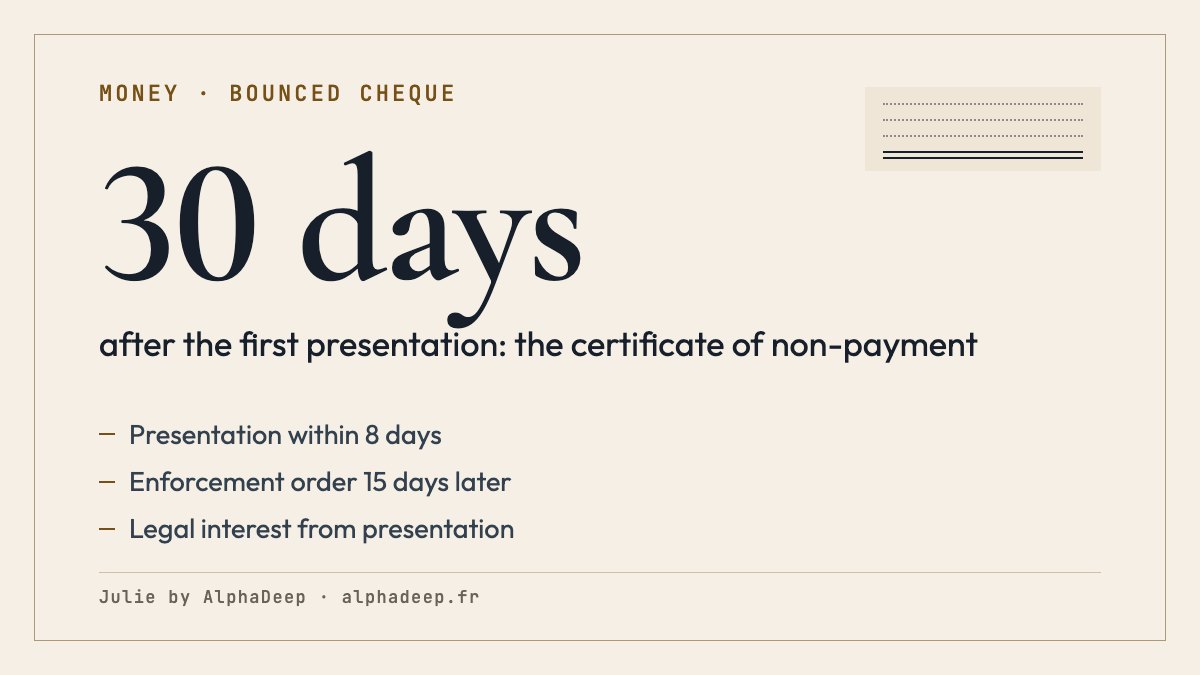
A cheque issued in mainland France is presented within 8 days (Monetary and Financial Code, article L131-32). If it bounces, you can get a certificate of non-payment 30 days after the first presentation; served on the drawer, it becomes an enforcement order after 15 days (article L131-73). You claim the cheque, legal interest from presentation and the costs (article L131-52).
Go to the tool: the statement of sums
Julie by AlphaDeep is an AI legal assistant for French law: it researches official references to help answer your questions (Légifrance, case law, service-public), analyses your documents and drafts your letters, for individuals and professionals alike.
General legal information with official references and dated checks. It is not personalised advice: for a decision that commits you, have your situation checked by a qualified professional.

Let’s look at your situation
Give the cheque’s date and amount, the rejection date, payments received since and the costs incurred.
Example questions
Your question carries over after signup. Maximum 400 characters. Avoid health data and names.
How much can you claim, and by when?
Give the cheque’s date and amount, its first presentation, your status as creditor, any partial payment and the documented costs: the statement works out interest semester by semester, sets a payment against interest first and dates each remedy. The example: a €1,000 cheque dated 1 July 2026, presented on 3 July, €200 received on 15 August, statement at 27 September.
Fictional example · the cheque statement
€814.57 to claim at 27 September 2026; certificate of non-payment from 2 August 2026.
- Last day for presentation
- 9 July 2026
- Certificate of non-payment from
- 2 August 2026
- Claim against the drawer until
- 9 January 2027
- Action against the drawee bank until
- 9 July 2027
- Amount of the chequearticle L131-52, 1€1,000.00€1,000.00
- Interest from 3 July 2026 to 15 August 2026legal rate for a private creditor€8.06€1,008.06
- Payment received on 15 August 2026set against interest first(€200.00)€808.06
- Interest from 15 August 2026 to 27 September 2026on the remaining principal€6.51€814.57
Sum to claim€814.57
Indicative result: simple interest at the legal rate, over 365 days; the date of first presentation is on the rejection notice.
Which deadlines apply to the payee of the cheque?
From depositing the cheque to the enforcement order, then the time bars.
| Step | Deadline | Text |
|---|---|---|
| Present a cheque issued in mainland France | 8 days after the cheque’s date | Article L131-32 |
| Issued in Europe or a Mediterranean country | 20 days | Article L131-32 |
| Issued outside Europe | 70 days | Article L131-32 |
| Ask for the certificate of non-payment | 30 days after the first presentation | Article L131-73 |
| Pay after the certificate is served | 15 days, then an enforcement order | Article L131-73 |
| Claim against the drawer or endorsers | 6 months after the presentation period ends | Article L131-59 |
| Action against the drawer’s bank | 1 year after the presentation period ends | Article L131-59 |
Once the presentation period is over, the cheque in principle stays payable: it is payable on sight (article L131-31).
Sources: CMF L131-32 · CMF L131-73 · CMF L131-59 · CMF L131-31
Which legal interest rate applies in 2026?
The rate depends on who the creditor is, never the debtor, and changes each half-year.
- Private creditor, not acting for business
- 6.84%second half of 2026 · Service-public, sheet F783
- Other cases, notably a business creditor
- 2.75%second half of 2026 · Service-public, sheet F783
- Private creditor
- 6.67%first half of 2026 · Service-public, sheet F783
- Other cases
- 2.62%first half of 2026 · Service-public, sheet F783
What should you do in the 30 days after the rejection?
This guide is for the payee recovering an unpaid cheque. If you issued the cheque, use regularisation by the drawer; for a debt without a cheque, the general interest guide in French uses a different starting point.
Present the cheque again to your bank, and ask the drawer in writing to fund the account or pay another way (sheet F1537). If the cheque is not paid on the second presentation, the drawer’s bank issues, at your request, a certificate of non-payment (article L131-73).
A cheque of €15 or less must be paid by the bank despite the lack of funds, for one month after its date (article L131-82).
Sources: Service-public F1537 · CMF L131-73 · CMF L131-82
How do you get an enforcement order?
Have a commissaire de justice notify or serve the certificate on the drawer: it counts as a demand for payment. Without proof of payment of the cheque and costs within 15 days, the commissaire issues an enforcement order, with no further step or cost (article L131-73).
All costs caused by the rejection fall on the drawer (article L131-73); seizure can then follow.
Sources: CMF L131-73 · Service-public F1537
What exactly can you claim?
The amount of the cheque, interest at the legal rate from the day of presentation, and protest, notice and other costs (article L131-52).
A partial payment goes first to interest, then to the principal (Civil Code, article 1343-1): later interest is worked out on the remaining principal.
Sources: CMF L131-52 · C. civ. 1343-1
What does article L131-52 of the French Monetary and Financial Code say?
What the payee of a bounced cheque can claim.
Le porteur peut réclamer à celui contre lequel il exerce son recours :
1. Le montant du chèque non payé ;
2. Les intérêts à partir du jour de la présentation, dus au taux légal applicable en France ;
3. Les frais de protêt, ceux des avis donnés, ainsi que les autres frais.
In English, briefly (our summary, not an official translation): The holder can claim from the person against whom they exercise their remedy: 1. the amount of the unpaid cheque; 2. interest from the day of presentation, at the legal rate applicable in France; 3. the protest costs, those of the notices given, and the other costs. Our note: after the time bars, an action remains against a drawer who did not fund the cheque (article L131-59).
What do payees of a bounced cheque ask?
Is a cheque still valid after 8 days?
In principle yes: it is payable on sight, and the 8 days start the time bars (articles L131-31 and L131-59); the action against the drawee bank is time-barred one year later.
Who pays the costs of the rejection?
The drawer: all costs caused by the rejection of an unfunded cheque fall on them (article L131-73).
Which interest rate should you apply?
The legal rate of the half-year, by your status: 6.84% if you act privately, 2.75% in other cases in the second half of 2026 (sheet F783). The rate changes every half-year, and the statement covers periods up to 31 December 2026.
Can a banker’s draft bounce?
A genuine banker’s draft (chèque de banque) is funded by the issuing bank, but fakes exist: check it with that bank before handing over the goods (sheet F2403).
Which texts does recovering a cheque rest on?
- Monetary and Financial Code, article L131-31 (payable on sight)Légifrance
- Monetary and Financial Code, article L131-32 (presentation period)Légifrance
- Monetary and Financial Code, article L131-52 (sums claimable)Légifrance
- Monetary and Financial Code, article L131-59 (time bars)Légifrance
- Monetary and Financial Code, article L131-73 (certificate of non-payment)Légifrance
- Civil Code, article 1343-1 (allocating payments)Légifrance
- What to do on receiving a bounced cheque (sheet F1537, in French)Service-public.fr · checked on 28 January 2025
- Monetary and Financial Code, article L131-82 (cheques of €15 or less)Légifrance
- Working out legal interest (sheet F783, in French)Service-public.fr · checked on 1 July 2026
- Crossed, certified or banker’s cheque: the differences (sheet F2403, in French)Service-public.fr · checked on 17 November 2025
Texts cited last checked: 27 September 2026