Family and couples · Children · being heard
Being heard by the French family judge: the child’s age, request and letter
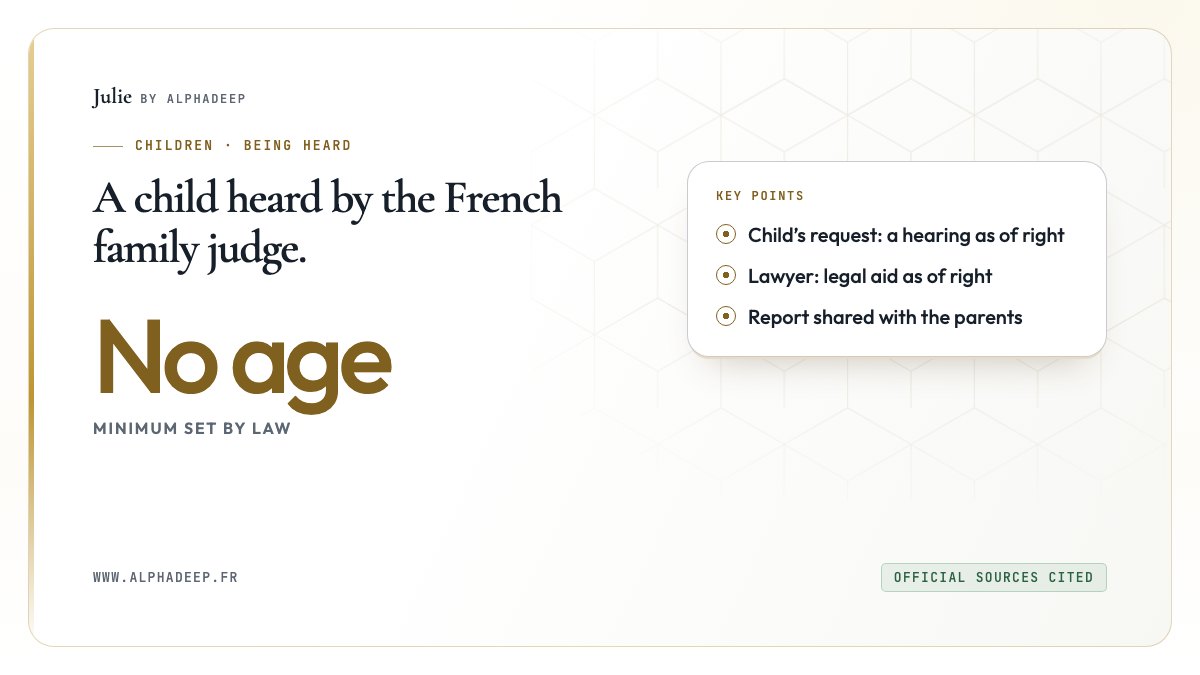
French law sets no age limit: in any proceedings that concern them, a minor capable of discernment may be heard by the judge (article 388-1 of the Civil Code). When the child asks, the hearing is a right. The child may be heard alone, with a lawyer or with a person they choose. The judge takes the child’s feelings into account, but the child does not decide in the judge’s place.
- Official texts cited
- Sources checked on
- Drafted with AI assistance, our method
General legal information with official references and dated checks. It is not personalised advice: for a decision that commits you, have your situation checked by a qualified professional.
Julie by AlphaDeep
Your child wants to be heard by the French judge, or you wonder whether they can be: I can explain the steps and review their letter.
3 free questions at signup. Avoid names and sensitive information.
From what age can a child be heard by a French judge?
The law sets no age: the test is discernment. A minor capable of discernment may be heard in any proceedings that concern them, by the judge or, when their interest requires it, by a person the judge appoints. The ages quoted online come from no legal text.
The parents must tell the child of the right to be heard and to have a lawyer, and the summons sent to the parents repeats that right.
Code civil, article 388-1Code de procédure civile, article 338-1
Can the child choose which parent to live with?
No. Being heard does not make the child a party to the case: the child gives a view and the judge decides. The feelings the child expresses are one of the factors the judge weighs, alongside how the parents managed before, each parent’s ability to respect the other’s rights, expert and social reports and any violence.
Until the child turns eighteen, where they live is set by the parents’ agreement or by the judge, shared or with one parent.
Code civil, article 388-1Code civil, article 373-2-11Code civil, article 373-2-9Code civil, article 388
How does the child write a request to be heard?
Fill in the fields and the letter builds on the right. No set form applies, the request can be made at any stage, and the child does not have to explain what they will say.
Letter to the family judge (in French)
Tribunal judiciaire de [ville], juge aux affaires familiales
Objet : demande d’audition, dossier [numéro RG, si connu]
Madame, Monsieur le juge,
Je m’appelle [prénom et nom] et j’ai [âge] ans. Mes parents, [prénoms et noms des parents], sont en procédure devant vous à mon sujet.
Je demande à être entendu par le juge, comme l’article 388-1 du Code civil m’en donne le droit. Je souhaite être entendu seul.
Vous pouvez m’envoyer la convocation à cette adresse : [adresse].
Fait le [date]. [prénom et nom]
No set form is required: the child can copy the letter by hand or put it in their own words, then sign it and send it to the court registry. French courts work in French, so the letter stays in French.
Can the judge refuse to hear the child?
When the child asks, hardly ever: a refusal can only rest on the child lacking discernment or on the case not concerning them, and there is no appeal against that ruling.
When a parent asks, the judge can also refuse if the hearing is not needed to decide the case or seems contrary to the child’s interest. In every case, the reasons for refusing appear in the decision.
Code de procédure civile, article 338-4Code de procédure civile, article 338-5
Will the parents find out what the child told the judge?
Yes, in outline. A report of the hearing is made, with regard to the child’s interest, and it is open to both sides: the parents can read it and comment on it.
The child can prepare what they want to say knowing their parents will see it. The judge decides on the whole file.
Code de procédure civile, article 338-12Code civil, article 388-1
What should the letter say, and in which order?
What the letter says, in the order the judge reads it. None of it is required by law: it lets the registry match the letter to the right case and summon the child.
The court and the case number
The court handling the case, and the case number if it appears on the parents’ summons.
Who is writing
The child’s first name, surname and age, and the parents’ names.
The request itself
One sentence is enough: “I ask to be heard”. When the child asks, the hearing is a right.
Code civil, article 388-1Code de procédure civile, article 338-2
Who comes along
Alone, with a lawyer or with a person they choose. If the child does not pick a lawyer, the judge has the bar president appoint one.
Code civil, article 388-1Code de procédure civile, article 338-7
Where to send the summons
The summons is sent to the child by ordinary post: give the address where they will receive it.
Date and signature
The child dates and signs the letter, then sends it to the court registry.
What does article 388-1 of the Civil Code say?
Dans toute procédure le concernant, le mineur capable de discernement peut, sans préjudice des dispositions prévoyant son intervention ou son consentement, être entendu par le juge ou, lorsque son intérêt le commande, par la personne désignée par le juge à cet effet. Cette audition est de droit lorsque le mineur en fait la demande. Lorsque le mineur refuse d’être entendu, le juge apprécie le bien-fondé de ce refus. Il peut être entendu seul, avec un avocat ou une personne de son choix. Si ce choix n’apparaît pas conforme à l’intérêt du mineur, le juge peut procéder à la désignation d’une autre personne. L’audition du mineur ne lui confère pas la qualité de partie à la procédure. Le juge s’assure que le mineur a été informé de son droit à être entendu et à être assisté par un avocat.
In plain English: In any proceedings concerning them, a minor capable of discernment may be heard by the judge or, when their interest requires it, by a person the judge appoints. The hearing is a right when the minor asks for it. The minor may be heard alone, with a lawyer or with a person they choose, and does not become a party to the case.
Since 1 September 2025, a parents’ agreement concerning a minor capable of discernment must state how the child was told of this right to be heard; otherwise the judge cannot approve it and the registry cannot make it enforceable.
What else do parents ask?
Does the child get a free lawyer?
Yes. A minor heard with a lawyer, whether chosen or appointed, receives legal aid as of right. If the child does not choose a lawyer, the judge asks the bar president to appoint one.
Loi n° 91-647 du 10 juillet 1991, article 9-1Code de procédure civile, article 338-7
Can a parent ask for the child to be heard?
Yes. The child or the parties can ask, with no set form, at any stage of the case, even for the first time on appeal. The judge can then refuse if the hearing is not needed or seems contrary to the child’s interest.
Code de procédure civile, article 338-2Code de procédure civile, article 338-4
Is the child heard by the judge or by someone else?
By the judge as a rule. When the child’s interest requires it, the judge appoints a person with no link to the child or the parties, who works or has worked in the social, psychological or medical-psychological field.
Code civil, article 388-1Code de procédure civile, article 338-9
What does a request to be heard change for an amicable divorce?
It closes the route of divorce without a judge: spouses cannot divorce by lawyers’ agreement when the child, told of the right to be heard on a form, asks for a hearing. The mutual-consent divorce then goes before the judge.
Code civil, article 229-2Code de procédure civile, article 1144
Which texts is this model based on?
- Code civil, article 388-1Légifrance
- Code civil, article 373-2-11Légifrance
- Code de procédure civile, article 338-1Légifrance
- Code de procédure civile, article 338-2Légifrance
- Code de procédure civile, article 338-4Légifrance
- Code de procédure civile, article 338-5Légifrance
- Code de procédure civile, article 338-6Légifrance
- Code de procédure civile, article 338-7Légifrance
- Code de procédure civile, article 338-9Légifrance
- Code de procédure civile, article 338-12Légifrance
- Code civil, article 229-2Légifrance
- Code de procédure civile, article 1144Légifrance
- Code de procédure civile, article 1541-2Légifrance
- Loi n° 91-647 du 10 juillet 1991, article 9-1Légifrance
- Code civil, article 373-2-9Légifrance
- Code civil, article 388Légifrance
Texts cited last checked: 17 October 2026