Family and couples · Family · cross-border
Family allowance in Switzerland when your children live in France: who pays first and how much
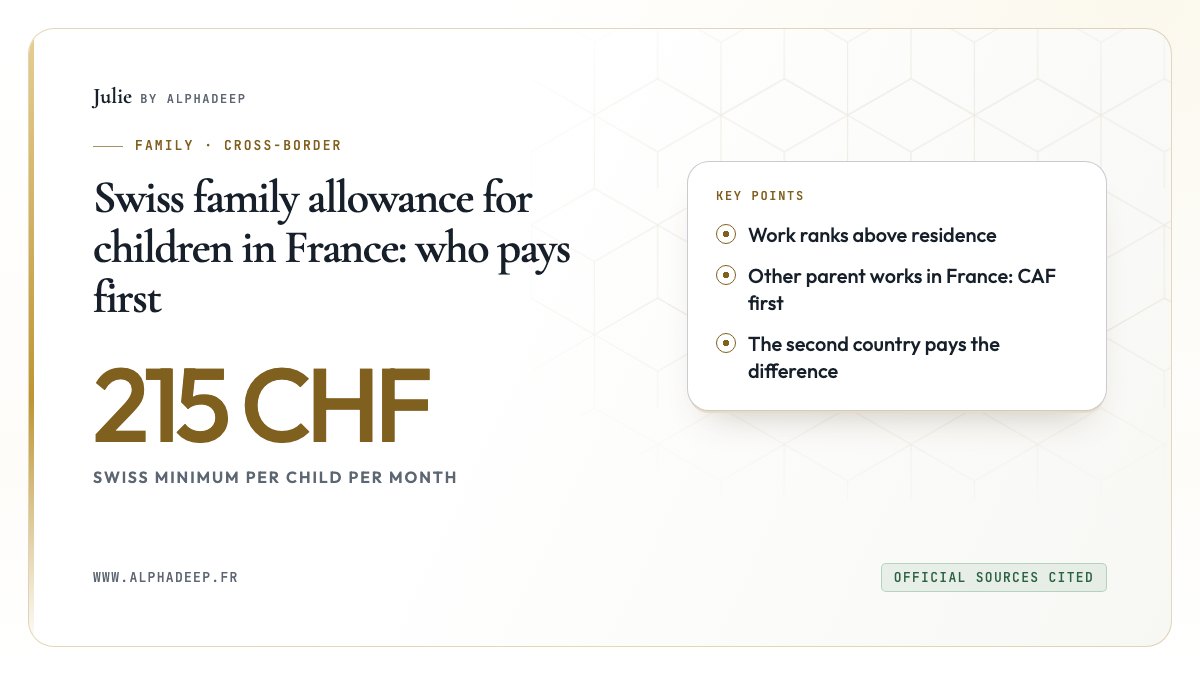
When one parent works in Switzerland and the children live in France, EU Regulation 883/2004, applied through the Swiss-EU free movement agreement, sets the order: work comes before residence. If the other parent works in France, France pays first and the Swiss fund adds a differential supplement. Otherwise Switzerland pays, at least 215 CHF a month per child, and the French CAF pays a differential allowance only where French amounts are higher (Social Security Code, article L512-5).
- Official texts cited
- Sources checked on
- Drafted with AI assistance, our method
General legal information with official references and dated checks. It is not personalised advice: for a decision that commits you, have your situation checked by a qualified professional.
Julie by AlphaDeep
You work in Switzerland and your children live in France: I can tell you which country should pay family allowances first and whether a differential is owed.
3 free questions at signup. Avoid names and sensitive information.
Which country pays family allowances when one parent works in Switzerland?
When one parent works in Switzerland and the children live in France, work decides: the country where a parent is employed pays before the country where the family merely lives. EU Regulation 883/2004, which applies between Switzerland and France through the Swiss-EU agreement on the free movement of persons, ranks claims in this order: employment or self-employment, then a pension, then residence (article 68). Each country owes benefits for children living in the other as if they lived on its own territory (article 67).
In practice the family allowance fund of the Ain (Caf de l’Ain) sets out three cases. Both parents are employed in Switzerland: Switzerland pays first. The other parent has work or income in France (wages, unemployment benefit, invalidity pension): France pays first. The other parent has neither work nor income: Switzerland pays first. The second country pays the difference if its own amounts are higher.
Regulation (EC) No 883/2004 (SR 0.831.109.268.1): article 68 (in French)Regulation (EC) No 883/2004 (SR 0.831.109.268.1): article 67 (in French)Caf de l’Ain: Vous êtes frontalier (in French)
What changes if the other parent works in France or in Switzerland?
If the other parent works in France, both claims rest on employment, so the regulation breaks the tie by where the children live: France pays first (article 68, paragraph 1(b)(i)). The Swiss fund suspends its own claim up to the French amount and pays a differential supplement (complément différentiel) for any part above it (article 68, paragraph 2).
If the other parent also works in Switzerland, Switzerland pays first and the Swiss Federal Family Allowances Act (LAFam) decides which parent claims: the one in paid work, then the one with parental authority, then the one the child lives with (article 7 LAFam). The French family allowance fund (caisse d’allocations familiales, CAF) then only looks at a possible differential allowance.
According to the LAFam (article 5), the Swiss fund pays at least 215 CHF per child and 268 CHF per young person in training each month; the employer’s canton may pay more.
Regulation (EC) No 883/2004 (SR 0.831.109.268.1): article 68 (in French)Federal Family Allowances Act (LAFam): article 7 (in French)Federal Family Allowances Act (LAFam): article 5 (in French)Caf de l’Ain: Vous êtes frontalier (in French)
What does article L512-5 of the French Social Security Code say?
Les prestations familiales du régime français ne peuvent se cumuler avec les prestations pour enfants versées en application des traités, conventions et accords internationaux auxquels la France est partie ou en application d'une législation ou d'une réglementation étrangère, ainsi qu'avec les prestations pour enfants versées par une organisation internationale.
Lorsque des prestations familiales ou des avantages familiaux sont versés, en application des traités, conventions et accords internationaux auxquels la France est partie ou en application d'une législation étrangère de sécurité sociale, à une famille résidant en France et que leurs montants sont inférieurs à celui des prestations familiales du régime français de sécurité sociale, seules des allocations différentielles peuvent être éventuellement versées. Un décret fixe les modalités d'application du présent article.
In plain English: A family living in France cannot draw full French and full Swiss child benefits at the same time. Where the Swiss amounts are lower than French benefits, the CAF pays only the difference: the differential allowance.
The order between the two countries comes from article 68 of Regulation 883/2004, which applies to Switzerland.
Which country pays first for your family, and which amounts apply?
Enter the other parent’s situation, where the children live, your employer’s canton and your French income bracket. The worksheet applies article 68 of Regulation 883/2004 and shows the published amounts; it does not calculate the differential and does not replace the funds’ decisions.
Fictional example · Country that pays first and amounts to compare
The other parent works in France: both claims rest on employment, so the children’s country of residence, France, pays first (article 68 of Regulation 883/2004). Your Swiss fund pays a differential supplement if the cantonal amount is higher than total French benefits. Ask the CAF for form E411.
- Country that pays first
- France (CAF)
- Possible differential
- Swiss fund’s differential supplement
- Swiss reference amount per child per month
- 311 CHF, 415 CHF in training (Geneva 2026, 1st and 2nd child)
- French family allowance per month
- 152.25 €
- Ask the CAF for form E411 (Mon Compte or « Contacter ma Caf ») and send it to your Swiss fund.
- Ask the Swiss fund to confirm the amount it pays for a child living in France, then compare each country’s totals.
- Keep the CAF notification and the Swiss fund’s decision: you need both to check the differential.
Indicative result based on article 68 of Regulation 883/2004 and the amounts published for 2026. The funds set the exact amount; the cantonal amount for a child living in France must be confirmed with the Swiss fund.
How is the French differential allowance worked out?
The French differential allowance (allocation différentielle) is the gap between the total French child benefits the family would receive and the total Swiss benefits paid for the same period. The French Social Security Code bars drawing both in full and, where foreign benefits are lower, allows only a differential allowance (article L512-5).
The comparison covers every child-related benefit, not just family allowances. The Caf de l’Ain counts, among others:
- family allowances (allocations familiales) and the basic PAJE allowance for young children
- the shared child-rearing benefit (PreParE) and the childcare supplement (complément de libre choix du mode de garde)
- the family supplement (complément familial) and the back-to-school allowance (allocation de rentrée scolaire)
- the family support allowance (ASF) and the disabled child’s education allowance (AEEH)
Code de la sécurité sociale: article L512-5Caf de l’Ain: Vous êtes frontalier (in French)Service-public.fr: Allocations familiales, page F13213 (in French)
What do you file with the CAF and with the Swiss fund?
You start with the country that pays first, then send a certificate to the country that pays the differential. If France pays first, the CAF issues form E411 (a certificate of payment or non-payment): claimants with an up-to-date file find it in their online account (Mon Compte) early in the year; otherwise they request it through « Contacter ma Caf », giving their Swiss social security (AVS) number, their Swiss fund, the period and the children. The Swiss fund then works out the supplement, in 2 to 5 weeks on average according to the Caf de l’Ain.
If Switzerland pays first, you claim through the family allowance fund of your Swiss employer. A parent who is not yet a CAF claimant fills in the CAF situation form (déclaration de situation, DSIT). A claim filed in the wrong country is forwarded without delay to the country that pays first, and the original filing date is kept (article 68, paragraph 3, of the regulation).
Caf de l’Ain: Vous êtes frontalier (in French)Regulation (EC) No 883/2004 (SR 0.831.109.268.1): article 68 (in French)
How much per child in Geneva, in Vaud and at the Swiss federal minimum in 2026?
| Allowance | Geneva | Vaud | Federal minimum | Source |
|---|---|---|---|---|
| Child allowance, 1st and 2nd child | 311 CHF | 322 CHF | 215 CHF | FSIO 2026 table; article 5 LAFam |
| Child allowance, from the 3rd child | 411 CHF | 365 CHF | 215 CHF | FSIO 2026 table; article 5 LAFam |
| Training allowance, 1st and 2nd child | 415 CHF | 425 CHF | 268 CHF | FSIO 2026 table; article 5 LAFam |
| Training allowance, from the 3rd child | 515 CHF | 468 CHF | 268 CHF | FSIO 2026 table; article 5 LAFam |
| Birth or adoption allowance (one-off) | 2,073 CHF, not paid for a child living in France | 1,617 CHF, not paid for a child living in France | No federal minimum | FSIO 2026 table; article 3 LAFam; FSIO, children abroad |
The child allowance runs to age 16; the training allowance runs from post-compulsory education up to age 25 at most (article 3 LAFam). The amount follows the canton of the employer’s registered office, not where you live.
FSIO: types and amounts of family allowances 2026, as at 12.12.2025 (in French and German)Vaud AVS fund: Information 2026, family benefits (in French)Federal Family Allowances Act (LAFam): article 5 (in French)Federal Family Allowances Act (LAFam): article 3 (in French)FSIO: Family allowances for children living abroadFederal Family Allowances Act (LAFam): article 12 (in French)
Which figures frame family allowances for cross-border families?
Monthly amounts published by the Swiss and French authorities for 2026.
- Swiss federal minimum per child / per young person in training
- 215 / 268 CHF
- since 1 January 2025 · LAFam, article 5 (SR 836.2)
- Geneva: child allowance, 1st and 2nd child (411 CHF from the 3rd)
- 311 CHF
- 2026 · FSIO, types and amounts of family allowances 2026 (as at 12.12.2025)
- Vaud: child allowance, 1st and 2nd child (365 CHF from the 3rd)
- 322 CHF
- 2026 · Vaud cantonal AVS compensation fund, Information 2026 family benefits
- French family allowance for 2 children, lowest income bracket
- 152.25 €
- since 1 April 2026 · Service-public.fr, page F13213
Separated parents: who receives the allowance across the border?
After a separation the priority order stays the same: each parent’s work counts whether or not the parents live together. In France the allowance goes to the parent who has actual and permanent care of the child; with alternating residence the parents name the claimant or split the entitlement in half (Social Security Code, article L521-2).
On the Swiss side, if the parent receiving the benefits does not spend them on the children, the institution may pay them directly to the person who actually maintains the children, at that person’s request, through the institution of their country of residence (article 68a of the regulation). For separated parents the Caf de l’Ain asks for both parents’ details and sends the certificate to the Swiss fund itself.
Code de la sécurité sociale: article L521-2Regulation (EC) No 883/2004 (SR 0.831.109.268.1): article 68a (in French)Caf de l’Ain: Vous êtes frontalier (in French)
What do cross-border families most often ask about Swiss and French allowances?
Can I get Swiss family allowance for one child if my partner works in France?
Yes, a cross-border worker can receive Swiss family allowance for one child even if the partner works in France. France then pays first, but it pays no family allowance for a single child (Social Security Code, article L521-1). The Swiss fund therefore pays a differential supplement: the cantonal amount minus any other French benefits for that child, on receipt of form E411.
Code de la sécurité sociale: article L521-1Regulation (EC) No 883/2004 (SR 0.831.109.268.1): article 68 (in French)Caf de l’Ain: Vous êtes frontalier (in French)
Is the Swiss birth allowance paid for a child born in France?
No, the Swiss birth allowance is not paid for a child living in France. According to the FSIO, child and training allowances are exported to EU states, but birth and adoption allowances are not, such as Geneva’s 2,073 CHF or Vaud’s 1,617 CHF in 2026.
FSIO: Family allowances for children living abroadFSIO: types and amounts of family allowances 2026, as at 12.12.2025 (in French and German)
Does the Swiss amount follow the canton you live in or your employer’s canton?
The Swiss family allowance amount follows the canton of the employer’s registered office, not the canton or country where the cross-border worker lives. The employer falls under the scheme of the canton where the business has its seat, or where its branch is (article 12 LAFam), and the employee is paid under that scheme (article 13 LAFam).
Federal Family Allowances Act (LAFam): article 12 (in French)Federal Family Allowances Act (LAFam): article 13 (in French)
Does the Swiss fund pay the full cantonal rate for a child living in France?
The texts we read do not settle this; the Swiss fund confirms it. The Swiss ordinance reduces only the legal minimum for purchasing power (article 8 OAFam), and the FSIO mentions that adjustment only for countries without a social security agreement with Switzerland. Ask the fund which amount it applies for a child living in France.
Family Allowances Ordinance (OAFam): article 8 (in French)FSIO: Family allowances for children living abroad
What is form E411 and who fills it in?
Form E411 is a certificate of family benefits that the French CAF issues to the Swiss fund, stating whether and how much France pays. The CAF fills it in: up-to-date claimants find it in Mon Compte early in the year, others request it with their AVS number and Swiss fund. The Swiss fund then sets the differential supplement.
Which texts set the order between the CAF and the Swiss fund?
- Regulation (EC) No 883/2004 (SR 0.831.109.268.1): article 68 (in French)Swiss Confederation: Fedlex
- Regulation (EC) No 883/2004 (SR 0.831.109.268.1): article 67 (in French)Swiss Confederation: Fedlex
- Caf de l’Ain: Vous êtes frontalier (in French)Caisse d’allocations familiales de l’Ain
- Code de la sécurité sociale: article L512-5French Republic / DILA: Légifrance
- Federal Family Allowances Act (LAFam): article 5 (in French)Swiss Confederation: Fedlex
- Code de la sécurité sociale: article L521-1French Republic / DILA: Légifrance
- FSIO: types and amounts of family allowances 2026, as at 12.12.2025 (in French and German)Federal Social Insurance Office (FSIO)
- Vaud AVS fund: Information 2026, family benefits (in French)Vaud cantonal AVS compensation fund
- Service-public.fr: Allocations familiales, page F13213 (in French)French Republic / DILA: Service-public.fr
- FSIO: Family allowances for children living abroadFederal Social Insurance Office (FSIO)
- Federal Family Allowances Act (LAFam): article 7 (in French)Swiss Confederation: Fedlex
- Federal Family Allowances Act (LAFam): article 13 (in French)Swiss Confederation: Fedlex
- Federal Family Allowances Act (LAFam): article 12 (in French)Swiss Confederation: Fedlex
- Regulation (EC) No 883/2004 (SR 0.831.109.268.1): article 68a (in French)Swiss Confederation: Fedlex
- Code de la sécurité sociale: article L521-2French Republic / DILA: Légifrance
- Family Allowances Ordinance (OAFam): article 8 (in French)Swiss Confederation: Fedlex
- Federal Family Allowances Act (LAFam): article 3 (in French)Swiss Confederation: Fedlex
Texts cited last checked: 30 October 2026