Money, tax and inheritance · Tax · cross-border workers
Living in France and working in Switzerland: which country taxes your salary?
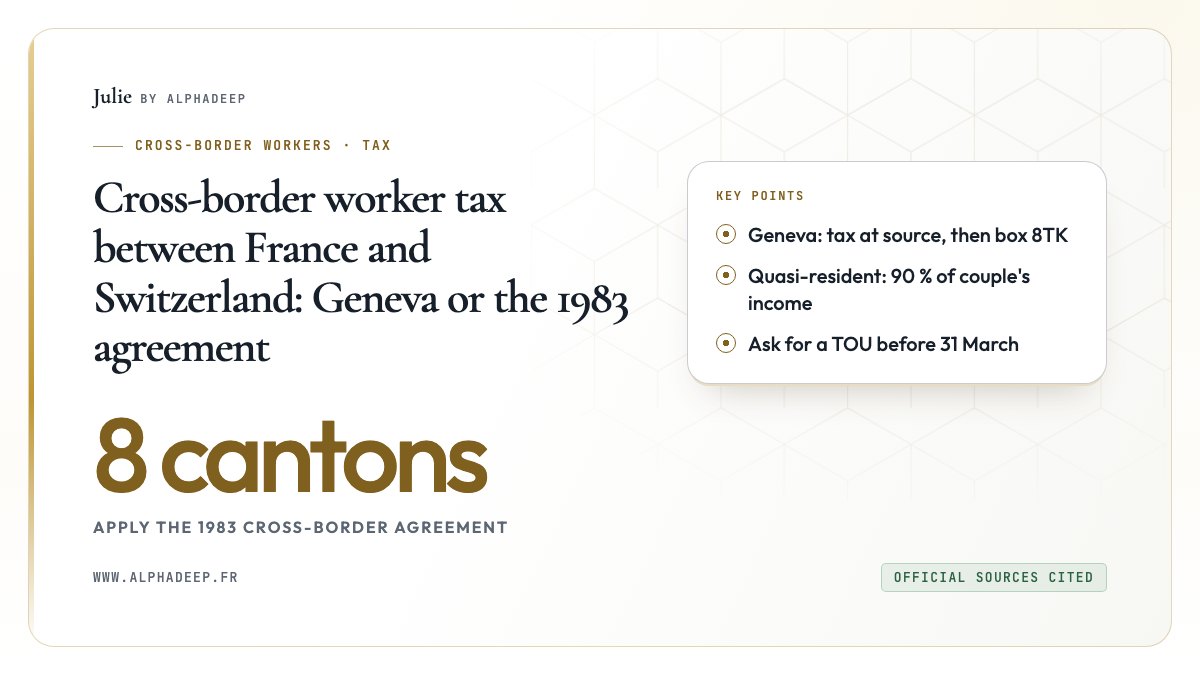
If you live in France and work in Geneva, Switzerland taxes your salary at source, because Geneva is outside the 1983 France-Switzerland cross-border agreement. You still report it on your French return (form 2047-SUISSE) and receive a tax credit equal to the French tax. In Bern, Solothurn, Basel-City, Basel-Country, Vaud, Valais, Neuchâtel and Jura, the salary is taxed in France only, once you give your employer the 2041-AS certificate.
Text in force1 July 1979Sources checked30 October 2026
- Official texts cited
- Sources checked on
- Drafted with AI assistance, our method
General legal information with official references and dated checks. It is not personalised advice: for a decision that commits you, have your situation checked by a qualified professional.
Julie by AlphaDeep
You live in France and work in Switzerland: tell me your canton of work and your household situation, and I will tell you which country taxes your salary and which forms to file.
3 free questions at signup. Avoid names and sensitive information.
Which country taxes your salary if you live in France and work in Geneva?
If you live in France and work in Geneva, Switzerland taxes your salary, through tax withheld at source (impôt à la source) that your employer deducts every month. The France-Switzerland tax convention of 9 September 1966 lets the country where the job is done tax the salary (article 17), and Geneva is not part of the 1983 cross-border agreement. Swiss federal law therefore taxes at source people living abroad who work in Switzerland (article 91 of the Federal Act on Direct Federal Tax, LIFD).
You are not taxed twice: France takes the salary into account on your return, then grants a tax credit equal to the French tax on it. According to OCSTAT, the Geneva statistics office (6 August 2026), 118 067 foreign cross-border workers (frontaliers) worked in the canton of Geneva at the end of June 2026, out of 414 262 in Switzerland.
France-Switzerland double tax convention of 9 September 1966 (SR 0.672.934.91), art. 17 (in French)Federal Act on Direct Federal Tax (LIFD/DBG), art. 91 (in French)France-Switzerland double tax convention of 9 September 1966 (SR 0.672.934.91), art. 25, A, para. 1(a) (in French)OCSTAT: foreign cross-border workers in the canton of Geneva, second quarter of 2026 (6 August 2026) (in French)
Why are cross-border workers in Vaud or Neuchâtel taxed in France?
Cross-border workers in Vaud or Neuchâtel are taxed in France because these cantons apply the agreement of 11 April 1983, under which the salary is taxable only in the country of residence (article 1). Eight cantons are covered: Bern, Solothurn, Basel-City, Basel-Country, Vaud, Valais, Neuchâtel and Jura.
In return, France pays these cantons 4.5 % of the total gross annual pay of their cross-border workers (article 2). The agreement covers people who work for an employer established in Switzerland and, as a general rule, return to France every day (article 3). So that your employer withholds no Swiss tax, you give it the French tax residence certificate 2041-AS; you then report the salary in France under CAS 1 of form 2047-SUISSE.
- Salary converted into euros at the rate of 1.07 for 2025 income
- Amount carried to line 1AG of the main return (form 2042)
- Box 8TJ/8TY filled in: certificate 2041-ASK is sent the following year
France-Switzerland agreement of 11 April 1983 on the taxation of cross-border workers' pay, art. 1 to 3 (in French)Certificate 2041-AS: French tax residence certificate for France-Switzerland cross-border workers (in French)Form 2047-SUISSE and notes, 2025 income (2026 edition) (in French)
Which figures frame cross-border worker tax?
The thresholds come from the France-Switzerland texts; the headcounts from the Geneva cantonal statistics office.
- Compensation France pays the eight agreement cantons, as a share of cross-border workers' gross pay
- 4.5 %
- since 1 January 1983 · France-Switzerland agreement of 11 April 1983, art. 2
- CHF/EUR exchange rate set by form 2047-SUISSE
- 1.07
- 2025 income · impots.gouv.fr, form 2047-SUISSE, 2026 edition
- Home working allowed per calendar year without losing the 1983 regime
- 40 %
- since 1 January 2023 · France-Switzerland mutual agreement of 22 December 2022
- Nights a year away from the country of residence while remaining a full-time cross-border worker
- 45
- note in force (2004) · Swiss Federal Tax Administration, note on the definition of a cross-border worker
- Foreign cross-border workers employed in the canton of Geneva at the end of June
- 118 067
- second quarter of 2026 · OCSTAT (Geneva statistics office), release of 6 August 2026
- Cross-border workers employed in Switzerland
- 414 262
- second quarter of 2026 · OCSTAT (Geneva statistics office), release of 6 August 2026
What does article 4 A of the French Tax Code say?
Les personnes qui ont en France leur domicile fiscal sont passibles de l'impôt sur le revenu en raison de l'ensemble de leurs revenus.
Celles dont le domicile fiscal est situé hors de France sont passibles de cet impôt en raison de leurs seuls revenus de source française.
In plain English: If your home or tax home is in France, you report all your income in France, Swiss salary included. The France-Switzerland convention then decides which country taxes that salary and how France avoids taxing it twice.
This is why a Geneva cross-border worker fills in form 2047-SUISSE even after Geneva has withheld the tax.
Do you still file a French return if Geneva withholds tax at source?
Yes, you still report a salary already taxed in Geneva on your French return, on form 2047-SUISSE (CAS 2.A) and then on lines 1AF and 8TK of the main return (form 2042). Your tax home (domicile fiscal) stays in France, so France taxes your worldwide income (article 4 A of the French General Tax Code).
The convention says this income is taken into account to compute the French tax and gives a tax credit equal to the French tax on it, provided Swiss tax applied to it (article 25, A, paragraph 1(a)). In practice the Geneva salary adds no French tax of its own, but it raises the rate applied to your other income and to your household's. The form notes reserve this credit for salaries taxed under the standard Swiss withholding scale: keep your Swiss salary certificate (certificat de salaire) or withholding receipt.
Form 2047-SUISSE and notes, 2025 income (2026 edition) (in French)French General Tax Code (Code général des impôts): article 4 AFrance-Switzerland double tax convention of 9 September 1966 (SR 0.672.934.91), art. 25, A, para. 1(a) (in French)
Is quasi-resident status in Geneva worth asking for?
Quasi-resident (quasi-résident) status in Geneva is worth asking for only if at least 90 % of your couple's gross worldwide income is taxable in Switzerland and your actual costs exceed what the withholding scale already allows for. It opens subsequent ordinary taxation (taxation ordinaire ultérieure, TOU), which reflects your real situation: children, your spouse's income, actual expenses.
You must ask every year, in writing, by 31 March of the following year, on Geneva's DRIS/TOU form (article 99a LIFD). Once filed, the request cannot be withdrawn (article 14 of the ordinance on tax at source, OIS). Geneva's own example: 75 000 francs earned in Geneva and 35 000 francs earned by the spouse in Vaud, taxable in France, give a Swiss share of 68.18 %. That couple does not qualify.
Geneva tax administration: what is a quasi-resident? (in French)Federal Department of Finance ordinance on tax at source (OIS/QStV), art. 14 (in French)Federal Act on Direct Federal Tax (LIFD/DBG), art. 99a (in French)Geneva tax administration: request for correction or subsequent ordinary taxation (DRIS/TOU) (in French)
Nights in Switzerland, home working: what ends cross-border worker status?
In the eight cantons of the 1983 agreement, you lose cross-border worker status if you spend more than 45 nights a year away from France for work, or if you work from home in France for more than 40 % of your working time over the calendar year. The 45 nights include nights in Switzerland and business trips to other countries; part-time workers get a lower ceiling (36 days at 80 %, 31 days at 70 %).
Renting a home in Switzerland creates a presumption that you stay there regularly. Without the status, you fall under CAS 2 of form 2047-SUISSE: Swiss tax, then a credit in France. In Geneva, nights away do not change which country taxes you; above 40 % home working, however, the part of the salary for home-working days is taxable in France from the first day.
Swiss Federal Tax Administration: note on the definition of a cross-border worker (art. 3 of the 1983 agreement) (in French)France-Switzerland mutual agreement of 22 December 2022 on home working under the 1983 agreement (in French)Form 2047-SUISSE and notes, 2025 income (2026 edition) (in French)Geneva tax administration: home working above 40 % (in French)
Geneva or a 1983-agreement canton: which tax regime applies?
| Canton of work | Country taxing the salary | Formality | Source |
|---|---|---|---|
| Geneva | Switzerland (tax at source), then a French credit equal to the French tax | Form 2047-SUISSE CAS 2.A, lines 1AF and 8TK; TOU possible if 90 % of the couple's income is Swiss | Art. 91 LIFD; art. 17 and 25 of the 1966 convention |
| Vaud, Valais, Neuchâtel, Jura | France only | Certificate 2041-AS given to the employer; form 2047-SUISSE CAS 1, line 1AG | Agreement of 11 April 1983, art. 1 |
| Bern, Solothurn, Basel-City, Basel-Country | France only | Certificate 2041-AS; form 2047-SUISSE CAS 1, box 8TJ/8TY | Agreement of 11 April 1983, art. 1 |
| Agreement canton, more than 45 nights away from France | Switzerland, then a credit in France | Form 2047-SUISSE CAS 2 | Federal Tax Administration note; 2047-SUISSE notes |
| Another canton (Zurich, Fribourg, Ticino...) | Switzerland, then a credit in France | Form 2047-SUISSE CAS 2 | Art. 17 of the 1966 convention |
The rate of 1.07 converts 2025 Swiss salaries into euros.
Federal Act on Direct Federal Tax (LIFD/DBG), art. 91 (in French)France-Switzerland double tax convention of 9 September 1966 (SR 0.672.934.91), art. 25, A, para. 1(a) (in French)France-Switzerland agreement of 11 April 1983 on the taxation of cross-border workers' pay, art. 1 to 3 (in French)Swiss Federal Tax Administration: note on the definition of a cross-border worker (art. 3 of the 1983 agreement) (in French)Form 2047-SUISSE and notes, 2025 income (2026 edition) (in French)
Which tax regime applies to your situation?
Enter your canton of work, your nights away from France, your home working and, for Geneva, your couple's income. The worksheet points you to the regime and the boxes to fill in; it computes no tax.
Fictional example · Tax regime indicated
Geneva withholds tax at source on your salary (article 91 LIFD). In France, report it under CAS 2.A of form 2047-SUISSE, lines 1AF and 8TK: the credit equals the French tax (article 25 of the convention). If at least 90 % of the couple's income is taxable in Switzerland, you may ask for a TOU before 31 March (article 14 OIS).
- Share of the couple's income taxable in Switzerland
- 68.18 %
- Swiss income needed to reach 90 %
- 99,000.00 CHF
- Compare the share shown with the 90 % threshold: below it, a TOU as a quasi-resident is not open to you.
- If you ask for a TOU, send the DRIS/TOU form before 31 March of the following year; the request cannot be withdrawn.
- Convert the salary into euros at the rate of 1.07 set by form 2047-SUISSE for 2025 income.
- Keep your Swiss salary certificate and the Swiss tax statement: they support the tax credit or your cross-border status.
The worksheet applies the France-Switzerland convention, the 1983 agreement and Geneva's quasi-resident rules. It does not compute the tax due and does not replace the tax administration's view.
What do France-Switzerland cross-border workers ask about their tax?
How do you get the 2041-AS certificate for your Swiss employer?
Certificate 2041-AS, the French tax residence certificate for cross-border workers, is printed from impots.gouv.fr; the 2047-SUISSE notes then tell you to contact your French tax office (service des impôts des particuliers) before giving it to your Swiss employer. It only applies in the eight cantons of the 1983 agreement. If you fill in box 8TJ/8TY on your return, certificate 2041-ASK is sent to you automatically the following year.
Form 2047-SUISSE and notes, 2025 income (2026 edition) (in French)Certificate 2041-AS: French tax residence certificate for France-Switzerland cross-border workers (in French)
Which exchange rate does form 2047-SUISSE use for 2025 income?
For 2025 income, declared in 2026, form 2047-SUISSE sets an exchange rate of 1.07: the net income in Swiss francs (line C) is multiplied by 1.07 to give the amount in euros (line D). The rate changes with each yearly edition of the form, so check the one printed on the form for your income year.
Form 2047-SUISSE and notes, 2025 income (2026 edition) (in French)
Your spouse works in France: can you still be a Geneva quasi-resident?
A Geneva cross-border worker whose spouse is employed in France can stay a quasi-resident only if at least 90 % of the couple's gross worldwide income remains taxable in Switzerland. The spouse's French salary counts in the worldwide total but not in the Swiss share, so it often pushes the couple below the threshold, as in the Geneva tax administration's example (68.18 %).
Federal Department of Finance ordinance on tax at source (OIS/QStV), art. 14 (in French)Geneva tax administration: what is a quasi-resident? (in French)
Can a request for subsequent ordinary taxation in Geneva be withdrawn?
No. A request for subsequent ordinary taxation (TOU) filed in Geneva as a quasi-resident cannot be withdrawn once filed (article 14 of the ordinance on tax at source, OIS). The tax authority then checks whether you met the conditions for the year. Compare your actual costs and income before sending the DRIS/TOU form, by 31 March at the latest.
Federal Department of Finance ordinance on tax at source (OIS/QStV), art. 14 (in French)Geneva tax administration: request for correction or subsequent ordinary taxation (DRIS/TOU) (in French)
Which texts govern the tax of France-Switzerland cross-border workers?
- France-Switzerland double tax convention of 9 September 1966 (SR 0.672.934.91), art. 17 (in French)Swiss Confederation: Fedlex
- Federal Act on Direct Federal Tax (LIFD/DBG), art. 91 (in French)Swiss Confederation: Fedlex
- France-Switzerland double tax convention of 9 September 1966 (SR 0.672.934.91), art. 25, A, para. 1(a) (in French)Swiss Confederation: Fedlex
- OCSTAT: foreign cross-border workers in the canton of Geneva, second quarter of 2026 (6 August 2026) (in French)Cantonal statistics office, Geneva
- France-Switzerland agreement of 11 April 1983 on the taxation of cross-border workers' pay, art. 1 to 3 (in French)French Republic, tax administration (DGFiP): impots.gouv.fr
- Certificate 2041-AS: French tax residence certificate for France-Switzerland cross-border workers (in French)French Republic, tax administration (DGFiP): impots.gouv.fr
- Form 2047-SUISSE and notes, 2025 income (2026 edition) (in French)French Republic, tax administration (DGFiP): impots.gouv.fr
- French General Tax Code (Code général des impôts): article 4 AFrench Republic / DILA: Légifrance
- Geneva tax administration: what is a quasi-resident? (in French)Republic and Canton of Geneva, cantonal tax administration
- Federal Department of Finance ordinance on tax at source (OIS/QStV), art. 14 (in French)Swiss Confederation: Fedlex
- Federal Act on Direct Federal Tax (LIFD/DBG), art. 99a (in French)Swiss Confederation: Fedlex
- Geneva tax administration: request for correction or subsequent ordinary taxation (DRIS/TOU) (in French)Republic and Canton of Geneva, cantonal tax administration
- Swiss Federal Tax Administration: note on the definition of a cross-border worker (art. 3 of the 1983 agreement) (in French)Swiss Confederation, Federal Tax Administration
- France-Switzerland mutual agreement of 22 December 2022 on home working under the 1983 agreement (in French)French Republic, tax administration (DGFiP): impots.gouv.fr
- Geneva tax administration: home working above 40 % (in French)Republic and Canton of Geneva, cantonal tax administration
Texts cited last checked: 30 October 2026