Employment law · Cross-border · employment contract
Swiss employment contract while living in France: which law applies and what differs from a French contract
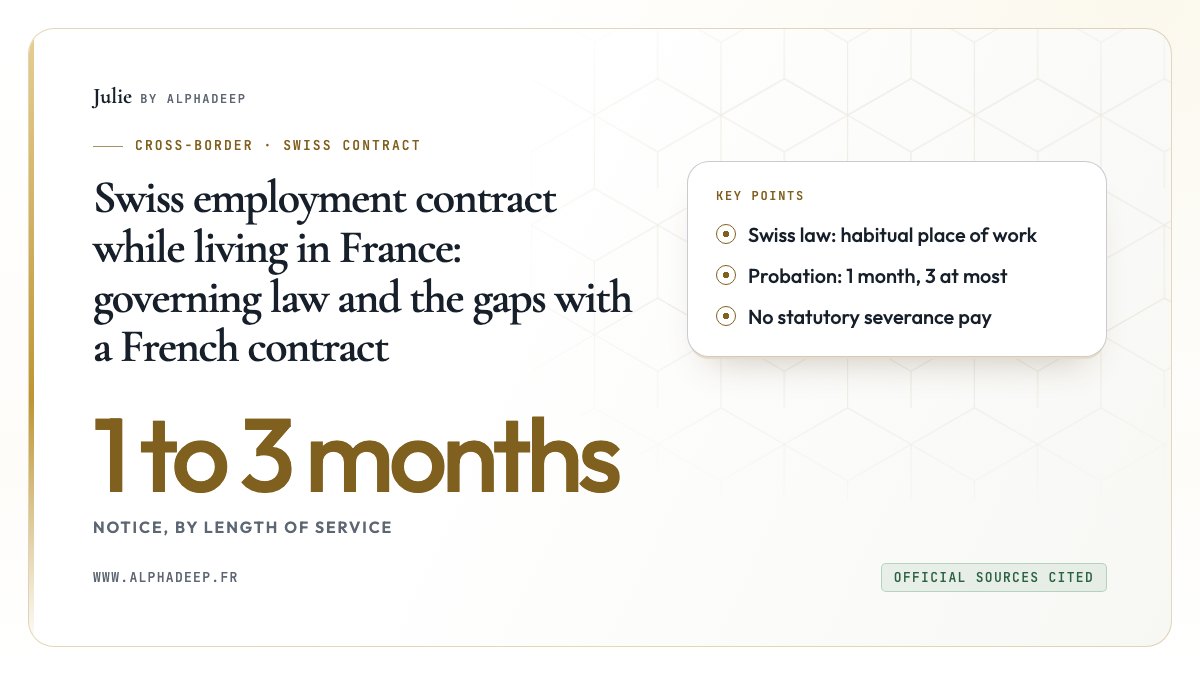
If you live in France and work in Switzerland, your Swiss employment contract is normally governed by Swiss law, the law of the place where you habitually work (Swiss Private International Law Act, art. 121). French labour law then does not apply: a one-month probation period, three at most, one to three months’ notice depending on service, no statutory severance pay and four weeks’ holiday. A collective agreement (CCT) or your contract can give more.
- Swiss law: habitual place of work
- Probation: 1 month, 3 at most
- No statutory severance pay
- Official texts cited
- Sources checked on
- Drafted with AI assistance, our method
General legal information with official references and dated checks. It is not personalised advice: for a decision that commits you, have your situation checked by a qualified professional.
Julie by AlphaDeep
You live in France and have, or are about to sign, a contract with a Swiss employer: I can check with you which law applies, your notice period, the competent court and what differs from a French contract.
3 free questions at signup. Avoid names and sensitive information.
Which law governs your contract if you live in France and work in Switzerland?
If you live in France and habitually work in Switzerland, your contract is normally governed by Swiss law, the law of the country where you habitually carry out your work. A Swiss court applies that rule under article 121 of the Swiss Private International Law Act (LDIP). A French court reaches the same result under the Rome I Regulation (article 8) when the parties made no choice: the law of the country in which, or from which, you habitually work. Where you live is not part of that test.
Working from home in France does not change the rule, but it weighs in the assessment: the larger the share done from France, the more the habitual place of work becomes a real question. Rome I also applies the law of another country if all the circumstances show the contract is more closely connected with it. In the usual case the contract is governed by the Swiss Code of Obligations (Code des obligations, CO), not the French Labour Code (Code du travail). According to OCSTAT, 414,262 cross-border workers (frontaliers) were working in Switzerland in the second quarter of 2026.
Swiss Private International Law Act (LDIP), art. 18 and 121 (in French)Regulation (EC) No 593/2008 (Rome I): article 8, individual employment contractsOCSTAT: foreign cross-border workers active in the canton of Geneva, Q2 2026 (in French)
Can your Swiss employer choose the governing law in the contract?
Yes, but only within limits: article 121(3) LDIP allows the parties to choose the law of the country where the worker habitually resides (France) or the law of the country of the employer’s establishment or domicile (Switzerland). A « Swiss law » clause is therefore valid, and so is a « French law » clause. Before a Swiss court, the law of a third country cannot be chosen.
The choice does not settle everything. Before a Swiss court, Swiss mandatory rules that apply whatever law is designated are always reserved (article 18 LDIP). Before a French court, article 8 of Rome I prevents a choice of law from depriving the employee of the protection of the mandatory rules of the law that would apply without a choice, usually Swiss law as the law of the workplace. A French law clause in a Swiss contract therefore does not remove those Swiss protections; a Swiss law clause simply confirms the default rule.
Swiss Private International Law Act (LDIP), art. 18 and 121 (in French)Regulation (EC) No 593/2008 (Rome I): article 8, individual employment contracts
Which figures matter in a Swiss employment contract?
The minimums of the Swiss Code of Obligations, set against the French Labour Code, and the number of cross-border workers.
- Default probation period in Switzerland (3 months at most, 7 days’ notice)
- 1 month
- CO as in force on 1 October 2026 · Swiss Code of Obligations, art. 335b
- Swiss statutory notice by length of service (year 1, years 2 to 9, after), to the end of a month
- 1, 2 or 3 months
- CO as in force on 1 October 2026 · Swiss Code of Obligations, art. 335c
- Minimum holiday per year of service in Switzerland (5 weeks up to age 20), against at most 30 working days in France
- 4 weeks
- CO as in force on 1 October 2026 · Swiss Code of Obligations, art. 329a
- Minimum premium for an overtime hour not offset by time off, unless a written agreement, CTT or CCT says otherwise
- +25 %
- CO as in force on 1 October 2026 · Swiss Code of Obligations, art. 321c
- Maximum probation for a manager on a permanent contract in France (8 months including renewal)
- 4 months
- in force since 27 June 2008 · French Labour Code, art. L1221-19
- Cross-border workers employed in Switzerland
- 414,262
- Q2 2026 · OCSTAT, foreign cross-border workers active in the canton of Geneva (6 August 2026)
Probation, notice, severance, holiday, overtime: what changes in Switzerland?
| Contract term | Swiss contract (CO) | French contract (Labour Code) | Source |
|---|---|---|---|
| Probation period | 1 month by default, 3 months at most by written agreement, standard contract (CTT) or CCT; 7 days’ notice; extended for illness or accident | Permanent contract (CDI): 2 months (workers, clerical staff), 3 months (supervisors, technicians), 4 months (managers); renewable once if an extended sector agreement allows it, 8 months at most for a manager | CO, art. 335b; Labour Code, art. L1221-19 and L1221-21 |
| Notice period | 1 month in year 1, 2 months in years 2 to 9, 3 months after that, to the end of a month | Dismissal: 1 month with 6 months to 2 years of service, 2 months beyond, unless a more favourable rule applies | CO, art. 335c; Labour Code, art. L1234-1 |
| Severance pay | None as a general rule; at age 50 with 20 years of service, at least 2 months’ salary, at most 8 | From 8 months of service on a CDI, except for gross misconduct: 1/4 of a month per year up to 10 years, 1/3 beyond | CO, art. 339b and 339c; Labour Code, art. L1234-9 and R1234-2 |
| Holiday | At least 4 weeks a year, 5 up to age 20 | 2.5 working days per month, 30 working days at most | CO, art. 329a; Labour Code, art. L3141-3 |
| Overtime | Equal time off with the employee’s consent, otherwise salary plus at least 25 %, unless a written agreement, CTT or CCT says otherwise | Absent an agreement: +25 % for the first 8 hours, +50 % after that | CO, art. 321c; Labour Code, art. L3121-36 |
These figures are legal minimums. A CCT binding your employer applies directly to your contract and overrides less favourable clauses (art. 357 CO).
Swiss Code of Obligations (CO), art. 335b and 335c (in French)Code du travail (French Labour Code): articles L1221-19 and L1221-21Code du travail (French Labour Code): articles L1234-1, L1234-9 and R1234-2Swiss Code of Obligations (CO), art. 339b and 339c (in French)Swiss Code of Obligations (CO), art. 329a (in French)Code du travail (French Labour Code): article L3141-3Swiss Code of Obligations (CO), art. 321c (in French)Code du travail (French Labour Code): article L3121-36Swiss Code of Obligations (CO), art. 357 (in French)
Where can you sue a Swiss employer?
To bring a claim against your Swiss employer, you normally go to the Swiss courts: under article 19 of the Lugano Convention, the employer can be sued in the courts of the country where it is domiciled, or in the court of the place where you habitually work. If that place is in Switzerland, both options lead to Switzerland, before the canton’s employment court. A French labour court (conseil de prud’hommes) only has jurisdiction if your habitual place of work, or your last one, is in France.
It does not work the other way round: your employer can only sue you in the courts of the country where you are domiciled, which is France (article 20). A contract clause naming another court only applies if it was agreed after the dispute arose, or if it lets you go to courts in addition to those of the Convention (article 21). A jurisdiction clause signed when you were hired cannot take away the Swiss court or the court of your workplace.
Lugano Convention of 30 October 2007, art. 19 to 21 (in French)
Which social security covers you if you work from home in France?
You stay in the Swiss social security system as long as your work from home in France stays under 25 % of your working time or pay, and up to 49.9 % with an A1 certificate. The rule comes from Regulation (EC) No 883/2004, applied between Switzerland and the European Union through Annex II of the Agreement on the Free Movement of Persons (ALCP). According to Cleiss, an employee who carries out at least 25 % of their activity in their country of residence is in principle insured there.
The multilateral framework agreement on cross-border telework, in force since 1 July 2023, makes an exception to that threshold. According to the Swiss Federal Social Insurance Office (OFAS), the Swiss employer asks its AVS compensation fund for the A1 certificate through the ALPS platform; it lasts 3 years at most and can be renewed. At 50 % telework or more, French social security takes over. This social security threshold is separate from the 40 % tax rule: the same telework share can meet one and exceed the other.
Agreement on the Free Movement of Persons (ALCP), art. 8 and Annex II (in French)Cleiss: Législation applicable, Regulation 883/2004 (in French)OFAS: Télétravail, framework agreement, A1 certificate, ALPS (in French)
What does article L1234-9 of the French Labour Code give you that Swiss law does not?
Le salarié titulaire d'un contrat de travail à durée indéterminée, licencié alors qu'il compte 8 mois d'ancienneté ininterrompus au service du même employeur, a droit, sauf en cas de faute grave, à une indemnité de licenciement.
Les modalités de calcul de cette indemnité sont fonction de la rémunération brute dont le salarié bénéficiait antérieurement à la rupture du contrat de travail. Ce taux et ces modalités sont déterminés par voie réglementaire.
In plain English: In France, an employee on a permanent contract who is dismissed after 8 months of service, except for gross misconduct, is entitled to statutory severance pay based on gross salary. The Swiss Code of Obligations has no general equivalent: under a Swiss contract, only the contract, a CCT or article 339b CO can give you one.
French minimum (art. R1234-2): 1/4 of a month’s salary per year up to 10 years, 1/3 of a month beyond.
Which law, notice period and court apply to your contract?
Enter your share of work from France, the governing-law clause, your length of service and the date notice was given: the worksheet applies the LDIP, Rome I, the CO and the Lugano Convention to those facts. It does not compute any salary or payment and does not predict the outcome of a dispute.
Fictional example · Law, notice period and court
Your contract is governed by Swiss law, the law of the place where you habitually work (article 121 LDIP; article 8 Rome I before a French court). The Code of Obligations sets the probation and notice periods below; a CCT binding your employer can give more (article 357 CO). To sue the employer, you go to the Swiss courts (article 19 of the Lugano Convention).
- Notice period (art. 335c CO)
- 2 months, to the end of a month: end of the month containing 2027-01-12
- Protection during illness (art. 336c CO)
- Dismissal void for 90 days (years 2 to 5), 180 days from year 6
- You sue the employer
- In Switzerland: employer’s domicile or habitual place of work (Lugano, art. 19)
- The employer sues you
- In France, your country of domicile (Lugano, art. 20)
- Social security
- Switzerland, with an A1 certificate requested by the employer
- Check the date notice was received: the period runs from receipt and, after probation, to the end of a month.
- Look up your sector’s CCT: it can change probation, notice and the 13th month salary.
- Get written confirmation that the employer has requested the A1 certificate from its AVS fund.
- If you consider the dismissal abusive, object in writing before the notice period ends (art. 336b CO).
The worksheet applies the rules of the LDIP, Rome I, the CO and the Lugano Convention to the facts you enter. It does not take a CCT or your contract clauses into account and does not replace reading them.
What should you check before signing a Swiss contract?
Before signing, check the clauses that depart from the Swiss legal minimum and the clauses on governing law and jurisdiction. The Code of Obligations leaves wide room to the contract, but several departures require a written agreement or a collective labour agreement (convention collective de travail, CCT). If a CCT binds your employer, its terms apply directly and any contrary contract clause is void, unless it is more favourable to you (article 357 CO).
Points to read closely:
- probation (temps d’essai): one month without a clause, three months at most by written agreement (art. 335b CO);
- notice period (délai de congé): can be changed in writing, but not below one month, except by a CCT and in the first year (art. 335c CO);
- 13th month salary: the CO does not require one; a bonus is owed only if agreed, and pro rata on leaving only if that is also agreed (art. 322d CO);
- overtime: a written agreement can exclude the 25 % premium (art. 321c CO);
- law and court: only French or Swiss law can be chosen, and a jurisdiction clause signed in advance cannot remove a court given by the Lugano Convention;
- written terms: the contract needs no particular form (art. 320 CO), but the employer must give you in writing, within one month, the parties, start date, job, salary and weekly working hours (art. 330b CO).
Swiss Code of Obligations (CO), art. 357 (in French)Swiss Code of Obligations (CO), art. 335b and 335c (in French)Swiss Code of Obligations (CO), art. 322d (in French)Swiss Code of Obligations (CO), art. 321c (in French)Lugano Convention of 30 October 2007, art. 19 to 21 (in French)Swiss Code of Obligations (CO), art. 320 and 330b (in French)
What else do cross-border workers ask about Swiss contracts?
Is a 13th month salary owed if your Swiss contract does not mention it?
No, the Swiss Code of Obligations does not require a 13th month salary. A special payment on top of salary, for example at Christmas or at year end, is owed only if it was agreed (article 322d CO). Check your sector’s collective labour agreement (CCT): if it binds your employer and provides a 13th month salary, that term applies directly to your contract (article 357 CO).
Swiss Code of Obligations (CO), art. 322d (in French)Swiss Code of Obligations (CO), art. 357 (in French)
Can you be dismissed while on sick leave in Switzerland?
Yes, but not during the protection periods. After probation, a dismissal given while you are unable to work because of illness or an accident that is not your fault is void for 30 days in the first year of service, 90 days from the second to the fifth year and 180 days from the sixth year (article 336c CO). If notice was given before the illness, the notice period is suspended and then extended to the next end date.
Swiss Code of Obligations (CO), art. 336b and 336c (in French)
Does a Swiss employer have to give you your terms of employment in writing?
Yes, a Swiss employer must inform an employee hired for more than one month or for an indefinite period in writing, no later than one month after the start: names of the parties, start date, job, salary and supplements, and weekly working hours (article 330b CO). The contract itself needs no particular form (article 320 CO), except for clauses the law requires in writing.
Swiss Code of Obligations (CO), art. 320 and 330b (in French)
Can a French labour court hear your claim against a Swiss employer?
Usually not: under the Lugano Convention, a Swiss employer can be sued in the courts of its domicile or of the place where you habitually work (article 19). A French labour court (conseil de prud’hommes) only has jurisdiction if that habitual place of work, or the last one, is in France. Your employer, for its part, can only sue you in France, your country of domicile (article 20).
Lugano Convention of 30 October 2007, art. 19 to 21 (in French)
How long is a G permit valid with a permanent contract?
A G permit (cross-border commuter permit) for an EU national with a permanent contract, or a contract of more than one year, is valid for five years, according to the State Secretariat for Migration (SEM). For a contract of three months to one year, it lasts as long as the contract; up to three months of work per calendar year only needs an online notification. The holder returns home daily or at least once a week.
Which legal texts set these rules for cross-border contracts?
- Swiss Private International Law Act (LDIP), art. 18 and 121 (in French)Swiss Confederation: Fedlex
- Regulation (EC) No 593/2008 (Rome I): article 8, individual employment contractsEuropean Union: EUR-Lex
- OCSTAT: foreign cross-border workers active in the canton of Geneva, Q2 2026 (in French)Cantonal Statistics Office, Geneva
- Lugano Convention of 30 October 2007, art. 19 to 21 (in French)Swiss Confederation: Fedlex
- Agreement on the Free Movement of Persons (ALCP), art. 8 and Annex II (in French)Swiss Confederation: Fedlex
- Cleiss: Législation applicable, Regulation 883/2004 (in French)Cleiss, French liaison body for European and international social security
- OFAS: Télétravail, framework agreement, A1 certificate, ALPS (in French)Swiss Federal Social Insurance Office
- Swiss Code of Obligations (CO), art. 357 (in French)Swiss Confederation: Fedlex
- Swiss Code of Obligations (CO), art. 335b and 335c (in French)Swiss Confederation: Fedlex
- Swiss Code of Obligations (CO), art. 322d (in French)Swiss Confederation: Fedlex
- Swiss Code of Obligations (CO), art. 321c (in French)Swiss Confederation: Fedlex
- Swiss Code of Obligations (CO), art. 320 and 330b (in French)Swiss Confederation: Fedlex
- Swiss Code of Obligations (CO), art. 329a (in French)Swiss Confederation: Fedlex
- Code du travail (French Labour Code): articles L1221-19 and L1221-21French Republic / DILA: Légifrance
- Code du travail (French Labour Code): articles L1234-1, L1234-9 and R1234-2French Republic / DILA: Légifrance
- Swiss Code of Obligations (CO), art. 339b and 339c (in French)Swiss Confederation: Fedlex
- Code du travail (French Labour Code): article L3141-3French Republic / DILA: Légifrance
- Code du travail (French Labour Code): article L3121-36French Republic / DILA: Légifrance
- Swiss Code of Obligations (CO), art. 336b and 336c (in French)Swiss Confederation: Fedlex
- SEM: Autorisation frontalière G UE/AELE (in French)State Secretariat for Migration
Texts cited last checked: 30 October 2026