Residence and nationality · Cross-border work · Switzerland
The Swiss G permit for people living in France: who qualifies, how long it lasts, what happens if the job changes
To live in France and work in Switzerland you need a G permit. EU and EFTA nationals get it with their job contract, with no border-zone condition, if they return home at least weekly; it lasts 5 years for an open-ended contract or one over a year (ALCP, annex I, art. 7). Third-country nationals need a durable French residence right and 6 months living in the border zone, and the permit first lasts 1 year.
- Official texts cited
- Sources checked on
- Drafted with AI assistance, our method
General legal information with official references and dated checks. It is not personalised advice: for a decision that commits you, have your situation checked by a qualified professional.
Julie by AlphaDeep
You live in France and are about to work in Switzerland: I can check which G permit rules apply to you, who applies, how long it lasts and what happens if your job changes.
3 free questions at signup. Avoid names and sensitive information.
Who needs a G permit to live in France and work in Switzerland?
Anyone who lives in France and works in Switzerland for more than three months in a calendar year needs a G permit, the Swiss cross-border commuter permit (autorisation frontalière). EU and EFTA nationals are entitled to it with a Swiss job contract, with no border-zone condition: the State Secretariat for Migration (SEM) states that the zones were abolished for them. They must only return home in principle every day, or at least once a week (ALCP, annex I, art. 7).
Third-country nationals (from a non-EU/EFTA country, État tiers) can only be admitted if they hold a durable right of residence in France, have lived for at least six months in the neighbouring border zone (zone frontalière) and work in the Swiss border zone (LEI, art. 25). Swiss labour-market rules also apply. According to OCSTAT, 414,262 cross-border workers were working in Switzerland in the second quarter of 2026.
Agreement on the free movement of persons (ALCP), annex I, art. 7 (official French text)SEM: G permit EU/EFTA (cross-border commuter permit) (in French)Federal Act on Foreign Nationals and Integration (LEI), art. 25 (in French)SEM: G permit for third-country nationals (in French)OCSTAT: foreign cross-border workers active in Geneva, Q2 2026 (in French)
What does the Swiss-EU free movement agreement say about cross-border workers?
(1) Le travailleur frontalier salarié est un ressortissant d’une partie contractante qui a sa résidence sur le territoire d’une partie contractante et qui exerce une activité salariée sur le territoire de l’autre partie contractante en retournant à son domicile en principe chaque jour, ou au moins une fois par semaine.
(2) Les travailleurs frontaliers n’ont pas besoin d’un titre de séjour.
Cependant, l’autorité compétente de l’État d’emploi peut doter le travailleur frontalier salarié d’un titre spécifique pour une durée de cinq ans au moins ou pour la durée de son emploi si celle-ci est supérieure à trois mois et inférieure à un an. Il est prolongé pour cinq ans au moins pour autant que le travailleur frontalier produise la preuve qu’il exerce une activité économique.
(3) Le titre spécifique est valable pour l’ensemble du territoire de l’État qui l’a délivré.
In plain English: A salaried cross-border worker lives in one country and works in the other, returning home every day or at least weekly. No residence permit is needed, but Switzerland issues a specific permit of at least five years, or for the length of a 3 to 12 month job, valid nationwide.
This text covers EU/EFTA nationals; third-country nationals fall under articles 25, 35 and 39 of the LEI.
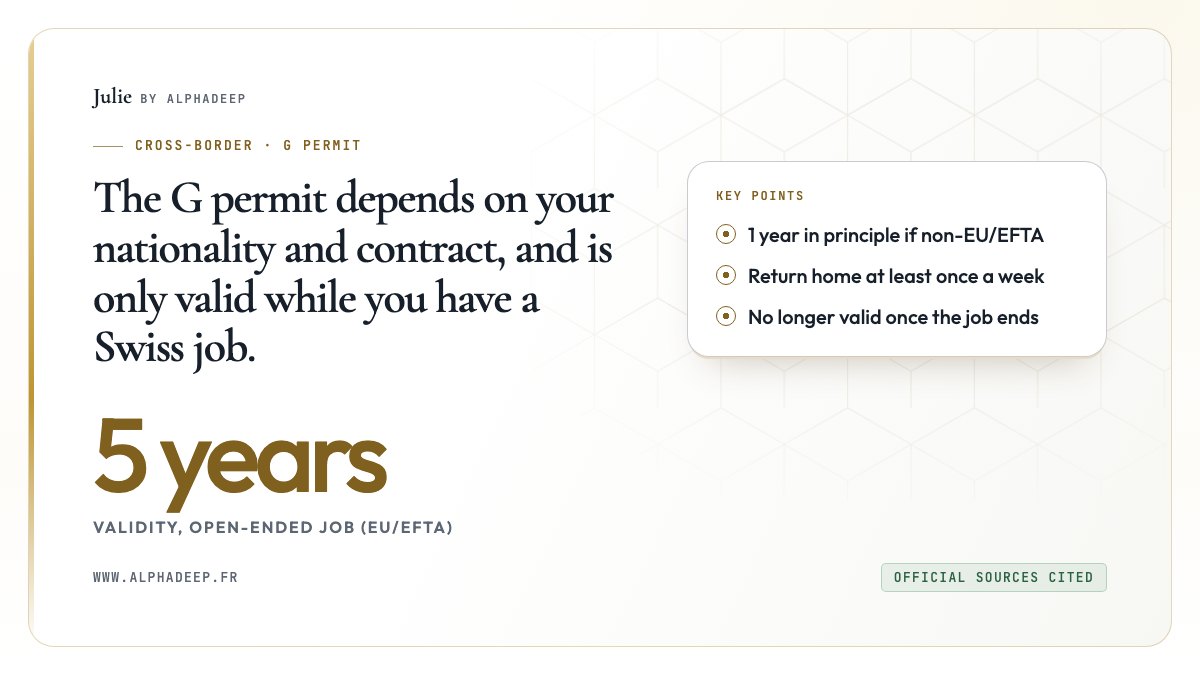
Which figures frame the G permit?
These benchmarks come from Swiss law, the SEM and OCSTAT; your own dates are worked out in the worksheet below.
- Validity of an EU/EFTA cross-border worker’s G permit on an open-ended contract or one over a year
- 5 years
- SEM page, as of 1 January 2022 · State Secretariat for Migration (SEM), G permit EU/EFTA (in French)
- Work in Switzerland without a permit, on online notification only, for an EU/EFTA national
- 3 months
- per calendar year, OLCP as of 1 January 2026 · Ordinance on the introduction of free movement of persons (OLCP), art. 4 (in French)
- Initial validity of a third-country national’s G permit
- 1 year
- in principle, SEM page of 9 September 2022 · State Secretariat for Migration (SEM), G permit for third-country nationals (in French)
- Minimum residence in the neighbouring border zone required of a third-country national
- 6 months
- LEI as of 12 June 2026 · Federal Act on Foreign Nationals and Integration (LEI), art. 25 (in French)
- Cross-border workers employed in Switzerland
- 414,262
- 2nd quarter 2026 · OCSTAT Geneva, foreign cross-border workers active in Geneva (6 August 2026, in French)
Who applies for the G permit, and can you start work before it arrives?
In Geneva, an EU/EFTA national files the application online with the cantonal population and migration office (OCPM) and may start work as soon as the complete file has been sent. Keep the second acknowledgement email: it confirms you may work while waiting for the permit. The file contains a colour copy of your ID, a photo and an employer certificate or a copy of the contract. According to the Canton of Geneva (October 2026), processing currently takes 4 months. In the canton of Vaud, the population service (Service de la population) handles jobs of more than three months, using form G1.
For a third-country national, the employer files the G permit application with the OCPM, ideally 6 to 8 weeks before the planned start, and the answer comes within 12 to 16 weeks. The employee may only work once the permit has been received.
Canton of Geneva: salaried work for an EU/EFTA cross-border worker (in French)Canton of Vaud: cross-border work by an EU-27/EFTA national (in French)Canton of Geneva: cross-border permit for a non-EU/EFTA national (in French)
How long is a G permit valid for your type of contract?
For an EU/EFTA national, the G permit lasts 5 years if the contract is open-ended or longer than one year, and the length of the contract if it runs 3 to 12 months (SEM). Below three months per calendar year no permit is needed: an online notification is enough (OLCP, art. 4). The permit is extended for at least five years if you prove you are still working (ALCP, annex I, art. 7).
For a third-country national, the first permit lasts 1 year in principle and is only valid in the border zone of the canton that issued it. Its validity is limited but can be extended; after five years of uninterrupted work you are entitled to the extension unless there is a ground for revocation (LEI, art. 35). In Geneva, the employer receives a permit expiry notice (avis d’échéance) one month before the end date; a self-employed holder receives it directly.
SEM: G permit EU/EFTA (cross-border commuter permit) (in French)Ordinance on the introduction of free movement of persons (OLCP), art. 4 (in French)Agreement on the free movement of persons (ALCP), annex I, art. 7 (official French text)SEM: G permit for third-country nationals (in French)Federal Act on Foreign Nationals and Integration (LEI), art. 35 (in French)Canton of Geneva: renewing a cross-border permit (in French)
EU/EFTA or third-country G permit: what is different?
| Point | EU/EFTA national | Third-country national | Source |
|---|---|---|---|
| Residence required | Any EU/EFTA state, no border zone | Durable residence right in a neighbouring state and 6 months in the neighbouring border zone | ALCP, annex I, art. 7; SEM; LEI, art. 25 |
| Where you may work | Anywhere in Switzerland | Border zone of the canton that issued the permit | OLCP, art. 4; SEM |
| Who files in Geneva | The worker, online | The employer, with the OCPM | ge.ch |
| Starting work | Once the complete file is sent (Geneva) | Only after the permit arrives | ge.ch |
| Validity | 5 years (open-ended or over a year), contract length for 3 to 12 months | 1 year in principle, renewable | SEM; LEI, art. 35 |
| Changing job | Notice before starting | Prior authorisation until 5 years of uninterrupted work, then notice | OLCP, art. 9; LEI, art. 39; OASA, art. 13a |
| Returning home | Daily in principle, at least once a week | At least once a week | ALCP, annex I, art. 7; LEI, art. 35 |
Third-country nationals remain subject to the border zones set by agreements with neighbouring countries; the canton of Vaud still applies them.
Agreement on the free movement of persons (ALCP), annex I, art. 7 (official French text)SEM: G permit EU/EFTA (cross-border commuter permit) (in French)SEM: G permit for third-country nationals (in French)Federal Act on Foreign Nationals and Integration (LEI), art. 25 (in French)Ordinance on the introduction of free movement of persons (OLCP), art. 4 (in French)Canton of Geneva: salaried work for an EU/EFTA cross-border worker (in French)Canton of Geneva: cross-border permit for a non-EU/EFTA national (in French)Federal Act on Foreign Nationals and Integration (LEI), art. 35 (in French)Ordinance on the introduction of free movement of persons (OLCP), art. 9 (in French)Federal Act on Foreign Nationals and Integration (LEI), art. 39 (in French)Ordinance on Admission, Period of Stay and Employment (OASA), art. 13a (in French)
Which G permit steps apply to your nationality and situation?
Enter your nationality, canton of work, contract and the event that concerns you: the worksheet shows which rules apply, who files the application, how long the permit lasts and the dates of the notices you owe. It does not decide in place of the OCPM or the Vaud population service and shows no fee.
Fictional example · Rules, validity and notices for your G permit
EU/EFTA national with an open-ended contract or one over a year: the G permit lasts 5 years, until {end5} if work starts on the date entered (ALCP, annex I, art. 7; SEM). In Geneva you apply online and may start as soon as the complete file has been sent.
- Applicable rules
- ALCP, annex I, art. 7, and OLCP
- Indicative end of validity (5 years)
- 2031-11-02
- Gather a colour copy of your ID and an employer certificate or a copy of the contract.
- Apply online to the OCPM and keep the second acknowledgement, which allows you to work.
- Then check the health-insurance option (three months) and which country taxes your salary.
The worksheet applies the Swiss texts and the official Geneva and Vaud pages to the facts you enter. It shows no fees and does not replace the cantonal authority’s decision.
What happens to your G permit when you change employer?
An EU/EFTA national keeps the G permit but must report the new job to the authority of the place of work before starting it (OLCP, art. 9, para. 3). In Geneva, the OCPM asks for this notice through its online form, at the latest 14 days after the event, because the permit is tied to one employer. The EU/EFTA permit is valid throughout Switzerland; if you leave Geneva for another canton, the OCPM asks you to cancel the Geneva permit and apply for a new one in the new canton.
A third-country national needs an authorisation to change job until reaching five years of uninterrupted work (LEI, art. 39). In Geneva, the new employer files the request 6 to 8 weeks before the start date, and you may not work for that employer in the meantime. After five years the change becomes a right and a prior notification is enough (OASA, art. 13a), unless the Geneva labour inspectorate (OCIRT) has restricted the permit.
Ordinance on the introduction of free movement of persons (OLCP), art. 9 (in French)OCPM: FAQ on EU/EFTA cross-border permits (in French)Ordinance on the introduction of free movement of persons (OLCP), art. 4 (in French)Federal Act on Foreign Nationals and Integration (LEI), art. 39 (in French)Canton of Geneva: change of employer for a non-EU/EFTA cross-border worker (in French)Ordinance on Admission, Period of Stay and Employment (OASA), art. 13a (in French)
Is your G permit still valid after you lose your Swiss job?
No: the G permit is only valid with a job in Switzerland and stops being valid when your work for the employer ends. The OCPM says so plainly in its FAQ, and adds that a cross-border permit cannot be obtained to look for work. In Geneva, the employer must report the end of employment within 14 days, using form R.
The rule is the same at the end of a fixed-term contract (CDD) or after a dismissal. The OLCP provides that an EU/EFTA cross-border permit may be revoked or not extended when the conditions for issuing it are no longer met (art. 23). If you find a new job in Switzerland, the notification or the new application is made before you start, depending on your nationality.
OCPM: FAQ on EU/EFTA cross-border permits (in French)Ordinance on the introduction of free movement of persons (OLCP), art. 23 (in French)Ordinance on the introduction of free movement of persons (OLCP), art. 9 (in French)
Weekly return, short assignments, self-employment, non-EU nationals: what are the answers to common G permit questions?
Do you have to go back to France every evening on a G permit?
No. On a G permit, an EU/EFTA cross-border worker returns home in principle every day, or at least once a week (ALCP, annex I, art. 7); a third-country national at least once a week (LEI, art. 35). A G permit holder who stays in Switzerland during the week must register with the authority of their Swiss place of residence (OLCP, art. 9, para. 4).
Agreement on the free movement of persons (ALCP), annex I, art. 7 (official French text)Federal Act on Foreign Nationals and Integration (LEI), art. 35 (in French)Ordinance on the introduction of free movement of persons (OLCP), art. 9 (in French)
Do you need a G permit for a Swiss assignment of under three months?
Not for an EU/EFTA national: work in Switzerland totalling no more than three months per calendar year needs no G permit (OLCP, art. 4). It is notified online on the SEM website, at the latest the day before the first working day (OLCP, art. 9, para. 1bis). This exemption does not apply to third-country nationals.
Ordinance on the introduction of free movement of persons (OLCP), art. 4 (in French)Ordinance on the introduction of free movement of persons (OLCP), art. 9 (in French)Canton of Vaud: cross-border work by an EU-27/EFTA national (in French)
Can a non-EU national with a French residence card get a G permit?
Yes, if they hold a durable right of residence in France, have lived for at least six months in the neighbouring border zone and work in the Swiss border zone (LEI, art. 25). The employer files the application and the labour market is checked. According to the SEM, the G permit first lasts one year in principle and is valid only in the issuing canton’s border zone.
Federal Act on Foreign Nationals and Integration (LEI), art. 25 (in French)SEM: G permit for third-country nationals (in French)Canton of Geneva: cross-border permit for a non-EU/EFTA national (in French)
Can a self-employed person living in France get a G permit?
Yes. An EU/EFTA national living in France and self-employed in Switzerland receives a specific permit of at least five years on proof that they carry on, or intend to carry on, that activity (ALCP, annex I, art. 13). In Geneva, the self-employed holder receives the expiry notice directly and proves the activity at renewal. A salaried third-country G permit holder needs an authorisation to become self-employed (LEI, art. 39).
Agreement on the free movement of persons (ALCP), annex I, art. 13 (official French text)Canton of Geneva: renewing a cross-border permit (in French)Federal Act on Foreign Nationals and Integration (LEI), art. 39 (in French)
Does the G permit decide where you pay tax and who covers your healthcare?
No. The G permit authorises work in Switzerland; it does not settle tax or health insurance. Salaries paid in Geneva are taxed in Switzerland; in the cantons of the 11 April 1983 agreement, including Vaud, they are taxed in France. For healthcare, the cross-border worker chooses between Swiss LAMal insurance and the French scheme within three months of being hired, and the choice is final.
Geneva tax administration: agreements applicable to cross-border telework (in French)Canton of Geneva: new cross-border worker, health insurance (in French)
Which treaties, laws and official pages are these G permit rules based on?
- Agreement on the free movement of persons (ALCP), annex I, art. 7 (official French text)Swiss Confederation: Fedlex
- SEM: G permit EU/EFTA (cross-border commuter permit) (in French)State Secretariat for Migration (SEM)
- Federal Act on Foreign Nationals and Integration (LEI), art. 25 (in French)Swiss Confederation: Fedlex
- SEM: G permit for third-country nationals (in French)State Secretariat for Migration (SEM)
- OCSTAT: foreign cross-border workers active in Geneva, Q2 2026 (in French)Geneva cantonal statistics office (OCSTAT)
- Canton of Geneva: salaried work for an EU/EFTA cross-border worker (in French)Republic and Canton of Geneva, OCPM
- Canton of Vaud: cross-border work by an EU-27/EFTA national (in French)Canton of Vaud, Service de la population
- Canton of Geneva: cross-border permit for a non-EU/EFTA national (in French)Republic and Canton of Geneva, OCPM
- Ordinance on the introduction of free movement of persons (OLCP), art. 4 (in French)Swiss Confederation: Fedlex
- Federal Act on Foreign Nationals and Integration (LEI), art. 35 (in French)Swiss Confederation: Fedlex
- Canton of Geneva: renewing a cross-border permit (in French)Republic and Canton of Geneva, OCPM
- Ordinance on the introduction of free movement of persons (OLCP), art. 9 (in French)Swiss Confederation: Fedlex
- Federal Act on Foreign Nationals and Integration (LEI), art. 39 (in French)Swiss Confederation: Fedlex
- Ordinance on Admission, Period of Stay and Employment (OASA), art. 13a (in French)Swiss Confederation: Fedlex
- OCPM: FAQ on EU/EFTA cross-border permits (in French)Republic and Canton of Geneva, OCPM
- Canton of Geneva: change of employer for a non-EU/EFTA cross-border worker (in French)Republic and Canton of Geneva, OCPM
- Ordinance on the introduction of free movement of persons (OLCP), art. 23 (in French)Swiss Confederation: Fedlex
- Agreement on the free movement of persons (ALCP), annex I, art. 13 (official French text)Swiss Confederation: Fedlex
- Geneva tax administration: agreements applicable to cross-border telework (in French)Republic and Canton of Geneva, Cantonal Tax Administration
- Canton of Geneva: new cross-border worker, health insurance (in French)Republic and Canton of Geneva, Health Insurance Service
Texts cited last checked: 30 October 2026