The letterDebts · Payment plan proposal
Court payment extension in France: asking a judge to spread a debt over 2 years under article 1343-5; distinct lease regime to verify arrears, and when
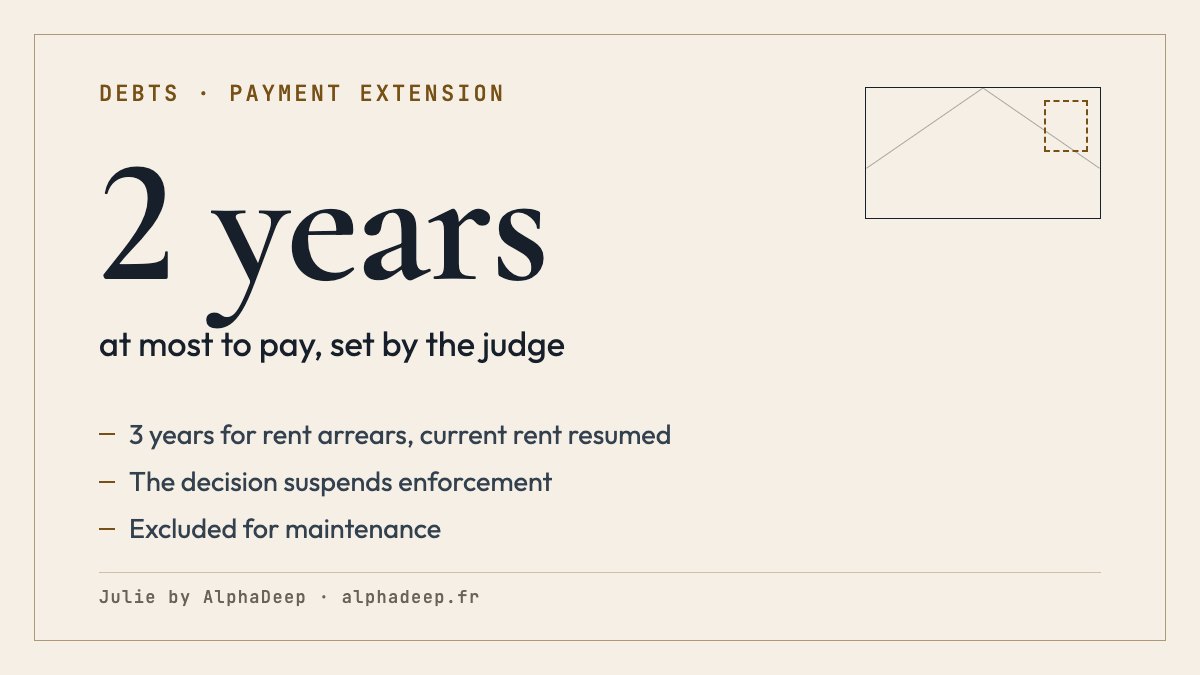
A French judge can defer or spread payment of a debt over 2 years at most, weighing the debtor’s situation against the creditor’s needs (Civil Code, article 1343-5); for rent arrears, up to 3 years if the tenant can clear the debt and has resumed the full current rent. The decision suspends enforcement. Maintenance debts are excluded. Offer the creditor a written payment plan first.
Julie by AlphaDeep is an AI legal assistant for French law: it researches official references to help answer your questions (Légifrance, case law, service-public), analyses your documents and drafts your letters, for individuals and professionals alike.
General legal information with official references and dated checks. It is not personalised advice: for a decision that commits you, have your situation checked by a qualified professional.

Let’s look at your situation
Give the amount of the debt, who claims it, what you can pay each month, and whether a formal demand or seizure has arrived.
Example questions
Your question carries over after signup. Maximum 400 characters. Avoid health data and names.
Which payment plan should you offer, and how far can the judge go?
Give the amount of the debt, its type, what you can pay each month and whether enforcement has started: the letter works out the maximum term and the number of instalments, names the judge and drafts the proposal to the creditor, in French, for a French creditor. The example: €9,000 of rent arrears, €300 a month, no formal demand or seizure yet.
Fictional example · the proposal to your creditor
A plan you can keep: 30 months at your pace, within the 36 months the judge can grant.
- Longest term
- 36 months
- Instalments at your pace
- 30 months
- Instalment over the longest term
- €250.00
- Proposal to the creditor
- 30 × €300.00
- Judge to ask, failing agreement
- Protection litigation judge (juge des contentieux de la protection)
Lettre recommandée avec accusé de réception
[Vos nom et prénom][Votre adresse]
[Nom du créancier][Adresse du créancier]
À [ville], le [date]
ObjetProposition d’échéancier pour 9 000,00 €
Madame, Monsieur,
Je reste redevable de 9 000,00 € au titre de l’arriéré de loyers et de charges du logement que je loue (référence [référence du dossier ou du contrat]). Ma situation ne me permet pas de régler cette somme en une fois : [exposez brièvement vos ressources et vos charges].
Je vous propose de la régler par 30 versements mensuels de 300,00 €, à compter du mois suivant votre accord. J’ai repris le paiement intégral du loyer courant ; je joins les justificatifs.
Faute d’accord, je demanderai au juge des délais de paiement, qu’il peut accorder dans la limite de trois ans (article 24 de la loi du 6 juillet 1989).
Je vous remercie de me faire connaître votre réponse par écrit.
Je vous prie d’agréer, Madame, Monsieur, l’expression de mes salutations distinguées.[Signature]
Pièces jointes : un justificatif de ressources ; un état de mes charges
Indicative result: the judge sets the term according to your situation and the creditor’s needs, and does not have to grant one. The proposal is in French because your creditor is in France.
Must a French judge give you more time to pay?
No: it is a power, not a duty. The judge may defer or spread payment over 2 years at most, taking account of the debtor’s situation and the creditor’s needs (French Civil Code, article 1343-5). A realistic plan, backed by your income and outgoings, weighs in the decision.
By a decision giving specific reasons, the judge may also cut the interest rate, never below the legal rate, or apply payments to the capital first, and make these measures conditional on steps that secure payment (same article).
Sources: C. civ. 1343-5 · Service-public F35820
What does a decision granting time to pay change?
A decision granting time to pay suspends any enforcement the creditor has started, and late-payment interest increases or penalties do not run during the period set; any clause to the contrary is deemed unwritten (French Civil Code, article 1343-5).
No extension can be granted to a debtor whose assets are being seized by other creditors, or who has by their own act reduced the security given to the creditor; in those cases an extension already obtained is lost too (Code of Civil Procedure, article 512). The extension does not prevent protective measures (article 513).
Sources: C. civ. 1343-5 · C. pr. civ. 512 · C. pr. civ. 513
Can rent arrears be spread over 3 years?
Yes: the judge can grant up to 3 years, on the request of the tenant or the landlord or on the judge’s own motion, provided the tenant is able to clear the debt and has resumed paying the full current rent before the hearing (law of 6 July 1989, article 24, V).
The extension can suspend the lease’s automatic termination clause: if the tenant keeps to it, the clause is deemed never to have applied. A formal demand to pay (commandement de payer) leaves 6 weeks to pay up (same article, as amended on 29 July 2023).
Sources: Loi n° 89-462, art. 24 · Service-public F31272
Can you get time to pay maintenance?
No: article 1343-5 of the French Civil Code excludes maintenance debts, such as spousal maintenance or child support (service-public.fr, fiche F35820).
If your income has fallen, the step is a request to the family court judge (juge aux affaires familiales) to revise the amount. For taxes or social contributions, a payment plan is asked of the office that claims them.
Sources: C. civ. 1343-5 · Service-public F35820
Should you write to the creditor before going to court?
Writing to the creditor is the first step: a written, costed proposal shows good faith and may be enough. For a claim of €5,000 or less before the court, an attempt at conciliation, mediation or participatory procedure is in principle compulsory before you apply to the judge (service-public.fr, fiche F1783).
Starting a court case carries a €50 legal aid contribution, unless you receive legal aid (General Tax Code, article 1635 bis Q). Before the enforcement judge, a lawyer is compulsory above €10,000 (fiche F35820).
Sources: Service-public F1783 · CGI 1635 bis Q · Service-public F35820
Which judge grants time to pay, depending on where you are?
The extension is asked of the judge deciding the debt; once enforcement has started, of the enforcement judge.
| Situation | Judge | Text | Longest term |
|---|---|---|---|
| Residential rent arrears, before judgment | Protection litigation judge (juge des contentieux de la protection) | Law of 6 July 1989, article 24 | 3 years |
| Consumer credit or home loan | Protection litigation judge | Consumer Code, article L314-20 | 2 years |
| Any other debt, in the case on the debt | The judge deciding the debt | Code of Civil Procedure, article 510 | 2 years |
| Urgency | Urgent applications judge (juge des référés) | Code of Civil Procedure, article 510 | 2 years |
| After a formal demand or a seizure | Enforcement judge (juge de l’exécution) | Code of Civil Enforcement Procedures, article R121-1 | 2 years under article 1343-5; distinct lease regime to verify |
| Maintenance | No extension possible | Civil Code, article 1343-5 | Excluded |
For disputes of €5,000 or less, an attempt at amicable settlement is in principle compulsory before applying to the judge (fiche F1783).
Sources: C. pr. civ. 510 · C. pr. exéc. R121-1 · Loi n° 89-462, art. 24 · C. conso. L314-20 · C. civ. 1343-5 · Service-public F1783
What does article 1343-5 of the French Civil Code say?
The text that lets the judge defer or spread a debt, and what it leaves out.
Le juge peut, compte tenu de la situation du débiteur et en considération des besoins du créancier, reporter ou échelonner, dans la limite de deux années, le paiement des sommes dues.
Par décision spéciale et motivée, il peut ordonner que les sommes correspondant aux échéances reportées porteront intérêt à un taux réduit au moins égal au taux légal, ou que les paiements s’imputeront d’abord sur le capital.
La décision du juge suspend les procédures d’exécution qui auraient été engagées par le créancier. Les majorations d’intérêts ou les pénalités prévues en cas de retard ne sont pas encourues pendant le délai fixé par le juge.
In English, briefly (our summary, not an official translation): Taking account of the debtor’s situation and considering the creditor’s needs, the judge may defer or spread payment of the sums owed over two years at most. By a specific decision giving reasons, the judge may order that the deferred sums bear interest at a reduced rate no lower than the legal rate, or that payments go to the capital first. The decision suspends any enforcement the creditor has started, and late-payment increases or penalties are not incurred during the period set. Our summary of the rest: the measures can be made conditional on steps by the debtor, and maintenance debts are excluded; for rent, article 24 of the law of 6 July 1989 raises the limit to three years.
What do debtors ask when they want to spread a debt?
Does my letter to the creditor stop enforcement?
No: only the judge’s decision granting time to pay suspends enforcement (French Civil Code, article 1343-5).
Can the creditor refuse my payment plan?
Yes: an amicable plan needs their agreement. If they refuse, the judge can impose an extension of up to 2 years, or 3 for rent.
For a loan, does interest run during the extension?
Not necessarily: the protection litigation judge may decide that the sums owed bear no interest during the extension, in particular after a dismissal (Consumer Code, article L314-20).
Can I ask for time after a seizure?
Yes, from the enforcement judge, once the formal demand or the seizure has been served (Code of Civil Enforcement Procedures, article R121-1).
What happens if I miss the plan the judge set?
The creditor can enforce again; for rent, the lease’s automatic termination clause takes effect again (law of 6 July 1989, article 24).
What if even 2 or 3 years are not enough?
If you meet the filing conditions, the Banque de France overindebtedness commission examines your overall situation. Some debts, including maintenance and fines, are excluded or treated differently (service-public F134).
Which texts is a court payment extension based on?
- Civil Code, article 1343-5 (court payment extension)Légifrance
- Law no. 89-462 of 6 July 1989, article 24 (rent arrears, up to three years)Légifrance
- Code of Civil Procedure, article 510 (which judge grants the extension)Légifrance
- Code of Civil Procedure, article 512 (exclusions)Légifrance
- Code of Civil Enforcement Procedures, article R121-1 (enforcement judge)Légifrance
- Code of Civil Procedure, article 513 (protective measures)Légifrance
- General Tax Code, article 1635 bis Q (€50 contribution)Légifrance
- Applying to the protection litigation judge (fiche F1783, in French)Service-public.fr · checked on 11 September 2026
- Applying to the enforcement judge (JEX), including for time to pay (fiche F35820, in French)Service-public.fr · checked on 1 March 2026
- Formal demand to pay served on a tenant (fiche F31272, in French)Service-public.fr
- Consumer Code, article L314-20 (loans: suspension by the judge)Légifrance
- Child maintenance: amount, payment and revision (F991, in French)Service-public.fr
- Filing for overindebtedness: conditions and excluded debts (F134, in French)Service-public.fr
- Requesting time to pay tax (in French)impots.gouv.fr
- Asking Urssaf for time to pay as an employer (F38100, in French)Entreprendre.service-public.fr
Texts cited last checked: 27 September 2026