Fines, complaints and courts · Complaint · threats
Reporting threats to the police in France: what the law says, how to file and the risks
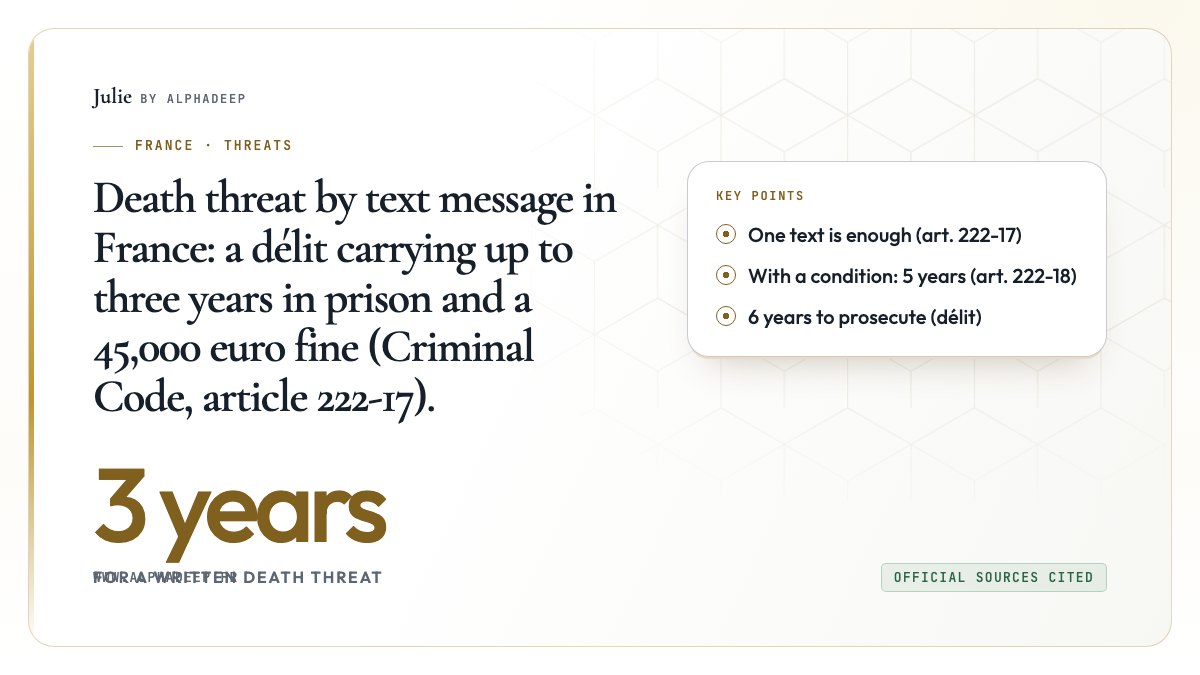
In France, a threat to commit a crime or délit against a person is an offence when it is repeated or put in writing, a text message or an image: a death threat then carries up to three years in prison and a 45,000 euro fine (Criminal Code, article 222-17). Said once out loud, it is only punished if it comes with an order to fulfil a condition. Police and gendarmes must take your complaint.
- One text is enough (art. 222-17)
- With a condition: 5 years (art. 222-18)
- 6 years to prosecute (délit)
- Official texts cited
- Sources checked on
- Drafted with AI assistance, our method
General legal information with official references and dated checks. It is not personalised advice: for a decision that commits you, have your situation checked by a qualified professional.
Julie by AlphaDeep
You are receiving threats in France: tell me what was said or written, and I will help you see which offence applies and how to file a complaint.
3 free questions at signup. Avoid names and sensitive information.
Is a threat sent by text, or said only once, an offence in France?
Yes: a death threat sent by text, message or image is a délit (a mid-level criminal offence) carrying up to three years in prison and a 45,000 euro fine, even if sent once, because it is "put in writing, an image or any other object" (Criminal Code, article 222-17). A written or repeated threat of another crime or délit against the person, such as rape or kidnapping, carries up to six months and 7,500 euros.
Said only once out loud, a threat is punished in three cases only: it comes with an order to fulfil a condition (article 222-18: three years, five for a death threat), it targets a teacher, health worker, elected official or police officer doing their job (article 433-3), or it aims to stop you filing a complaint (article 434-5).
A threat of ordinary violence, repeated or written, remains a 3rd-class minor offence (contravention) under article R623-1, with a fine of up to 450 euros (article 131-13).
French Criminal Code (Code pénal): article 222-17French Criminal Code (Code pénal): article 222-18French Criminal Code (Code pénal): article 433-3French Criminal Code (Code pénal): article 434-5French Criminal Code (Code pénal): article R623-1French Criminal Code (Code pénal): article 131-13
Which offence matches the threats you are receiving?
Describe the threat: what was threatened, how, by whom and for what purpose. The sheet shows the matching article of the French Criminal Code, the maximum penalty written in the code, the time-limit date and how to file. It does not predict what will happen to the complaint.
Fictional example · The French text that matches your situation
A death threat in writing, by text, message or image is a délit carrying up to three years in prison and a 45,000 euro fine (Criminal Code, article 222-17, paragraph 2), even if sent only once. Keep the message and the sender’s number or profile.
- Time limit if the offence is a délit (6 years, Code of Criminal Procedure, article 8)
- 2032-10-12
- Take dated screenshots of every message, showing the sender’s number or profile, and keep the voicemails.
- Write a dated timeline: the exact words, the place, the witnesses, the date of the last threat (2026-10-12).
- File the complaint at any police station (commissariat) or gendarmerie and ask for the receipt (récépissé) and a copy of the report (Code of Criminal Procedure, article 15-3).
- Or write to the public prosecutor (procureur de la République) at the court (tribunal judiciaire) where the events happened or where the person lives, with your evidence.
- Act well before 2032-10-12: after that date, the délit is in principle time-barred.
This sheet applies articles 222-17, 222-18, 222-18-3, 433-3, 434-5 and R623-1 of the French Criminal Code to your answers. It does not say whether the prosecutor will act or what a court will decide.
What penalty applies to each kind of threat or accusation?
| Situation | Text | Maximum penalty | Time limit to prosecute |
|---|---|---|---|
| Repeated or written threat of violence | Criminal Code, R623-1 | 450 euro fine (3rd-class contravention) | 1 year |
| Repeated or written threat of a crime or délit against the person | Criminal Code, 222-17, paragraph 1 | 6 months and 7,500 euros | 6 years |
| Repeated or written death threat (text, message, image) | Criminal Code, 222-17, paragraph 2 | 3 years and 45,000 euros | 6 years |
| Threat with an order to fulfil a condition | Criminal Code, 222-18 | 3 years and 45,000 euros; death threat: 5 years and 75,000 euros | 6 years |
| Threat by a spouse, cohabiting or PACS partner, or a former partner | Criminal Code, 222-18-3 and 132-80 | From 3 years and 45,000 euros to 7 years and 100,000 euros, depending on the threat | 6 years |
| Threat against a teacher, health worker, elected official, police officer | Criminal Code, 433-3 | 3 years and 45,000 euros; death threat: 5 years and 75,000 euros | 6 years |
| Accusation known to be false, made to the police or an employer | Criminal Code, 226-10 | 5 years and 45,000 euros | 6 years |
| Public defamation of a private individual | 1881 Press Freedom Act, art. 32 | 12,000 euro fine | 3 months |
Time limits run in principle from the day of the events (Code of Criminal Procedure, articles 8 and 9; 1881 Act, article 65).
French Criminal Code (Code pénal): article R623-1French Criminal Code (Code pénal): article 131-13French Criminal Code (Code pénal): article 222-17French Criminal Code (Code pénal): article 222-18French Criminal Code (Code pénal): article 222-18-3French Criminal Code (Code pénal): article 132-80French Criminal Code (Code pénal): article 433-3French Criminal Code (Code pénal): article 226-10Press Freedom Act of 29 July 1881 (loi du 29 juillet 1881): article 32French Code of Criminal Procedure (Code de procédure pénale): article 8French Code of Criminal Procedure (Code de procédure pénale): article 9Press Freedom Act of 29 July 1881 (loi du 29 juillet 1881): article 65
Where and how do you file a complaint for threats in France?
You can file a criminal complaint (plainte) at any police station (commissariat) or gendarmerie: officers must take it, even if the events happened elsewhere (Code of Criminal Procedure, article 15-3). A report (procès-verbal) is drawn up and you receive a complaint receipt (récépissé) straight away; a copy of the report is given to you on request.
Two other routes exist. You can write to the public prosecutor (procureur de la République) at the court (tribunal judiciaire) for the place of the events or the person’s home, describing the facts and enclosing your screenshots (Service-Public.fr, fact sheet F1435). For some offences, a complaint by video call (visioplainte) is possible by appointment, with a FranceConnect login and a camera.
The online complaint service does not cover threats from a known person: it is limited to property offences by an unknown author and some internet scams (the THESEE service, which includes blackmail or threats in a romantic or friendly relationship formed online).
French Code of Criminal Procedure (Code de procédure pénale): article 15-3File a complaint (Porter plainte, fact sheet F1435, English version)
What happens after the complaint: receipt, dropped case, civil-party claim?
After the complaint, the public prosecutor chooses between three outcomes: prosecute, use an alternative to prosecution, or drop the case (classement sans suite) when the circumstances justify it (Code of Criminal Procedure, article 40-1).
The receipt you are given states the time limits to prosecute and the option of a complaint as a civil party (article 15-3). For a threat that is a délit, the time limit is six years from the events (article 8); for a contravention, one year (article 9).
If the case is dropped, you can appeal to the senior prosecutor (procureur général), who can order prosecution (article 40-3). You can also bring a complaint as a civil party to an investigating judge (plainte avec constitution de partie civile) once the prosecutor has told you he will not prosecute, or three months after your complaint (article 85).
French Code of Criminal Procedure (Code de procédure pénale): article 40-1French Code of Criminal Procedure (Code de procédure pénale): article 15-3French Code of Criminal Procedure (Code de procédure pénale): article 8French Code of Criminal Procedure (Code de procédure pénale): article 9French Code of Criminal Procedure (Code de procédure pénale): article 40-3French Code of Criminal Procedure (Code de procédure pénale): article 85
What evidence should you gather before filing?
- Document 1
Dated screenshots of the messages, with the sender’s number or profile
They prove the written threat under article 222-17. Keep the phone or account too: the original may be requested.
- Document 2
Voicemails and call log
They date each contact and show repetition when the threats are spoken.
- Document 3
Official record by a commissaire de justice for online threats
Useful when a post or account may disappear: this court officer’s record (constat) fixes the content and its address on a given date.
- Document 4
Witnesses’ details and written statements
For a spoken threat, they are often the only proof of repetition or of the condition imposed.
- Document 5
A dated written timeline of events
Exact words, place, time, people present: it gives structure to your statement at the police station.
- Document 6
The complaint receipt and report number
They prove the filing date and, three months later, open the way to a complaint as a civil party.
Could you face a false-accusation charge if the person is not prosecuted?
No, a dropped case or an acquittal is not enough: false accusation (dénonciation calomnieuse) requires that you knew the reported fact was wholly or partly untrue when you reported it to the police, the prosecutor or the person’s employer (Criminal Code, article 226-10). It carries up to five years in prison and a 45,000 euro fine.
The falsity is automatic only if a final decision of acquittal or dismissal (acquittement, relaxe, non-lieu) states that the fact did not happen or cannot be attributed to the person. In every other case, including a case dropped for lack of evidence, the court trying the complainant assesses the accusations itself (article 226-10, paragraphs 2 and 3).
So describe what you saw, read or heard, without exaggerating or stating what you only suspect. Hand over the messages as they are, without cropping or editing them.
What is the difference between false accusation and defamation in France?
False accusation is a charge you know to be untrue, made to an authority able to sanction (police, prosecutor, employer); defamation (diffamation) is an allegation of a fact that harms a person’s honour, made to the public (Press Freedom Act of 29 July 1881, article 29).
Penalties and time limits differ widely. False accusation is a délit carrying up to five years in prison and a 45,000 euro fine (Criminal Code, article 226-10), with a six-year time limit (Code of Criminal Procedure, article 8). Public defamation of a private individual carries a 12,000 euro fine (1881 Act, article 32) and is time-barred after only three months (article 65).
A complaint made in good faith is neither: it goes to the competent authority, not the public, and you believe what you report. Avoid, however, posting your accusations on social media before any decision.
Press Freedom Act of 29 July 1881 (loi du 29 juillet 1881): article 29French Criminal Code (Code pénal): article 226-10French Code of Criminal Procedure (Code de procédure pénale): article 8Press Freedom Act of 29 July 1881 (loi du 29 juillet 1881): article 32Press Freedom Act of 29 July 1881 (loi du 29 juillet 1881): article 65
What does article 222-17 of the French Criminal Code say?
La menace de commettre un crime ou un délit contre les personnes dont la tentative est punissable est punie de six mois d'emprisonnement et de 7 500 euros d'amende lorsqu'elle est, soit réitérée, soit matérialisée par un écrit, une image ou tout autre objet.
La peine est portée à trois ans d'emprisonnement et à 45 000 euros d'amende s'il s'agit d'une menace de mort.
In plain English: A threat to commit a crime or délit against a person is punished under this article only if it is repeated or left in writing, an image or an object. One text message is enough. The penalty rises from six months to three years for a death threat.
A threat said once out loud falls under article 222-18 if it comes with a condition, and otherwise under neither text.
What else do people ask about reporting threats in France?
Can the police refuse your complaint because you have no proof?
No, French police or gendarmes cannot refuse a complaint for threats because you have no proof: judicial police officers and agents must take victims’ complaints (Code of Criminal Procedure, article 15-3). Evidence matters later, for the prosecutor’s decision. If the front desk refuses, write directly to the public prosecutor (procureur de la République).
French Code of Criminal Procedure (Code de procédure pénale): article 15-3File a complaint (Porter plainte, fact sheet F1435, English version)
Are threats from a former partner punished more severely?
Yes, threats from a spouse, cohabiting partner or PACS partner are punished more severely in France: from three to seven years in prison depending on the threat (Criminal Code, article 222-18-3). The aggravation also covers a former partner when the threats are linked to the past relationship (article 132-80). Such a complaint must be taken by a judicial police officer or agent (Code of Criminal Procedure, article 15-3).
French Criminal Code (Code pénal): article 222-18-3French Criminal Code (Code pénal): article 132-80French Code of Criminal Procedure (Code de procédure pénale): article 15-3
The person who threatened you is pushing you to withdraw: what do they risk?
A person who threatens or intimidates you to stop you filing a complaint in France, or to make you withdraw it, commits a separate offence carrying up to three years in prison and a 45,000 euro fine (Criminal Code, article 434-5). Report the pressure to the investigator or in an additional complaint, with the messages received.
What is the penalty for threatening a teacher or a health worker?
Threatening a teacher, school staff member, health professional, elected official or police officer in the course of their duties carries up to three years in prison and a 45,000 euro fine in France, and five years and 75,000 euros for a death threat (Criminal Code, article 433-3), when the person knew the victim’s role.
Can you file a complaint with an interpreter if your French is limited?
Yes, a victim who does not understand French has the right to an interpreter and to a translation of the information needed to exercise their rights when filing a complaint (Code of Criminal Procedure, article 10-2, 7°). Ask for one at the front desk. You may also be accompanied by an adult of your choice (article 10-2, 8°).
French Code of Criminal Procedure (Code de procédure pénale): article 10-2
Which French texts is this guide to threats based on?
- French Criminal Code (Code pénal): article 222-17French Republic / DILA: Légifrance
- French Criminal Code (Code pénal): article 222-18French Republic / DILA: Légifrance
- French Criminal Code (Code pénal): article 433-3French Republic / DILA: Légifrance
- French Criminal Code (Code pénal): article 434-5French Republic / DILA: Légifrance
- French Criminal Code (Code pénal): article R623-1French Republic / DILA: Légifrance
- French Criminal Code (Code pénal): article 131-13French Republic / DILA: Légifrance
- French Code of Criminal Procedure (Code de procédure pénale): article 15-3French Republic / DILA: Légifrance
- File a complaint (Porter plainte, fact sheet F1435, English version)French Republic / DILA: Service-Public.fr
- French Code of Criminal Procedure (Code de procédure pénale): article 40-1French Republic / DILA: Légifrance
- French Code of Criminal Procedure (Code de procédure pénale): article 40-3French Republic / DILA: Légifrance
- French Code of Criminal Procedure (Code de procédure pénale): article 85French Republic / DILA: Légifrance
- French Code of Criminal Procedure (Code de procédure pénale): article 8French Republic / DILA: Légifrance
- French Code of Criminal Procedure (Code de procédure pénale): article 9French Republic / DILA: Légifrance
- French Criminal Code (Code pénal): article 226-10French Republic / DILA: Légifrance
- Press Freedom Act of 29 July 1881 (loi du 29 juillet 1881): article 29French Republic / DILA: Légifrance
- Press Freedom Act of 29 July 1881 (loi du 29 juillet 1881): article 32French Republic / DILA: Légifrance
- Press Freedom Act of 29 July 1881 (loi du 29 juillet 1881): article 65French Republic / DILA: Légifrance
- French Criminal Code (Code pénal): article 222-18-3French Republic / DILA: Légifrance
- French Criminal Code (Code pénal): article 132-80French Republic / DILA: Légifrance
- French Code of Criminal Procedure (Code de procédure pénale): article 10-2French Republic / DILA: Légifrance
Texts cited last checked: 30 October 2026