The filing deskFamily in France
Private and family life residence permit in France: parent of a French child, spouse, family ties
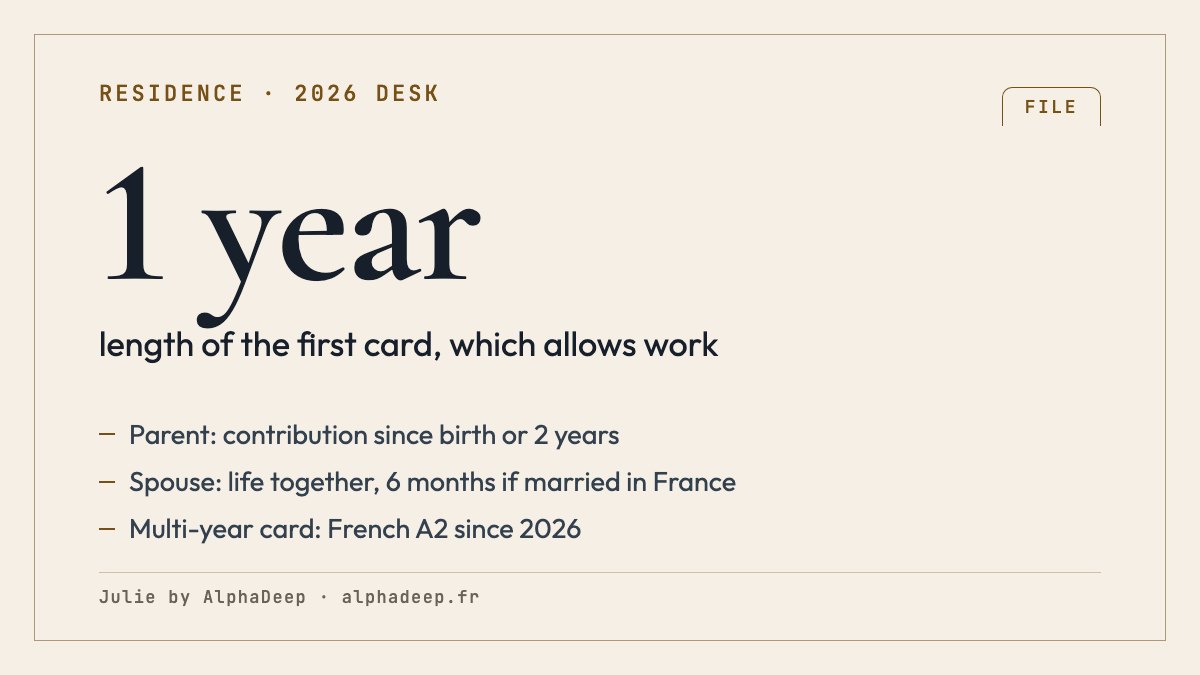
The "private and family life" residence card is issued for one year, to the parent of a French minor child living in France who has contributed to the child’s upkeep and education since birth or for at least two years (CESEDA, article L423-7), to the spouse of a French national (article L423-1) and to a foreign national with long-standing, stable personal and family ties in France (article L423-23). Since 2026, the multi-year card requires French A2, subject to statutory exemptions.
Go to the tool: the filing desk
Julie by AlphaDeep is an AI legal assistant for French law: it researches official references to help answer your questions (Légifrance, case law, service-public), analyses your documents and drafts your letters, for individuals and professionals alike.
General legal information with official references and dated checks. It is not personalised advice: for a decision that commits you, have your situation checked by a qualified professional.

Let’s look at your situation
Give your tie to France and since when, without names or file numbers.
Example questions
Your question carries over after signup. Maximum 400 characters. Avoid health data and names.
Which ground for the private and family life card fits your situation?
This desk covers only the ordinary CESEDA regime. European nationals, Algerian nationals and people covered by an applicable bilateral agreement must check their specific rules. Choose your tie to France, then answer the questions for that ground: the desk gives the applicable article, the conditions met and those still to prove. The example is the father of a 3-year-old French child who has contributed to the child’s upkeep since birth.
Fictional example · grounds desk
Under the ordinary CESEDA regime: "Parent of a French child" ground: a one-year private and family life card, if the contribution is proven.
These results do not determine rights under the specific rules for European nationals, Algerian nationals or an applicable bilateral agreement: check your regime first.
Conditions: article L423-7 of the CESEDA
- A French minor child living in France
- An actual contribution to the child’s upkeep and education since birth or for at least 2 years
The long-stay visa is not required.
First card: one year, with the right to work. For a first multi-year card, French at A2 level and the civic exam are required since 2026, subject to the statutory exemptions and adaptations in articles L413-5 and R433-5.
Which conditions apply to each of the three grounds?
The three grounds give the same one-year card, but require neither the same proof nor the same visa. Outside the categories and family-reunification route specified by article L423-23, personal and family ties require a proportionality assessment: intensity, age, stability, living conditions, integration and ties in the country of origin. If the statutory conditions are met, the article provides for issuing the card.
| Ground | Main condition | Proof expected | Long-stay visa | Text |
|---|---|---|---|---|
| Parent of a French child | Minor child living in France; contribution since birth or for at least 2 years | The child’s birth certificate; proof of contribution: maintenance, purchases, school follow-up, emotional bond | Not required | CESEDA, art. L423-7 |
| Spouse of a French national, married abroad | Life together since the marriage; spouse still French; marriage transcribed | Transcription of the marriage; proof of life together | Required in principle | CESEDA, art. L423-1 |
| Spouse of a French national, married in France | Lawful entry and 6 months of life together in France | Joint declaration and shared documents: lease, bills, bank details | Not required | CESEDA, art. L423-2 |
| Personal and family ties | Intense, long-standing and stable ties; integration into French society | Proof of ties in France, of integration and of the situation of the family left behind | Not required | CESEDA, art. L423-23 |
The card allows work without a work authorisation (article L414-10). According to service-public.fr, a first card costs €350 in tax stamps: a €300 tax and a €50 stamp duty.
Sources: CESEDA L423-7 · CESEDA L423-1 · CESEDA L423-23 · Service-public F2209
How do you prove your contribution to the French child’s upkeep?
By any means, since birth or for at least 2 years: payment of maintenance, purchases for the child, certificates of accommodation or school follow-up, proof of a real emotional bond, according to service-public.fr. The contribution is assessed under article 371-2 of the Civil Code (CESEDA, article L423-7).
If the child’s parentage with the French parent results from a recognition, you must also prove that this parent contributes to the child’s upkeep, or produce a court decision on that contribution. Failing that, the prefect assesses your situation in the light of private and family life and the child’s interest (article L423-8).
Sources: CESEDA L423-7 · Service-public F2209
Married in France or abroad: what changes?
If you entered lawfully and married a French national in France, 6 months of real life together in France are enough, with no long-stay visa (CESEDA, article L423-2).
If the marriage took place abroad, it must be transcribed in the French civil-status registers, the life together must not have ended and your spouse must still be French (article L423-1); a long-stay visa is then required in principle. Service-public.fr specifies that the life together may have ended in case of death or domestic violence.
Sources: CESEDA L423-1 · Service-public F2209
How do you then move to a multi-year or resident card?
After a year of lawful residence, the multi-year card can be requested if you still meet the conditions of your card and, since 1 January 2026, if you show French at A2 level and a sufficient result in the civic exam, subject to statutory exemptions and adaptations (CESEDA, articles L433-4 and R433-5).
A2 is not required for people exempt from the republican integration contract under article L413-5, including after three years at a French secondary school or one academic year of higher education in France. Article R433-5 allows adaptations or waivers, with supporting evidence, for a disability or chronic health condition incompatible with the tests. People over 65 are exempt from the language condition and the civic exam.
The spouse of a French national can obtain a 10-year resident card after 3 years of marriage and 3 years of lawful residence, if the life together has not ended and they meet the conditions of republican integration (articles L423-6 and L413-7).
Sources: CESEDA L433-4 · CESEDA L423-1 · Service-public F2209 · CESEDA R433-5 · CESEDA L413-5
Which documents should you attach to the card application?
The identity documents come with the proof specific to your ground; the full list is on service-public.fr and on your prefecture’s website.
- Document 1
Passport or nationality certificate
Civil-status, validity, entry and visa pages; the nationality certificate must be less than 6 months old.
- Document 2
Proof of address and photos
The proof of address must be less than 6 months old.
- Document 3
Parent: the French child’s birth certificate
Full copy showing parentage, with proof of contribution since birth or for 2 years.
- Document 4
Spouse: nationality and marriage
Proof of the spouse’s French nationality, full copy of the marriage certificate or transcription of a marriage celebrated abroad.
- Document 5
Spouse: proof of life together
A joint sworn statement and shared documents: lease, bills, bank details.
- Document 6
Family ties: proof of your connections
Ongoing relations with family in France, integration (associations, volunteering, children’s schooling) and the situation of the family left in the home country.
What does article L423-7 of the CESEDA say about the parent of a French child?
The article sets the three conditions of the "parent of a French child" ground: a minor child, living in France, and your contribution.
L’étranger qui est père ou mère d’un enfant français mineur résidant en France et qui établit contribuer effectivement à l’entretien et à l’éducation de l’enfant dans les conditions prévues par l’article 371-2 du code civil, depuis la naissance de celui-ci ou depuis au moins deux ans, se voit délivrer une carte de séjour temporaire portant la mention « vie privée et familiale » d’une durée d’un an, sans que soit opposable la condition prévue à l’article L. 412-1.
In English, briefly (our summary, not an official translation): A foreign national who is the father or mother of a French minor child living in France, and who shows that they have actually contributed to the child’s upkeep and education, under article 371-2 of the Civil Code, since the child’s birth or for at least two years, is issued a one-year temporary residence card marked "private and family life", without the condition of article L412-1 being enforceable. That condition is the long-stay visa: the parent of a French child can apply for the card without it.
What changed for the private and family life card in 2026?
Two 2026 changes affect access to the multi-year card and the cost of permits.
A first multi-year card requires French at A2 level and passing the civic exam, in addition to attendance at the republican integration contract where applicable, subject to statutory exemptions and adaptations (article L433-4, law no. 2024-42 of 26 January 2024).
Sources: CESEDA L433-4 · Service-public F2209 · CESEDA R433-5 · CESEDA L413-5
First issue: a €300 tax and a €50 stamp duty, against €200 and €25 before; renewal: a €200 tax and a €50 stamp duty. Subject to statutory exceptions, the €300 regularisation visa fee is added if required entry documents or visas were missing, or after an adult remains without a permit for 3 months from entry (or the applicable longer statutory period) (articles L436-1, L436-4 and L436-7, law no. 2026-103 of 19 February 2026).
Source: CESEDA L436-1
Which questions come up during the application?
Does a Pacs with a French national give a right to this card?
Not on the spouse ground: articles L423-1 and L423-2 refer to marriage. Living together with a Pacs partner counts among the personal and family ties of article L423-23, which the prefect assesses by their intensity, age and stability.
How much does the first residence card cost?
Since 1 May 2026, €350 in tax stamps: a €300 tax and a €50 stamp duty (CESEDA, articles L436-1 and L436-7). Renewal costs €250. Subject to statutory exceptions, a €300 regularisation visa fee is added if legally required entry documents or visas were missing, or if an adult remains without a permit after 3 months from entry (or the applicable longer statutory period); €100 is paid on filing (article L436-4).
Can you work with a private and family life card?
Yes. The temporary residence card gives the right to work (CESEDA, article L414-10), and service-public.fr specifies that the employer does not have to apply for a work authorisation.
When should you apply to renew the card?
For parents of French children and spouses of French nationals: online between 4 and 2 months before the permit expires, according to service-public.fr. For other personal and family ties: at the prefecture or subprefecture, 2 months before expiry, following the local procedure. A late application exposes you to a €180 regularisation visa fee, except in case of force majeure or a valid visa (article L436-5).
Which texts set the three grounds for the card?
- CESEDA, articles L423-7 and L423-8 (parent of a French child)Légifrance, in French
- CESEDA, articles L423-1, L423-2 and L423-6 (spouse of a French national)Légifrance, in French
- CESEDA, article L423-23 (personal and family ties)Légifrance, in French
- CESEDA, articles L433-4 and L413-7 (multi-year card and resident card, versions of 1 January 2026)Légifrance, in French
- CESEDA, articles L436-1, L436-4, L436-5 and L436-7 (taxes and stamp duties, version of 1 May 2026)Légifrance, in French
- "Private and family life" residence card for a foreign national in France (fiche F2209)Service-public.fr, in French
- CESEDA, article R433-5 (A2, civic exam, exemptions and adaptations)Légifrance, in French
- CESEDA, article L413-5 (exemptions from the republican integration contract)Légifrance, in French
- CESEDA, article L414-10 (right to work)Légifrance, in French
Texts cited last checked: 24 September 2026