The filing deskResidence and nationality · since 1 January 2026
French civic exam: who must take it for a residence card or naturalisation
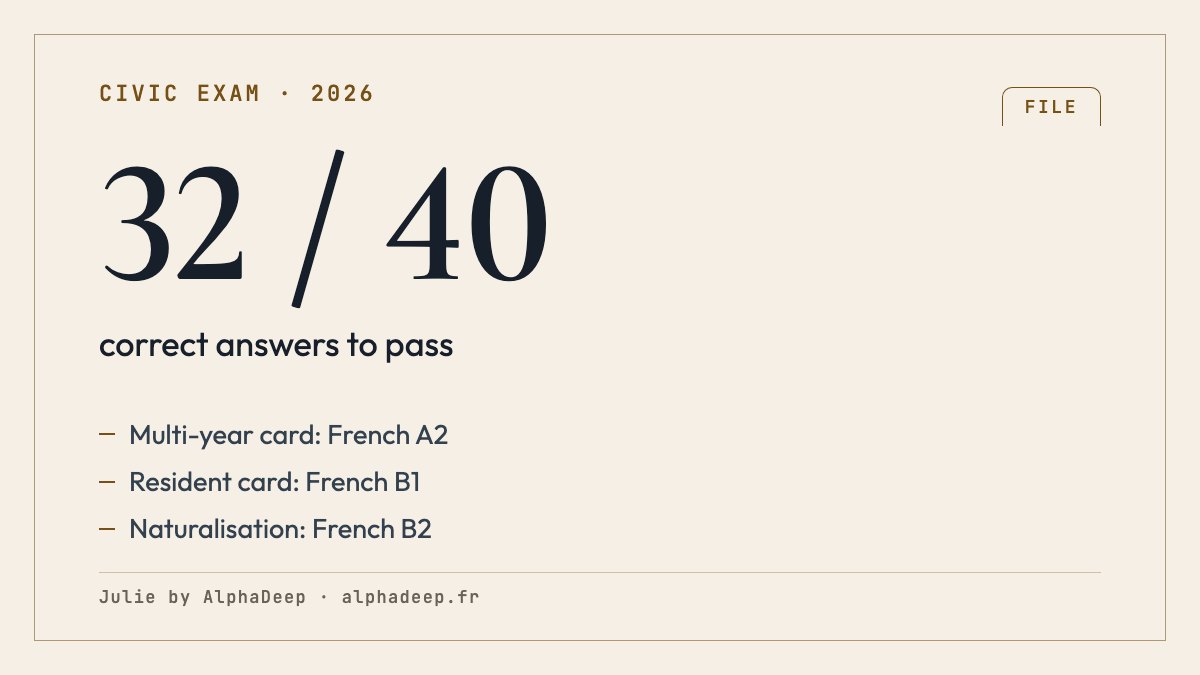
In 2026, first multi-year and resident cards covered by these rules, and naturalisation applications filed from 1 January, require a civic exam unless exempt: 40 questions and at least 32 correct answers (CESEDA, article D413-12-2; order of 10 October 2025). A level of French is added: A2 for the multi-year card, B1 for the resident card, B2 for naturalisation (CESEDA, articles R433-5 and R413-15; decree of 30 December 1993).
Go to the tool: the filing desk
Julie by AlphaDeep is an AI legal assistant for French law: it researches official references to help answer your questions (Légifrance, case law, service-public), analyses your documents and drafts your letters, for individuals and professionals alike.
General legal information with official references and dated checks. It is not personalised advice: for a decision that commits you, have your situation checked by a qualified professional.

Let’s look at your situation
Say which permit or nationality you are applying for, and how long you have been in France.
Example questions
Your question carries over after signup. Maximum 400 characters. Avoid health data and names.
Must you take the civic exam for your application?
Choose the procedure and enter your age; for nationality, also confirm a filing from 1 January 2026: the desk says whether the exam is required, with which mention, which level of French and which documents to attach. The example: a first multi-year residence card applied for at 34.
Fictional example · civic exam desk
Civic exam required, "multi-year residence card" or "resident card" mention, and level A2 in French.
- Exam mention
- Multi-year card or resident card
- Pass mark
- 32 out of 40, that is 80%
- Test
- 40 questions, 45 minutes
- French level required
- A2
Documents to attach to the file
- Certificate of passing the civic exam, "multi-year residence card" or "resident card" mention: at least 32 correct answers out of 40
- Diploma or TCF or TEF test certificate less than 2 years old proving level A2 in French
Questionnaire in French, on screen, in an approved centre: CCI Paris Île-de-France or France Éducation international. Proof of language level: a diploma, or a TCF or TEF test less than 2 years old.
For residence cards, the pass certificate has no expiry date and a failure can be retaken at any time; fraud bars the exam for 2 years.
Which exam and which level of French for each procedure?
The exam mention and the language level follow the permit or nationality applied for.
| Procedure | Civic exam | French | Not concerned | Text |
|---|---|---|---|---|
| First multi-year residence card | "Multi-year residence card" or "resident card" mention | A2 | Permits without the republican integration contract, subsidiary protection, stateless persons, over 65 | CESEDA L433-4, R433-5 |
| First resident card: spouse or parent of a French national, family reunification | "Resident card" mention | B1 | Over 65 | CESEDA L413-7, R413-15 |
| First long-term EU or permanent resident card | "Resident card" mention | B1 | Over 65 | CESEDA L413-7, L426-19 |
| Naturalisation or reinstatement by decree | "Naturalisation" mention | B2 | Medical exemption only | C. civ. 21-24; decree 93-1362, art. 37 |
| Nationality through marriage | No exam | B2 | Medical exemption for the language | C. civ. 21-2; decree 93-1362, art. 14 |
| Renewing a card | No exam | Not required | All renewed cards | Service-public F39530 |
Disability or chronic ill health: an adjusted test or an exemption, on a medical certificate, for all these procedures (CESEDA, article R413-15, and orders of 30 December 2025).
Sources: CESEDA L433-4 · CESEDA L413-7 · CESEDA R413-15 · C. civ. 21-24 · Decree 93-1362, art. 37 · Service-public F39530
What changed on 1 January 2026?
The law of 26 January 2024 created the exam; two decrees of 15 July 2025 and several orders set its rules.
The order of 10 October 2025 sets the test: 40 multiple-choice questions in French, including practical situations, taken on screen in 45 minutes at most, with a pass mark of 80% for the "naturalisation" mention.
Source: Order of 10 October 2025
The first multi-year residence card requires passing the civic exam and level A2; the first resident card, the exam and level B1 instead of A2 (decree no. 2025-647 of 15 July 2025, CESEDA articles R433-5 and R413-15).
Sources: Decree no. 2025-647 · CESEDA R413-15 · CESEDA L433-4
For naturalisation applications filed since this date, the level rises from B1 to B2 and the civic exam with the "naturalisation" mention is added; the declaration through marriage also moves to level B2, with no exam (decree no. 2025-648 of 15 July 2025).
Sources: Decree no. 2025-648 · Decree 93-1362, art. 37
Two language tests are recognised for residence permits as for nationality, the TCF of France Éducation international and the TEF of the CCI Paris Île-de-France, with a certificate valid for 2 years (orders of 22 December 2025).
Source: Order of 22 December 2025
A new citizen’s booklet (livret du citoyen), used to prepare for the naturalisation exam, is approved by order of 3 July 2026, published on 16 July and in force from 17 July 2026.
Source: Service-public F39426
Who must take the French civic exam in 2026?
A non-European national applying for the first time for a multi-year residence card or a resident card, and a candidate for naturalisation or reinstatement by decree whose application is filed since 1 January 2026. For resident cards, the exam covers the cards of a spouse or parent of a French national, family reunification, long-term EU and permanent resident (CESEDA, article L413-7).
Renewals, the declaration of nationality through marriage and the refugee’s resident card are not concerned. For the multi-year card, holders of a permit exempt from the republican integration contract (student, visitor, talent, trainee, seasonal worker), beneficiaries of subsidiary protection and stateless persons are exempt, according to service-public, as are people over 65.
Sources: CESEDA L413-7 · CESEDA D413-12-2 · Service-public F39530 · Service-public F39426
How does the civic exam work?
The civic exam is a multiple-choice questionnaire of 40 questions in French, mixing knowledge and practical situations, taken on screen in 45 minutes at most in an approved centre (order of 10 October 2025, articles 3 and 4). A correct answer is worth 1 point; you need 80% correct answers, that is 32 out of 40 (CESEDA, article D413-12-2, and article 2 of the order).
The questions are split as follows: 11 on the principles and values of the Republic, 6 on the institutional and political system, 11 on rights and duties, 8 on history, geography and culture, 4 on life in French society (order of 10 October 2025, article 3). The knowledge questions are published by the Ministry of the Interior.
Sources: Order of 10 October 2025 · CESEDA D413-12-2
Which level of French is needed, and how do you prove it?
A2 for the first multi-year card (CESEDA, article R433-5), B1 for the first resident card (article R413-15), B2 for naturalisation and for the declaration through marriage (articles 14 and 37 of the decree of 30 December 1993). For naturalisation, the Civil Code describes this level: understanding the essentials of a complex text and expressing oneself clearly and in detail (article 21-24).
The proof is a diploma (brevet, a State diploma at level 3 or higher, a French-language diploma of the required level) or a certificate less than 2 years old from the TCF or the TEF, the only two recognised tests, taken in a centre in a single session (orders of 22 December 2025).
Sources: CESEDA L433-4 · CESEDA R413-15 · Decree 93-1362, art. 37 · C. civ. 21-24 · Order of 22 December 2025
Can you be exempted from the exam for health reasons?
Yes. A disability or chronic ill health opens an adjusted test, or an exemption if assessment is impossible, on a medical certificate following the model set by order (CESEDA, article R413-15, and orders of 30 December 2025). The authorities can have the certificate checked by a new medical assessment, according to service-public.
For naturalisation, the certificate concludes either that adjustments are needed or that the person cannot take the assessment; the same rule applies to the proof of language level (order of 30 December 2025, articles 1 and 2). Political refugees and stateless persons strictly over 70 who have lived regularly and habitually in France for at least 15 years are exempt from the language condition only (Civil Code, article 21-24-1).
Sources: CESEDA R413-15 · Order of 30 December 2025 · Service-public F39530 · C. civ. 21-24
Which documents should you attach for the exam and the language?
The exam and language documents come on top of the usual documents for the residence permit or the nationality application.
- Document 1
Certificate of passing the civic exam
Issued by the approved centre, with the mention that matches the procedure. For residence cards, it has no expiry date, according to service-public.
- Document 2
Diploma proving the level of French
The diplôme national du brevet, a State diploma or professional certification at level 3 or higher, or a French-language diploma of the required level.
- Document 3
Otherwise, a TCF or TEF certificate
Separate oral and written tests, on the same day, in a centre; the certificate bears the candidate’s photo and is valid for 2 years.
- Document 4
Medical certificate, where relevant
For an adjustment or an exemption only, filled in by a doctor on the model annexed to the orders of 30 December 2025.
What does article L413-7 of the CESEDA provide for the resident card?
Article L413-7 is the text linking the first resident card to the civic exam and to French.
La première délivrance de la carte de résident prévue aux articles L. 423-6, L. 423-10 ou L. 423-16, de la carte de résident portant la mention « résident de longue durée-UE » prévue aux articles L. 421-12, L. 421-25, L. 424-5, L. 424-14 ou L. 426-19, ainsi que de la carte de résident permanent prévue à l’article L. 426-4 est subordonnée à l’intégration républicaine de l’étranger dans la société française, appréciée en particulier au regard du résultat obtenu à l’examen mentionné au sixième alinéa de l’article L. 413-3, qui doit être supérieur à un seuil fixé par décret, et de sa connaissance de la langue française […].
Les étrangers âgés de plus de soixante-cinq ans ne sont pas soumis à la condition relative à la connaissance de la langue française.
In English, briefly (our summary, not an official translation): The first issue of the resident cards of articles L423-6, L423-10 or L423-16, of the long-term EU resident card and of the permanent resident card is subject to the foreign national’s republican integration into French society, assessed in particular by the result obtained in the exam of article L413-3, which must be above a threshold set by decree, and by their knowledge of the French language. Foreign nationals over sixty-five are not subject to the language condition. The threshold is set at 80% correct answers by article D413-12-2, the same as for the multi-year card.
What do candidates ask before registering for the civic exam?
Where do you register to take the civic exam?
In a centre approved by the Ministry of the Interior. The CCI Paris Île-de-France and France Éducation international publish maps of their centres; from abroad, the Institut français, the Alliance française or the consulate explain the steps for the "naturalisation" mention, according to service-public.
Does the resident card exam count for the multi-year card?
Yes. The "resident card" mention also meets the condition for the multi-year card; the "multi-year residence card" mention is not enough for the resident card (CESEDA, article R413-12-1). Naturalisation requires its own mention.
What happens if you fail the civic exam?
For residence cards, you can take it again on request and at any time (CESEDA, article L413-3). Fraud or attempted fraud, however, bars you from retaking the exam for 2 years (order of 10 October 2025, article 5).
Must people over 65 take the civic exam?
Not for the resident card: neither the exam (CESEDA, article R413-15) nor the language condition (article L413-7). Service-public applies the same exemption to the multi-year card. For naturalisation, service-public only mentions the medical exemption.
Is the exam required to renew a residence card?
No. Only the first application for a multi-year card or a resident card is concerned, according to service-public; renewal requires continuing to meet the conditions of the permit held (CESEDA, article L433-1).
Which texts set the civic exam and the language level?
- CESEDA, article L413-7 (first resident card: civic exam and French)Légifrance, in French
- CESEDA, articles L433-4 and R433-5 (first multi-year card: exam and level A2)Légifrance, in French
- CESEDA, articles R413-12-1 and D413-12-2 (exam mentions, 80% pass mark)Légifrance, in French
- CESEDA, article R413-15 (resident card: level B1, over 65, medical exemption)Légifrance, in French
- Civil Code, articles 21-24 and 21-24-1 (assimilation and language level for naturalisation)Légifrance, in French
- Decree no. 93-1362 of 30 December 1993, articles 14 and 37 (level B2, civic exam)Légifrance, in French
- Multi-year residence card and resident card: how do you take the civic exam? (fiche F39530)Service-public.fr, in French · checked by the publisher on 10 February 2026
- French naturalisation: how do you take the civic exam? (fiche F39426)Service-public.fr, in French · checked by the publisher on 16 July 2026
- Order of 10 October 2025 on the programme, tests and organisation of the civic examLégifrance, in French
- Orders of 22 December 2025 (recognised diplomas and TCF and TEF tests)Légifrance, in French
- Orders of 30 December 2025 (medical certificate, adjustment and exemption)Légifrance, in French
- Decree no. 2025-647 of 15 July 2025 (article 20 of the law of 26 January 2024: civic exam and language)Légifrance, Journal officiel, in French
- Decree no. 2025-648 of 15 July 2025 amending decree no. 93-1362 (nationality)Légifrance, Journal officiel, in French
- Resident card and multi-year card: how do you prove your knowledge of French? (fiche F34501)Service-public.fr, in French · checked by the publisher on 10 February 2026
Texts cited last checked: 25 September 2026